

Selling an online course on Instagram comes down to link delivery. Only three surfaces carry a tappable link: your bio, a Story link sticker, and a DM. Captions, Reels and comments do not. The system that works is to build interest in feed content, then move every buying signal into a DM, where the link is clickable and the email is capturable.
Most advice on this topic skips that part. It tells you to post Stories, go Live, run ads, and be authentic, then leaves you with a course page nobody can reach in two taps. You end up with a Reel that got 40 comments asking how to join and no mechanism for answering them before those people scroll on.
This guide is built the other way around. It shows you how to sell an online course on Instagram starting from where a link actually works in August 2026, builds five steps on top of that, and closes with three tactics from the older Instagram playbook that stopped working and are still being repeated.
Key Takeaways
- Three surfaces carry links: your bio (up to five native links), the Story link sticker (no follower minimum since October 2021), and DMs. Captions, comments and Reel text are not clickable.
- The buy no longer happens in the app: as of September 2025, Shops on Facebook and Instagram use website checkout, and Meta discontinued in-app payouts and order management (facebook.com/business/help, August 2026).
- Comments are the strongest buying signal you get: a comment is a public, timestamped request. Answering it in seconds instead of hours is the single biggest change most course creators can make.
- Email is the asset, not the follower count: the DM is where you capture it, and it is the only part of this system you keep if your reach drops.
- Hashtags stopped being a discovery subscription: Instagram removed the ability to follow hashtags on December 13, 2024 (socialmediatoday.com, August 2026).
- The automation layer is cheap: CreatorFlow runs $15/month flat, ManyChat runs $17 to $199/month billed monthly. The course platform is your larger line item.
Where a course link is actually clickable on Instagram
Instagram has three link-bearing surfaces. Everything else is discovery. Knowing which is which determines where you put the ask.
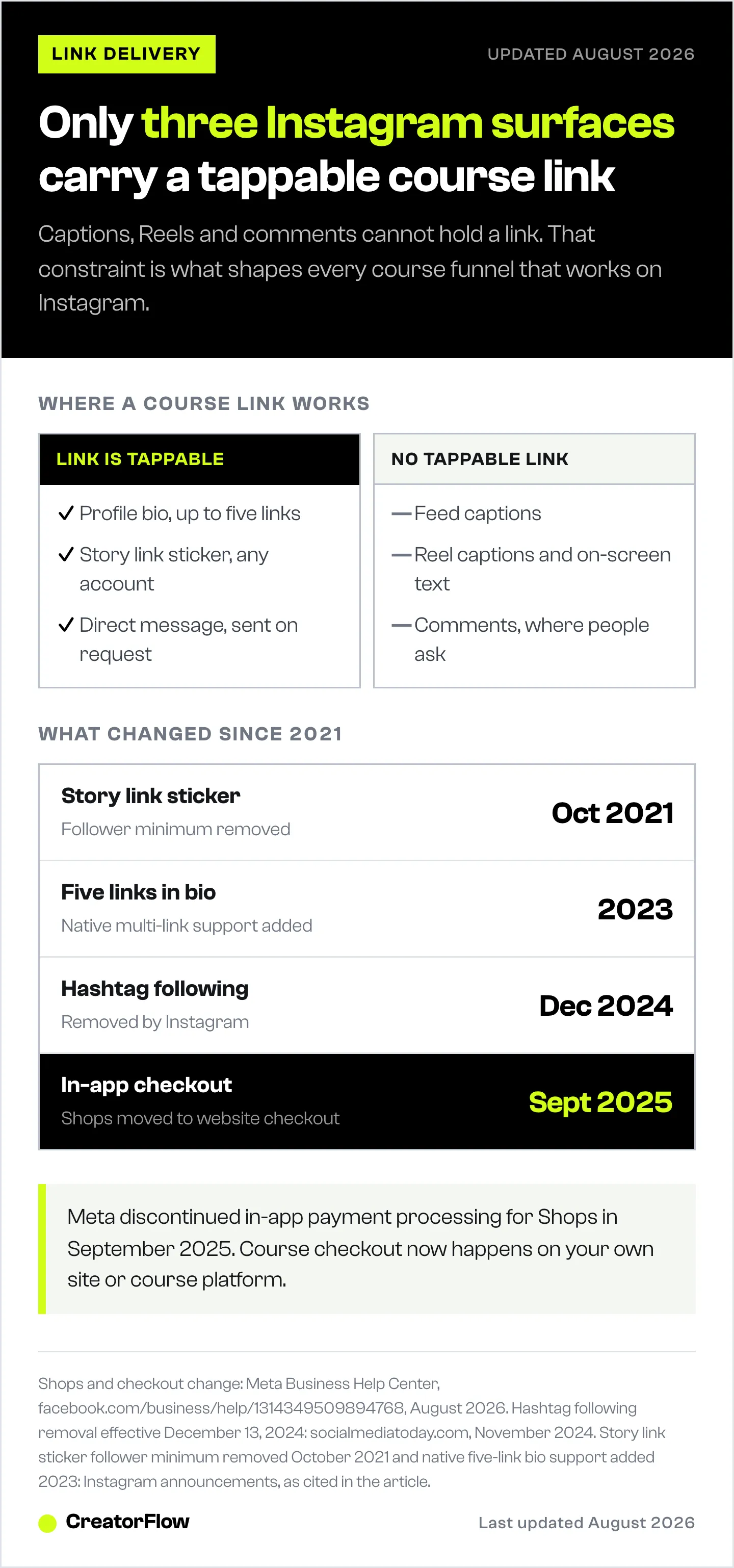
| Surface | Link clickable? | Best use for a course |
|---|---|---|
| Profile bio | Yes, up to 5 native links | Permanent home for your course page and waitlist |
| Story link sticker | Yes, any account | Time-boxed asks: enrollment open, cart closing, live session |
| Direct message | Yes | Delivering the link the moment someone asks for it |
| Feed caption | No | Building the case for the course, driving comments |
| Reel caption and on-screen text | No | Reach and proof, not conversion |
| Comments | No | The buying signal that triggers the DM |
The pattern falls out of the table. To sell an online course on Instagram you work across all three columns: Reels and feed posts are where people decide they want the course. Comments are where they say so. DMs are where they can actually be sent somewhere. A course funnel on Instagram is the connective tissue between those three columns.
Instagram added native multi-link support to the bio in 2023, so you can list up to five destinations without a third-party link page (linktr.ee, August 2026). The Story link sticker replaced the old swipe-up and has carried no follower minimum since October 2021, which means the “you need 10,000 followers to link out” rule that still circulates has been dead for close to five years.
Step 1: Pick one course promise your feed can prove
Course pages fail on Instagram when the promise is broader than the content that leads to it. A follower watched a 30-second Reel. Whatever the course claims, the Reel has to have made that claim credible.
Write the promise as a specific outcome for a specific person: not “learn photography” but “shoot and edit a client-ready portrait session on a kit lens.” Then audit your last 20 posts. If fewer than half of them demonstrate a piece of that outcome, the gap is your content problem, not your funnel problem.
This matters more than the tooling. Our course launch conversion benchmarks show tool choice moving results far less than most creators expect, while the fit between content and offer moves them a lot.
Step 2: Turn your bio into a course landing strip
Your bio is the only permanently linked surface you control, and it gets read in about two seconds. Three things belong in it.
- The Name field, not the bio text, is the searchable one. It holds 30 characters and is indexed by Instagram search. Put the topic there: “Sarah | Watercolor Classes” beats “Sarah Chen.”
- One line naming who the course is for and what changes. Bio text runs to 150 characters, so this is one sentence, not a paragraph.
- A link block of at most three of your five slots. Course page, free lesson, waitlist. Five links is the ceiling, not a target. Every extra option costs you taps.
The free lesson slot matters more than it looks. It is the offer you point cold traffic to, and it is what people who are not ready to buy will take instead of leaving.
Step 3: Use Stories for the ask, not the pitch
Stories are the second linked surface, and their scarcity is the point. A link sticker sits on a Story for 24 hours, which makes Stories the right home for anything with a deadline: enrollment opening, a bonus expiring, a live session starting.
Two habits separate Stories that sell from Stories that get watched:
- Put the ask in a single frame with the sticker on it. Split across five frames, most viewers tap away before the linked one.
- Reply to Story replies. A Story reply is a private, low-friction question, and it is the warmest inbound you get on Instagram. Story replies can trigger an automated response, which means the answer arrives while the person is still in the app.
For the mechanics of placing and troubleshooting the sticker, see our Instagram Story link sticker guide.
Step 4: Move every “how do I join?” comment into a DM automatically
A comment is the strongest buying signal Instagram gives you. It is public, timestamped, and unambiguous. It is also the surface where you cannot put a link, which is why the comment has to become a DM.
Comment-to-DM automation does that conversion. Someone comments a keyword you chose, and a direct message with your course link arrives in seconds through Meta’s official Instagram API. The mechanism is the same one Instagram supports for private replies to comments, so it does not involve password sharing or third-party account access.
The speed is the whole argument. Manual replies to a Reel that pulled 40 comments realistically go out hours later, in batches, after the moment has passed. Automated replies go out while the person still has the app open.
Keyword choice is worth thinking about for a course specifically. Use a word tied to the outcome rather than a generic one: “PORTRAIT” for a photography course, “LESSON” for a free module. Generic keywords like “INFO” pull in people who have not decided anything.
The setups themselves are covered in more depth in our guide to Instagram DM automation for course creators, and if you are running a launch rather than an evergreen offer, the automated course launch funnel walks through the sequenced version.
Step 5: Collect the email before the sale
Instagram reach moves. Email does not. The DM is where you convert an Instagram follower into a contact you keep, and doing it at the moment of highest intent costs you almost nothing.
Timing is the reason this step cannot wait. Instagram closes the thread 24 hours after the buyer’s last message, so the address has to be collected in the first exchange, not a later one. The full arithmetic is in AI DM agents for course creators.
The exchange that works: someone asks for the course link, and the automation offers the free lesson or the syllabus in return for an email address, then sends the course page either way. You get the contact, and the person who was not going to buy today still gets something useful.
Two features do this work on paid plans. An email gate collects the address inside the DM before the link goes out. CSV export moves those contacts into whatever email platform you already use. Geographic analytics tells you which countries your course interest is coming from, which matters when you are deciding what time to run a live session.
The same pattern fills seats for live teaching. Our guide to webinar registration through Instagram DMs covers that variant.
Three tactics from the 2021 playbook that no longer work
Course-selling advice for Instagram has aged badly, and the older articles are still ranking. Three tactics in particular are repeated as current and are not.
”People can buy your course inside the app”
As of September 2025, Shops on Facebook and Instagram use website checkout. Meta discontinued in-app payment processing, order management, returns handling and dispute resolution at the same time (facebook.com/business/help, August 2026). Purchases now happen on your own site.
For course creators this mostly confirms what was already true, since course checkout ran on a course platform rather than through a Shops catalog. What it changes is the advice: any guide still describing an in-app purchase path for a digital product is describing something Meta retired.
”Use 30 hashtags to get discovered”
Instagram removed the ability to follow hashtags effective December 13, 2024 (socialmediatoday.com, August 2026). Hashtags no longer function as a subscription that delivers your course post to people who opted into a topic. Keywords in your caption, your Name field and your on-screen text now do more of that work.
”500 million people watch Stories every day, so post more Stories”
The 500 million figure has been in circulation since 2019 and still appears in 2026 statistics roundups (businessofapps.com, August 2026). Some roundups now cite a higher number sourced to a Meta report that does not appear to exist publicly, which is a good reason to treat any precise Stories figure carefully.
Post Stories because they are one of three linked surfaces you have. That reason holds regardless of what the daily viewer count is.
What it costs to sell an online course on Instagram
The automation layer is the cheap part of a course business. The course platform itself is the larger line, and entry prices run from $0 to $179 a month across the nine platforms that host courses and coaching. These are the two automation tools course creators most often compare.
| CreatorFlow | ManyChat | |
|---|---|---|
| Entry price | $0 free plan, $15/month Pro | $0 free plan, $17/month Essential |
| Annual billing | $12/month on Pro | $14/month on Essential |
| Pricing model | Flat rate | Per active contact |
| Channels | Instagram, Facebook, WhatsApp, SMS, TikTok, Telegram, email | |
| Meta program | Meta Tech Provider since December 2025 | Meta Business Partner |
ManyChat covers seven channels and suits course creators who are running Instagram alongside WhatsApp, SMS or email in one builder. Its ladder runs Essential $17 for 250 contacts, Pro $39 for 2,500, Business $99 for 7,500, and Advanced $199 for 25,000, with a free plan capped at 25 active contacts. Billed annually those tiers become $14, $29, $69 and $139 per month (manychat.com/pricing, August 2026).
CreatorFlow is Instagram-only and flat-rate, so the price does not move as your contact list grows with your launch. Pro is $15/month or $12/month billed annually, and includes the follow gate, the email gate, CSV export and geographic analytics.
Your course platform will cost more than either. Price that first, then pick the automation layer around it.
FAQ
How many followers do you need to sell a course on Instagram?
There is no threshold. The link sticker has had no follower minimum since October 2021, and bio links have never had one. What matters is whether your content has demonstrated the outcome your course promises. Course creators in the 5,000 to 50,000 follower range routinely sell, because a small audience that arrived for a specific topic converts better than a large general one.
Can you sell a course directly inside Instagram?
No. As of September 2025 Shops on Facebook and Instagram use website checkout, and Meta discontinued in-app payment processing (facebook.com/business/help, August 2026). Your course is sold on your own site or course platform, and Instagram’s job is getting the buyer there in as few taps as possible.
Where should the course link go if captions are not clickable?
Into a DM, triggered by the comment. Captions, comments and Reel text carry no tappable link, so asking people to “check the link in bio” adds three taps and loses most of them. Have the caption ask for a comment, then send the link by direct message the moment the comment lands.
Do hashtags still help a course post get found?
Not the way they used to. Instagram removed hashtag following on December 13, 2024 (socialmediatoday.com, August 2026), so hashtags no longer deliver your post to people subscribed to a topic. Descriptive keywords in the caption, the 30-character Name field and on-screen text carry more weight for discovery now.
How much does it cost to automate course sales on Instagram?
CreatorFlow has a free plan and a $15/month Pro plan, or $12/month billed annually. ManyChat has a free plan capped at 25 active contacts and paid tiers from $17 to $199/month billed monthly, or $14 to $139/month billed annually (manychat.com/pricing, August 2026). The course platform hosting your content is the larger cost in both cases.
Is DM automation against Instagram’s rules?
Not when the tool connects through Meta’s official Instagram API. That path uses OAuth, involves no password sharing, and is what Meta publishes the messaging endpoints for. Meta enforces per-second rate limits and a 24-hour messaging window on replies, and tools pace sends well beneath those ceilings. Tools that ask for your Instagram password instead are the ones that carry real account risk.
How long before an Instagram course funnel makes sales?
Plan on the first enrollment coming from an audience that already knew you rather than from new reach. The automation starts working the day you turn it on, but the content that makes people want the course takes weeks to accumulate. Creators who set expectations from realistic benchmarks rather than headline case studies are the ones who keep running the system long enough for it to compound.
Platform behaviour verified from Meta’s Business Help Center (facebook.com/business/help/1314349509894768) and Instagram’s own announcements as of August 2026. Competitor pricing verified at manychat.com/pricing in August 2026; ManyChat’s pricing page defaults to the annual view, so confirm the billing period before comparing. Hashtag-following removal reported by socialmediatoday.com, November 2024. Individual results vary with audience size, offer, and content cadence.


