

To make money coaching online, sell an outcome as a package, price it from an income target, and fill your calendar from one channel where buyers already talk to you. Income is your rate multiplied by booked hours. The 2025 ICF Global Coaching Study puts the average coach at $49,283 a year at $234 an hour, or roughly four paid hours a week.
That number changes the advice. Most guides tell you to raise your rate, pick a niche and launch a store. All three help. None of them fixes a week with four paid hours in it, and that is the week the average coach in the largest coaching survey runs. Most coaches have a calendar problem, and price is the smaller lever.
This guide covers what online coaches earn, the arithmetic that shows where the money leaks, how to price from a target, which coaching models fit which stage, what the tools cost, and how to turn Instagram comments into booked calls. It is written for solo coaches in any niche who sell online, either starting out or stuck below their target.
Key Takeaways
- The average coach earns $49,283 a year: that is the 2025 ICF Global Coaching Study figure for active coach practitioners, from 10,035 valid survey responses.
- At the average rate, that is about 211 paid hours a year: $49,283 divided by the $234 average one-hour fee. Over 48 working weeks, that is roughly 4.4 hours a week.
- Coaches expect growth from more clients, not higher fees: 60% expect more clients and 51% more sessions, while only 37% expect to raise fees.
- Price from a target, then count the hours: divide your income goal by your package price to get the number of sales you need, then check your calendar can hold them.
- Packages beat single sessions: a package sells the outcome once and fills the same weekly slot for 6 to 12 weeks.
- Instagram comments are a booking channel: a keyword comment can trigger one private DM with your booking link, sent while you are coaching someone else.
How Much Money Can You Make Coaching Online?
The 2025 ICF Global Coaching Study reports that active coach practitioners earn an average of $49,283 a year from coaching. They charge an average of $234 for a one-hour session, spend 11.6 hours a week working as a coach, and work with 12.4 active clients. The figures are self-reported by 10,035 respondents, and 80% of them are ICF members.
Those numbers come from the ICF executive summary, which PwC ran as an online survey from February 28 to April 23, 2025. The same study estimates total coaching revenue at $5.34 billion, up 17% on the 2023 study, and counts a record 122,974 coach practitioners worldwide.
Experience moves income more than any other factor the summary reports:
| Group in the ICF study | Average annual revenue | Average hourly fee |
|---|---|---|
| All active coach practitioners | $49,283 | $234 |
| Coaches with over 10 years of experience | $69,721 | Higher (not stated in the summary) |
| Baby Boomer coaches | $60,323 | $270 |
| Millennial coaches | $33,553 | $193 |
Read that table with care. ICF members who answer a 10,000-person survey are not the same group as someone who started coaching on Instagram last year. Treat $49,283 as a reference point for an established practice, not a promise for your first year.
Why Booked Hours Matter More Than Your Rate
Here is the arithmetic the averages imply. This is our own division of ICF’s published averages, not a figure ICF reports, and averages from different respondents never divide perfectly. The direction is still clear.
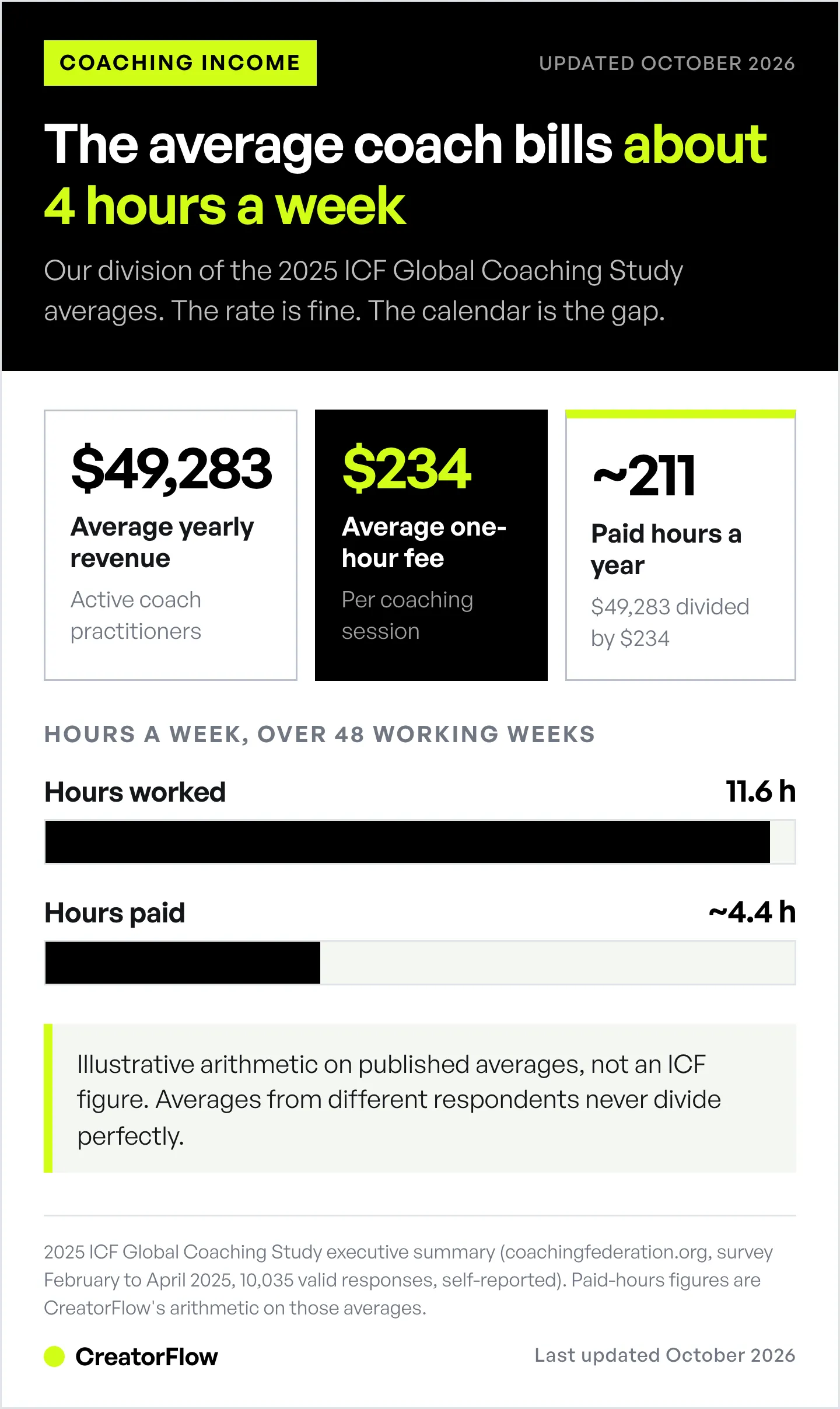
- Paid hours a year: $49,283 divided by $234 is about 211 hours.
- Paid hours a week: 211 hours over 48 working weeks is about 4.4 hours.
- Hours worked a week: ICF reports 11.6 hours a week working as a coach.
- Revenue per active client: $49,283 divided by 12.4 clients is about $3,974 a year.
If all 11.6 weekly hours were paid at $234 for 48 weeks, revenue would be about $130,000. The gap between that and $49,283 is the cost of unpaid time: preparation, admin, discovery calls, discounted sessions and empty slots. The rate is fine. The calendar is the problem.
Coaches seem to know this. In the same study, 60% expect next year’s growth to come from more clients and 51% from more sessions. Only 37% expect to raise fees. So the useful question is how to turn more of your working hours into paid hours. A higher rate comes second.
That gives you three levers, in this order:
- Fill empty slots. More booked sessions at the same rate. This is a client acquisition problem.
- Cut unpaid hours. Fewer free calls that go nowhere, less manual back-and-forth to book a time, less admin.
- Raise the rate. It works best once your calendar is full and you have a waitlist.
If you want the full stage-by-stage version of lever one, the client acquisition system for coaches breaks the path from first message to paid client into five measured stages.
How to Price Online Coaching From an Income Target
Start with the money you need and work backwards. Pricing from what other coaches charge tells you what the market accepts. It does not tell you whether your calendar can reach your goal at that price.
The formula has four steps:
- Set the yearly target. Revenue you need from coaching, before tax, including your tool costs.
- Pick the package. Number of sessions, length of the program and the price.
- Divide. Target divided by package price is the number of packages you must sell each year.
- Check the calendar. Packages multiplied by sessions per package, divided by your working weeks, is your weekly load.
An illustrative example, not a measured result. You want $80,000 a year. You sell a 12-week program with one call a week for $2,700, which is $225 a session.
| Step | Calculation | Result |
|---|---|---|
| Packages needed | $80,000 / $2,700 | 30 a year (2.5 a month) |
| Sessions delivered | 30 x 12 | 360 a year |
| Weekly load | 360 / 48 weeks | 7.5 calls a week |
| Card fees on one sale | 2.9% + $0.30 on $2,700 | About $78.60 |
Now the test is concrete. Can you find 2.5 new clients a month, and can you hold 7.5 calls a week plus the prep around them? If the answer to the first question is no, a lower price will not save you. You need a better way to get booked calls. If the answer to the second is no, raise the price or add a group format.
The card fee line uses Stripe’s standard US rate of 2.9% plus 30 cents per successful domestic card charge (checked October 2026). Your platform may add its own fee on top, so check yours.
Online Coaching Business Models Compared
Each model sells your time differently. Most coaches who earn well online run two at once: a 1:1 package as the main earner and one format that does not need their hours.
| Model | Your time per sale | Best moment to add it |
|---|---|---|
| Single 1:1 session | One hour plus prep | First weeks, to test demand and learn the problem |
| 1:1 package (6 to 12 weeks) | Fixed weekly slot for the program | As soon as single sessions sell |
| Group program | One session serves many people | When you have a waitlist or repeated questions |
| Workshop for a company | One half day, with the employer paying | When a client asks for their team |
| Recorded course or template | Hours once, then none per sale | After you have answered the same question many times |
Single sessions are easy to sell and hard to earn from, because each one needs a new sale. Use them to learn what people pay for.
Packages are where most coaching income comes from. You sell once and the client fills the same slot for weeks. Pick a length that matches the change you promise. A 6-week interview prep program and a 12-week fitness program are both honest lengths.
Group programs break the link between hours and income. If you want a launch plan for one, see the guide to enrolling a group coaching program from Instagram DMs.
Workshops and courses add income without adding weekly hours. They work better as a second step than as your first offer, because they sell best to people who already know you.
What You Need to Sell Coaching Online
You need four things: a page that explains the offer, a booking calendar, a way to take payment and a channel that sends people to the page. Many platforms combine the first three. The comparison of platforms to sell courses and coaching covers nine of them with verified pricing.
What some common pieces cost, checked October 2026:
| Tool | What it does | Price |
|---|---|---|
| Stan Store | Store page, coaching calls, payments | Creator $29/month, Creator Pro $99/month, 0% Stan fee (stan.store, October 2026) |
| Calendly | Booking calendar | Free plan with one event type; payments from Standard at $10 per seat per month |
| Stripe | Card payments | 2.9% + $0.30 per US domestic card charge |
| CreatorFlow | Instagram comment-to-DM and keyword replies | Free with 500 DMs a month; Pro $15/month |
Calendly’s pricing page shows a yearly-billing discount next to the Standard price, so check which billing period you are on. Card processing fees apply on Stan as they do everywhere else, because the 0% refers to Stan’s own cut.
Keep the stack small. The coaching tech stack audit shows how to price each tool per active client so you can see which ones pay for themselves.
How to Get Online Coaching Clients From Instagram
Instagram works as a booking channel because people already ask questions there. The problem is speed. A follower comments “how do I start?” on your post at 9pm, you see it the next afternoon after three client calls, and by then the moment has passed.
Comment-to-DM automation closes that gap. You pick a keyword, add it to your caption (“Comment PLAN and I’ll send you my free 3-step plan”), and every comment with that word gets a private DM. The DM carries your booking link, your free resource or a short qualifying question. It goes out while you are on a call with someone else.
Meta sets the rules for this. Its private replies documentation allows one private message to a commenter, sent within 7 days of the comment, and further messages only after the person replies, within 24 hours of that reply (checked October 2026). So put everything in the first message:
- What they asked for, at the top. The free plan, the checklist, the link.
- One question that opens the conversation, for example “What is the one thing you want to change in the next 90 days?” A reply opens a 24-hour window for you to answer.
- The booking link, with one line on who the call is for.
CreatorFlow sends that first DM from comment keywords, story replies and DM keywords. On Pro it can also collect an email before it sends the link, so a follower who is not ready to book still joins your list. CreatorFlow is a Meta Tech Provider and connects through Meta’s official Instagram API, so you never share your password.
Two habits keep this channel paying:
- Answer the replies yourself. The automation starts the conversation. The diagnosis and the price talk are where the client decides, and they belong to you.
- Protect the booked call. A booked call that does not happen earns nothing. The guide to reducing discovery call no-shows from Instagram DMs covers confirmation and reminder messages inside Meta’s rules.
For a full setup with message examples, see Instagram DM automation for coaches and consultants.
A 30-Day Plan to Make Your First Coaching Money Online
This plan assumes you have a skill people already ask you about and an Instagram account with an audience of any size.
- Days 1 to 3: write the offer. One sentence: who it is for, the change, and how long it takes. Then one price for one package.
- Days 4 to 5: run the formula. Target divided by price. Write down how many sales a month you need and how many calls a week that makes.
- Days 6 to 7: set up the page, calendar and payment. One page, one booking link, one payment method. Block your coaching hours in the calendar so bookings land where you want them.
- Days 8 to 10: set up the comment keyword. One keyword, one first DM with a free resource, one question and the booking link.
- Days 11 to 30: post three times a week with the keyword in the caption. Each post answers one question your buyers ask. Reply to every DM reply the same day.
- Day 30: count. Comments, DMs, replies, booked calls, held calls, clients. The lowest number against your target is the one to fix next month.
Offering two or three free or discounted sessions in the first month is a reasonable way to collect testimonials. Cap it in advance so it does not take over the paid hours you are trying to build.
FAQ
How much do online coaches make a year?
The 2025 ICF Global Coaching Study reports an average of $49,283 a year for active coach practitioners, at an average fee of $234 per one-hour session. Coaches with over 10 years of experience average $69,721. These are self-reported figures from 10,035 respondents, most of them ICF members, so first-year income is usually lower.
Can you make money coaching online without a certification?
Yes, in most niches no law requires a coaching certificate. Credentials do affect demand: 73% of coaches in the 2025 ICF study say clients increasingly expect professional credentials. Health, fitness and finance topics can carry their own legal rules, so check what applies to your niche and country before you sell.
How many clients do I need to make $100,000 coaching online?
Divide the target by your package price. At $2,500 a package you need 40 sales a year, a little over 3 a month. At $5,000 you need 20. Then check the hours: 40 packages of 12 weekly calls is 480 sessions, about 10 a week over 48 weeks.
What should I charge for online coaching as a beginner?
Price from your income target and your available hours, then compare the result to what similar coaches charge. The ICF average of $234 an hour is a reference for established coaches. A beginner package priced lower is fine if the formula shows your calendar can still reach your target at that price.
Is 1:1 coaching or group coaching more profitable?
Group coaching earns more per hour once it fills, because one session serves many people. 1:1 coaching is easier to sell first and teaches you what your clients need. Most coaches start with 1:1 packages and add a group program once they have a waitlist or keep answering the same questions.
How do I get my first online coaching client?
Start where people already ask you questions. Post content that answers one buyer question, invite a keyword comment, and send a DM with a free resource and a booking link. Reply to every answer yourself and book the call. Your first clients usually come from people who already follow you, not from strangers.
How long does it take to make money coaching online?
A clear offer, a booking page and one active channel can produce a first paid client within a month if you already have an audience that asks you questions. Reaching a steady income takes longer, because the numbers at each stage need a few months of data before you can trust them.
The coaches who earn well online are rarely the ones with the highest rate. They are the ones whose working hours turn into paid hours. Fill the calendar first, then raise the price.
Coaching income, fee, hours and client figures verified from the 2025 ICF Global Coaching Study executive summary in October 2026. Paid-hours and per-client figures are our arithmetic on ICF’s published averages. Tool prices checked October 2026 on Stan Store, Calendly and Stripe. Instagram private reply rules verified from Meta’s developer documentation, October 2026. Pricing examples are illustrative. Individual results vary.


