

A client acquisition system for coaches is the measured path a stranger takes from first asking you something to paying you. It has five stages: hand-raisers, qualified conversations, booked calls, calls held, and clients. Each stage has a number attached. The system works when you know all five numbers and which one is lowest against its normal band. Most coaches have the stages but not the numbers, so they fix the wrong stage.
You post more. You go live. You rewrite the offer for the third time this quarter. Two calls show up, one no-shows, the other says they need to speak to their partner. So you post more. That loop is not a content problem, and adding reach to a system that leaks at the qualification stage produces more of exactly the same result, at higher cost and more hours. If the cost side is what is bothering you, run a coaching tech stack audit first and price every tool per active client.
This guide gives you the arithmetic behind a full coaching practice, a working band for every stage with the source it comes from, the one diagnostic that tells you which stage is really broken, and a five-week build order. It is written for solo and small-team coaches selling packages between $1,000 and $25,000.
Key Takeaways
- Five numbers run the whole thing: hand-raisers, qualified conversations, booked calls, calls held, clients. Everything else is decoration on top of those five.
- The volume you need is smaller than you think: at a $3,000 package, roughly 95 hand-raisers a month supports the $49,283 average annual coaching revenue reported in the 2025 ICF Global Coaching Study. At $10,000, it is about 28 a month, or one a day.
- Speed is the cheapest fix on the list: the 2007 MIT Sloan and InsideSales study found the odds of qualifying a lead drop 21x between a 5-minute and a 30-minute response. Direction is reliable; the exact multiple is not transferable to 2026 coaching DMs.
- Discovery call benchmarks disagree by 3x for a reason: published bands run from 10-30% to 35-55%. They are measuring different denominators, not different skill levels.
- Fix the stage furthest below its own band, not the stage with the lowest raw percentage. Stages have different natural ranges, so raw numbers are not comparable.
- Automate the reply, the qualifier, the booking link, and the record. Keep the diagnosis, the price conversation, and the objection in your own hands.
What Is a Client Acquisition System for Coaches?
A client acquisition system for coaches is a repeatable, measured path from first contact to signed client, where every stage has a defined owner, a defined handoff, and a tracked conversion rate. It differs from lead generation, which only fills the top, and from a sales funnel, which describes the shape but not the measurement. The defining feature is that you can name the number at each stage.
That definition sounds obvious and almost nobody meets it. Ask a coach how many people asked them a real question last month and you get an estimate. Ask what percentage of booked calls were held and you get a shrug. Without those two numbers, a decision to buy ads, hire a setter, or rewrite the offer is a guess with a budget attached.
The five stages, in plain terms:
- Hand-raisers. Anyone who asks you something real. A DM, a comment with a question, a form fill, a reply to an email. Passive views and follows do not count.
- Qualified conversations. Hand-raisers who match your client profile on budget, timing, and problem.
- Booked calls. Qualified people who put a time on your calendar.
- Calls held. Booked calls that took place.
- Clients. Held calls that turned into payment.
Four conversion rates sit between those five stages. Those four rates are the entire system. If you write them on a card and update them monthly, you have more operating visibility than most coaching businesses at three times your revenue.
The Arithmetic Behind a Full Coaching Practice
The 2025 ICF Global Coaching Study, conducted by PwC across more than 10,000 participants in 127 countries, put the global average annual revenue for a coach practitioner at $49,283, with a record 122,974 coach practitioners worldwide and total industry revenue of $5.34 billion (coachingfederation.org, September 2025). Take that average as a working target and run it backwards through the five stages.
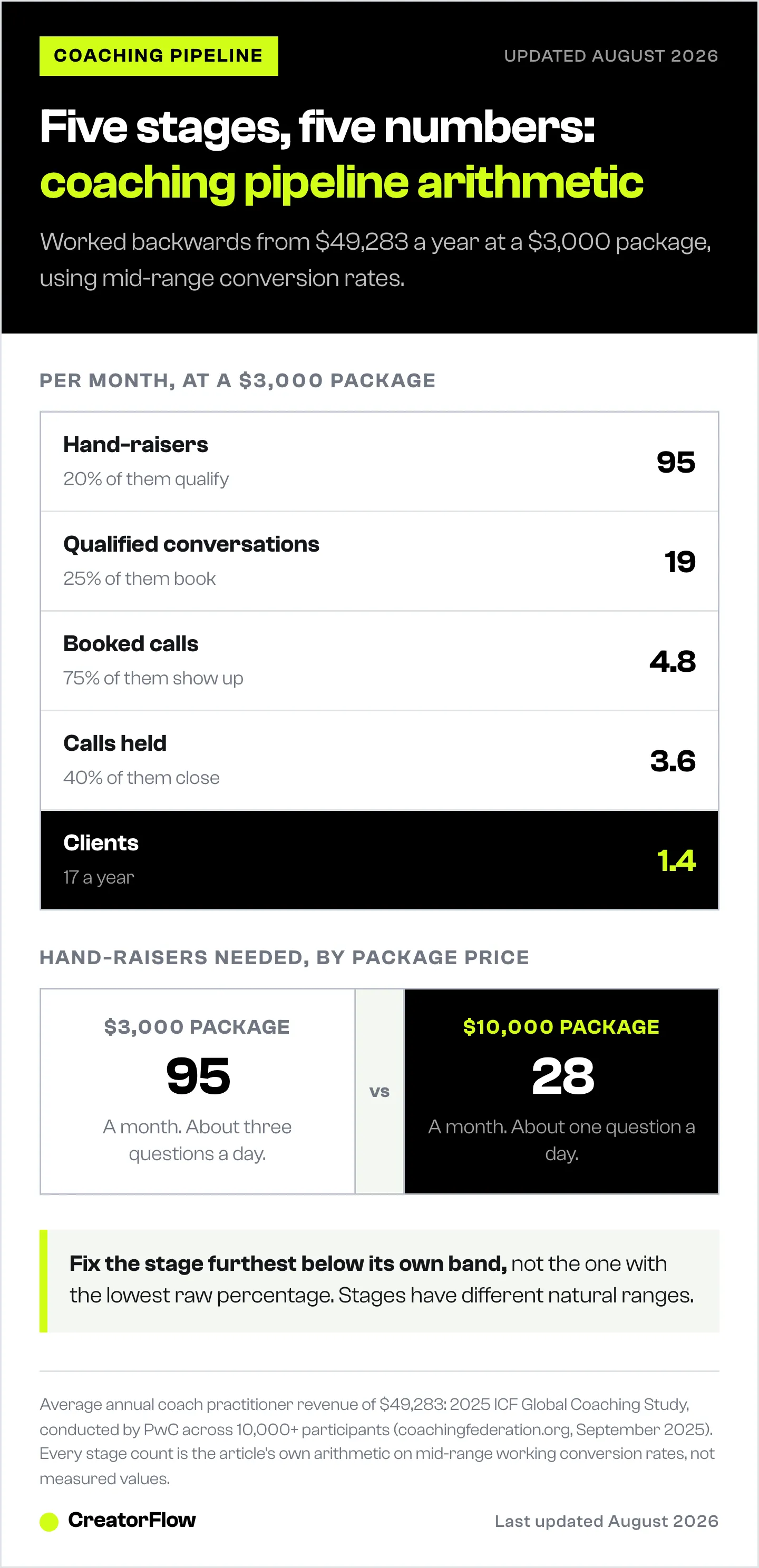
Using mid-range conversion rates at every step, a $3,000 package needs roughly 17 clients a year:
| Stage | Rate to next stage | Per year | Per month |
|---|---|---|---|
| Hand-raisers | 20% qualify | 1,140 | 95 |
| Qualified conversations | 25% book | 228 | 19 |
| Booked calls | 75% show | 57 | 4.8 |
| Calls held | 40% close | 43 | 3.6 |
| Clients | — | 17 | 1.4 |
Ninety-five hand-raisers a month is about three real questions a day. Three people a day asking you something specific is enough to build an average-revenue coaching practice at a $3,000 price point.
Run the same math at $10,000 and the picture changes again. Five clients a year covers the same revenue, which needs about 12 held calls, 17 booked calls, 67 qualified conversations, and 335 hand-raisers across twelve months. That is 28 hand-raisers a month, or roughly one a day.
One serious question a day. That is the actual top-of-funnel requirement for a high-ticket coaching practice at average industry revenue. Set that against the amount of energy the coaching industry spends on reach and the mismatch is the whole story. If you are getting more than one good question a day and still not booked out, more reach will not help you, because reach is not your lowest number.
Two caveats on this table. The rates are mid-range working assumptions, not measured values from your business, and the point of the exercise is to replace them with yours. And revenue per client varies enormously by delivery model, so run the math on your own package price rather than the industry average.
The Five Numbers That Run the System
Each stage fails in a specific, recognisable way. Learning the failure signature is faster than reading a dashboard, because the signature usually shows up in your inbox weeks before it shows up in revenue.
Hand-raisers. Failure signature: high view counts, quiet inbox. Your content is being consumed and is not asking for anything. Content that generates hand-raisers ends in a specific, low-cost request, not a general invitation to reach out.
Qualified conversations. Failure signature: a busy inbox full of people who cannot afford you or are not ready. The filter is missing, and it is costing you the most expensive resource you have, which is attention. Three questions asked before a call, covering the problem, the timing, and the budget range, do most of this work.
Booked calls. Failure signature: good conversations that end with “let me think about it” and never resume. The gap between interest and calendar is where most coaching pipelines die. Anything that adds friction here, including asking people to reply with times, costs you calls.
Calls held. Failure signature: a full calendar and an empty Zoom room. No-shows are a booking-quality problem more often than a reminder problem, though reminders help. A call booked seven days out from a lukewarm conversation is a no-show waiting to happen.
Clients. Failure signature: strong rapport, no decision. Usually this is a diagnosis problem inside the call rather than a closing problem at the end of it.
The order matters. Fixing the close rate while unqualified people are still reaching your calendar means you are getting better at selling to people who were never going to buy.
Stage-by-Stage Benchmarks: What Normal Looks Like
Published benchmarks for coaching businesses are thin and inconsistent, so treat this table as a working band rather than a law. Where a number comes from published research, the source is named. Where it comes from practitioner reporting, it is labelled as such, and you should hold it loosely.
| Stage transition | Working band | Basis |
|---|---|---|
| Hand-raiser to qualified | 15-30% | Practitioner reporting; varies most with content specificity |
| Qualified to booked | 20-40% | Practitioner reporting; friction-sensitive |
| Booked to held | 70-85% | Practitioner reporting; drops sharply past 3 days lead time |
| Held to client, pre-qualified | 35-55% | Paperbell analysis of roughly 2,500 discovery calls, as reported August 2026 |
| Held to client, unfiltered | 10-30% | Multiple coaching-industry sources, August 2026 |
The two close-rate rows are the interesting part, and the next section explains why they sit 3x apart.
Before you compare yourself to any of these, collect four weeks of your own data. A benchmark tells you whether a number is unusual. Only your own trend tells you whether a change worked.
Why Response Speed Beats Every Sales Script
The most reliable finding in the entire lead-conversion literature is about time, not language.
The original work is the 2007 Lead Response Management study by Dr James Oldroyd at MIT’s Sloan School of Management, run with InsideSales.com across three years of data from six companies, covering more than 15,000 leads and over 100,000 call attempts. It found the odds of contacting a lead drop by about 100x between a 5-minute and a 30-minute response, and the odds of qualifying one drop by about 21x across the same gap.
Almost every article you will read attributes those two figures to Harvard Business Review. That is wrong, and it matters for how much weight you give them. HBR published a separate and equally useful study in March 2011, “The Short Life of Online Sales Leads” by Oldroyd, Kristina McElheran and David Elkington, which audited 2,241 US companies. That audit found an average response time of 42 hours, with 37% responding within an hour, 24% taking more than a day, and 23% never responding at all. Firms contacting a lead within an hour were about seven times as likely to qualify it as those waiting one hour longer, and more than sixty times as likely as those waiting a day (hbr.org, March 2011).
Now the honest caveat, which no benchmark article on this topic seems willing to make. Both studies measured outbound phone calls to web form leads at B2B companies, one of them nearly twenty years ago. Neither measured a coach replying to an Instagram DM in 2026. The direction of the finding is about as well established as anything in sales research. The specific multiples are not transferable to your business, and any article quoting “21x” as if it applies to coaching DMs is overreaching.
What does transfer is the mechanism. Intent decays fast, and it decays fastest in the channel where the question was asked. Someone who types a question into your DMs at 9pm is in a buying state that has a short half-life. A reply at 9pm the following day reaches a different person.
For most solo coaches this is the single cheapest improvement available, because it needs no new audience, no new offer, and no new content. It needs the first reply to leave without waiting for you. Our breakdown of how slow DM replies cost sales covers the mechanics on Instagram specifically, and Meta’s own constraint reinforces the point: the standard messaging window for an Instagram conversation is 24 hours from the person’s last message, with the human agent tag extending manual replies to 7 days for genuine human responses only (developers.facebook.com, August 2026).
Why Discovery Call Benchmarks Disagree by 3x
Search for a coaching close-rate benchmark and you will find two incompatible answers. One camp reports 35-55%. Another reports 10-30% with only the top slice clearing 30%. Both are published in good faith, and the gap is not a measurement error.
They are dividing by different denominators.
The high band counts calls that survived a filter. An application form, three qualifying questions, a price range stated before booking, a minimum revenue or readiness threshold. By the time the call happens, the people who were never going to buy have already removed themselves. The low band counts every call booked from an open calendar link, including the browsers, the researchers, and the people who wanted free advice.
The practical consequence is the part that changes how you run the business: a close rate is not a measure of how well you sell. It is a measure of what your qualification let through. Two coaches with identical selling ability will report 22% and 55% purely on the basis of what sits upstream of the calendar.
This cuts both ways, which is why “improve your close rate” is bad advice in isolation. Tighten qualification hard enough and your close rate climbs while your total client count falls, because you filtered out people who would have said yes. The number to protect is clients per month, not close rate. Close rate is a diagnostic, not a target.
One documented example of the upstream effect: a coach adding a pre-call application form with three qualifying questions moved from 22% to 58%, without charging for the call itself (reported August 2026). The selling did not change. The denominator did. If you want the specific question set, we cover how to qualify leads before the discovery call in detail, and there is a separate walkthrough for high-ticket coaching leads where the filter has to be stricter.
How to Find the Stage That Is Leaking
Here is the diagnostic, and it takes about ten minutes once you have four weeks of numbers.
Write your four conversion rates next to their working bands. Calculate how far below the bottom of its band each one sits, in percentage points. Fix the one with the largest gap. Not the smallest raw number.
This matters because the stages have different natural ranges. A coach with a 22% qualified-to-booked rate and a 68% booked-to-held rate might look at those and work on the 22%. That would be the wrong call. The 22% sits inside its 20-40% band, and the 68% sits 2 points below its 70-85% band. The booking-to-held gap is the real leak, and it is likely a lead-time or a qualification-freshness problem rather than anything to do with the calendar itself.
Two rules that keep this honest:
Change one stage at a time. If you tighten qualification and add reminders in the same month, and clients go up, you have learned nothing about which one worked, and you will keep paying for both.
Give a change four weeks before you judge it. Coaching pipelines are low-volume. At 19 qualified conversations a month, a two-week sample is noise, and you will chase a random fluctuation into a permanent process change.
If every stage sits inside its band and revenue is still below target, the system is working and the volume is too low. That is the only situation where the answer is genuinely more reach, and it is far rarer than the amount of advice pointed at it suggests.
The Build Order: One Stage at a Time
Five weeks, in this order. The order is deliberate: instrument first, then fix backwards from the money, because a fix at a late stage compounds across everything upstream of it.
Week 1 - Count. Do not change anything. Log every hand-raiser, qualified conversation, booked call, held call, and client in a spreadsheet with five columns. A messy manual count beats a clean estimate. If your conversations live in Instagram messages, the six-stage DM sales pipeline gives you a place to record them as they move.
Week 2 - Fix the handoff to the calendar. Every qualified conversation ends with a link and a time, in the same message, in the channel the conversation is happening in. No “email me and we’ll sort a time”. This is usually the largest single-week gain available.
Week 3 - Add the filter. Three questions before the call: what the problem is, when they want it solved, and what range they expected to invest. Ask them in the conversation, not in a long form. Your close rate will move; watch clients per month rather than the rate itself.
Week 4 - Close the response gap. Get the first reply out in minutes, not hours, for every channel where people raise a hand. This is where automation belongs, and the next section covers exactly where it stops.
Week 5 - Protect the held call. Book inside three days where you can. Send a reminder the day before and the hour before. Put one line in the reminder that restates the specific problem they described, so the call keeps the context that made them book it.
Then repeat the count and see which gap is now largest. The system is never finished, but it does stop being a mystery.
For a one-person version of this with no ad budget and no assistant, we have a full walkthrough on lead generation without a team.
What to Automate, and What to Never Automate
The line is cleaner than most tooling conversations make it sound. Automate everything that is a routing or a record. Keep everything that is a judgement.
Automate:
- The first reply, so intent is met while it still exists
- The delivery of the thing they asked for, whether that is a guide, a price list, or a case study
- The qualifying questions, asked in sequence
- The booking link, sent the moment someone qualifies
- The reminders before the call
- The record of who asked what, and when
Keep manual:
- The diagnosis of their actual problem
- The price conversation
- Any objection, including the ones that look like scheduling issues
- Anything that requires you to disagree with them
Coaching is bought on judgement. The moment an automated message tries to handle an objection, the buyer learns that the judgement they were paying for is not in the room. Meta’s own rules point the same direction: the human agent tag that extends the Instagram messaging window to 7 days is for genuine human replies, not bot messages (developers.facebook.com, August 2026).
Most coaches get this backwards. They handle the first reply personally, at whatever hour they happen to see it, and then send a generic proposal after the call. Reverse both. The first reply should be instant and standardised. The proposal should be specific and written by you.
CreatorFlow handles the first four items on the automate list for coaches whose hand-raisers arrive through Instagram: a keyword or comment triggers the reply, the qualifying sequence runs in the DM, the booking link goes out with click tracking, and the Email Gate captures the address so the conversation continues if the call does not get booked. Flat $15 a month on Pro, no per-contact pricing, and CreatorFlow is a Meta Tech Provider (since December 2025) working through the official Instagram API. If Instagram is where your questions come from, our guide to booking discovery calls straight from Instagram covers the setup, and the DM funnel guide covers the message sequence itself.
FAQ
What is the difference between lead generation and a client acquisition system?
Lead generation fills the top of the pipeline. A client acquisition system for coaches covers the entire path from first question to payment, with a measured conversion rate at each stage and a defined handoff between them. A coach can have excellent lead generation and no acquisition system, which shows up as a busy inbox and a quiet calendar.
How many leads does a coach need per month to stay booked?
Fewer than most expect. Using mid-range conversion rates, roughly 95 hand-raisers a month supports about 17 clients a year at a $3,000 package, which approximates the $49,283 average annual revenue reported in the 2025 ICF Global Coaching Study. At a $10,000 package it drops to about 28 a month. Run the math on your own price rather than the average, using the income-target pricing formula for online coaching.
What is a good discovery call conversion rate for coaches?
It depends entirely on what your qualification filters out. Published bands run 35-55% for pre-qualified calls, based on Paperbell’s analysis of roughly 2,500 discovery calls, and 10-30% for unfiltered calendar bookings. A 25% close rate on an open calendar and a 50% close rate behind an application form can represent identical selling ability. Track clients per month as the target and use close rate only as a diagnostic.
How long does it take to build a client acquisition system?
Five weeks to a working version, one stage per week, starting with a week of counting before you change anything. Getting the numbers stable enough to trust takes a further two to three months, because coaching pipelines run at low volume and short samples are noisy.
Do coaches need paid ads to acquire clients?
No, and ads are usually the wrong first move. Ads increase hand-raisers, which is only the right fix when every downstream stage already sits inside its normal band. Buying traffic into a pipeline that leaks at qualification or booking raises cost per client without raising client count.
Should I use a discovery call or an application form?
Both, in sequence. The form or the three in-conversation questions sit before the call and decide who reaches it. Removing the call entirely works for lower-priced packages, and above roughly $3,000 most coaches find the conversation is where the diagnosis and the decision happen.
How do I know which part of my acquisition system is broken?
Compare each of your four conversion rates against its working band and calculate the gap in percentage points. The stage furthest below the bottom of its own band is the one to fix. Do not compare raw percentages against each other, because a 25% qualified-to-booked rate is healthy while a 25% booked-to-held rate is a serious problem.
Build the count first. Almost every coach who runs the five-stage arithmetic for a month discovers their instinct about which stage was broken was wrong, and that the fix was cheaper than the strategy they were about to buy.
Coaching industry figures verified from the 2025 ICF Global Coaching Study (coachingfederation.org, September 2025). Lead response findings verified from the 2007 MIT Sloan and InsideSales Lead Response Management study and “The Short Life of Online Sales Leads” (hbr.org, March 2011). Instagram messaging window verified from developers.facebook.com, August 2026. Discovery call conversion bands reflect published practitioner reporting as of August 2026 and vary by niche, price point, and qualification method. Individual results vary.


