

A DM sales pipeline is a set of named stages that a coaching lead moves through inside Instagram messages, from the moment they raise a hand to the moment they buy or get parked. A working pipeline has six stages, each defined by something the lead did rather than something you sent, and each carrying a maximum age before the lead stops replying.
Most coaches do not have a lead problem. They have a visibility problem. Forty conversations sit in the inbox, six of them are worth money, and there is no way to tell which six without scrolling every thread. So follow-up happens by memory, and memory follows whoever messaged most recently instead of whoever is closest to buying.
This guide covers the six stages, what each one should convert at, how long a lead can sit in each before it decays, which stages to delete from the pipeline you already have, and how to move leads between stages without doing it by hand.
Key Takeaways
- Define stages by lead behaviour, not by your activity. “Booking link sent” describes what you did. “Replied” describes what they did. Only the second one predicts revenue.
- Every stage needs a maximum age. In Instagram DMs a lead does not cool down gradually. Meta closes the standard reply window 24 hours after the prospect’s last message.
- Six stages is enough. Triggered, Replied, Qualified, Booked, Attended, Closed. More stages produce more admin and no more clarity.
- Speed is the only free variable. The 2007 MIT/InsideSales lead response study found leads contacted at five minutes were 21 times more likely to qualify than leads contacted at 30 minutes.
- Booked is not the finish line. Show rate is a separate measurement from close rate, and reminder research points to a meaningful recovery when reminders are automated.
- Stage age beats stage count. A pipeline with 40 leads and no ages is a list. A pipeline with 12 leads and an age on each is a forecast.
What a DM Sales Pipeline Is
A DM sales pipeline tracks coaching leads through named stages inside Instagram direct messages. Each stage records one observable event: the prospect triggered an automation, sent a real reply, answered the fit questions, booked a call, attended it, or reached a decision. The pipeline gives every open conversation a status and an age, so follow-up runs on position rather than on whoever messaged last.
The distinction that matters is between a stage and an activity. An activity is something you performed: sent a link, left a voice note, followed up on Tuesday. A stage is a state the prospect entered. Activities feel productive and fill a board with cards that never move. Stages move only when the prospect does something, which is why a stage-based board tells you the truth about a month before the month ends.
For coaches the pipeline sits downstream of content. Getting someone from a post into the inbox is a separate job, and it fails for reasons that have nothing to do with sales process. If your posts get comments and your inbox stays empty, fix where the content-to-DM handoff breaks before you build stages for leads you do not have yet.
Why CRM Stages Break Inside the Instagram Inbox
Standard CRM stages assume you can reach a contact whenever you decide to. Instagram does not work that way. Meta’s Instagram Platform documentation allows an app to respond within 24 hours of receiving a message from the user, and the human agent tag extends that window to seven days for human support cases, not for automated sends (developers.facebook.com, August 2026). The clock resets only when the prospect writes again.
That single rule rewrites the pipeline. In an email or phone pipeline, a lead sitting in one stage for eleven days is stale but reachable. In a DM pipeline, a lead sitting in one stage for 25 hours may be unreachable by automation, and the only route back is a new post that pulls them into a fresh conversation. Time is not a soft signal here. It is a hard boundary set by the platform.
Two consequences follow. First, the age of a lead in a stage matters more than the number of leads in it. Second, the pipeline needs a rule that fires before the window closes, not a weekly review that discovers the loss afterwards. Coaches who run their inbox on a Sunday review lose the Tuesday leads every week and never see it happen.
The 6 Stages of a DM Sales Pipeline
The six stages below cover every coaching conversation from first signal to decision. Each row names the event that moves a lead into the stage, the maximum age before the lead should be treated as decaying, and a planning range for how many leads should exit into the next stage. Treat the ranges as starting assumptions to measure against, then replace them with your own numbers after 100 conversations.
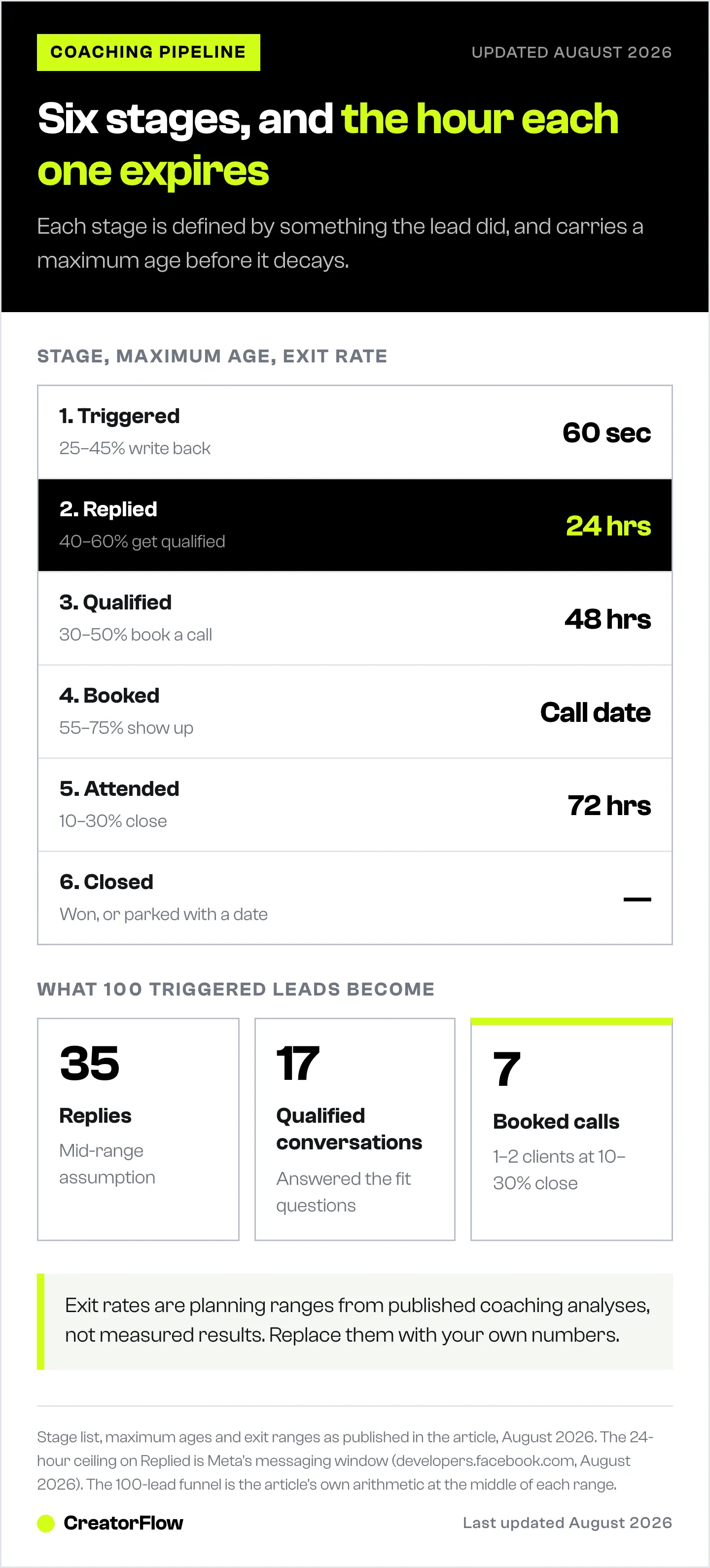
| Stage | Entry event (what the lead did) | Max age | Exit rate to next stage |
|---|---|---|---|
| 1. Triggered | Commented a keyword, replied to a Story, or sent a first message | 60 seconds | 25-45% |
| 2. Replied | Wrote a second message of their own after your first | 24 hours | 40-60% |
| 3. Qualified | Answered the fit questions (problem, timeline, budget band) | 48 hours | 30-50% |
| 4. Booked | A calendar event exists with a date | Until call date | 55-75% show |
| 5. Attended | The call happened | 72 hours | 10-30% close |
| 6. Closed | Bought, or parked with a reason and a return date | n/a | n/a |
Stage 1: Triggered
The lead did one thing: raised a hand. A keyword comment, a Story reply, a reaction to a poll, a first DM. Nothing has been qualified and nothing has been promised. This stage should be empty at all times, because a lead that stays in it for more than a minute is a lead you are losing to response latency.
The exit rate here is the honest measure of your first message. If fewer than a quarter of triggered leads write back, the problem is the message, not the audience.
Stage 2: Replied
The prospect sent a message that was theirs, not a keyword. This is the first stage with a human in it, and it is where the 24-hour clock starts running in earnest. Every reply they send resets it. Every hour you take burns it.
Replied is also the stage most coaches skip past. They send the booking link on the first real reply, which converts the small group who were already sold and loses everyone who needed two more sentences of context.
Stage 3: Qualified
The prospect has answered enough to tell you whether the work is a fit: what they are trying to change, when they want to start, and roughly what they expect to invest. Two or three questions is the ceiling before it reads as a form. The full sequence, including what to ask and in what order, is covered in the guide on qualifying Instagram leads before discovery calls.
For programmes above five figures the screen goes deeper, because the cost of an unqualified call is higher. That version of the stage is laid out in the walkthrough for high-ticket coaching leads.
Stage 4: Booked
A calendar event exists with a date on it. Not “they said they would book.” Not “link sent.” The event, or the stage does not move.
This is the stage where a pipeline most often lies to its owner. Booked leads look like revenue and behave like maybes. Measure show rate separately from close rate or you will read a no-show problem as an offer problem and rewrite a sales script that was working.
Stage 5: Attended
The call happened. From here the conversation frequently returns to the DM, because prospects who need a night to think reply on Instagram rather than by email. Set the age limit at 72 hours: past that, a deal without a next step is a deal without a date.
Some coaching offers never need a call at all and close in the thread. If that is your model, this stage folds into the previous one and the relevant mechanics are in the guide on closing the sale inside the DM.
Stage 6: Closed
Two exits, both terminal, both requiring a written reason. Won records what the prospect said in the message that turned it, in their words. Parked records why it did not close and the date you will raise it again. A parked lead without a date is a deleted lead with extra steps.
Stage Age: The Number Most Coaches Never Track
Stage age is the number of hours a lead has spent in its current stage. It is the most useful column in a DM pipeline because Instagram’s messaging window makes staleness a deadline rather than a trend. A lead 20 hours into Replied is a different asset from a lead two hours into Replied, and a board that shows only stage names hides that difference completely.
The evidence for speed comes from outside social media, and it is worth being precise about what it does and does not prove. The Lead Response Management study run by Dr James Oldroyd with InsideSales analysed three years of data across six companies, more than 15,000 leads and over 100,000 call attempts. It found the odds of qualifying a lead contacted at five minutes were 21 times higher than at 30 minutes, and the odds of making contact at all around 100 times higher (leadresponsemanagement.org, August 2026).
That study is from 2007 and it measured outbound phone calls, not Instagram messages. Nobody has run its equivalent on DMs. What transfers is the shape of the curve rather than the multiplier: attention decays fast, and the decay is steepest in the first minutes. What DMs add on top is a hard cutoff that phone calls never had.
The practical version for a coaching pipeline is three thresholds. Under 60 seconds for the first response, which only automation reaches. Under four hours for the first human reply, which is achievable with two check-ins a day. Under 24 hours for anything still in Replied, because after that the standard window has closed and the next move costs you a post rather than a message.
Conversion Benchmarks for Each Stage
Stage-level benchmarks for coaching DMs are thin, and any single number you find online is one operator’s account rather than a study. Published coaching analyses put discovery-call close rates in a 10-30% band for the average practice, with the top tier reporting above 30% once the niche is narrow and the calls are pre-qualified. Treat that as the widest useful range and calibrate on your own data.
Two things are worth measuring rather than assuming. Show rate is one, because it is the cheapest number to move: reminder research, mostly drawn from healthcare scheduling, reports reductions in no-shows around 38% for automated SMS reminders and higher for multi-channel sequences. The mechanism transfers to coaching calls even if the exact percentage does not.
The other is the Triggered to Replied rate, because it is the only stage whose conversion is almost entirely in your control. It measures one message, sent by a machine, at a moment you choose. If it sits under 25%, no amount of pipeline discipline downstream will compensate, and rewriting that one message is the highest-return hour in the whole system.
Context on the market you are measuring against: US business coaching was a $20.0bn industry across 75,590 businesses in 2026 (ibisworld.com, August 2026). Most of those businesses are running their sales process out of an inbox with no stages at all, which is why a mediocre pipeline still beats the field.
Three Stages to Delete From Your Pipeline
Most coaching pipelines are too long, and the extra stages share a trait: they record your effort instead of the prospect’s decision. Three appear over and over.
“Booking link sent.” This measures an action you took. A lead who received a link and ignored it is in exactly the same state as a lead who never got one, and giving that state its own column makes a stalled pipeline look busy. Send the link inside the Qualified stage and let the calendar event, not the send, move the card.
Permanent “Nurture.” Nurture is a destination coaches invented so that no lead ever has to be marked lost. Cards go in and stop having ages, and within a quarter it holds 200 conversations nobody will ever open. Park leads instead, with a reason and a date, and let the date do the work.
Temperature stages. Warm, hot, very interested. These describe your read on a conversation rather than anything the prospect did, and two coaches reading the same thread will grade it differently. Every temperature judgement can be replaced by a behavioural one: did they answer the budget question, did they book, did they show.
Automating Movement Between Stages
Stage movement automates cleanly at the front of the pipeline and needs a human at the back. The first three stages run on triggers: a keyword comment starts the conversation, a reply advances it, and answers to the fit questions mark it qualified. The last three stages hang off calendar and payment events. Nothing between Attended and Closed should move without a person reading the thread.
CreatorFlow handles the front half. Keyword triggers and story-reply automation fire the first message in seconds rather than hours, which is the whole of Stage 1. Templates carry the qualifying questions, the email gate collects an address before the link goes out so the lead survives outside Instagram, and link tracking shows which posts produce leads that actually book. CSV export moves those contacts into whatever board or CRM holds the stages, on the Pro plan at $15/month or $12/month billed annually. The free plan runs 500 DMs a month, which covers a coach testing the flow on one offer.
For the board itself, coaches split roughly two ways. A spreadsheet with six columns and a last-touch timestamp is enough below about 30 open conversations a month and costs nothing. Above that, a CRM earns its keep through automatic timestamping and reminders. The full setup for pushing DM leads into a GoHighLevel CRM pipeline for Instagram DMs covers the webhook path and the sub-account structure for coaches running more than one offer.
ManyChat is the other common choice at this layer, with five tiers since its March 2026 restructure: Free at 25 active contacts, then Essential at $17/month for 250 contacts, Pro at $39 for 2,500, Business at $99 for 7,500 and Advanced at $199 for 25,000, or $14, $29, $69 and $139 respectively billed annually (manychat.com/pricing, August 2026). It covers Instagram alongside Facebook, WhatsApp, SMS, TikTok, Telegram and email, so it fits coaches whose pipeline spans more than one channel. Pricing scales with contact count rather than staying flat, which is the trade to weigh against a fixed monthly rate.
The broader funnel this pipeline sits inside, including the message sequence and the templates, is documented in the DM automation funnel for business coaches.
The 15-Minute Weekly Pipeline Review
A weekly review works only if the daily rule already exists. The daily rule is one line: nothing in Replied crosses 24 hours. That takes two minutes a day and prevents the single largest loss in a DM pipeline. The weekly session handles the rest.
- Sort by stage age, not by stage. Oldest first. The top of that list is your entire follow-up plan for the week.
- Clear Stage 1. Anything still sitting in Triggered is a broken automation. Fix the trigger before the follow-up.
- Force a decision on anything over its max age. Parked with a date, or one final message. No third option.
- Read the exit rates across all six stages. One will be visibly worse than the rest. That is the only thing to work on this week.
- Count the Won reasons. Three months of prospects’ own words is better positioning research than any survey you could run.
The output should be a number you can say out loud: how many qualified conversations are open, and how many of them will resolve this week. A coach who can answer that has a pipeline. A coach who has to scroll the inbox to answer it has a backlog.
FAQ
How many stages should a DM sales pipeline have?
Six. Triggered, Replied, Qualified, Booked, Attended, Closed. Every stage past six splits an existing one without adding a decision you would make differently, and each extra column adds admin that gets abandoned within a month. If you sell more than one offer, run one pipeline per offer rather than adding stages to a shared one.
What is the difference between a DM pipeline and a CRM pipeline?
A CRM pipeline assumes you can contact a lead whenever you choose. A DM pipeline cannot, because Meta allows automated replies within 24 hours of the prospect’s last message and extends that to seven days only for human support cases (developers.facebook.com, August 2026). That makes stage age a deadline rather than a health indicator.
How long should a lead sit in one DM pipeline stage?
Under 60 seconds in Triggered, under 24 hours in Replied, under 48 hours in Qualified, and under 72 hours in Attended. Booked runs until the call date. These are ceilings, not targets. The 24-hour figure on Replied is set by Meta’s messaging window rather than by sales convention.
Can you automate a DM sales pipeline on Instagram?
The first three stages automate well. Keyword triggers, story-reply automation and templated qualifying questions move leads from Triggered to Qualified without you present. Booking, call outcomes and closing stay manual, because those stages turn on judgement about a specific person and a specific offer.
What is a good conversion rate from DM to booked call?
Multiply the stage exits rather than looking for a single number. At the middle of the ranges above, 100 triggered leads produce roughly 35 replies, 17 qualified conversations and 7 booked calls. Published coaching analyses put discovery-call close rates in a 10-30% band, which puts one to two clients on those 100 leads.
Should “booking link sent” be a pipeline stage?
No. It records an action you performed, and a lead who ignored the link occupies the same state as one who never received it. Keep the send inside the Qualified stage and let the confirmed calendar event move the card. The same reasoning rules out any stage named after your own follow-up.
What tools track Instagram DM pipeline stages?
Below roughly 30 open conversations a month, a six-column spreadsheet with a last-touch timestamp is enough. Above that, a CRM such as GoHighLevel adds automatic timestamping and reminders. CreatorFlow runs the trigger, first-reply and qualification layer at $15/month on Pro and exports contacts by CSV into whichever board holds the stages.
Platform rules verified from Meta’s Instagram Platform documentation, response-time figures from the MIT/InsideSales Lead Response Management study, market data from IBISWorld, and pricing from manychat.com and creatorflow.so, as of August 2026. Stage exit rates are planning ranges compiled from published coaching analyses, not measured results. Individual results vary.


