

The content-to-DM handoff is the path between a post someone reacts to and the first useful message they get back. For coaches it fails at four points: the call to action points at a surface that cannot trigger a message, the message lands in the prospect’s Message Requests folder, the 7-day comment reply window closes, or the conversation cannot continue because the prospect never replied. Only the first point is a copy problem.
You posted the carousel. It got the comments you wanted: “this is me,” “ouch,” “needed this today.” Your calendar looks identical to last week. So you rewrite the hook, test a new CTA, and post again.
Most advice on this problem stops at the copy. Write a better prompt, keep the context, add a follow-up. That advice is fine and it fixes about a quarter of the failures. The rest are delivery failures, and they happen after your words are already correct. This guide covers the four gates every coaching handoff has to clear, how to tell which one yours dies at, and how to design the CTA backwards from the mechanics instead of forwards from the caption.
Key Takeaways
- The handoff is four gates, not one message. Trigger surface, delivery folder, reply window, continuation window. A perfect CTA still fails if it clears gate one and dies at gate two.
- A comment private reply is a single message. Meta allows exactly one private reply per comment, and the thread cannot be continued unless the person answers it (developers.facebook.com, August 2026).
- Non-followers get your reply in Message Requests. Instagram routes messages from accounts a person does not follow into a separate folder they have to accept before it reaches their Chats list (help.instagram.com, August 2026).
- The comment window is 7 days. A private reply must go out within 7 days of when the comment was created, and on Instagram Live it can only be sent during the broadcast (developers.facebook.com, August 2026).
- Story replies open a better door than comments. A story reply is the prospect messaging you first, which starts a 24-hour window you can hold a real conversation inside.
- Diagnose before you rewrite. Comments high and DM starts low is a gate problem. DM starts high and qualified conversations low is a copy problem. They need opposite fixes.
What the Content-to-DM Handoff Covers
The handoff is the moment recognition converts into a conversation. Someone sees a post about the Sunday night promise they keep breaking by Wednesday, feels seen, and does something. What they do next, and whether your reply reaches them, is the whole game.
Coaches tend to model this as one step: they comment, I reply. Instagram models it as a chain of permissions. Each link has its own rule about who may message whom, how many times, and for how long.
That distinction matters because the two models fail differently. A copy failure looks like silence after your message arrives. A delivery failure looks like silence because your message never arrived, or arrived somewhere the prospect does not check. From your side of the screen both look the same, which is why coaches keep rewriting captions to fix problems that live in the plumbing.
The Four Gates a Coaching Handoff Has to Clear
Gate 1: The trigger surface
Your call to action has to point at a surface that can start a message. “DM me” printed over a Reel asks the viewer to leave the video, find your profile, open a thread, and type unprompted. That is four actions of friction placed on someone who has not decided anything yet.
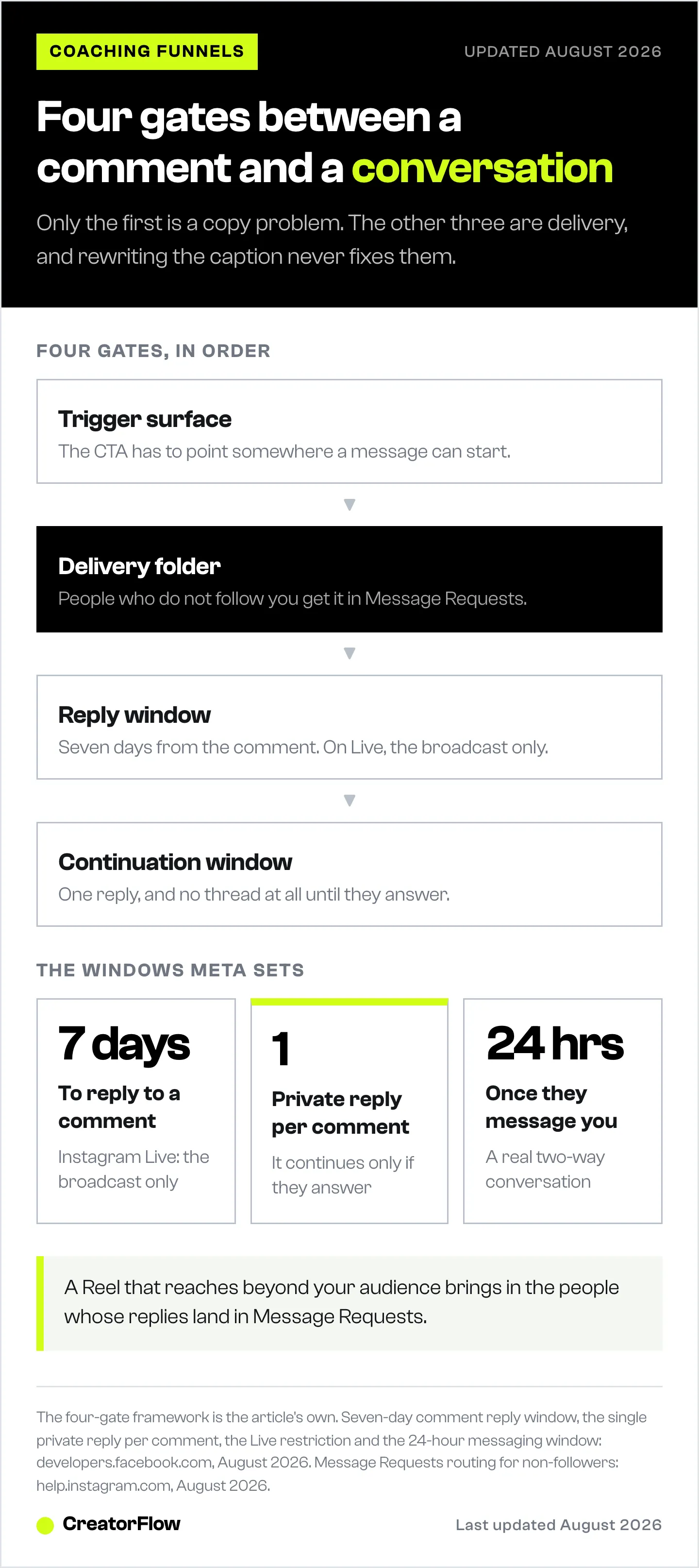
Comments, story replies, and direct keyword messages are surfaces automation can respond to. A caption instruction to visit a link hub is not. When a CTA sends people somewhere the system cannot see, nothing downstream can save it.
This is also the gate where a broken keyword lives. If your trigger word is buried in a sentence, misspelled by half your audience, or shared across two different offers, the reply never fires. Coaches running more than one program should give each offer one keyword and one destination rather than a single catch-all word. If replies are firing for some people and not others, work through the comment-to-DM troubleshooting checks before touching the copy.
Gate 2: The delivery folder
This is the gate almost nobody accounts for. When your account messages someone who does not follow you, Instagram routes it into their Message Requests folder. Instagram’s own help documentation is explicit: requests have to be accepted in that folder before the conversation appears in the Chats list, while messages from people the user follows land directly in Chats (help.instagram.com, August 2026).
Meta’s developer documentation describes the same split for private replies to comments. The reply goes to the person’s inbox if they follow the professional account, or to their Request folder if they do not (developers.facebook.com, August 2026).
Read that against how coaching content works. A Reel that reaches beyond your audience brings in exactly the people who do not follow you yet. The better the post performs, the higher the share of replies that land in a folder most people check rarely. Your best-performing content produces your worst-delivering handoffs.
A follow gate addresses this directly by asking the person to follow before the link goes out, which puts the next message in their Chats list instead of their requests. It also turns a one-time reply into an audience member you can reach again.
Gate 3: The reply window
A private reply to a comment must be sent within 7 days of when the comment was created. Comments on Instagram Live are tighter still: the private reply can only be sent during the live broadcast itself (developers.facebook.com, August 2026).
Seven days sounds generous until you picture a coach who batches DMs on Sunday. Comments from the previous Monday are already dead, and the coach reads that silence as disinterest rather than an expired window.
The Live rule catches people out more often. Coaches run a Live, collect a wall of comments, and plan to work through them the next morning. By then the surface is closed.
Gate 4: The continuation window
Here is the constraint that quietly invalidates a lot of handoff advice. Meta allows exactly one private reply per comment. The documentation states that only when the Instagram user responds to that private message can the conversation continue, and then inside the standard 24-hour messaging window (developers.facebook.com, August 2026).
So the common instruction to write one gentle follow-up for people who went quiet does not work on the comment surface. If they never answered your first message, there is no thread to follow up in. The one message you were allowed has already been spent.
Standard messaging gives you up to 24 hours to respond once someone does reply, and promotional content is permitted inside that window. Outside it, Meta restricts what can be sent to approved message tags, and one-time notification is not available on the Instagram Messaging API at all (developers.facebook.com, August 2026).
The practical consequence is that your single comment reply carries the entire weight of earning an answer. It is not an opener in a sequence. It is the sequence, until they speak.
Which Instagram Surface Opens Which Door
| Surface | Who starts it | Messages you get | Window | Lands in |
|---|---|---|---|---|
| Comment on post or Reel | You reply to them | One private reply | 7 days from the comment | Requests if they do not follow you |
| Comment on a Live | You reply to them | One private reply | During the broadcast only | Requests if they do not follow you |
| Story reply | They message you | Full conversation | 24 hours from their message | Chats, because they wrote first |
| Keyword sent to your DMs | They message you | Full conversation | 24 hours from their message | Chats, because they wrote first |
| Click-to-message ad | They tap into a thread | Full conversation | Up to 7 days from their first message | Chats, because they wrote first |
The pattern is the useful part. Every surface where the prospect messages you first gives you a real conversation in their main inbox. The comment surface, which is where most coaching CTAs point, gives you one message that may land in a folder they ignore.
That does not make comment CTAs a mistake. Comments are the cheapest intent signal on the platform and they carry reach. It means the comment reply has a different job than coaches assume: its job is to earn a reply, because the reply is what upgrades the whole thread into a conversation you can work in.
Diagnose Which Gate Your Handoff Dies At
Four numbers tell you where you are losing people. Pull them once a week and compare the drop between each pair.
Comments or story replies on the post. If this is low, the content or the prompt is the problem and no mechanics fix helps. Go rewrite.
DM starts from that post. Comments high and DM starts low points at gate one or gate three. Check the keyword fired at all, then check how long the comments sat before your reply went out.
Replies to your first message. DM starts high and replies low is gate two or a copy problem, and you can separate them. Look at what share of the people who commented already follow you. If most do not, you are watching the Request folder eat your handoff, not a weak message.
Track these four as a chain rather than as separate stats. Coaches running real volume should graduate them into named DM sales pipeline stages so a stalled lead is visible before it expires.
Qualified conversations. Replies high and qualified conversations low is the one genuinely copy-shaped failure in the set. Your first message is getting read and answered, and it is attracting curiosity rather than fit. That is where the screening questions used before a high-ticket call do their work.
The reason this order matters: the fixes are unrelated. A gate two problem is solved by getting the person to follow first or by moving the CTA to a surface where they message you. Rewriting the message does nothing. A gate four problem is solved by making one message earn an answer. Adding a follow-up sequence does nothing, because the sequence cannot send.
Design the Handoff Backwards From the Gates
Start at the last gate and work back. Ask what the prospect has to do for the thread to stay open, then build the CTA that makes them do it.
Pick a surface that matches the ask. For a high-value offer where the conversation needs room, drive to a story reply or a direct keyword rather than a comment. A poll sticker or a question box turns passive viewers into people who messaged you first, which is why story replies convert differently from comments. For reach-driven Reels where you want volume, comments are right, and you plan for the one-message constraint.
Make the first message ask something answerable. Because a reply is what unlocks everything after it, the message needs a question a person can answer in four words while walking. “Is the break happening before you start the week, or once work gets busy?” earns a reply. “Let me know if you want to chat about coaching” does not.
Carry the context in the first line. Referencing the specific post the person reacted to is the difference between a warm message and a cold one. It also tells them the reply came from a system that remembers them, which is the part that makes people answer.
Handle the follow relationship on purpose. If most of your inbound is non-followers, a follow gate ahead of the link is the cleanest fix, and it compounds because those people stay reachable. If most of your inbound already follows you, skip it and reduce the friction instead.
Route the answered threads somewhere. Once they reply, you have a 24-hour window and a real conversation. That is where the qualification layer belongs, not in the first message. Coaches selling $1K and up should look at how the DM funnel for business coaches sequences questions once the thread is open, and at the broader structure of an Instagram DM funnel if you are building the path from scratch.
The Coaching CTA That Survives All Four Gates
A CTA that clears all four looks different from the ones most coaches write. It names a specific artifact, uses one clean keyword, and asks a question in the reply rather than delivering and going quiet.
On a Reel about clients stalling mid-programme: “Comment STALL and I will send the three questions I use to find where it breaks.” The keyword is one word, unlikely to appear by accident, and tied to one offer.
The private reply then does two jobs in three lines. It delivers the thing you promised, so the person got what they came for. And it asks the narrowing question that earns the reply your window depends on: “Sending these over. Before you read them, is the stall happening in week two or closer to week six?”
If they answer, the thread is live for 24 hours and you are in a conversation. If they do not, you spent your one message on something genuinely useful and they still associate your account with a real answer. That is a reasonable floor for a handoff, and it beats a message that asked them to book a call from inside a folder they never opened.
CreatorFlow runs this pattern on Instagram: keyword triggers on comments and story replies, a follow gate ahead of the link, email capture inside the thread, and click tracking with country and city data so you can see which posts produce conversations rather than applause. Pro is $15 a month flat, and the free plan covers 500 DMs a month while you test which surface your audience uses.
FAQ
What is a content-to-DM handoff?
A content-to-DM handoff is the path from a piece of content someone reacts to through to the first message they receive back. It covers the call to action in the post, the surface the person uses to respond, the message your account sends, and whether that message reaches an inbox they read.
Why do my Instagram posts get comments but no DMs?
The most common causes are mechanical rather than creative. The trigger keyword did not fire, the reply landed in the person’s Message Requests folder because they do not follow you, or the 7-day comment reply window closed before the message went out (developers.facebook.com, August 2026).
How long do I have to reply to an Instagram comment with a DM?
Seven days from when the comment was created for posts, ads posts, and Reels. Comments on Instagram Live are an exception: the private reply can only be sent during the broadcast (developers.facebook.com, August 2026).
Can I send a follow-up if someone never replies to my first DM?
Not on the comment surface. Meta allows one private reply per comment, and the conversation can only continue once the person responds to it (developers.facebook.com, August 2026). Design the first message to earn an answer rather than treating it as the opener in a sequence.
Why do my DMs go to Message Requests instead of the inbox?
Instagram routes messages from accounts a person does not follow into their Message Requests folder, and they have to accept the request before it appears in their Chats list (help.instagram.com, August 2026). Reels that reach non-followers produce the highest share of requests, which is why strong posts often deliver weak handoffs.
Should coaches use comments or story replies for lead generation?
Use both for different jobs. Comments carry reach and cost the viewer almost nothing, so they suit top-of-funnel Reels. Story replies mean the prospect messaged you first, which puts the thread in their main inbox and opens a 24-hour window, so they suit higher-value offers that need a real conversation.
How many qualifying questions should the first DM ask?
One. The first message has a single job, which is earning a reply, because the reply is what opens the window everything else happens in. Stack the rest of the qualification into the thread once it is live.
Instagram messaging windows, private reply limits, and message request routing verified from developers.facebook.com and help.instagram.com as of August 2026. Individual results vary.


