

Instagram DM follow-up automation for coaches is governed by Meta’s messaging windows, not by your tool. Your app has 24 hours to respond after a lead messages you, and the human agent tag extends that to seven days for replies a human actually writes (developers.facebook.com, August 2026). Every follow-up flow that works on Instagram is built to fit inside those two windows.
Most coach DM advice stops the moment the booking link goes out. That leaves the expensive half unbuilt: the lead who asks “how much?” and vanishes, the one who answered three questions on Tuesday and went silent, the booked call that no-showed, and the application from six weeks ago sitting in your archive.
This guide covers six follow-up flows for coaches and consultants, sorted by which messaging window each one lives in. Two of them can run automatically. Three of them are human-agent work by Meta’s own rules. One of them cannot happen in the DM at all, and knowing that saves you from buying a tool that promises otherwise.
Key Takeaways
- The window decides the flow: Meta gives your app 24 hours to respond to a user message, extendable to seven days with the human agent tag, which is documented for human replies rather than automated ones (developers.facebook.com, August 2026)
- Price questions are a same-day job: the “how much?” DM arrives inside the 24-hour window, so it is the one follow-up you can fully automate without any tagging
- Quiet leads need a re-open, not a nudge: once the window closes, a new comment, story reply, or keyword from the lead reopens it, which is why follow-up content beats follow-up messages
- No-show recovery is human-agent work: the reply is written by a person within seven days, which is exactly what Meta’s human agent tag is for
- Cold leads weeks old have no DM path: the compliant routes are email, a paid re-engagement ad, or new content that pulls them back into a fresh conversation
- Handoff notes are the highest-return flow: they cost nothing to build, break no rules, and change how every booked call opens
- Build order: price reply first, then handoff notes, then no-show recovery, because the first two are pure upside and the third recovers revenue you already earned
What Instagram DM Follow-Up Automation Can Do for Coaches
Automation handles two of the follow-ups that land inside Meta’s 24-hour window: the price reply and the single private reply you get after a comment. The booking-link handoff stays human, because it turns on three things the lead has to tell you first. Once that window closes, the compliant routes are a human-written reply under the seven-day human agent tag, or content, email, and ads that pull the lead back into a fresh conversation. Build the in-window flows first.
How Long Can You Keep Messaging an Instagram Lead?
Three separate windows govern coach follow-up on Instagram, and they start at different moments. Confusing them is the most common reason a follow-up sequence quietly stops delivering.
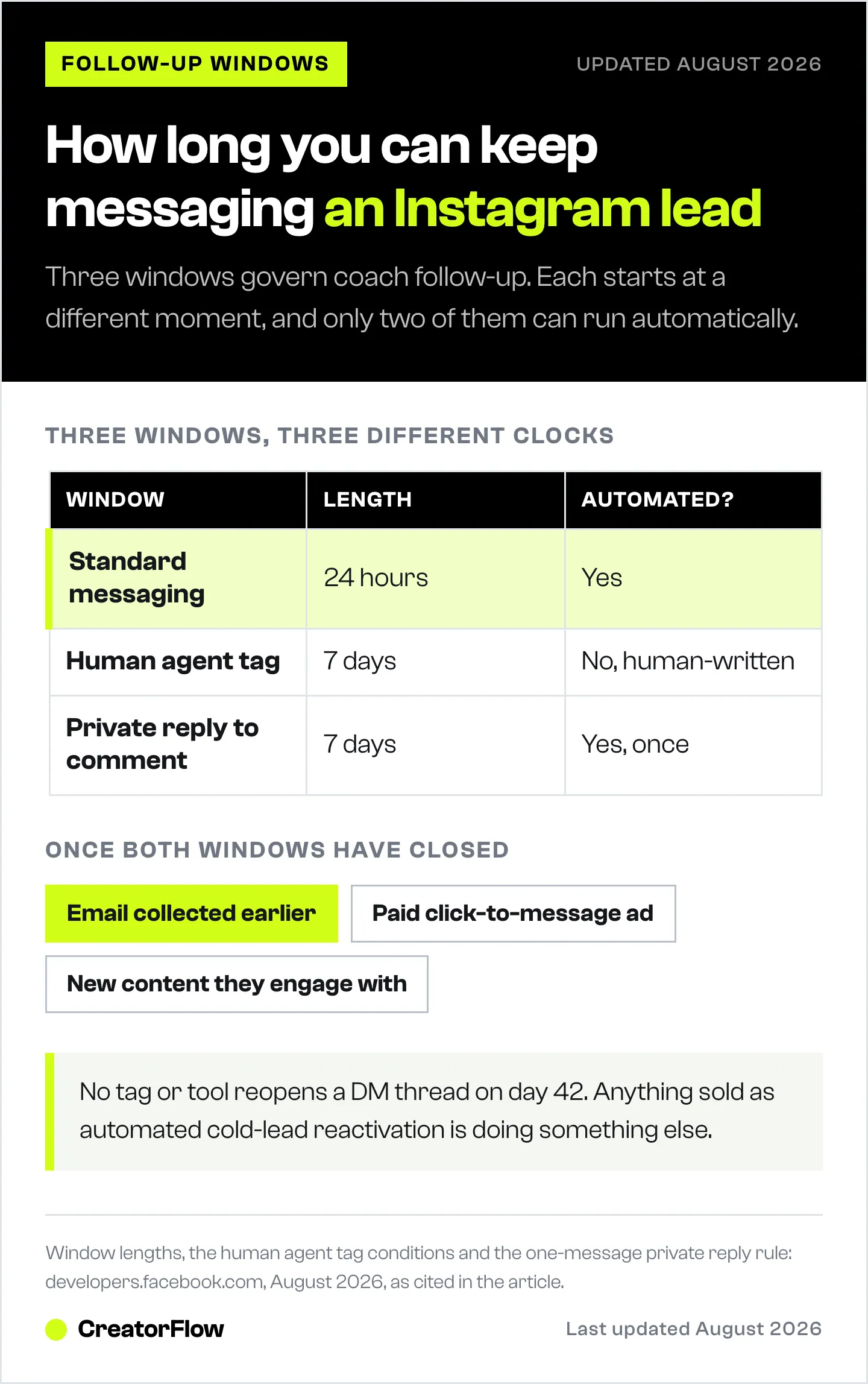
| Window | Length | Starts when | What you can send | Automated? |
|---|---|---|---|---|
| Standard messaging window | 24 hours | The lead sends you a message | Any message, including links | Yes |
| Human agent window | 7 days | The lead’s message | A reply written by a person | No, human-written |
| Private reply to a comment | 7 days | The lead posts the comment | One single message | Yes, once |
The standard messaging window is the one every DM tool runs on. Meta’s documentation is direct about it: your app has 24 hours to respond to any message sent from an Instagram user (developers.facebook.com, August 2026). The clock restarts every time the lead replies, which is why a conversation with real back-and-forth can run for days without ever touching a tag.
The human agent tag extends the response window to seven days. Meta describes its allowed usage as providing human agent support when a user’s issue cannot be resolved in the standard window, and it requires App Review plus business verification (developers.facebook.com, August 2026). The word doing the work in that sentence is human.
Private replies are their own thing. When someone comments on your post, you can send them one message, and it has to go out within seven days of the comment being published (developers.facebook.com, August 2026). One message, not a sequence.
Why Coach Follow-Up Breaks at the 24-Hour Mark
A coaching sale rarely closes in a single sitting. Someone watches a Reel at 11pm, DMs a question, gets an answer, thinks about it for two days, and comes back. That gap is where the standard window expires.
Tools handle this well up to the boundary and then stop, because there is nothing compliant on the other side of it. A sequence advertised as “4-hour and 24-hour follow-ups” works because both touches land inside the window. A “day 7 re-engagement” touch is a different animal, and on Instagram it needs either a human writing it or the lead reopening the conversation first.
This is worth checking before you buy anything. If a tool markets automated messages to leads who went quiet weeks ago, ask which window that runs in. The rules covering automated Instagram DMs are the same for every tool connected through the official API.
The practical consequence for coaches: your follow-up system should aim to keep the window open rather than to message people after it shuts.
Flow 1: The “How Much?” Reply
The price question is the highest-intent DM a coach receives and the easiest one to automate, because it always arrives inside the 24-hour window. Someone asking what it costs has already decided they want the thing. The only question is fit.
Two failure modes are common. Dodging the number reads as evasive and kills trust with a serious buyer. Sending the number with no context invites a comparison against a program they have not understood yet.
The flow that works answers the question and then earns the right to a second exchange:
- Trigger: a keyword such as PRICE, COST, or INFO, or a story reply mentioning cost
- Send: the actual number or the starting number, with one sentence on what it includes
- Ask: one fit question, not three
- Tag: whether they replied, so you know who to prioritise
A working example for a coach with a fixed entry price:
“The 12-week program is $1,800, or three payments of $650. Before I send the full breakdown, what are you trying to change in the next 90 days?”
That message does something a link cannot. It gives a real answer, and the question that follows it restarts the 24-hour clock the moment they reply. If you run a tiered or application-based offer, the deeper mechanics are covered in the guide to qualifying high-ticket coaching leads.
One rule: do not let an automation negotiate. Fixed numbers and fixed inclusions only. Anything involving a discount, a payment-plan exception, or a guarantee is a conversation you take yourself.
Flow 2: The Lead Who Answers, Then Goes Quiet
This is the most valuable lead in your inbox and the one most often lost. They told you their goal, gave you a real constraint, and then stopped replying.
Inside the first 24 hours, one automated follow-up is fair and effective. Make it specific to what they said, because a generic check-in reads as a bot to someone who just had a real exchange with you.
“Following up on the shift-work schedule you mentioned. That is the exact thing the first four weeks are built around. Still worth a conversation this week?”
After the window closes, the reflex is to write another message. The better move is to make the lead reopen the window themselves. Three things do that reliably:
- A story with a question sticker or a poll, which turns a tap into a story reply and a fresh 24 hours
- A post whose comment trigger is relevant to their stated problem, which gives you a private reply slot
- A new Reel that lands in their feed because they engaged with you recently
This is why follow-up content outperforms follow-up messaging for coaches. The content does the reopening, and the DM does the selling. Coaches already running a booking funnel can layer this on top of an existing Instagram automation setup for coaches.
Tag these leads so you can see them. A lead who answered two questions and stalled is a different asset from a lead who only ever sent one word.
Flow 3: The Booking Link Handoff
Sending the calendar link faster is not the goal. Sending it at the point where the lead has given you enough context to make the call worth taking is.
Most coaches send it too early. The link goes out on the first reply, the lead books without ever stating a goal, and the call opens with fifteen minutes of discovery that a DM could have handled.
Set a floor. The link goes out only after the lead has given you three things:
| Signal | Why it matters | How you ask |
|---|---|---|
| The goal | Tells you which offer fits | ”What are you trying to change?” |
| The timing | Separates buyers from browsers | ”Is this a now thing or a later thing?” |
| The constraint | Becomes the first thing you solve on the call | ”What has stopped this working before?” |
Then frame the link around what they said rather than dropping it bare:
“Based on the plateau you described and wanting this sorted before March, a call makes sense. Here is the calendar. Pick anything that works and I will have your notes ready.”
That last clause matters more than it looks, and Flow 4 is what makes it true. The mechanics of wiring the calendar itself are covered in the guide to connecting Instagram DMs to Calendly.
Flow 4: The Call-Prep Note
This is the flow almost nobody builds, and it costs nothing. Before a booked call, write a short note from the DM thread and put it where you will see it.
A weak note says the lead is interested in coaching. A useful one gives you the first ninety seconds of the call:
“Came from the Reel about training around shift work. Nurse, rotating nights, has tried two online programs and quit both around week three. Wants to be consistent before summer. Asked about payment plans, so price is live. Booked the same evening she messaged.”
Six fields cover almost every coaching call:
- Where they came from, meaning the post, story, or ad
- The problem in their own words, quoted rather than summarised
- The outcome they named
- What they have already tried
- Any objection they raised, especially price
- How fast they moved from first message to booking
Speed of booking is the underrated one. A lead who booked within an hour of a first DM is in a different state from one who took nine days, and opening the call the same way for both wastes the difference.
If you already run a pipeline, this note is the field that makes the pipeline worth having. Coaches routing leads through a CRM can attach it at the stage change described in the GoHighLevel and Instagram DM pipeline setup.
Flow 5: No-Show Recovery
A no-show is not a rejection. People forget, get pulled into work, or lose nerve about a call where they expect to be sold to. The follow-up should give them a clean way back without making it awkward.
The timing is the part people get wrong. Same-day is right. A week later, the lead has moved on and the message reads as a form letter.
This is human-agent work, and that is not a workaround. Meta documents the seven-day extension specifically for a human agent responding when the issue cannot be resolved inside the standard window (developers.facebook.com, August 2026). A missed call is precisely that situation, and the reply is one you write yourself.
What that means in practice:
- Send it the same day, ideally within a few hours
- Reference the reason they booked, which is why Flow 4 exists
- Offer one reschedule option, not a list
- Give them a clear exit
“Looks like today got away from you. You mentioned wanting the consistency piece sorted before summer, so it is worth twenty minutes. Want me to hold something Thursday, or should I leave it for now?”
The exit clause does real work. It reads as respectful, and the leads who take it were never going to buy, so you get your calendar back. Service businesses running higher call volume will find a fuller version of this in the Instagram appointment-setting system.
Flow 6: Reopening a Cold Lead
Here is the flow that most workflow libraries get wrong, and the reason matters more than the message.
A lead from six weeks ago is outside both windows. The standard window closed after 24 hours. The human agent window closed at seven days. There is no tag, no tier, and no tool that reopens an Instagram DM thread on day 42 by sending a message into it.
Anything marketed as automated cold-lead reactivation on Instagram is either messaging inside a window it did not tell you about, or operating outside the official API. The second kind is what puts accounts at risk.
Three compliant routes exist, and coaches should be running all three:
| Route | How it works | What it needs |
|---|---|---|
| You captured the address during the original conversation | An email gate on the original flow | |
| Paid re-engagement | A click-to-message ad targeted at people who messaged you before | Ad spend and a custom audience |
| New content | A post or story they engage with, which opens a fresh window | Consistent posting |
The email route is the one coaches under-build. If your DM flow captures an email address during the first conversation, a lead going cold costs you a reply, not the relationship. Every lead you can still reach in six weeks is one you collected an address from in week one.
The paid route works because click-to-message ads start a new conversation rather than continuing an old one. The click-to-DM ad playbook covers the setup, and the same targeting logic applies to a coaching offer.
The content route is free and slower. Someone who commented on your post has handed you a private reply slot for the next seven days, which is a new conversation with a warm lead who already knows you.
Build Order: Which Flow Pays First
Six flows is too many to build at once, and the order is not arbitrary.
- The price reply. Highest intent, fully automatable, lives inside the standard window. Build it this week.
- The call-prep note. Zero technical work, zero policy risk, and it improves every call you take from here.
- No-show recovery. Recovers revenue you already paid for with content and time.
- The booking-link floor. Fewer calls, better calls. Expect your booking count to drop and your close rate to rise.
- Email capture on the front end. This is what makes Flow 6 possible three months from now.
- Quiet-lead re-open content. Ongoing work rather than a one-time build.
Coaches who want the front half of this system, meaning the trigger and delivery layer that these flows sit on top of, should start with the qualifying questions that run before a discovery call and the tactics for closing sales in Instagram DMs.
CreatorFlow runs the trigger side of these flows: comment-to-DM, story reply, and keyword automations that deliver your price message, your booking link, and your lead magnet, with an email gate that collects addresses before the link goes out and link tracking that shows which post produced the conversation. Flat $15/month on Pro, and setup takes about five minutes.
FAQ
How long can you send automated DMs to an Instagram lead?
Your app has 24 hours to respond after a user sends a message, and that clock restarts each time they reply (developers.facebook.com, August 2026). The human agent tag extends the response window to seven days, but Meta documents it for replies written by a human agent, not for automated sends.
Can you automate follow-up to a lead who went quiet a week ago?
Not through an automated DM. Once the 24-hour window closes, a person can reply within seven days using the human agent tag, and after that the thread needs the lead to reopen it. A comment, story reply, or new DM from them starts a fresh window.
What should a no-show follow-up DM say?
Send it the same day, reference the specific reason the lead booked, offer one reschedule option, and include a clear way for them to decline. Keep it to three sentences. The message should be written by you, since a missed call is the human-agent situation Meta’s seven-day extension exists for.
Should coaches answer price questions in the DM or push to a call?
Answer it. A price question inside the 24-hour window is your highest-intent message, and dodging it reads as evasive. Send the number with one sentence on what it includes, then ask one fit question. Save exceptions, payment plans, and discounts for a conversation you handle personally.
How do you reactivate cold Instagram leads without breaking Meta’s rules?
Three compliant routes: email them if you captured an address, run a click-to-message ad that starts a new conversation, or publish content they engage with, which opens a fresh messaging window. Sending an automated DM into a months-old thread is not one of them.
When should the booking link go out in a coaching DM?
After the lead has given you their goal, their timing, and the constraint that stopped this working before. Sending it on the first reply fills your calendar with people who have not stated an outcome, which turns the call into discovery you could have done in the DM.
Does a comment on my post let me DM someone?
Yes, once. A private reply to a comment is a single message and it has to be sent within seven days of the comment being published (developers.facebook.com, August 2026). It is one message rather than a sequence, so make it count.
Instagram messaging windows, the human agent tag, and private reply limits verified from Meta’s official developer documentation (developers.facebook.com) as of August 2026. CreatorFlow pricing verified at creatorflow.so, August 2026. Meta may change platform limits at any time. Individual results vary by audience, offer, and niche.


