
Instagram DM automation helps business coaches turn comment and story-reply traffic into qualified discovery calls without manual back-and-forth. Instead of closing in DMs, the system captures intent, asks 2-3 qualifying questions, and routes high-fit leads to a booking link. Low-intent contacts go to a nurture sequence. Coaches keep their reputation, calendar, and time.
A business coach with 5,000 followers posts a Reel about pricing mistakes. It gets 80 comments and 30 “tell me more” DMs over the week. She spends 6 hours replying. Most are tire-kickers. Two book a call. One shows up. Zero close.
The problem is not the content. The problem is the funnel. High-ticket coaching offers need qualification before a call, and a single coach cannot manually qualify 30 strangers per week without burning out or sounding curt. The usual fork at that point is software or a hire, and the DM setter versus AI setter cost comparison covers which one your volume justifies. This guide covers how to build an Instagram DM funnel that does the qualifying for you, when to hand off to a human, and the templates and benchmarks that actually work for coaches selling $1K+ programs.
Key Takeaways
- For offers above $500, your DM should book a discovery call, not try to close (inro.social, May 2026).
- A coach DM funnel has 4 layers: inbound capture, qualification, nurture, and re-engagement (instantdm.com, May 2026).
- High-intent leads go straight to a Calendly link. Low-intent leads go to a nurture sequence (instantdm.com, May 2026).
- Calendly is the most common booking integration, though some tools book in-DM without redirect (setsmart.io, May 2026).
- Before adding tools to the funnel, price the ones you already run: a coaching tech stack audit sorts them by cost per active client.
- Meta’s Graph API enforces a 7-day comment-to-DM window and a 24-hour messaging window, and automation tools pace sends at about 200 DMs/hour (spurnow.com, May 2026).
- Coaches need fewer leads than creators — qualification matters more than volume.
- Automation books qualified calls. It does not close deals. The human still does that.

How Instagram DM Automation Works for Business Coaches
A comment keyword, story reply, or DM keyword pulls the lead into a private thread. Two or three questions sort them by business stage. Leads who fit get the booking link straight away. Everyone else gets a free resource and a nurture tag. For offers above $500 the DM books a call rather than closing the sale, and Meta’s 24-hour messaging window keeps the qualifying exchange short by design.
Why Coaches Need a Different DM Strategy Than Creators
Most DM automation advice is built for creators selling $20-50 affiliate clicks. The math is different for coaches:
- Higher offer prices. Coaching programs run $1,500 to $30,000. One client offsets months of tooling and ad spend.
- Qualification matters more. A wrong-fit client damages outcomes, refunds, and testimonials. Filters protect both sides.
- Fewer leads needed. A coach booking 5 qualified calls per week from Instagram is doing well. A creator pushing affiliate links wants 500.
- Reputation risk is higher. Coaches sell trust. A robotic, spammy DM erodes the exact authority that drives sales.
The implication: your automation should reduce volume on purpose. Filter hard early so the calls that land on your calendar are worth showing up for.
For a broader framework, see our coaches and consultants guide to booking calls. If comments are strong but the DMs never start, the problem is usually upstream in the content-to-DM handoff.
The 4-Layer Coach DM Funnel
DM marketing for coaches works as a funnel sequence, not a single message (instantdm.com, May 2026):
- Inbound capture. Comment-to-DM, story reply, or keyword trigger pulls the lead into a private conversation.
- Qualification. 2-3 questions identify fit: stage of business, current revenue, what they have tried, urgency.
- Booking or nurture routing. High-intent and qualified contacts get a Calendly link. Low-intent contacts get value-first follow-ups (instantdm.com, May 2026).
- Re-engagement. No-shows and ghosters get a single, gentle follow-up sequence — not a daily nag.
Each layer has a job. Skip qualification and you waste calendar slots. Skip nurture and you lose 60% of the leads who were not ready that week.
Setup: Comment-to-DM to Calendly
Here is a 5-step setup using a coach scenario. The coach posts a Reel: “3 reasons your coaching offer isn’t selling.” She wants commenters to book a free clarity call.
Step 1: Choose a trigger keyword. Tell viewers in the Reel and caption: “Comment CLARITY for the framework.” Keep it one specific word, not a phrase. CreatorFlow, ManyChat, and most platforms support this.
Step 2: Connect your Instagram Business account to your automation tool via OAuth. Pick a tool that uses Meta’s official Graph API so you stay inside Instagram’s policies. Setup in CreatorFlow takes about 5 minutes.
Step 3: Build the opening DM. Acknowledge the comment, deliver a small piece of value, then ask the qualifying question. Example: “Hey [Name], thanks for commenting. The framework lives inside my free clarity call. Quick question first — where is your business right now: pre-revenue, under $10K/mo, or scaling past $10K?”
Step 4: Set up branching logic. If they answer “scaling past $10K” or “$5-10K/mo,” send the Calendly link. If “pre-revenue,” send a free resource and tag for nurture. Most tools support this with a button or keyword response.
Step 5: Test the flow yourself. Comment from a test account. Walk through both branches. Time how long the DMs feel. If the qualifying question lands within 30 seconds of the comment, you are in good shape.
For the booking-tool integration specifically, see Instagram + Calendly DM automation.
Qualifying Questions That Don’t Feel Like a Quiz
Qualification only works if it feels like a normal conversation. Three patterns that work:
Pattern 1: The single-question filter. “Quick question before I send the link — are you currently working with clients, or is this for a future business?”
Pattern 2: The 2-question stage check. “Where are you at right now: just starting, getting some clients but inconsistent, or booked out and ready to scale?” Then: “What’s the one thing you’ve tried that didn’t work?”
Pattern 3: The 3-question deeper qualifier (for premium offers).
- “What does your business look like today — revenue range, offer type?”
- “What’s the goal in the next 90 days?”
- “What’s getting in the way?”
Three questions is the ceiling. Past that, you start losing people. More on the qualification logic in qualify Instagram leads for discovery calls.
DM Templates for Business Coaches
Three templates you can adapt. Replace bracketed sections with your specifics.
Template 1: Discovery Call Invite (post-qualification, high intent)
Got it — sounds like you’re at the right stage for what I do. I run a free 30-minute clarity call where we map out the 1-2 things standing between you and your next $10K month. No pitch, no pressure. If it makes sense to work together after, I’ll mention it. If not, you walk away with a plan.
Grab a slot here: [calendly link]
Pick a time that gives you 24 hours of breathing room so you actually show up.
Template 2: Qualifying Follow-Up (mid-flow, lead went quiet)
Hey [Name], no pressure — just checking in. You mentioned [their stage] and [their goal]. Still want to talk through it? If timing’s off this week, totally fine. Just reply “later” and I’ll circle back next month.
Template 3: No-Show Recovery (call missed, sent within 2 hours)
Hey [Name], looks like we missed each other on the call. Life happens. If you still want to talk, here’s the link to rebook: [calendly link]. If your priorities shifted, no worries — just let me know and I’ll close the loop.
For more script patterns, see Instagram DM scripts that convert. For the flows that run after the booking link goes out, see the six DM follow-up flows for coaches. For the wider channel playbook, see the Instagram DM marketing growth strategy guide.
Avoiding the “Bot Vibe” That Loses Coaches Their Reputation
Coaches sell expertise. The moment a DM feels machine-written, you lose the sale and risk a screenshot landing on someone’s “look at this fake guru” story. Signs you’ve over-automated:
- Every reply starts with “Hey [Name]!” with the exact same energy
- Generic affirmations like “Great question!” before every message
- The DM ignores what the person actually said
- 3+ messages fire back-to-back within seconds
- Emoji density that does not match your normal voice
Where to add human touch:
- The first reply after qualification — have the automation pause, then you respond personally before sending the booking link for high-ticket offers.
- Any message where the lead asks something off-script — route to your inbox, do not let the bot guess.
- Post-call follow-up — this is sales, not automation. Write it yourself.
A safe rule: automate the first 2 messages and the booking link. Everything else is you.
Realistic Conversion Benchmarks
Treat these as practitioner ranges based on what coaches typically report. Your numbers depend on niche, offer price, and content quality.
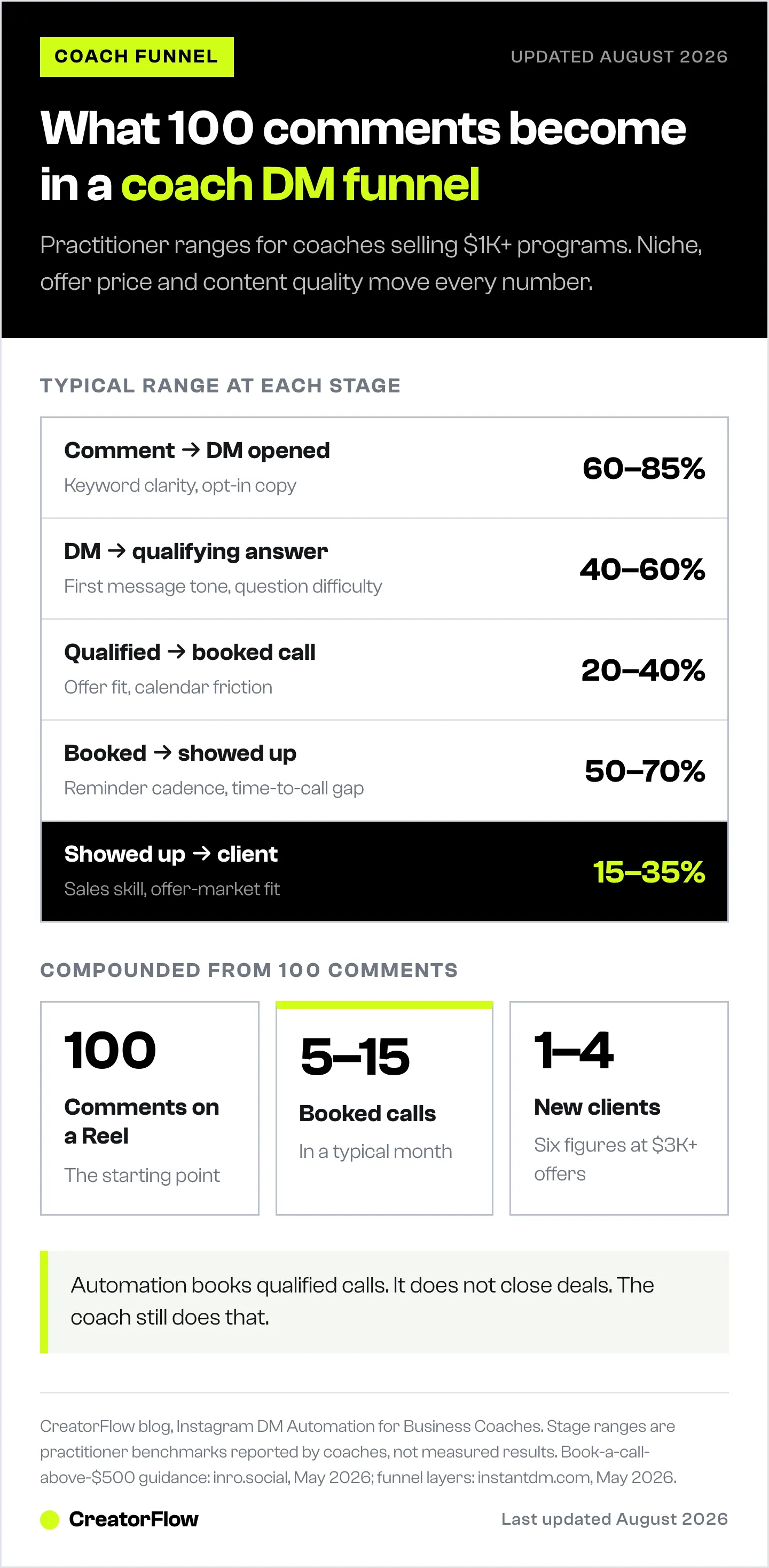
| Stage | Typical Range | What Drives It |
|---|---|---|
| Comment-to-DM-opened | 60-85% | Keyword clarity, opt-in copy |
| DM-to-qualifying-answer | 40-60% | First message tone, question difficulty |
| Qualified-to-booked-call | 20-40% | Offer fit, calendar friction |
| Booked-to-show | 50-70% | Reminder cadence, time-to-call gap |
| Show-to-client | 15-35% | Sales skill, offer-market fit |
Compounding the funnel: if 100 people comment, expect 5-15 booked calls and 1-4 new clients in a typical month. That is enough volume to build a six-figure coaching business if your offer is $3K+.
If your show rate is below 50%, the problem is usually pre-call friction (too many days between booking and call) or low qualification (people booking who never intended to buy).
There is a page built specifically for business coaches that walks through the setup end to end: CreatorFlow for business coaches.
FAQ
Is Instagram DM automation safe for coaches worried about their reputation?
Yes, if you use a tool that runs on Meta’s official Graph API and you keep messages conversational. The risk is not the tool — it’s writing DMs that sound like a bot. Limit automation to the first 1-2 messages and the booking link. Handle anything off-script personally.
What’s the best booking tool to integrate?
Calendly is the most common (setsmart.io, May 2026), and most DM automation platforms support it natively. Acuity and SavvyCal also work. Some tools let you book directly in the DM without a redirect, which can lift conversion by 10-20% but reduces your control over reminders and time-zone handling.
Should I close in DMs or always book a call?
For offers above $500, book a call (inro.social, May 2026). Below $500, you can sometimes close in DMs with a clear payment link. High-ticket coaching almost always needs a live conversation — both for trust and for refund prevention.
How many DMs per hour can I send safely?
Meta’s Graph API enforces a 24-hour messaging window after a user contacts you, and automation tools pace sends at about 200 DMs/hour (spurnow.com, May 2026). Comment-to-DM has a separate 7-day window. Most coaches stay well below these limits naturally.
What if someone doesn’t fit my qualification criteria?
Route them to a free resource (PDF, mini-course, email list). They may be ready in 6 months. Burning the lead with “you don’t qualify” energy costs you future revenue and word-of-mouth referrals.
How much does a setup like this cost?
CreatorFlow Pro is $15/month flat (creatorflow.so, May 2026). Calendly is free for one event type, $12/mo for paid. Total stack under $30/month is realistic for a solo coach.
Will automation work if I have under 1,000 followers?
Yes. The funnel works at any size. With smaller accounts, the bottleneck is content reach, not DM logic. Build the system now so when a Reel hits, you are ready.
Sources: inro.social, instantdm.com, setsmart.io, spurnow.com, creatorflow.so (all accessed May 2026).


