
Group coaching and mastermind enrollment via Instagram DM works by stacking three jobs into one channel: a waitlist trigger that captures interest weeks before doors open, an application-to-call funnel during open cart, and a last-chance push as the window closes. Done right, a coach launching a $1K-$5K cohort can fill 8-15 seats in a 10-day window without manually messaging every applicant.
Here is the scenario most coaches recognize. You are launching a $2,000 cohort. The cart is open for 12 days. Eighty people raised their hand on a teaser post. You now have to qualify each one, book calls, send payment links, and follow up with the no-shows. By day four you are answering DMs at 11pm and confusing two prospects with the same name. By day eight you have lost track of who said yes, who is on the fence, and who ghosted after the call.
This guide covers the full DM-driven cohort launch — pre-launch waitlist building, the open-cart application funnel, templates for each touchpoint, the 48-hour close sequence, and post-cohort waitlist nurture for round two. The structure works for masterminds, group coaching programs, and cohort-based courses priced $500 and up.
Key Takeaways
- DM-to-application funnels typically outperform email-only launches by 2-4x because Instagram reply rates beat inbox rates (industry observation, present as practitioner range).
- Cohort launches usually run 8-14 days from open-cart to close-cart — shorter windows force decisions, longer windows lose momentum (industry standard, varies).
- High-ticket offers above $500 require a human conversation step before close. DM automation handles qualification and booking, not the close itself (inro.social, May 2026).
- Application questions filter poor-fit prospects before they reach your call calendar (instantdm.com, May 2026).
- Meta Graph API rules: a 24-hour messaging window (7 days with the Human Agent tag) per conversation. On top of that, tools add their own pacing of about 200 DMs/hour, which is a tool-side convention rather than a Meta-published limit (spurnow.com, May 2026).
- CreatorFlow’s free 500 DMs/month covers most single-cohort launches; Pro at $15/month handles larger waitlists (creatorflow.so, May 2026).
- Mass DM blasts, fake countdown timers, and generic application questions kill conversion faster than slow follow-up.

How Group Coaching Enrollment Works via Instagram DM
Group coaching enrollment via Instagram DM stacks three jobs into one channel. A keyword trigger collects a waitlist 14 to 30 days before doors open. During an 8 to 14 day open cart, every interested prospect moves through the same application-to-call funnel. A last-chance push in the final 48 hours reaches applicants who stalled and calls that never happened. Automation handles the interest check and the payment link. Any offer above $500 still closes on a human call.
The Cohort Launch Timeline
A cohort launch on Instagram has three distinct phases, and each one needs different DM behavior.
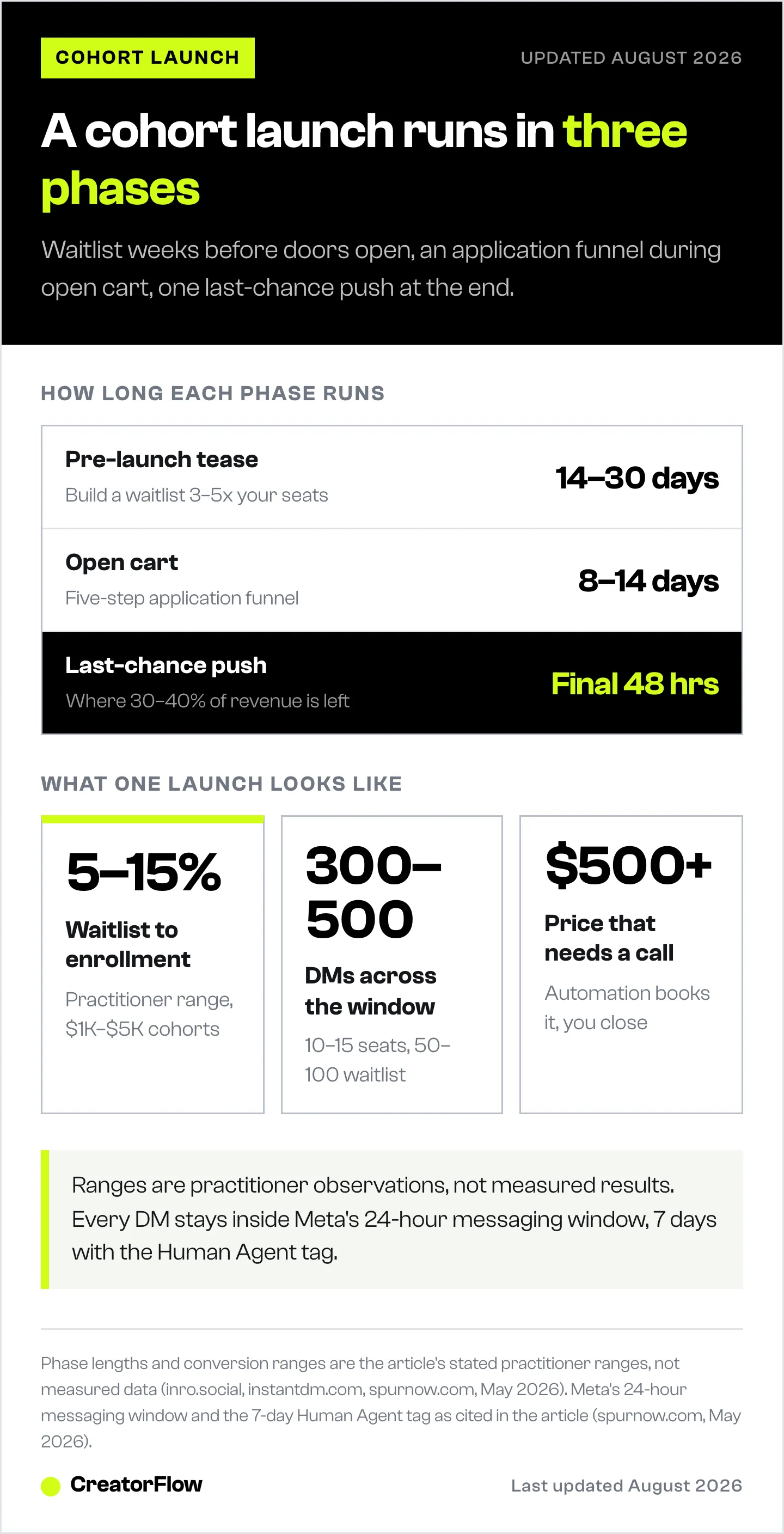
Phase 1: Pre-Launch Tease (14-30 days before open cart). Build the waitlist. Post about the transformation, the format, and the dates without selling. Use a keyword trigger to capture waitlist interest in DM. Goal: 3-5x your target enrollment in waitlist size.
Phase 2: Open Cart with DM Funnel (8-14 days). Doors open. Waitlist gets the first DM. New traffic enters via comment-to-DM triggers on launch content. Every interested prospect moves through the same five-step application funnel.
Phase 3: Last-Chance Push (final 48 hours). Re-engage applicants who stalled, fence-sitters who booked but did not show, and waitlist members who never responded. This is where most launches leave 30-40% of revenue on the table.
The full template architecture for course launches lives in the course creator Instagram launch funnel guide. Cohort launches add the application step.
Pre-Launch: Building the Waitlist via DM
Two weeks before doors open, start posting cohort-relevant content. On each post, mention a keyword that triggers the waitlist DM. Common triggers: WAITLIST, COHORT, MASTERMIND, or the program name itself.
The waitlist DM does three things in 4-6 short messages:
- Confirms they are on the list.
- Sets expectations on dates, price range, and format.
- Asks one micro-qualifying question (current situation, biggest blocker, or specific outcome they want).
That single question accomplishes more than any sales page. People who answer tend to apply at meaningfully higher rates than passive subscribers when doors open. Track your own ratio across launches to set an internal benchmark. People who do not answer get a different sequence at launch.
Tag every waitlist member in your CRM or export tool with the date they joined and their answer. When open cart hits, segment your launch DM accordingly. Someone who said “I am stuck at $5K months” gets a different opening line than someone who said “I want to scale my agency to 7 figures.”
For coaches specifically, the Instagram DM automation guide for coaches and consultants covers the call-booking infrastructure that plugs into this flow.
Open Cart: The Application-to-Call Funnel
When doors open, every interested prospect goes through five steps:
Step 1: Interest Check. They reply to a launch post, story, or waitlist message with intent (“tell me more”, “I am interested”, “send details”). Auto-DM sends program overview, dates, price, and a link to the application form.
Step 2: Application Submission. External form (Typeform, Google Forms, Tally) captures qualifying data: revenue stage, niche, biggest constraint, why now, ability to invest. Application takes 5-8 minutes.
Step 3: Application Review. You review applications daily and reply in DM within 24 hours: yes (here is my call link), no (here is why and what I recommend instead), or follow-up question.
Step 4: Discovery Call. Approved applicants book a 20-30 minute call. The call confirms fit, answers objections, and presents the offer. The full qualification framework is in the discovery call qualification guide.
Step 5: Payment Link Delivery. After a yes on the call, payment link goes out via DM within 30 minutes while momentum is high. Include a one-line welcome and the date of the cohort kickoff call.
This sequence works because each step does one job. Automation handles steps 1 and 5. You handle steps 3 and 4. The application form handles step 2.
For benchmark conversion rates at each step, see the course launch DM funnel benchmarks.
DM Application Templates
Interest Check Auto-Reply (after a comment trigger):
“Hey! Saw your comment on the [program name] post. Quick rundown: 8-week mastermind, 12 founders max, kicks off [date]. Investment is $2K. If you want the full breakdown and application, here is the link: [link]. Let me know if you have questions.”
Qualifying Application Follow-Up (after they submit):
“Got your application. Reading it now — will get back to you within 24 hours with a yes, no, or one follow-up question. Thanks for the detail you put into it.”
Call Invite (after approval):
“Reviewed your app. You are a strong fit for this round. Let us hop on a 20-minute call to make sure it is the right move for both of us. Pick a slot that works: [calendar link]. We will cover your goals, how the mastermind runs, and any questions you have.”
Payment Link Delivery (after a yes on the call):
“Welcome in. Here is the payment link: [link]. Once that goes through, you will get an email with the kickoff call details, the private group invite, and the prep work for week one. Stoked to have you.”
Keep every message short. Long DMs read as desperate or scripted. Five sentences max per message.
Last-Chance Push: 48-Hour Close Sequence
The final 48 hours decide whether your launch hits target. Three audiences need attention:
Applicants who stalled. Sent the application link, never submitted. One DM: “Cart closes Friday at midnight. If you are still interested, here is the application: [link]. If timing is off, no worries — I will save your spot in the waitlist for the next round.”
Booked calls who did not show. One DM: “Missed you on the call. Last chance to grab a slot before doors close: [calendar link]. Or if you already know it is a yes, here is the direct payment link: [link].”
Waitlist members who never engaged. One DM with the offer summary, deadline, and link. Do not send three. Do not send daily countdown messages. People who want in will move; people who do not will resent the pressure.
Avoid fake urgency. “Only 2 spots left” only works if it is true. “Price goes up tomorrow” only works if it actually does. Coaches who manufacture urgency once burn the trust they spent months building. The real urgency in a cohort launch is the start date — if they miss this round, they wait three to six months for the next one. Lead with that.
The broader Instagram product launch automation playbook covers this 48-hour push pattern across product types.
Post-Cohort: Running the Wait-List for the Next Round
The day after cart closes, do two things.
First, DM everyone who applied but did not enroll. Ask one question: “What stopped you?” Time, money, timing, fit — the answers shape your next launch. Tag responses in your CRM.
Second, set up the next-round waitlist trigger immediately. Most coaches wait three months and lose all the warm interest. Better play: keep the waitlist trigger live on your bio link or pinned post. Anyone who lands on your profile in the next quarter joins automatically.
Run a light nurture sequence — one DM per month with a relevant case study, behind-the-scenes content, or a question. By the time you announce round two, your waitlist is 2-3x larger than round one and warmer.
The graduating cohort is your other waitlist source. Ask them for introductions while the results are fresh, using the trigger moments and scripts coaches use to generate referrals.
What Doesn’t Work in Cohort DM Funnels
Mass DM blasts to your follower list. Meta flags this fast and your account loses reach. The tool-side pacing of about 200 DMs/hour applies even to your own followers (spurnow.com, May 2026). Trigger-based DMs are the only safe way to scale.
Fake countdown timers. “12 hours left” messages that reset every day train your audience to ignore you. Use real deadlines or none.
Generic application questions. “What is your biggest goal?” gets generic answers. “What was your revenue in the last 90 days and what is the one thing blocking the next 90?” gets answers you can actually use to qualify.
Skipping the call for high-ticket offers. Anything above $500 needs a human conversation before close (inro.social, May 2026). Automated payment links work for $97 mini-courses, not $2K masterminds. Use DM automation to book the call, not to replace it.
Following up more than three times. Three touches over the launch window is plenty. After that you are training people to dread your DMs.
FAQ
How many DMs does a typical cohort launch send?
A launch enrolling 10-15 students from a 50-100 person waitlist usually sends 300-500 DMs across the 10-14 day window. CreatorFlow’s free 500 DMs/month covers most single-cohort launches; the Pro plan at $15/month handles larger waitlists or back-to-back launches (creatorflow.so, May 2026).
Should I automate the entire funnel or keep parts manual?
Automate the interest check, application reminder, and payment link delivery. Keep the application review, call invite, and discovery call manual. The automation handles volume; the human steps handle conversion on high-ticket offers.
What conversion rate should I expect from waitlist to enrollment?
Practitioner range is 5-15% waitlist-to-enrollment for cohorts priced $1K-$5K. A 100-person waitlist often produces 5-15 enrollments. If you are below 5%, the issue is usually waitlist quality (not enough qualifying upfront) or call show-up rate.
Can I run this without an application form?
Yes for offers under $500. No for offers above. The application is the filter that protects your call calendar from time-wasters. Without it, you will spend 20 hours on calls with people who were never going to buy.
How long should the open-cart window be?
Eight to fourteen days is standard. Shorter than 8 days does not give applicants time to apply, get reviewed, and book a call. Longer than 14 days kills urgency and leaves you in launch mode for too long.
How do I avoid getting flagged by Instagram during a launch?
Stay inside Meta’s 24-hour messaging window (7 days with the Human Agent tag) per conversation, and let your tool pace sends at about 200 DMs/hour (spurnow.com, May 2026). Use trigger-based DMs only — never bulk message your follower list. Tools using the official API automatically respect these limits.
What happens to people who do not enroll this round?
Tag them in your CRM with the reason they did not enroll, then move them into the next-round waitlist nurture. Most enroll on the second or third launch they see, not the first.
Sources: inro.social (May 2026), instantdm.com (May 2026), spurnow.com (May 2026), creatorflow.so (May 2026). Industry conversion ranges presented as practitioner observations — specific numbers vary by niche, price point, and audience size.


