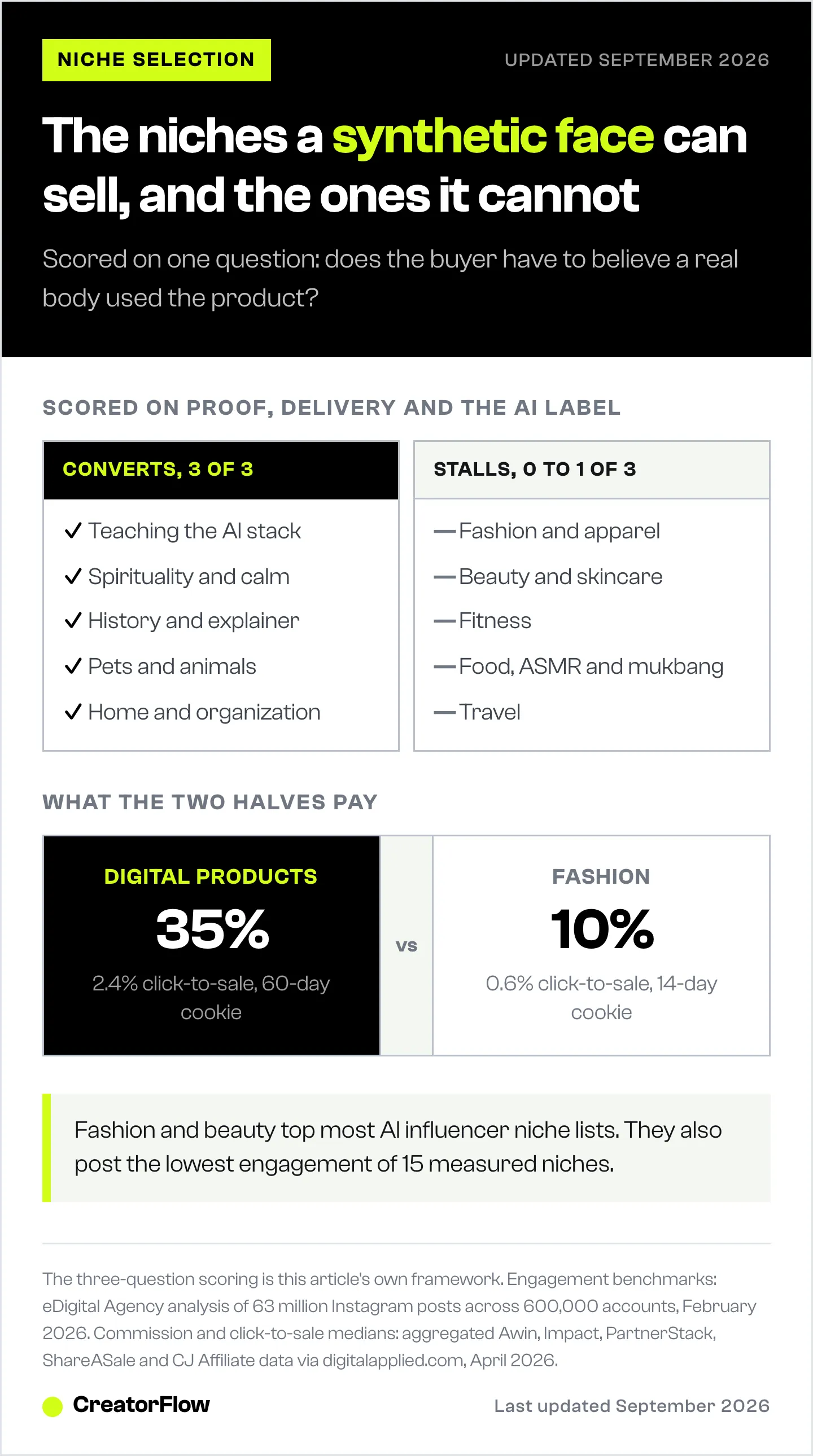
The AI influencer niches that convert are the ones where the buyer never needed a real body. Information products win: spirituality, history and explainer content, pet content, home and organization, and teaching the AI stack itself. Fashion, beauty, fitness, food and travel stall, because the purchase depends on believing a real person wore, ate, felt or visited the thing.
Most niche lists put fashion and beauty at the top. On Instagram those two post the lowest engagement rates of fifteen measured niches, 1.24% and 1.19% against a 1.55% average, and pay 10% and 12% commission at 0.6% and 1.6% click-to-sale. They are the two hardest categories to sell in with a face that does not exist, and they are the two everyone recommends first.
This guide gives you a three-question test that scores any niche, a ranked table built on that test, and what the largest synthetic accounts actually sell, checked against their live follower counts on August 31, 2026 rather than the figures circulating in roundups.
Key Takeaways
- The deciding variable is proof, not popularity. If the buyer has to believe a real body used the product, a synthetic persona cannot supply that. Information products carry no such requirement.
- Digital products pay 35% commission at 2.4% click-to-sale. Fashion pays 10% at 0.6%. The niches that suit a synthetic persona are also the better-paying half of the affiliate table.
- Brand deals are the weak path for an AI persona. Guess commissioned its own AI models for Vogue in July 2025 and H&M built digital twins of its own roster the same month. A brand that wants a synthetic face can generate one.
- Instagram changed the rules on August 31, 2026. Accounts featuring an AI-generated person that skip the new label lose eligibility for Reels and Explore recommendations.
- Scale does not equal income. Aitana Lopez averages about 3,000 euros a month at 403,711 followers. Yang Mun sells 5.99 to 59.99 dollar digital products direct at 2,525,838.
- Published revenue figures for AI personas are almost all self-reported. Treat any number an operator quotes about their own account as marketing, not accounting.
What Makes an AI Influencer Niche Convert?
An AI influencer niche converts when the product can be judged on its own merits instead of on the credibility of the person presenting it. A meditation script, a history explainer, a prompt pack and a printable planner all survive the viewer learning the narrator is synthetic. A serum, a supplement, a restaurant and a hotel do not, because the endorsement was the product.
That single distinction predicts more than category popularity does. It is why a synthetic monk selling a 49.99 dollar course outperforms a synthetic fashion model waiting for a brand to book her.
Conversion here means someone pays. Not a save, not a follow, not an argument in the comments about whether the face is real. Those three are what synthetic accounts collect most easily and monetize least.
The Body Test: Three Questions Before You Pick a Niche
Score any niche out of three. Anything under two is a hobby account.
1. Proof. Can the buyer get what they want without believing a real body used it?
A prompt pack works because the prompt either produces the image or it does not. A skincare routine fails because the entire claim is what happened to somebody’s skin over eight weeks. Ask what the buyer is verifying at the moment of purchase. If the answer is a human outcome, the niche is closed to you.
2. Delivery. Can the sale finish inside a DM, with a file or a link, and no human waiting on the other end?
A persona that has to hand a lead to a real consultant breaks the moment the consultant appears. Digital files, courses, templates, software trials and affiliate links all complete without a handoff. Coaching, consulting and services do not.
3. Label. Does the offer still make sense with “AI-generated profile” sitting under the account name?
Run this one honestly. A synthetic personal trainer selling a body transformation reads as a contradiction the second the label loads. A synthetic narrator selling a training plan written by a named human does not. The label is now permanent context for every offer you make, so build an offer that survives it.
AI Influencer Niches Ranked by the Body Test
Engagement figures come from an analysis of 63 million Instagram posts across 600,000 accounts (eDigital Agency, February 2026). Commission and click-to-sale medians are aggregated from Awin, Impact, PartnerStack, ShareASale and CJ Affiliate (digitalapplied.com, April 2026).
| Niche | Proof | Delivery | Label | Score | Engagement | Commission |
|---|---|---|---|---|---|---|
| Teaching the AI stack | Yes | Yes | Yes | 3/3 | 1.48% (education) | 35% digital, 22.5% SaaS |
| Spirituality and calm | Yes | Yes | Yes | 3/3 | 1.53% (lifestyle) | 35% digital products |
| History and explainer | Yes | Yes | Yes | 3/3 | 1.48% (education) | 35% digital products |
| Pets and animals | Yes | Yes | Yes | 3/3 | 2.00% (highest) | 9% pet supplies |
| Home and organization | Yes | Yes | Yes | 3/3 | 1.53% (lifestyle) | 9.5% home and garden |
| Finance education | Yes | Yes | Partly | 2/3 | 1.34% | 52 dollars per funded account |
| Character comedy | Yes | No | Yes | 2/3 | 1.55% (entertainment) | No native product |
| Fitness | No | Yes | No | 1/3 | 1.75% | 11% supplements |
| Fashion and apparel | No | Partly | No | 1/3 | 1.24% | 10%, 0.6% click-to-sale |
| Food, ASMR and mukbang | No | Partly | No | 1/3 | 1.55% | 8.4% cross-vertical |
| Travel | No | Yes | No | 1/3 | 1.83% | 4.2%, 0.8% click-to-sale |
| Beauty and skincare | No | Partly | No | 0/3 | 1.19% (lowest) | 12%, 1.6% click-to-sale |
Read the bottom four rows against the top five. The niches that fail the test are the ones with the lowest engagement, the worst click-to-sale rates, or both. Fashion sits at 1.24% engagement, a 10% commission and a 14-day cookie. Beauty is last on engagement at 1.19% and needs real skin to make its central claim. For the same table applied to human creators, where fashion and beauty look far more attractive, see what each niche pays a human creator.
The Niches That Convert Without a Real Body
Teaching the AI stack. The buyer is another operator, the product is a prompt pack or a workshop, and the synthetic face is proof of competence rather than a liability. This is the only niche where the label actively helps: the account is a demonstration of the thing being sold. Commission on digital products runs a 35% median with a 60-day cookie, and software affiliate programs pay 22.5% recurring in year one at an 8.2% trial-to-paid rate.
Spirituality, calm and reflection. The largest documented example is Yang Mun, a synthetic monk operated by Shalev Hani, at 2,525,838 Instagram followers as of August 31, 2026. The account sells its own catalogue directly: a 30-day course at 49.99 dollars, a course and ebook bundle at 59.99, a short ebook at 5.99 and a bestseller bundle at 39.99 (yang-mun.com, August 2026). Nothing in that catalogue asks the buyer to believe a body existed.
History and explainer content. Chloe vs History, built by Jonathan Laramy in Gloucestershire, reached 708,183 Instagram followers by August 31, 2026. The instructive part is where the money comes from. Laramy has said Instagram yielded almost no revenue and TikTok was not a significant source, and that YouTube became the earner only after he moved from short clips to long-form films costing 300 to 800 pounds each (Business Insider, August 2026). Reach on Instagram and income on Instagram are separate problems.
Pets and animals. Highest engagement of any measured niche at 2.00%, no human body in frame by definition, and a 9% commission on pet supplies with a 30-day window. The label costs this niche almost nothing, because nobody assumed the animal was filing its own posts.
Home, organization and design. The product is a template, a printable or a room plan. Judged on the file, not the filer.
The Niches Where the Body Is the Product
Fashion, beauty and fitness are the three most recommended AI influencer niches and the three that fail question one.
Aitana Lopez is the clearest case, because her operators published numbers. Created by Rubén Cruz at The Clueless in Barcelona, the account sits at 403,711 followers as of August 31, 2026. The agency has said it earns up to 10,000 euros in a good month and averages about 3,000, at just over 1,000 euros per advertisement (Euronews, updated December 2024). Those are agency-stated figures with no independent audit. Take them at face value and the fitness and fashion niche produces roughly 3,000 euros a month from 400,000 followers.
Food is worse, not better. ASMR and mukbang formats are built entirely on a sensory reaction the viewer is asked to believe. Travel has the third-best engagement rate of any niche at 1.83% and the worst commission on the board at 4.2%, with a 0.8% click-to-sale, because “I was there” is the whole product and it is the one thing a synthetic account cannot supply.
Character comedy is the interesting middle case. Granny Spills, operated by Eric Suerez and Adam Vaserstein at Blur Studios, reached 2,142,306 Instagram followers and 1,304,500 on Facebook by August 31, 2026, built with Claude for concepts and Veo for generation at five to ten minutes per video. TIME reported in November 2025 that TikTok removed the account from its Creator Rewards Program after flagging the videos as unoriginal, and that the founders were still hoping to sign brand deals rather than holding any (TIME, November 2025). Its Instagram bio link today is an affiliate URL for a stock media library. Two million followers of pure entertainment, and the monetization is an affiliate link and a Cameo page.
What Instagram’s AI Label Changed on August 31, 2026
Instagram renamed its AI creator label to “AI-generated profile” on August 31, 2026 and attached enforcement to it. Accounts that feature an AI-generated person and do not apply the label lose eligibility for recommendations, which is the pool Explore, the Reels tab and suggested posts draw from. Applying the label carries no penalty by itself (creators.instagram.com, August 2026; reported by TechCrunch and Engadget, August 2026).
For a synthetic persona this matters more than for a human creator. A human who loses recommendations still has a newsletter, a podcast, offline events and a real network. A persona has recommendations and nothing else. The full rules, the exemptions and the appeal path are covered in our guide to Instagram’s AI-generated profile label.
The strategic read is narrower than the compliance one. Once every viewer knows the account is synthetic before the first tap, niches that depended on ambiguity lose the thing that was carrying them. Niches that never depended on it are unaffected. That is the same sorting the Body Test performs, now enforced by the platform.
Why Brand Deals Are the Weak Path
The default plan for a new AI persona is to grow followers and wait for brands. Two events in July 2025 undercut that plan.
Guess ran AI-generated models in Vogue’s August 2025 print issue, commissioned from Seraphinne Vallora, a London agency that produced ten draft models for the brand to choose from (CNN, July 2025). H&M published its first images using AI digital twins of thirty of its own human models, built with the Swedish firm Uncut and watermarked as such (H&M Group, July 2025).
A brand that wants a synthetic face no longer has to rent yours. It can commission one that matches its art direction exactly, owns the likeness outright and never posts anything off-brief. The scarce asset in that transaction was never the face.
What a persona still owns is the audience and the relationship with it. That points at selling your own product rather than renting attention to somebody else’s, which is the same conclusion the commission table reaches from the other direction.
Consumer appetite is real but narrow. In a survey of 1,000 US consumers, 29.5% said they had already purchased on a virtual influencer’s recommendation while 15% said they trust products endorsed by virtual influencers highly and 43.5% had never been influenced to buy (The Influencer Marketing Factory, May 2024). That survey predates the current wave, so treat it as a floor rather than a current reading.
Read Every Revenue Claim as Marketing
Almost every headline figure attached to an AI persona was published by the person who runs it.
Yang Mun’s operator has been quoted saying the account made over 300,000 dollars since launching in October 2025, and separately that it took 300,000 dollars in profit in 90 days against 213,000 dollars gross over three months. Those two figures are inconsistent with each other, and the European Broadcasting Union noted in its January 2026 examination that no verified revenue totals exist for the account (spotlight.ebu.ch, January 2026; Columbia News Service, March 2026). Aitana’s earnings come from her own agency. Chloe vs History’s creator has said only that the channel pays better than his old job, with no figure attached.
None of that means the accounts make nothing. It means the numbers circulating in niche roundups are operator marketing repeated without a check, and you should not size your own plan against them. What is verifiable is what these accounts sell and at what price, and every one of the earners sells its own digital catalogue.
Before you commit to any of this, the practical build questions are covered separately: the build stack for an AI persona, the tools that keep one face consistent, and the AI influencers already earning on Instagram for the wider market picture.
How to Validate a Niche Before You Build the Persona
A niche that scores 3/3 on the Body Test can still fail on demand. Run these four checks in order and stop at the first one that rules it out. All four are answerable in a week, before you generate a single character sheet.
- Name the first product and its price. Write the exact file you will sell and the number on it. If you cannot name it in one sentence, the niche has no offer yet and no amount of reach will produce one. Price it against what the persona stack costs to run so the first product covers the subscriptions.
- Find three accounts already selling that product to that audience. They can be human. You are checking that money moves in this category at all, not that a synthetic account has done it before.
- Post twenty pieces before you sell anything. Watch for saves and shares rather than likes. Saves mean the content has utility, which is the signal that the audience will pay for a longer version of it.
- Ask for the product once, with a keyword. Put one post up that offers the file to anyone who comments a trigger word. The number of people who comment is your real demand figure, and it arrives weeks before revenue would.
Check four is the one people skip, and it is the only one that measures buying intent rather than viewing habit. An account that gets 40,000 views and nine keyword comments has a distribution result and a demand problem.
Luxury and aspirational content deserves a specific warning here. It looks ideal for a synthetic persona because the imagery is fully controllable, and it fails check one: the category has almost no digital product, and its brand-deal path runs directly into the in-house AI model problem above.
How the Sale Closes in the DM
Every converting niche above shares one mechanic. The product is a file or a link, the audience asks for it in the comments, and the account sends it.
That is the part most persona accounts get wrong. A synthetic account posting to two million followers and answering comments by hand is a distribution problem, not a content problem. Reach without a delivery path produces the exact pattern the numbers above describe: enormous follower counts, an affiliate link in the bio, and no catalogue.
Set a trigger word on the post. When someone comments it, Instagram DM automation sends the file or the checkout link straight to their inbox. The Email Gate collects the address first, so the audience becomes a list you own rather than one the platform lends you. Link tracking shows which posts drive the clicks, which is how you find out whether your niche behaves like the engagement rate by niche benchmarks say it should.
That mechanic matters more once recommendations are in question. An account converting the audience it already has does not need the reach it lost.
A niche decision often turns into a roster decision. Before generating a second character, read what running multiple AI influencer accounts costs in permission rather than in production.
Turn comments into delivered products. CreatorFlow sends your link the moment someone comments your keyword, so every post routes traffic instead of leaking it. Start free.
FAQ
Which AI influencer niche is the most profitable?
Teaching the AI stack itself is the most reliable, because the buyer is another operator, the product is a digital file and the synthetic face is evidence rather than a liability. Digital products carry a 35% median commission with a 60-day cookie, the best pairing in the affiliate table. Spirituality and calm content is the largest documented example by audience size.
Do AI influencers have to disclose that they are AI?
On Instagram, yes, if the profile features an AI-generated person. Instagram introduced the AI-generated profile label on August 31, 2026 and says unlabeled accounts it detects become ineligible for recommendations. Separately, US advertising rules require any paid endorsement to be disclosed in the post itself, and the profile label does not satisfy that.
Can an AI influencer get brand deals?
Some do. Aitana Lopez has worked with a sports supplement brand and a subscription platform, and Lil Miquela has a decade of named campaigns behind her. The path is harder than it looks, because brands including Guess and H&M now commission their own AI models rather than hiring an existing persona.
What is the best AI influencer niche for a beginner?
Pets, home and organization, or explainer content. All three score 3/3 on the Body Test, all three have an obvious first product that costs nothing to make, and pets carries the highest engagement rate of any measured niche at 2.00%. Avoid beauty and fashion as a first niche regardless of how often they top the lists.
Can an AI influencer sell skincare or fitness products?
Selling them is possible, converting on them is the problem. Both categories ask the buyer to believe a specific human body changed. A synthetic account can host a real practitioner’s programme and say so plainly, which shifts the proof onto a named human, but it cannot be the proof itself.
How many followers does an AI influencer need to earn?
Fewer than the follower counts suggest, and the counts are a poor predictor either way. One account at roughly 400,000 followers averages about 3,000 euros a month on brand deals, while accounts above two million monetize through a single affiliate link. What sets income is whether the account has its own product and a way to deliver it, not audience size.
Do these niches work outside Instagram?
The Body Test travels, the economics do not. Chloe vs History earns on YouTube after almost nothing on Instagram and TikTok, and Granny Spills was removed from TikTok’s Creator Rewards Program. Pick the niche on proof, then pick the platform on where that niche’s product actually sells.
Follower counts for Yang Mun, Granny Spills, Aitana Lopez, Chloe vs History and Lil Miquela were collected directly from Instagram and Facebook on August 31, 2026. Product prices verified at yang-mun.com the same day. Engagement benchmarks: eDigital Agency, February 2026. Commission and click-to-sale medians: aggregated network data via digitalapplied.com, April 2026. Platform rules: creators.instagram.com, August 2026. Case reporting: TIME, November 2025; Euronews, December 2024; Business Insider, August 2026; EBU Spotlight, January 2026; Columbia News Service, March 2026; CNN and H&M Group, July 2025. Revenue figures quoted by account operators are self-reported and unaudited. Individual results vary.