
AI lead qualification in Instagram DMs means software screens every inquiry against fixed criteria (problem fit, current stage, investment readiness, timeline) before you open the thread. Coaches run it two ways: a generative AI agent that composes replies on the fly, or a structured flow that asks scripted questions in a set order. Both route each lead to booking, nurture, or a polite redirect within seconds.
A Reel performs, 60 people comment “INFO”, and your inbox becomes a second job. A few of them are ready to invest in coaching this month. Most are curious, early, or collecting free advice. Every hour you spend finding out which is which is an hour you are not coaching, and the warm leads cool off fastest.
This guide is for coaches and consultants deciding how much AI belongs in that screening step. It covers what AI qualification does in your DMs, the four criteria that qualify a coaching lead, a step-by-step build order for a qualification flow, and a decision table for when a generative agent earns its place over a scripted one.
Key Takeaways
- Qualification is a routing decision: every DM lead resolves to one of three routes (book, nurture, redirect) based on four criteria: problem fit, stage, investment readiness, and timeline.
- Speed drives the outcome, and both architectures deliver it: older MIT/InsideSales research found replying within 5 minutes instead of 30 made teams 21x more likely to qualify a lead. Automation answers in seconds either way.
- Scripted flows give you exact-text control: you write every word your automation sends, which matters when your niche touches health, money, or career claims.
- Generative agents fit open-ended inboxes: several offers, unscripted pre-sales questions, and high volume are the signals that free-form AI replies will earn their setup cost.
- Use AI to design the flow, then run it scripted: drafting questions, mining past conversations, and stress-testing your script are where AI helps most coaches, with zero risk to the live conversation.
- Humans still close: 87% of customers say companies using generative AI for service must provide access to a human (Gartner, August 2026). Automation sorts the inbox; you close the client.
What AI Lead Qualification in Instagram DMs Means
AI lead qualification is software screening Instagram DM inquiries against preset criteria before a human reads them. A trigger (a comment, a Story reply, a keyword DM) starts the conversation, the system asks qualifying questions, and each lead routes to a booking link, a nurture sequence, or a polite redirect. The AI can sit in two places: composing the replies live, or helping you design the scripted flow you run.
The mechanics sit on top of ordinary DM automation. Someone comments your keyword, the tool sends a private reply, and a short exchange follows. What makes it qualification rather than link delivery is the question layer: the flow collects answers that predict whether a discovery call is worth 45 minutes of your time. The broader system around it is covered in our guide to AI chatbot lead generation, which looks at capture, scoring, and routing for any business that sells through DMs.
For coaches the stakes are higher than for most niches. The 2025 ICF Global Coaching Study counts 122,974 coach practitioners worldwide, up 15% since 2023, in an industry generating an estimated $5.34 billion a year (coachingfederation.org, September 2025). The coaches winning on Instagram are rarely the ones answering fastest by hand. They are the ones whose screening runs while they sleep.
Do You Need a Generative AI Agent to Qualify Coaching Leads?
Most coaching offers do not need one to qualify leads. Qualification is a routing decision built on three or four closed questions, and a scripted flow answers it with exact wording you approved in advance. A generative agent earns its place when your inbox carries genuinely open-ended pre-sales questions across several offers. Decide based on your question set, not on how impressive the reply engine sounds.
The case for any automation here is speed, and it is well documented. The Lead Response Management Study, run by Dr. James Oldroyd with InsideSales.com data, found that responding within 5 minutes instead of 30 made sales teams 21x more likely to qualify a lead (leadresponsemanagement.org; this is older research from 2007, but no newer study has overturned the direction of the effect). Fresher data points the same way: Chili Piper’s 2025 benchmark of roughly 4 million form submissions found 66.7% of qualified leads booked a meeting when scheduling was instant, against an industry standard near 30% for delayed follow-up (chilipiper.com, February 2025).
Notice what those numbers reward: the reply arriving in seconds. A scripted flow and a generative agent are identical on that measure. Where they differ is wording control. A generative agent composes each reply at send time, which lets it handle a question you never scripted. A structured flow sends only sentences you wrote, which means a lead asking about outcomes in a weight-loss, finance, or career niche gets the exact claim you are prepared to stand behind.
There is also a ceiling on what any automation should attempt. In Gartner’s February-March 2026 survey of 3,566 customers, 87% said companies using generative AI for customer service must provide access to a human agent (gartner.com, August 2026). Consumers accept automation for speed: 51% prefer interacting with bots over humans when they want immediate service (Zendesk, March 2026). They accept it for sorting and delivery, not for the sales conversation itself. For a coach, that boundary is convenient: the discovery call was always yours. How larger accounts draw the same line is covered in our breakdown of how brands use AI agents for Instagram DMs.
The Four Criteria That Qualify Every Coaching Lead
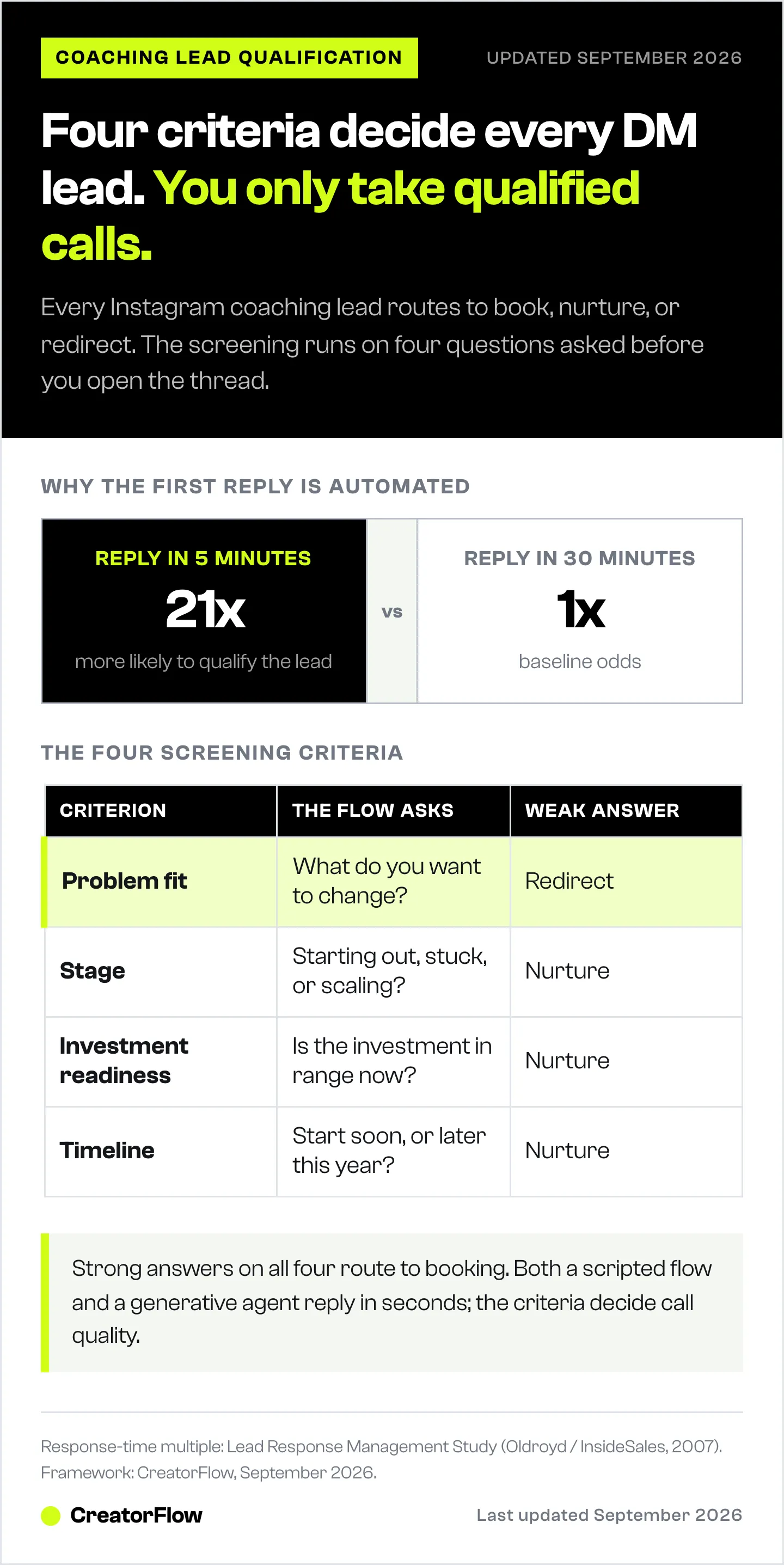
A coaching lead is qualified when four things are true: their problem is the one you coach, their current stage matches your offer, they can invest at your level now, and they want to start soon. Every qualification flow, scripted or generative, is a way of testing those four criteria and routing the lead on the answers.
| Criterion | The question your flow asks | A weak answer routes to |
|---|---|---|
| Problem fit | ”What’s the main thing you want to change right now?” | Redirect |
| Stage | ”Where are you today with this: starting out, stuck, or scaling?” | Nurture |
| Investment readiness | ”Our programs start at a set monthly investment. Is that in range for you this quarter?” | Nurture |
| Timeline | ”Are you looking to start in the next few weeks, or later this year?” | Nurture |
The three routes do different jobs:
- Book. Strong on all four criteria. Send the calendar link immediately and confirm the time in the same thread.
- Nurture. Right problem, wrong moment. Deliver a lead magnet, capture the email, and let your content do the slow work. Being told “not yet” politely keeps a future client warm.
- Redirect. Wrong problem entirely. Point them to a free resource or a better-suited creator. It costs one message and protects your calendar.
Order matters as much as the questions. Ask problem fit first because it costs the lead nothing to answer, and hold investment readiness until third, after the exchange has built some reciprocity. The deeper playbook for screening before calls, including disqualification paths, is in our guide to qualifying Instagram leads before discovery calls. If your programs sit at the premium end, the application-funnel version is covered in qualifying $10K+ coaching leads via Instagram DMs.
How Coaches Use AI Without Handing Over the Inbox
The highest-return place for AI in a coach’s DM funnel is the design layer. You use a language model to build and sharpen the flow, then run the live conversation scripted. You get AI’s pattern-finding where it helps and exact-text control where it counts.
Four jobs it does well:
- Draft the question set. Describe your offer, your ideal client, and your price floor, then ask the model for closed questions that test the four criteria. Keep the ones a stranger would answer in a DM. Cut anything that reads like a form.
- Mine your past conversations. Paste in your last 30 lead threads with names removed and ask which phrases predicted a no-show and which predicted a client. Most coaches have never audited this, and the patterns are usually visible in one pass.
- Stress-test the script. Have the model role-play a skeptical lead, a bargain hunter, and a ready buyer against your flow. Where the script breaks, rewrite it before a real lead finds the gap.
- Tighten every sentence. One idea per message, one question at a time, no jargon. A model is a fast editor for exactly this kind of trimming.
The live flow then runs deterministically. Nothing unapproved is ever sent under your name, and the wording that passed your stress test is the wording every lead receives.
How to Build the Qualification Flow Step by Step
- Pick one trigger keyword per offer. “READY” for your signature program, “AUDIT” for a strategy session. One keyword per offer keeps routing clean and tells you which content sells which thing.
- Write the opening reply. Deliver whatever the post promised, then ask the problem-fit question in the same message. Meta lets a private reply to a comment go out within 7 days of the comment, and only one private reply per comment, so the opener has to earn the response that reopens the conversation (developers.facebook.com, September 2026).
- Ask the four questions one message at a time. A wall of questions reads like an intake form and kills replies. Each answer triggers the next question.
- Gate the asset. Before the flow hands over your lead magnet or workshop link, ask for an email. That turns an anonymous commenter into a contact you own. CreatorFlow’s email gate and follow gate handle this step, with contacts exportable by CSV into your email platform.
- Route on the answers. Booked leads get the calendar link. Nurture leads get the lead magnet and land on your list. Redirects get one kind message. The booking leg pairs well with the setup in Instagram DM automation for coaches who book calls.
- Take over hot threads yourself. When a lead clears all four criteria, step in personally inside Meta’s 24-hour messaging window. For a manual reply that comes later, Meta’s human agent tag allows responses within a 7-day period (developers.facebook.com, September 2026).
CreatorFlow runs this entire flow on Meta’s official Instagram API. The free plan includes 500 DMs a month to test your script against real leads, and the Pro plan at $15/month flat adds the email gate, follow gate, and geographic analytics that show where your booked leads come from (creatorflow.so, September 2026).
AI Agent or Structured Flow: How to Decide
Match the tool to the shape of your inbox, not the other way around.
| Your situation | Better fit |
|---|---|
| One core offer with predictable questions | Structured flow |
| Several offers plus open-ended pre-sales questions | Generative agent |
| Niche touches health, money, or career outcome claims | Structured flow |
| No time to review conversation transcripts weekly | Structured flow |
| High-volume inbox across several languages | Generative agent |
| You want the email captured before any link goes out | Either, with a gate in the flow |
Two notes on reading the table fairly. Generative agents are genuinely better at the unscripted question: someone asking how your program handles a shift-work schedule gets a real answer instead of a fallback message. Scripted flows are genuinely better at accountability: every sentence was approved by you, which is why they remain the default where a misworded outcome claim carries professional risk. Whichever you choose, run it through a tool built on Meta’s official API rather than anything that asks for your password.
A generative agent also asks for an operating habit most solo coaches should budget for: reviewing transcripts regularly, because its replies are composed at send time and drift with context. A scripted flow asks for that work once, up front, when you write and test it.
What Meta’s Rules Mean for AI in Your DMs
Meta’s messaging rules apply identically to both architectures. The platform does not have a separate rulebook for generative replies; it has one set of windows and limits for automated Instagram messaging, published in its developer documentation (developers.facebook.com, September 2026).
The four numbers that shape a qualification flow:
- The 24-hour messaging window. Once a user messages you, your app has 24 hours to respond. Qualification flows work inside this window by design, because each answer from the lead reopens it.
- Private replies within 7 days. A comment can receive one private reply, sent within 7 days of the comment. Miss the window or waste the message, and that lead has to DM you first.
- Human agent responses within 7 days. Meta’s human agent tag lets you personally reply within a 7-day period, which is what makes the manual takeover on hot leads workable after a busy weekend.
- 750 private replies per hour per professional account, with per-second platform limits on sends. Reputable tools pace well inside these caps; the commonly quoted 200 DMs per hour is a tool-side pacing convention rather than a Meta-published figure.
None of these limits block a coaching funnel. A qualification flow that asks four questions and routes the lead uses a fraction of the allowed volume. The limits punish spray-and-pray broadcasting, which a qualification mindset already rules out.
FAQ
Can an AI agent qualify leads as well as a human coach?
For the first pass, yes. Testing problem fit, stage, investment readiness, and timeline is closed-question work that automation handles instantly and without fatigue. What automation does not replace is the discovery call, where a human reads nuance and closes. In Gartner’s 2026 survey, 87% of customers said companies using generative AI must provide access to a human (gartner.com, August 2026). Let the software sort; keep the selling.
Will leads be put off talking to automation?
Not for speed and delivery. Zendesk’s research found 51% of consumers prefer bots over humans when they want immediate service (zendesk.com, March 2026). Friction appears when automation overreaches into conversations that need judgment. A flow that answers in seconds, asks three or four respectful questions, and hands hot leads to a real person matches what people already expect from a professional account.
What questions should an automated flow ask coaching leads?
One question per criterion: what they want to change (problem fit), where they are today (stage), whether your price range works this quarter (investment readiness), and when they want to start (timeline). Phrase each as a single short question, sent one message at a time. Four answers give you a routing decision; more starts to read like a job application.
Is it against Instagram’s rules to use AI in Instagram DMs?
No. Meta permits automated messaging through its official Instagram API, and the same rules cover scripted and generative replies alike: a 24-hour messaging window, one private reply per comment within 7 days, and published rate limits (developers.facebook.com, September 2026). The tools that create ban risk are the ones that skip the API and log into your account with a password.
How fast should a coach respond to a new Instagram lead?
Within minutes, and in practice that means automating the first touch. The Lead Response Management Study found replying within 5 minutes instead of 30 made teams 21x more likely to qualify the lead, and Chili Piper’s 2025 data shows 66.7% of qualified leads book when scheduling is instant versus roughly 30% with delayed follow-up (chilipiper.com, February 2025). No manual inbox holds a 5-minute response time through a spike.
When does a generative AI agent make sense for a coach?
When the inbox outgrows a script: several distinct offers, a steady stream of pre-sales questions no branch can anticipate, or an audience messaging in several languages. At that point free-form replies solve problems a script cannot. Budget for reviewing transcripts regularly, since generative replies are composed at send time, and keep the discovery call human either way.
Response-time research verified from leadresponsemanagement.org and chilipiper.com; consumer sentiment from gartner.com and zendesk.com; platform rules from developers.facebook.com; coaching industry figures from coachingfederation.org, as of September 2026. Individual results vary.