

A client referral system for coaches is a repeatable sequence with four parts: a trigger that tells you when to ask, a specific ask, a message the client can forward, and a capture path that catches the referred person when they arrive. Most coaches build the first three and skip the fourth, which is exactly where warm referrals go quiet.
Your client mentions you to a friend on a Saturday. The friend opens Instagram, taps your profile, and sends a DM at 11:40pm asking if you take new people. You reply Monday morning. Two days have passed and the friend has already booked a call with someone who answered that night. Nothing about your ask was broken. The recommendation was made, accepted, and acted on. It died in the ninety seconds after.
This guide covers the trigger moments worth asking on, scripts that read like a normal sentence instead of a pitch, whether a referral bonus helps or hurts, and how to build the arrival path that most referral advice leaves out. It is written for coaches running a solo or small practice: fitness, business, health, life, and career.
Key Takeaways
- A referral system has four parts, not one: trigger, ask, forwardable message, and capture path. Advice that only covers the ask fixes a quarter of the problem.
- The ask has a hard ceiling: the average coach works with 12.4 active clients (2025 ICF Global Coaching Study, PwC). Perfect ask technique across twelve people is still twelve conversations a year.
- Referrals leak in five places, and only three of them happen in front of you. The arrival leak and the attribution leak happen after the conversation ends.
- Specificity beats frequency: “do you know anyone who is where you were in January” produces names. “Send people my way” produces nothing.
- Design the arrival before the ask. A referred stranger usually lands in Instagram DMs, off-hours, with no context. Give that moment an answer that works while you sleep.
- Track the source or you cannot repeat it. One question at intake, asked every time, turns luck into a pattern you can see.
What Is a Client Referral System for Coaches?
A client referral system is the fixed set of steps you run every time a client is happy, so that goodwill turns into an introduction instead of a nice feeling. It defines when you ask, what you say, what the client sends, where the referred person lands, and how you record who sent them. Written down, it survives a busy month. Held in your head, it does not.
The word system matters because referrals feel random when they are unmanaged. Two arrive in March, none in April, one in July. That pattern comes from a process that depends on you remembering to ask during a week you happened to have time.
Why Asking Better Stops Working at 12 Clients
Here is the arithmetic almost no referral guide runs. The 2025 ICF Global Coaching Study, conducted by PwC across 10,035 valid responses, found that active coach practitioners work with an average of 12.4 active clients and spend 11.6 hours a week coaching (coachingfederation.org, accessed August 2026).
Twelve clients is your entire ask-side inventory. If you ask every single one, at the perfect moment, with a flawless script, and a strong one in three says yes, you have generated four introductions. Improving your script from good to excellent might move that to five. That is the whole prize for optimizing the ask.
The same study found 60% of coaches expect to be working with more clients in the year ahead, against 37% who expect to charge more per session (coachingfederation.org, accessed August 2026). Most coaches are betting on volume with a referral engine capped at a dozen conversations.
So the gain sits somewhere else. Referrals are one channel inside a wider client acquisition system, and they are the channel with a fixed ceiling. Not in asking more often, which annoys people, and not in asking better, which has a ceiling you can calculate. The gain is in keeping the introductions you already earn. Every referral that gets made and then evaporates is a client you paid for with a year of good work.
That reframe is the reason this guide is ordered the way it is. Scripts still matter and they are below. They are not the constraint.
The Five Places Referrals Leak
A referral has to survive five separate steps to become a client. Most coaching advice covers the first three, because those are the parts you can see. The last two happen after you leave the conversation, which is why they stay broken for years.
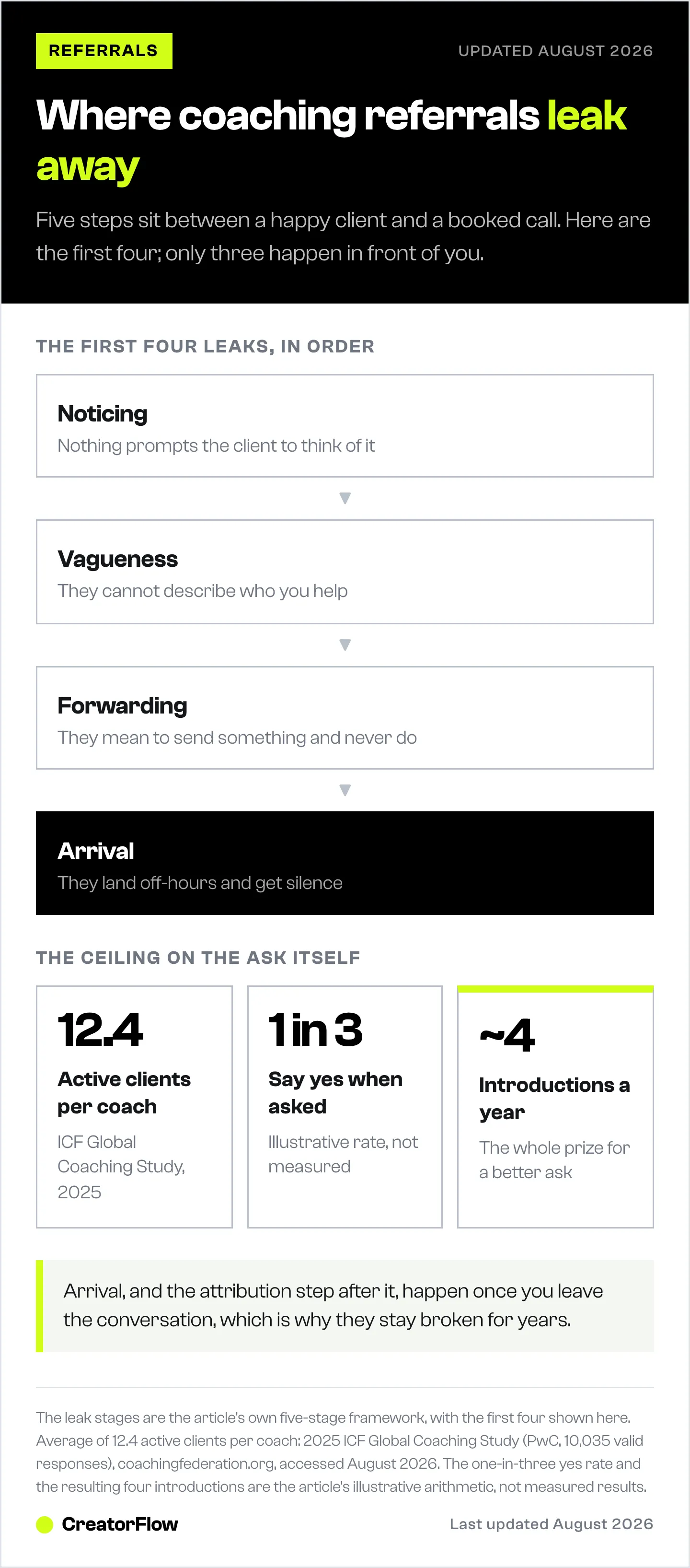
| Leak | What happens | The fix |
|---|---|---|
| Noticing | Your client would recommend you, but nothing ever prompts them to think of it | Fixed trigger moments, not a standing hope |
| Vagueness | They would refer, but cannot describe who you help, so they never match you to anyone | One sentence describing your person, said out loud |
| Forwarding | They intend to send something and have nothing to send, so it stays an intention | A short message they can copy and edit |
| Arrival | The referred person shows up off-hours and gets silence, or a bio link with six options | One clear path that answers immediately |
| Attribution | The referral converts and you never learn who sent them | One intake question, asked every time |
Read that table as a funnel and the shape of the problem changes. You can win the first three and still lose the client at step four, and you will never know it happened, because a referral that never introduced itself leaves no trace. It looks identical to a referral that was never made.
When to Ask for a Referral
The trigger is worth more than the wording. Ask at a moment when the client is actively feeling the result and the sentence sounds like a continuation of what you were already discussing.
Four moments do the work:
- Right after a named win. Not a general good session. A specific outcome the client says out loud: a promotion, a first pull-up, a signed client, a month without the thing that used to happen every week.
- At renewal or repurchase. Someone who has chosen to keep paying you has already made the argument internally. Asking here is asking someone who is mid-decision in your favor.
- When they mention a person. A client says a colleague is burnt out, or a friend keeps starting over in January. That is the referral, unprompted. All you do is name it.
- After they send a testimonial or a review. They already wrote the recommendation. The follow-up is asking whether anyone should read it.
Pick three of these and write them into your process so they fire without you deciding each time. A trigger you have to remember is not a trigger.
What to Say Without Sounding Needy
The neediness in a referral ask almost never comes from the request. It comes from vagueness, which forces the client to do the work of figuring out who you mean and how to phrase it. Specific asks are easier to say yes to and easier to say no to, and both of those are fine.
After a win: “That is a real change from where you were in January. Is there anyone in your team who is roughly where you were then? Happy for you to pass my name on, and equally happy if not.”
At renewal: “Glad we are carrying on. If it is useful, I have two spots opening in October. If someone comes to mind, send them over. No rush.”
When they mention someone: “You mentioned your colleague is running into the same thing. Want me to write two lines you can forward to her?”
After a testimonial: “Thank you for that. Would you mind if I sent it to you as a message, in case anyone asks you who you worked with?”
Low pressure, no occasion: “No agenda here. If anyone ever asks you about coaching, I would rather they came to you than to an ad.”
Then hand over the forwardable message, because this is where most asks quietly fail. The client agrees, means it, and never gets around to composing anything. Write it for them, in their voice, short enough to send from a phone:
“I have been working with a coach since the spring and it has made a real difference to how I handle work. Her name is [name], she works with [type of person] on [problem]. Her page is [link] if you want to look.”
One sentence of context, one sentence of who you help, one link. Anything longer gets edited into nothing.
Should You Pay for Referrals?
For most solo coaching practices, no, and the reason is about who you attract rather than what it costs. A cash bounty converts an act of trust into a transaction, and the person receiving the recommendation can usually sense the difference. Referred clients arrive pre-sold precisely because the recommendation looked disinterested.
There are two versions that hold up. The first is a thank-you that arrives after the fact and was never advertised: a book, a session, something specific to that client. The second is a benefit to the referred person rather than the referrer, such as a free intro session, which reads as hospitality instead of commission.
If you do run a formal program with a stated reward, be clear about it publicly and say so in the message the client forwards. Undisclosed paid recommendations create a disclosure problem for the client, and in the US the FTC treats a material connection between the recommender and the business as something the audience is entitled to know.
The blunter point: a referral bonus fixes the noticing leak and none of the other four. If people already recommend you and those recommendations keep evaporating, paying more for recommendations makes the leak more expensive rather than smaller.
Build the Capture Path Before You Build the Ask
The arrival leak is the one worth your weekend. A referred person almost never sends you a considered email. They get told about you in conversation, they look you up on their phone that evening, and they send a short message from wherever they found you. For a coaching practice in 2026, that is usually Instagram DMs, at an hour when you are not working.
Trust is not the issue at this point. Nielsen’s Trust in Advertising Study, which surveyed more than 40,000 consumers, found that 88% of respondents trust recommendations from people they know above any other channel (nielsen.com, 2021). The referred person arrives already believing your client. What they need is an immediate next step, and what they usually get is a bio link with six options and a reply two days later.
Speed is measurable in the direction you would expect. Harvard Business Review audited 2,241 US companies by sending each one a test inquiry. Among the companies that ever replied, the average first reply took 42 hours, and 23% never replied at all. A separate study in the same article, covering 1.25 million leads, found that firms making contact within an hour were nearly seven times more likely to reach a decision maker in a real conversation than those who tried even an hour later (hbr.org, March 2011).
Treat the direction as sound and the multiples as somebody else’s. That research is from 2011, it measured phone follow-up to B2B web forms rather than Instagram DMs, and one of its three authors ran a company selling speed-to-lead software. What survives all of that is the shape of the finding: the reply that arrives while the person is still thinking about you does something the reply two days later cannot.
Three things make the arrival survivable:
- One named path, not a menu. Decide the single action a referred person should take: book an intro call, or answer two questions, or read one page. Put that one thing everywhere a referral might land.
- An answer that works at 11pm. A keyword-triggered reply covers the hours you do not. Someone comments or DMs a word like COACHING and your intro details and booking link arrive in seconds instead of on Monday. That is the mechanism behind Instagram DM automation, and setting it up is a one-time job.
- A qualifying question before the calendar. Two questions in the DM thread filter people who are curious from people who are ready, which is the same screening high-ticket coaches use to qualify coaching leads in Instagram DMs before offering a slot.
Warm and cold traffic want the same thing here, which is why fixing this pays twice. The path that catches a referral at midnight is the same one that books discovery calls from Instagram during the day. Story replies are worth wiring up too, since a client resharing your post to their Story sends their friends straight into that thread, and an automated reply to Story replies answers them the moment they tap.
How to Track Referrals Without a CRM
You do not need software for this. You need one question asked every single time, in the same words, and written down somewhere you will look again.
Ask at intake: “How did you hear about me?” Then a second question if the answer is a person: “Do you mind if I thank them?” That second question is what converts a one-off into a repeat referrer, because the thank-you is what tells your client the recommendation landed. Clients who never find out what happened stop making them.
Keep a spreadsheet with five columns: date, name, who referred them, whether they booked, whether they became a client. After two quarters you will be able to see something you currently cannot: which clients refer repeatedly, whether referrals convert better than your other traffic, and which month the pattern falls off.
If you send anything by link, add a tracking parameter so you can separate referral clicks from everything else. Click and location data on your links tells you whether the path is being used at all, which is the difference between a referral that never arrived and one that arrived and bounced.
Your One-Week Referral Build
Six short jobs, none of which need a whole day.
- Monday. Write one sentence describing who you help, in the words a client would use, not marketing words. Test it by reading it aloud, and reuse it in the content pillars that attract your ideal clients.
- Tuesday. Pick your three trigger moments and write them into wherever your process lives.
- Wednesday. Write the forwardable message. Cut it until it fits on a phone screen without scrolling.
- Thursday. Decide the single arrival action and set up the automated reply that delivers it, keyword and all.
- Friday. Add the source question to your intake and open the spreadsheet.
- Every Friday after. Five minutes: who did I notice a moment with, who did I ask, who arrived, who did I thank.
The Friday review is the part that decays first and matters most. A referral system is a habit with paperwork, and habits need a scheduled slot.
Turn Every Recommendation Into a Booked Call
CreatorFlow answers the people your clients send you, at the hour they arrive. Keyword-triggered DMs deliver your intro and booking link in seconds, Story replies get an instant response, and click tracking shows you which posts and which referrers are sending real people.
FAQ
How do I ask a coaching client for a referral without sounding desperate?
Ask on the back of a specific win rather than at a random moment, and make the request narrow. “Do you know anyone in your team who is roughly where you were in January” is easy to answer either way. Add an explicit exit such as “equally happy if not”, which removes the pressure that creates the awkwardness.
When is the best time to ask a client for a referral?
Right after the client names a result out loud, at renewal, when they mention a person with the problem you solve, or straight after they send a testimonial. All four are moments when the value of your work is already on their mind, so the ask continues the conversation instead of interrupting it.
Should I offer a referral bonus or discount to coaching clients?
For most solo practices, an unadvertised thank-you after the fact works better than an advertised cash reward, because a disinterested recommendation is what makes referred clients arrive pre-sold. If you do run a paid program, disclose it clearly and include the disclosure in the message clients forward.
What percentage of coaching clients come from referrals?
There is no reliable published figure, and any single number you see quoted should be treated with suspicion. What is documented is scale: the 2025 ICF Global Coaching Study reports an average of 12.4 active clients per coach, so track your own referral share against your own numbers rather than an industry average.
How do I track where my coaching referrals come from?
Ask “how did you hear about me” at intake, every time, and record the answer in a five-column sheet: date, name, referrer, booked, converted. Add tracking parameters to any links you send so referral clicks are separable. Two quarters of this is enough to show a pattern.
What do I do when a referral messages me on Instagram at midnight?
Set up an automated first reply so they get your intro and next step immediately rather than two days later. A keyword trigger, a Story reply automation, or an auto-response to your DMs all cover the hours you are not working, and you take over the conversation personally when you are back.
Do referral programs work for online coaches with few clients?
A formal program with rewards and tracking usually does not pay off under a couple of dozen clients. What does pay off at any size is the four-part system: fixed triggers, a specific ask, a forwardable message, and an arrival path. The first three cost you a morning. The fourth keeps working while you sleep.
Coaching industry figures verified from the 2025 ICF Global Coaching Study (PwC, 10,035 responses) and trust data from Nielsen’s Trust in Advertising Study as of August 2026. The lead response research cited dates from 2011 and studied B2B web forms. Individual results vary.


