
AI chatbot lead generation uses an automated messaging bot to capture, qualify, score, and route leads from conversations, most often in Instagram DMs. A follower comments a keyword or sends a message, the bot replies in seconds, asks a few qualifying questions, then hands hot leads to you while nurturing the rest. It runs 24/7 without you answering DMs by hand.
Here is the problem it solves. A Reel overperforms, 200 people DM you in a day, and you answer 30 of them four hours late. The other 170 already bought from the creator who replied first. The leads that come in during a spike are the warmest you will ever get, and they go cold within hours. You cannot staff your way out of that. A chatbot can.
This guide covers what AI chatbot lead generation actually does, the two chatbot architectures you can choose from, a qualification framework that works, how to score and route leads without a CRM, and how to set the whole thing up on Instagram. It is written for coaches, service providers, and creators who sell, not for enterprise sales teams.
Key Takeaways
- What it is: A chatbot that captures a lead from a DM or comment, asks qualifying questions, scores intent, and routes hot leads to you while the rest go into a nurture sequence.
- Speed is the whole game: Responding within 5 minutes makes you up to 21x more likely to qualify a lead than waiting 30 minutes (Lead Response Management Study, Oldroyd / InsideSales.com). Bots reply in seconds.
- Two architectures: Keyword-triggered flows give you exact-message control and capture the contact before handoff. Generative AI flows hold freeform conversations. Most Instagram lead capture works best with keyword flows plus a gate.
- Qualify on three things: what they need, when they need it, and who makes the decision. Skip timeline and you route an urgent buyer like a researcher.
- You do not need a CRM to start: Tag and segment inside the tool. Add a CRM once you pass roughly 100 leads a week.
- Tools: CreatorFlow runs deterministic keyword flows with follow and email gates at $15/month flat. ManyChat adds generative AI on its Pro tier ($39/month, $29 billed annually) across Instagram, WhatsApp, and Messenger (manychat.com/pricing, July 2026).
What AI Chatbot Lead Generation Actually Does
An AI chatbot for lead generation replaces the manual DM grind with a system that does four jobs in order: capture, qualify, score, route. A lead enters through a comment keyword, a Story reply, or a direct message. The bot responds instantly, collects a contact detail such as an email, asks the questions a salesperson would ask, then decides whether the person is ready to talk to you or needs nurturing first.
The value is not that a bot talks. The value is that it does the boring, high-stakes first touch at machine speed and never gets tired, distracted, or asleep. Your manual process stops at midnight. The bot does not. On Instagram, where most buying interest shows up as a DM rather than a form fill, that first reply decides whether a warm lead stays warm.
If you want the broader tactical playbook for turning message threads into revenue, see our guide on how to convert Instagram DMs into leads automatically. This article stays focused on the chatbot layer specifically.
The Four Jobs: Capture, Qualify, Score, Route
Every lead-gen chatbot, no matter which tool builds it, runs the same pipeline. Understanding the four jobs helps you spot where your current setup leaks.
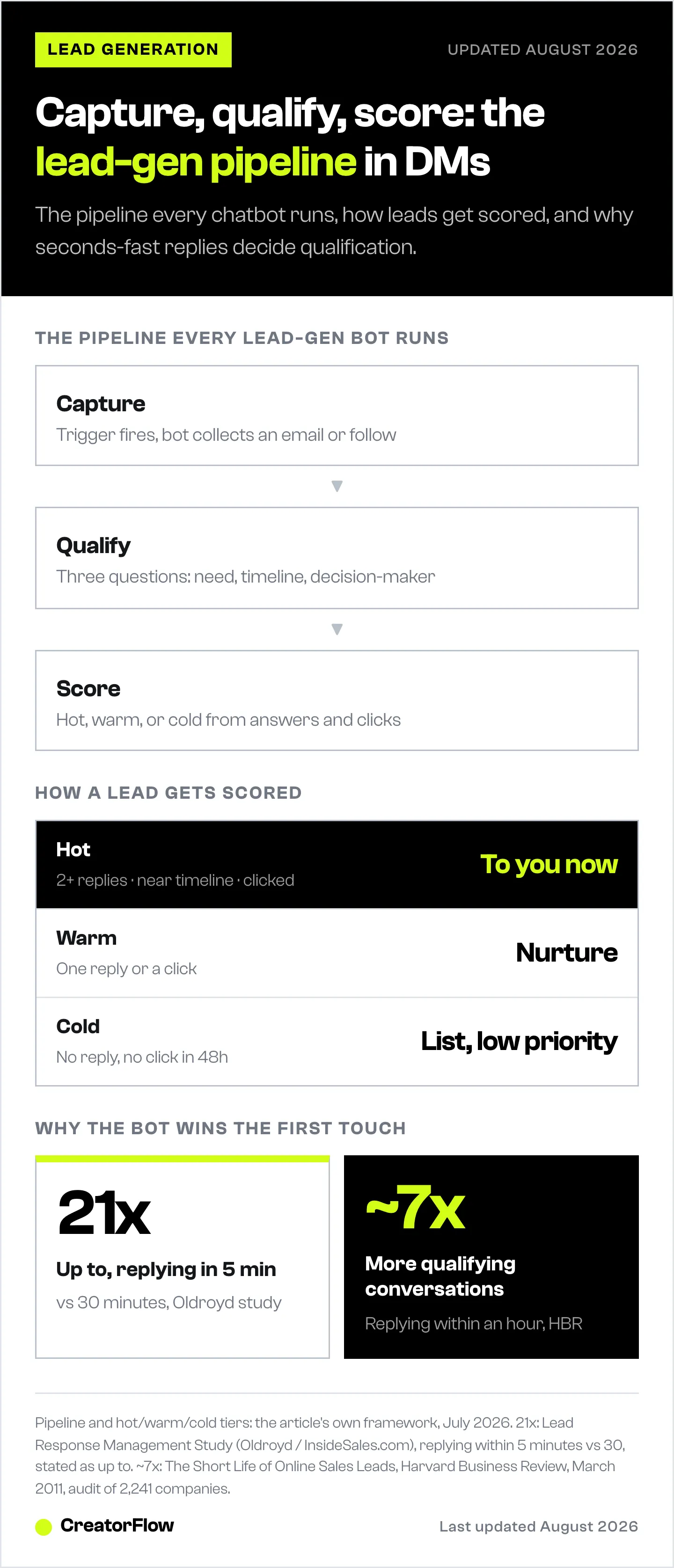
Capture. The bot starts a conversation from a trigger and collects a contact point. On Instagram, the highest-intent trigger is a keyword comment on a post (“comment PRICE and I’ll DM you”) because the person told you what they want. A gate that asks for an email before delivering the link turns an anonymous commenter into a list contact you own.
Qualify. The bot asks the questions that separate a buyer from a browser. This is where most flows quit early. A single “here’s the link” message captures interest but tells you nothing about fit.
Score. Based on the answers and behavior (did they reply, did they click), the bot ranks the lead hot, warm, or cold. Scoring is what stops you spending an hour on someone who was never going to buy.
Route. Hot leads get handed to you or sent a booking link now. Warm leads enter a nurture sequence. Cold leads stay on the list for later. Routing is the difference between a pile of names and a prioritized pipeline.
Miss any one job and the system underperforms. Capture without qualify gives you volume with no signal. Qualify without route gives you insight you never act on.
Two Chatbot Architectures: Keyword vs Generative AI
“AI chatbot” is a loose term. In practice there are two very different builds, and the right one depends on your goal. Neither is better in the abstract. They are better at different things.
| Keyword-triggered flow | Generative AI conversation | |
|---|---|---|
| How it works | Rules: a trigger word fires a set sequence | A language model replies freely to open text |
| Message control | Exact. You write every word | The model composes replies on the fly |
| Best for | Link delivery, email capture, fixed offers | Open-ended qualification, complex questions |
| Speed to build | Minutes | Hours to train and refine |
| Risk | Low. It only says what you wrote | Off-script replies possible without guardrails |
| Contact capture | Gate collects email before delivery | Depends on how the flow is designed |
Keyword flows win when the job is capture and delivery with a known offer. You control the exact message, you capture the email before you hand over the link, and there is no chance the bot invents an answer. That precision is why deterministic flows are the backbone of most creator lead capture.
Generative AI flows win when qualification is genuinely open-ended and a scripted branch cannot cover the range of questions. ManyChat’s AI Intent Recognition, for example, reads what a person means rather than matching an exact word, which suits multi-channel funnels that span Instagram, WhatsApp, and Messenger (manychat.com/product/ai, July 2026). That capability sits on its Pro tier and above.
For most Instagram lead capture, a keyword flow plus a follow or email gate does the job that matters, getting the contact and the qualifying answer, without the setup cost of training a model. Layer in AI intent detection when your question set outgrows what branches can handle. To choose a specific tool, compare options in our roundup of the best Instagram chatbots by price and features.
The Three-Question Qualification Framework
A qualification flow is not a form wearing a costume. It earns each answer by making the previous one feel useful. Every flow should resolve three things before it routes a lead.
What do they need? The surface question is rarely the real one. Someone who asks “how much is it” might be asking whether it is worth it or whether a different offer fits better. Open with the ask, then dig one level.
When do they need it? Timeline is the variable most flows skip, and it is the one that decides routing. A buyer who needs a solution in two weeks is not the same lead as someone planning for Q4. Ask, then prioritize.
Who makes the decision? If the person in your DMs is not the budget holder, you want to know before a call gets booked. Phrased well, it is not rude: “Are you evaluating this on your own, or would someone else be involved?”
Three questions, every flow, no exceptions. For higher-ticket offers where the qualification bar is steeper, our guides on qualifying Instagram leads before discovery calls and qualifying $10K+ coaching leads via DMs go deeper than a bot flow can. Coaches weighing whether a generative agent should run the conversation itself will find the decision framework in AI lead qualification in Instagram DMs.
Scoring and Routing Without a CRM
You do not need Salesforce to run this. Most DM lead-gen tools include tagging and segmentation that cover the job until you are well past hobby scale. Score on two inputs: what the lead answered and what the lead did.
- Hot: replied to two or more questions, gave a near-term timeline, clicked the link. Route to you or a booking link now.
- Warm: replied once or clicked but did not commit. Route to a nurture sequence.
- Cold: opened, no reply, no click after 48 hours. Keep on the list, low priority.
Link tracking is what makes scoring real instead of a guess. When you can see who clicked, you know which “warm” leads are actually active. A CRM integration earns its place once you generate roughly 100 or more leads a week and need an automated handoff into a sales team. Below that, added CRM complexity slows you down more than it helps. Start simple, add the CRM when volume forces it.
Why Response Speed Decides the Outcome
Speed is the single biggest lever, and it is the one a bot wins by default. The Lead Response Management Study (Oldroyd, via MIT/Kellogg, sponsored by InsideSales.com) found that responding to a lead within 5 minutes makes you up to 21x more likely to qualify it than waiting 30 minutes, and far more likely to make contact at all. Harvard Business Review’s separate audit of 2,241 companies found firms that responded within an hour were about 7x more likely to have a qualifying conversation than those that waited an hour longer (“The Short Life of Online Sales Leads,” HBR, March 2011).
A human cannot hold a 5-minute response time across a spike. A bot replies in seconds, every time, at 2 a.m. on a holiday weekend. That is not a marginal edge. It is the whole reason automated capture beats a faster inbox.
How to Set Up an Instagram Lead-Gen Chatbot
You can have a working capture flow live in an afternoon. Here is the order that works.
- Pick the trigger. Choose the keyword your buyers already say: PRICE, INFO, START, or the name of your offer. Comment triggers drive volume, keyword DMs drive intent. Use both.
- Write the first message. Deliver on the promise instantly and ask one qualifying question. Keep it human, not “your ticket has been opened.”
- Add a gate. Collect an email or ask for a follow before sending the link. This is where you turn a comment into an owned contact. CreatorFlow’s follow gate and email gate handle this on the Pro plan.
- Build the qualification branch. Two or three questions covering need, timeline, and decision-maker. Route based on the answers.
- Set routing. Hot leads get your booking link; warm leads enter a short nurture sequence; everyone lands on your email list.
- Turn it on and read the data. Watch which posts and keywords produce qualified leads, then double down.
For a step-by-step build of the capture layer, follow our comment-to-DM automation setup guide. CreatorFlow runs these flows on Meta’s official Instagram API with no password sharing, starting free with 500 DMs a month and $15/month flat for the follow gate, email gate, and geographic analytics.
Where AI Chatbots Fall Short
Honesty sells better than hype, so here are the limits. A bot handles roughly the first 80% of qualification: budget range, timeline, basic need. Complex or high-ticket deals still close better with a human after the bot does the sorting. The bot is not replacing your judgment; it is making sure you only spend it on people worth talking to.
Generative AI flows can drift off-script without guardrails, which is exactly why deterministic keyword flows remain the safe default for a fixed offer. And no chatbot fixes a weak offer or thin content. If nobody is commenting, there is nothing to capture. Automation multiplies demand you already have. It does not create it.
One more limit worth stating plainly: Meta’s messaging API sets per-second send limits, not the “200 DMs per hour” figure vendors often quote (that is a tool-side pacing convention, not a Meta rule), and new conversations run inside a 24-hour messaging window (developers.facebook.com, updated March 2026). Any tool worth using paces sends to stay safely inside those limits.
If you want the click-by-click version, follow the lead generation walkthrough.
FAQ
Can an AI chatbot qualify leads as well as a human?
For the first pass, yes. A chatbot handles budget range, timeline, and basic need instantly and without ego, which is about 80% of early qualification. Complex or high-ticket deals still benefit from a human taking over after the bot has sorted and scored the lead. The point is not replacement. It is making sure you only talk to people worth your time.
Do I need generative AI, or do keyword flows work for lead generation?
Keyword-triggered flows handle most Instagram lead capture well because you control the exact message and capture the contact before delivering the link. Generative AI helps when qualification is open-ended and a scripted branch cannot cover the range of questions. Start with keyword flows, add AI intent detection when your question set outgrows them.
How much does an AI chatbot for lead generation cost?
It ranges from free to over $100 a month. CreatorFlow starts free with 500 DMs a month and charges $15/month flat for gating and analytics (creatorflow.so, July 2026). ManyChat is free for 25 contacts, and its generative AI features begin on the Pro tier at $39/month for 2,500 contacts, scaling by contact count to $199/month ($29 and $139 respectively when billed annually) (manychat.com/pricing, July 2026).
Is AI chatbot lead generation on Instagram against Meta’s rules?
No, when the tool uses Meta’s official Instagram API with OAuth and no password sharing. Meta sets per-second messaging limits and a 24-hour window for new conversations (developers.facebook.com, March 2026). Compliant tools pace sends to stay inside those limits. Browser bots that log into your account and skip the API are the ones that get accounts suspended.
How fast can a chatbot respond to a lead?
Seconds. Most flows fire in 1 to 8 seconds after the trigger. That speed is the entire advantage: responding within 5 minutes makes you up to 21x more likely to qualify a lead than waiting 30 minutes (Lead Response Management Study). No human holds that response time across a traffic spike.
Do I need a CRM for chatbot lead generation?
Not to start. Most DM automation tools include tagging and segmentation that cover lead-gen workflows on their own. A CRM integration earns its place once you generate roughly 100 or more leads a week and need an automated handoff to a sales team. Below that, it adds complexity without a payoff.
What is the best trigger for capturing leads?
Use two. Comment-to-DM triggers generate the most volume because they are public, create social proof, and lift engagement. Keyword DM triggers generate the highest-intent leads because the person came to you with a specific question. Run comment triggers for reach and keyword triggers for quality.
AI chatbot lead-generation methods and competitor pricing verified from official sources (manychat.com, developers.facebook.com, Lead Response Management Study, Harvard Business Review) as of July 2026. Platform policies and pricing may change; check official sources for the latest. Individual results vary.
This article is for informational purposes only. CreatorFlow is built by CreatorFlow Labs, S.L. (Madrid, Spain). Always verify current pricing and features at creatorflow.so before purchasing.


