
To monetize an AI influencer, route comment volume into DMs by keyword, answer the “is this real?” question with an automated disclosure reply, then send links only to comments carrying buying language. Virtual accounts average 5.67% engagement against 1.89% for human creators (HypeAuditor panel data, August 2026), so the volume is large but mostly curiosity. Sorting it is the revenue step.
Three times the engagement rate should mean three times the sales. It does not. Virtual persona accounts pull enormous comment counts on their first viral post and then convert at a fraction of what the numbers promise, because a large share of those comments are people asking what they are looking at rather than people asking to buy.
This guide is for anyone running a synthetic persona account, and for marketers evaluating one. It covers the four revenue paths that work, why the engagement number misleads, a way to sort comments into three buckets that each need a different reply, the disclosure rules that now carry a reach penalty, and what a viral post realistically returns.
Key Takeaways
- Engagement is not demand: virtual influencer campaigns average 5.67% engagement against 1.89% for human creators (HypeAuditor panel data, August 2026), and that gap is curiosity-driven interaction rather than community loyalty
- Three comment types, three replies: identity questions, craft questions, and buying questions arrive mixed together, and sending one link to all three wastes most of the volume
- Disclosure comes first: Instagram announced its AI-generated profile label on August 31, 2026, and profiles that feature an AI-generated person without it may lose reach and recommendation eligibility (TechCrunch, August 2026)
- The EU deadline already passed: transparency obligations under Article 50 of the EU AI Act applied from August 2, 2026, requiring disclosure to a person at first exposure (artificialintelligenceact.eu, August 2026)
- Craft questions are a second product: “which tool did you use” is a creator asking, not a customer, and that audience buys prompt packs and tutorials rather than the sponsor’s product
- Capacity is real: Meta allows 750 private replies per hour per Instagram professional account for comments on posts and reels (developers.facebook.com, August 2026), and tools pace well below that
How to Monetize an AI Influencer: The Four Revenue Paths
A virtual persona account earns through four channels: brand partnerships, affiliate commissions, its own digital products, and paid subscription platforms. Brand deals dominate the top accounts, with virtual influencers accounting for $1.37 billion in annual brand spend and adoption climbing from 60% to 73% of surveyed companies in 2026 (Grand View Research, August 2026). The other three are what a smaller account can start on this week.
Affiliate commissions and digital products both depend on the same mechanic: someone comments, and a link reaches them in the DM. That link is the whole business. A persona with 200,000 followers and no way to move a commenter to a checkout page is a portfolio piece, not a revenue line.
The market is growing fast enough that the operational question matters more than the creative one. Grand View Research puts the virtual influencer market at $11.8 billion in 2026, heading to $45.9 billion by 2030 at a 40.8% compound rate (Grand View Research, August 2026). Plenty of accounts will look good. Fewer will have a working path from comment to payment.
Which of the four paths carries the account depends heavily on category, and the sortable version of that question is in our breakdown of which AI influencer niches convert. If you are still at the build stage, the character consistency and tooling side is covered in our guide to creating an AI influencer on Instagram.
Why AI Influencer Engagement Is High and Revenue Is Not
The engagement gap is real and it is measured. Virtual influencer campaigns average a 5.67% engagement rate against 1.89% for human creators (HypeAuditor panel data, August 2026). That is roughly a 3x multiple, and it is the number every deck about synthetic personas leads with.
The number is accurate and the conclusion drawn from it is wrong. Engagement on a virtual account is weighted toward novelty. People comment because the image is uncanny, because they want to know whether a person exists, because they are arguing in the replies about whether the account should be allowed. None of those states precede a purchase. In categories where authenticity carries the sale, sponsored posts from human creators outperform virtual ones by up to 2.7 times (industry analysis of HypeAuditor data, August 2026).
Treat the engagement rate as a reach signal and nothing else. It tells you the post will travel. It does not tell you what fraction of the people it reaches wants to buy something, and on a synthetic account that fraction is smaller than the raw comment count suggests.
The Three Comments an AI Persona Gets
Every viral post on a virtual account produces a comment stream with three distinct populations in it. Sorting them is the difference between a funnel and a firehose.
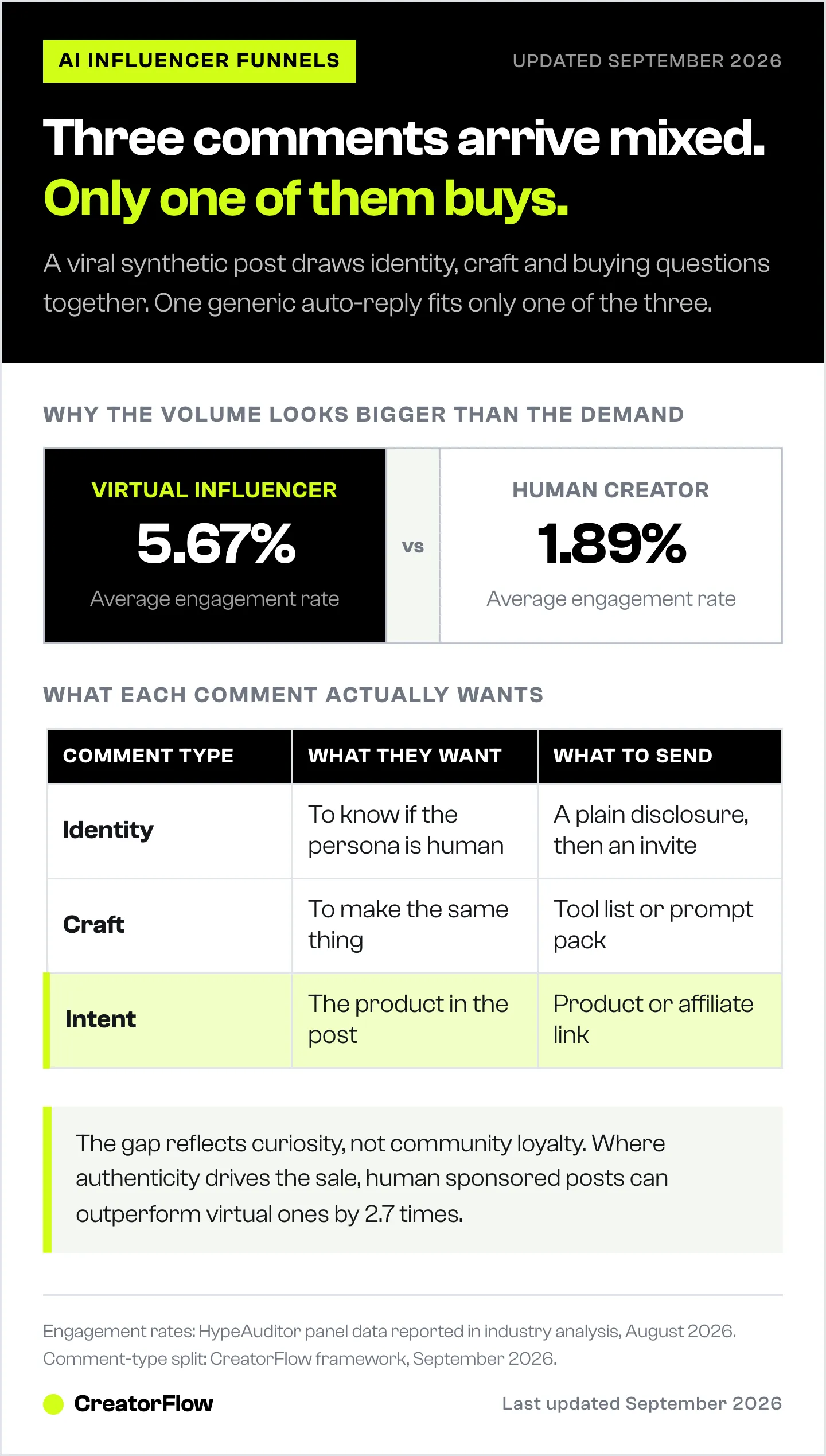
Identity comments ask whether the persona is real. “Is this AI”, “is she real”, “this is fake”, “why does her hand look like that”. On a first viral post this is frequently the largest single group. These people are not leads yet, and sending them a product link reads as evasion of the question they asked.
Craft comments ask how the content was made. “What tool”, “prompt please”, “how do you keep the face consistent”, “what did you use for the video”. These are creators. They are a real audience with real money, and they buy prompt packs, tutorials, and tool subscriptions. They will not buy the skincare the persona is holding.
Intent comments ask about the thing being sold. “Link”, “price”, “where can I get this”, “does it ship to the UK”, “does it come in black”. This is the only bucket that carries revenue for a sponsor or an affiliate offer, and on a viral synthetic post it is the smallest of the three.
| Comment type | What they want | What to send | Revenue path |
|---|---|---|---|
| Identity | To know if the persona is human | A plain disclosure, then an invitation | Long-term follow, no immediate sale |
| Craft | To make the same thing | Tool list, prompt pack, tutorial | Digital product, tool affiliate |
| Intent | The product in the post | Product or affiliate link | Commission, sponsor conversion |
Each bucket needs its own keyword trigger and its own message. Keeping them separate is what stops a single generic auto-reply from burning the two groups it does not fit.
Answer the Identity Question Before You Sell Anything
Route identity questions to a disclosure reply, not to a product link. This is a legal requirement in the EU and a reputational one everywhere else, and handling it well converts better than dodging it.
Transparency obligations under Article 50 of the EU AI Act applied from August 2, 2026. Deployers who create synthetic image, audio, or video content must disclose it, and disclosure has to reach a person at first exposure in a clear and distinguishable way (artificialintelligenceact.eu, August 2026). An account with EU followers is inside that scope. Some marking and detection provisions defer to December 2, 2026 and February 2, 2027, but the core disclosure duty is live now.
In the United States the exposure runs through endorsement law. The FTC’s Rule on the Use of Consumer Reviews and Testimonials, 16 CFR Part 465, took effect on October 21, 2024 and prohibits reviews or testimonials from anyone with no actual experience of the product, AI-generated ones included, alongside fake indicators of social media influence (ftc.gov, August 2026). A synthetic persona giving a first-person account of using a product is the exact shape that rule was written to cover, so the promotion needs to be framed as a brand message rather than as personal experience.
A disclosure reply that works is short, direct, and ends with a reason to stay. Something close to: “Yes, this account is an AI-generated character. Everything here is made with AI. If that is your thing, the tools I use are in my bio.” That answers the question, complies with both regimes, and moves an identity commenter into the craft bucket where they might buy something.
How to Build the Comment-to-DM Flow for a Virtual Persona
The flow is three separate automations on three separate triggers, not one branching conversation. Each keyword gets its own message, which keeps replies predictable and keeps the disclosure answer from ever landing on someone who asked about shipping.
- Set the identity trigger. Keywords: real, AI, fake, bot, human. Message: the disclosure line above, plus a link to whatever the craft audience buys.
- Set the craft trigger. Keywords: tool, prompt, how, made, app. Message: the tool stack and a link to the prompt pack or tutorial. This is the highest-converting bucket for most solo operators, because you own the product and keep the full margin.
- Set the intent trigger. Keywords: link, price, buy, shop, cost. Message: the product or affiliate link with the disclosure required for a paid partnership.
- Turn on link tracking so you can see which of the three actually produces clicks per post, rather than assuming.
- Add an email gate to the craft trigger. Creators who want a prompt pack will trade an address for it, and that list belongs to you rather than to the platform.
CreatorFlow runs each of these as its own automation with unlimited triggers on every plan, sends through Meta’s official Instagram API as a Meta Tech Provider since December 2025, and reports clicks by country and city on Pro. The keyword triggers that convert are worth testing against your own comment history rather than copying, since a persona in fashion draws different language than one in tech.
Capacity is not the constraint people expect. Meta allows 750 calls per hour per Instagram professional account for private replies to comments on posts and reels (developers.facebook.com, August 2026). Tools pace sends far below that ceiling, at roughly 200 per hour, as a behavioural safety margin rather than a Meta-published cap. A post pulling 15,000 comments will drain through the queue over hours, which is why the keyword split matters: you want the intent bucket moving first.
What Instagram’s AI-Generated Profile Label Changes
Instagram announced the AI-generated profile label on August 31, 2026, renaming the earlier AI creator label. It applies to profiles where the person featured was generated or substantially created with AI. Accounts that skip it may see reduced reach, while accounts that apply it are not penalised for featuring a synthetic person (TechCrunch, August 2026).
This flips the economics of hiding it. Before the change, an unlabelled persona account traded a disclosure risk for full distribution. Now the unlabelled version is the one that loses reach, and reach to non-followers is the entire growth mechanism for a synthetic account. Instagram’s stated reason was that people dislike discovering a profile that seemed human was not.
Using AI to edit photos, write captions, or make graphics does not require the label. The full scope, the exemptions, and the switch-on steps are in our breakdown of Instagram’s AI-generated profile label.
What a Viral AI Post Realistically Converts
Work the funnel with the three-bucket split rather than a flat conversion rate, and the numbers change shape. The following is illustrative arithmetic, not measured performance, and every rate here varies by niche and offer.
Take a post with 15,000 comments. If identity questions run at 45%, craft questions at 35%, and intent at 20%, the intent pool is 3,000 comments, not 15,000. Assume a fifth of those use a keyword you actually set, which is 600 DMs. At a 25% click rate that is 150 visits, and at 3% purchase on a $40 product that is roughly $180 from the intent path.
The craft path on the same post is larger. 5,250 craft comments, a fifth on keyword is 1,050 DMs, and an email gate converting at 40% adds 420 addresses to a list you own. That list is worth more over a quarter than the single-post commission, which is the argument for building a product for the audience that is actually asking.
The mistake the raw engagement number encourages is planning for 15,000 buyers and building one automation. Before either mistake is worth worrying about, the account needs reach, which our guide to growing an AI influencer account covers under the new label rules. The mistake it hides is that the second-largest bucket is a business, and most persona accounts throw it away. Human creators face a version of the same sorting problem, mapped in our guide to comments that signal a buyer is ready, and to what the top virtual accounts earn and how.
FAQ
How do AI influencers make money?
Through brand partnerships, affiliate commissions, their own digital products, and paid subscription platforms. Brand deals lead at the top end, with $1.37 billion in annual brand spend on virtual influencers and 73% of surveyed companies using them in 2026 (Grand View Research, August 2026). Smaller accounts usually start with affiliate links and a digital product sold to the audience asking how the content is made.
Can you use DM automation on an AI influencer account?
Yes. Automation runs on the Instagram professional account, not on the persona, so a synthetic character account uses the same official Meta API path as any other creator account. The account still has to meet Instagram’s disclosure requirements, and any paid promotion still needs its partnership disclosure.
Do you have to disclose that an influencer is AI-generated?
In the EU, yes. Article 50 of the EU AI Act has applied since August 2, 2026 and requires disclosure of AI-generated image, audio, and video content to a person at first exposure (artificialintelligenceact.eu, August 2026). On Instagram, profiles featuring an AI-generated person are expected to carry the AI-generated profile label, and skipping it can cost reach (TechCrunch, August 2026).
Why do AI influencers get high engagement but few sales?
Because engagement on a synthetic account is weighted toward curiosity. The 5.67% average against 1.89% for human creators reflects novelty interaction rather than community loyalty (HypeAuditor panel data, August 2026). In categories where authenticity drives the purchase, human sponsored posts can outperform virtual ones by up to 2.7 times.
Does the AI-generated profile label reduce reach?
Instagram states that applying the label does not penalise an account for featuring an AI-generated person. The reach reduction applies to profiles that feature an AI-generated person and do not label it (TechCrunch, August 2026).
How many DMs can an AI influencer account send per hour?
Meta permits 750 calls per hour per Instagram professional account for private replies to comments on posts and reels (developers.facebook.com, August 2026). Automation tools pace sends at roughly 200 per hour as a conservative safety margin, which is a tool-side convention rather than a Meta-published hourly limit.
Can an AI influencer account run affiliate links?
Yes, with disclosure. The FTC’s Rule on the Use of Consumer Reviews and Testimonials, 16 CFR Part 465, prohibits testimonials from anyone with no actual experience of the product, which includes an AI persona claiming personal use (ftc.gov, August 2026). Frame the promotion as a brand message with a clear paid-partnership disclosure rather than as first-person experience.
Turn a viral post into a list you own
Start with CreatorFlow and give each comment type its own trigger and its own message.
- Separate automations for identity, craft, and buying questions
- Email capture inside the DM, exported to your own platform
- Click tracking by country and city on Pro
- Official Meta API access as a Meta Tech Provider since December 2025
AI influencer engagement, market, platform policy, and disclosure data verified from HypeAuditor panel data, Grand View Research, TechCrunch, the EU AI Act Article 50 text, FTC 16 CFR Part 465, and Meta developer documentation as of August 2026. Conversion arithmetic in this article is illustrative, not measured. Individual results vary.