
Yapping on Instagram means talking straight into your phone camera in a short, unscripted Reel, with captions and a text hook on screen. The format suits the 2026 algorithm because it holds average watch time, which Adam Mosseri names as one of the three signals that matter most for ranking. Camera presence is a trained skill, and creators get there by posting reps.
You know the format even if you have never used the word. Someone holds a phone at arm’s length, talks for 45 seconds about one idea, adds burned-in captions, and the Reel does 180,000 views. Your carefully cut version, three days in the edit with B-roll and a licensed track, does 900.
This guide covers what yapping is, what Instagram’s own data says about why it works, what the viral Yap Challenge actually trained people to do, what the research on practice says about how far reps take you, and what to do with the comments the format produces. Written for solo creators, coaches, and small brands who post their own content.
Key Takeaways
- Yapping is a format, not a personality: unscripted talk-to-camera Reels, shot on a phone, with captions and a text hook. Scripts and teleprompters are allowed and widely used
- Watch time is the signal to design for: Mosseri names average watch time, likes per reach, and sends per reach as the top three ranking signals, and his December 2025 memo committed Instagram to favoring raw human content through 2026 (instagram.com/@mosseri, January 2025; engadget.com, December 2025)
- The bar is lower than you think: the average Instagram Reel is watched for 8.5 seconds, across 24.4 million posts studied (metricool.com, June 2026)
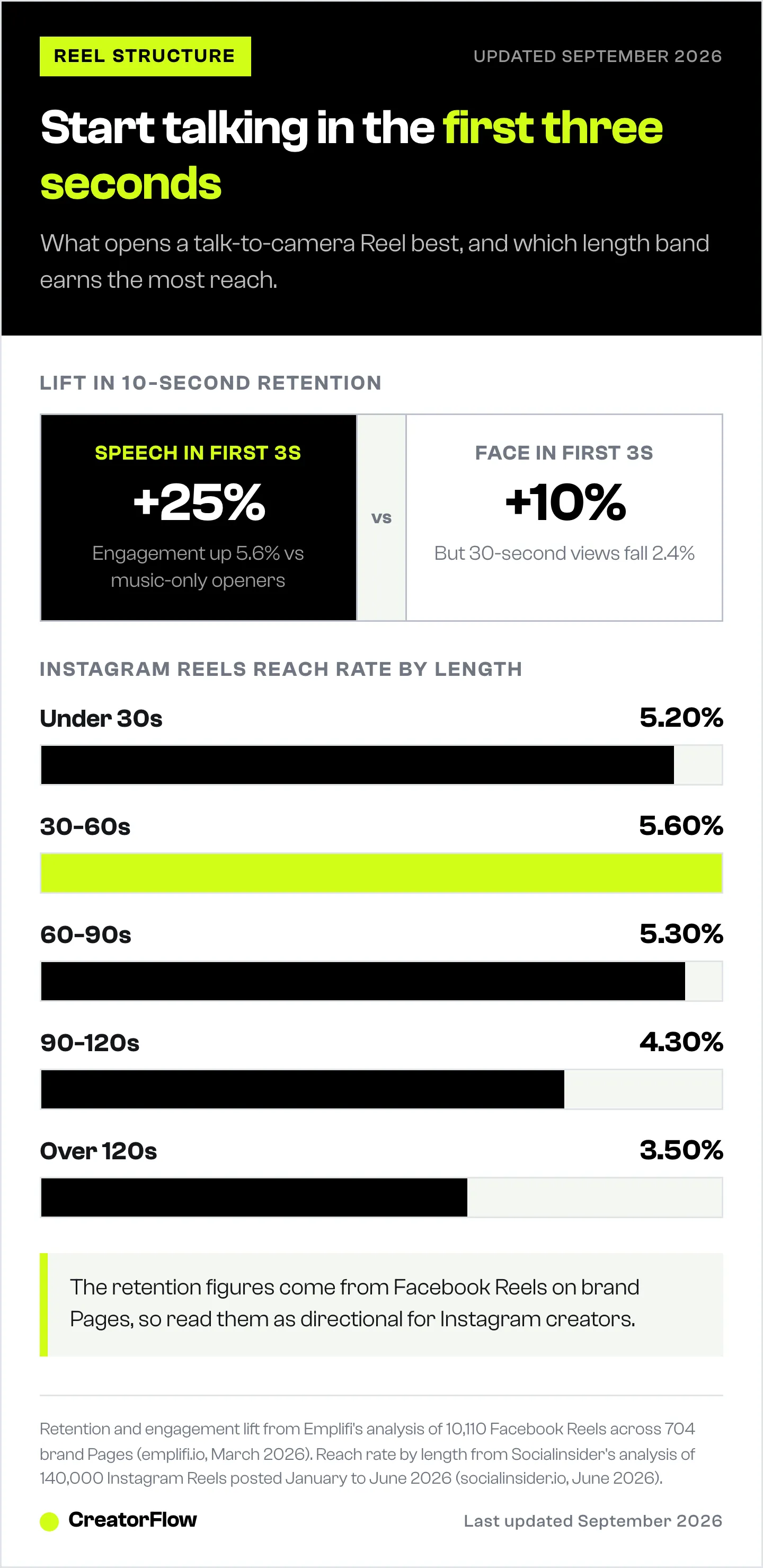
- Talking early is what holds people: human speech in the first three seconds lifted 10-second retention by almost 25% in a study of 10,110 Facebook Reels (emplifi.io, March 2026)
- Volume is the mechanism: the Yap Challenge is 40 posts in six weeks. The deadline is what removes overthinking, not the coaching
- Reach without capture is a dead end: a yap video that works fills your comments with people asking for the thing you mentioned. Comment-to-DM automation answers them in seconds instead of hours
What Is Yapping on Instagram?
Yapping is a short Reel where you talk directly into the front camera about a single idea, with minimal editing, on-screen captions, and a text hook in the first frame. No B-roll, no transitions, no studio. The look is deliberately plain so the content carries the video. Creators use the term loosely for any talking-head Reel that sounds like a person rather than a script being performed.
Two details separate a yap video from a generic talking head. The first is a single idea per video, stated early. The second is that the delivery sounds conversational, closer to explaining something to a friend than presenting to an audience. Both are choices you can make on purpose, which is why the format is teachable.
Nothing about it is new. Creators have talked to phones since the front camera existed. What changed in 2026 is that the format became the default advice for personal brands, and Instagram’s stated preferences moved toward it at the same time.
Why the Yap Format Earns Reach in 2026
Start with what Instagram has actually said. In January 2025 Mosseri posted the ranking signals directly: “the top three signals that matter most for ranking are watch time, likes and sends,” and he told creators to watch average watch time, likes per reach, and sends per reach. His one nuance was that “likes are slightly more important for connected content, and sends are slightly more important for unconnected content” (instagram.com/@mosseri, January 2025).
That word slightly is worth keeping. A popular claim in creator blogs is that a send is worth three to five likes, or fifteen. No multiplier appears anywhere in Mosseri’s published material.
| Ranking signal | What it measures | What a yap video does to it |
|---|---|---|
| Average watch time | How long viewers stay | One clear idea, delivered conversationally, holds people past the early skip point |
| Sends per reach | DM shares to other people | A specific opinion or tip is sendable. A montage rarely is |
| Likes per reach | Approval from viewers | Roughly neutral between formats |
The bar you are clearing is lower than it feels. Metricool’s 2026 study of 24,364,803 posts across 375,118 accounts put the average Instagram Reel watch time at 8.5 seconds, more than double the year before (metricool.com, June 2026). Holding someone for 20 seconds already puts you far above the average.
There is direct evidence that speaking is what does the holding. Emplifi analyzed 10,110 Facebook Reels across 704 brand Pages and found that human speech in the first three seconds raised 10-second retention by almost 25% and engagement rate by 5.6% against music-only openers. Simply appearing on screen did less: a person visible in the first three seconds lifted 10-second retention around 10%, while 30-second views fell 2.4% (emplifi.io, March 2026). The study covers Facebook Reels from brand Pages rather than Instagram creators, so read it as directional. It points at talking, not at being seen.
The platform’s stated direction agrees. On December 31, 2025, Mosseri published a year-end memo arguing that feeds are filling with “synthetic everything” and that creators proving they are real should embrace raw and unflattering imagery (engadget.com, December 2025). Our breakdown of Instagram’s 2026 ranking signals covers how each surface weighs them.
What the Yap Challenge Actually Trained
The Yap Challenge is a six-week program requiring 40 direct-to-camera posts, with daily prompts covering hooks, delivery, and scripting. It lists at $297 (jessijean.com, September 2026). Its first run closed about $1.2 million in two weeks with over 4,600 students and no ad spend, seven months after the creator started the account from scratch (inc.com, June 2026).
Those numbers pushed the format into general awareness, and they are the least useful part of the story. Larger totals circulate for later launches, but every figure above $1.2 million traces back to the creator’s own statements rather than independent reporting.
Strip away the coaching and the training mechanism is a deadline. Forty posts in six weeks means you cannot spend three hours on any one of them. You record, you accept the take, you post, because tomorrow needs another one. Overthinking is not defeated by confidence. It is defeated by a queue.
The program’s own sales page is unusually direct about this, promising skills rather than results: “I cannot guarantee you will grow a single follower” (jessijean.com, September 2026). Read that as the honest version of what any posting challenge does. It buys you reps and a deadline.
You do not need to buy anything to copy that. Pick a number of posts and a window, tell someone the number out loud, and hold to it.
The second lesson is quieter and more valuable. The creator spent months posting about a career change and watching which posts landed, then built the product her audience had already asked for. The audience picked the offer. That sequence, post first and productize the signal, reverses how most creators plan a launch. Our guide to testing formats in small batches applies the same logic to content.
How Common Is Fear of Speaking on Camera?
Two numbers get repeated in every article about camera confidence, and both are wrong.
The first is that 75% of people fear public speaking. It traces back to Philip Zimbardo’s 1977 book on shyness, where 73% of college students reported shyness when they were the focus of attention in a large group. A student shyness measure became a global prevalence statistic through repetition.
The second is that more people fear public speaking than death, which comes from a 1973 market research survey popularized by The Book of Lists. In it, 41% named speaking before a group and 19% named death on a checklist of fears. Those are two mention counts, not a ranking of intensity.
The rigorous figure is lower. The National Comorbidity Survey Replication, a nationally representative US household survey, put lifetime public speaking fear at 21.2% (Ruscio et al., Psychological Medicine, 2008). Looser community-sample criteria push the range to roughly 20% to 34%.
If four in five people carry no lasting fear of speaking, then what stops most creators recording is not a phobia. It is the absence of practice, plus the discomfort of watching yourself back. Both respond to reps in a way a phobia would not.
Does Practice Actually Make You Better on Camera?
Yes, but claims about practice are routinely oversold, and the honest version is more useful than the motivational one.
The famous research is Ericsson’s 1993 study of violinists, where the best performers had passed 10,000 hours by age 20. The follow-up matters more. Macnamara, Hambrick and Oswald ran a meta-analysis of 88 studies covering 11,135 participants and found deliberate practice explained 12% of the variance in performance. Their summary: “deliberate practice is important, but not as important as has been argued” (Psychological Science, 2014). Returns were 24% for highly predictable activities and 4% for low-predictability ones. Talking to camera about whatever happened this week sits at the low-predictability end.
So reps will not make you the most compelling person on Instagram. What they reliably change is narrow and observable: pace slows, filler words drop, sentences stop ending on an upward tone, and eye contact with the lens holds. Those are mechanical habits, and mechanical habits are what repetition fixes. Reps are also the only variable here you fully control.
How to Practice Yapping: A Four-Week Plan
Treat the first two weeks as training that happens to be public. Post the videos, but judge yourself on completion, not performance.
Week 1: one take, no deletes. Record one 30-second video a day on one idea. Whatever comes out is the post. The only rule is that you do not re-record. This week exists to break the re-record loop, which is where most people quit.
Week 2: add the hook. Same daily video, but write the first line before you press record and put it on screen as text. Your opening claim decides whether anyone hears the rest. Borrow a structure from our hook templates that stop the scroll rather than inventing one each morning.
Week 3: watch yourself back. Review the week’s clips at the end of each day and note one habit to change tomorrow. Speed, filler word, where your eyes go. One habit, not five. This is the week the change becomes visible to other people.
Week 4: add the ask. Keep everything from weeks one to three, and end each video with a single instruction. One ask per video, always the same shape, so your audience learns the pattern.
Scripts and teleprompters are fine at every stage. Broadcast professionals read from prompters and still sound natural, because delivery is a separate skill from memorization. If reading a script makes you steadier, read the script.
The Yap Video Structure That Holds Attention
Four parts, in order.
- Hook, spoken and on screen, in the first two seconds. A complete claim, not a tease. “Most creators pick the wrong CTA” works. “Let me tell you something” does not. Start talking immediately, since speech in the opening seconds is the strongest retention lever in the data
- One idea, stated plainly. If you need two, that is two videos. Splitting is free
- The evidence. A number, a before and after, a screenshot, something a viewer can verify
- One ask. A single instruction, usually a comment keyword
On length, aim for 30 to 60 seconds. Socialinsider’s analysis of 140,000 Reels posted between January and June 2026 found reach rate peaked at 5.60% in the 30 to 60 second band, easing to 5.30% at 60 to 90 seconds and falling to 3.50% beyond two minutes (socialinsider.io, June 2026). Mosseri’s own Reels checklist caps the recommendation at three minutes.
Burn captions into every video. A talking-head Reel without captions is silent to anyone scrolling with the sound off, and captions are on Instagram’s published checklist.
What to Do With the Comments a Yap Video Creates
A yap video that lands does not produce sales. It produces a comment section full of people typing the keyword you asked for. What happens next decides whether the reach was worth anything.
The launch that made this format famous ran on exactly that step. In an interview published by the DM automation vendor ManyChat, the creator described the setup: viewers commented or messaged the word YAP, an automated reply asked whether they wanted in, and they typed their email address into the DM thread, which added them to her mailing list without anyone leaving the app (manychat.com, August 2026). The interview is that vendor’s own marketing, so weigh the figures in it accordingly. The mechanism is the transferable part, and every comment-to-DM tool performs it, CreatorFlow included.
Manually replying works until it does not. Two hundred comments at four hours’ delay is a lost audience, because the intent that made someone type the word has a short life. Comment-to-DM automation closes that gap by sending the link, the guide, or the booking page within seconds of the comment landing, through Meta’s official Instagram API.
The delivery route matters as much as the speed. Sending people to a bio link adds steps between the comment and the thing they asked for, and every step costs you people. We compared how the two delivery routes perform on the same posts and the same audience.
CreatorFlow is built for this shape of traffic. You set a keyword, write the message once, and every comment on every yap video from then on gets answered instantly, with click tracking and geographic analytics on the results. It is the distribution layer under the format, and it runs whether or not you are holding your phone.
Where Yapping Does Not Work
The format works when you have a point of view, an audience that wants your judgment, and something specific to say more days than not. Coaches, consultants, educators, and founders are the natural fit.
It works less well when the product is the visual. A furniture maker, a nail artist, or a chef selling on craft is better served showing the work, with talking to camera used sparingly to frame it. It also demands a face and a name, which rules it out for anyone building anonymously. If that is you, our guide to growing without showing your face covers formats that do the same job.
The honest limit on the format is supply. Forty videos needs forty things to say. Creators who run out at week three were short of material, not short of confidence, and the fix is reading and note-taking rather than more practice. Your positioning and voice determine what you have to talk about in the first place.
FAQ
What does yapping mean on Instagram?
Yapping means talking directly into your phone camera in a short, largely unscripted Reel about a single topic, with captions and a text hook on screen. The editing is minimal by design. The term became widespread in 2026 as talking-head Reels replaced highly produced content as the default advice for personal brands.
Is the Yap Challenge worth doing?
The paid program bundles daily prompts, hook training, and community accountability across 40 posts in six weeks, at a $297 list price. The mechanism doing the work is the posting deadline, which you can impose on yourself for free. Buy it if you know you will not hold the schedule alone, and skip it if you will. Its own sales page states it cannot guarantee follower growth.
How long should a yap video be?
Between 30 and 60 seconds for most topics. That band showed the highest reach rate in Socialinsider’s 2026 analysis of 140,000 Reels, and reach declines steadily past 90 seconds. Stay under three minutes, which is the ceiling on Instagram’s published Reels checklist.
Do I need a script to yap on camera?
No, but a script helps and it costs you nothing in authenticity. News anchors read from prompters and still sound conversational. Write your first line at minimum, since the hook decides whether the rest gets heard. Many creators script fully for the first few weeks, then loosen as delivery improves.
Does yapping work for business accounts?
Yes. A professional account gives you the Reels insights you need to see retention and average watch time, which is how you tell whether the format is working. Business accounts have limited access to Instagram’s commercial music library, and original audio suits this format anyway.
How many videos before it starts working?
Plan on 30 to 40 before you judge the format, and expect the visible change in delivery around day 10 to 14. Reach usually moves later than delivery does, because the ranking systems need a run of videos to learn who to show you to.
What do I do with all the comments?
Set one keyword per video and answer it automatically. A comment-to-DM tool sends your link or resource within seconds of the comment, which is when the person still wants it. Doing it by hand works at low volume and stops working at exactly the point the format starts succeeding.
Turn Yap Videos Into Conversations
The format gets you the attention. The keyword and the automatic DM turn it into a list, a booking, or a sale.
CreatorFlow answers every comment on every Reel in seconds, through Meta’s official Instagram API, with no password sharing. Setup takes about five minutes.
Ranking signals quoted from Adam Mosseri’s January 2025 post on his own Instagram account; December 2025 memo via engadget.com. Watch-time data from metricool.com (June 2026, 24.4M posts); Reels length data from socialinsider.io (June 2026, 140,000 Reels); retention data from emplifi.io (March 2026, 10,110 Facebook Reels). Public speaking prevalence from Ruscio et al., Psychological Medicine (2008); practice research from Macnamara, Hambrick and Oswald, Psychological Science (2014). Yap Challenge structure and first-launch figures from jessijean.com and inc.com. Verified September 2026. Individual results vary.