
Your Instagram Reels suddenly stopped getting views for one of three reasons, and each needs a different fix. Either the drop is normal variance between posts, your account lost recommendation eligibility, or your content stopped earning the watch time and sends that carry Reels to non-followers. Check them in that order. Most sudden drops turn out to be the third, and unoriginal content is the usual cause.
You post a Reel you were proud of. Solid hook, clean edit, a take that worked for a bigger creator three months ago. It gets 400 views and dies. Last year that same formula would have done 40,000. Nothing about your effort changed, so it feels like the algorithm broke. It didn’t. It changed what it rewards, and the old playbook of “find what works and copy it” is now the exact thing holding you back.
This guide starts with the diagnosis, because the fix depends entirely on the cause. You will find out whether your drop is real, how to rule out an account penalty in about two minutes, and then what shifted in how Instagram ranks content. It is written for solo creators who were growing fine until recently and can’t figure out where the views went.
Key Takeaways
- Diagnose before you fix: Rule out normal variance, then an account flag, then a content problem. Instagram’s Account Status screen answers the middle one directly, so check it before you change anything about your content
- Views is a different metric than Plays: Instagram made Views the primary metric across all formats in August 2024, and Meta’s API retired Plays and Impressions on April 21, 2025. Views counts replays, so numbers from before the switch are not a like-for-like comparison (Social Media Today, August 2024; developers.facebook.com)
- Distribution works as an audition: Instagram shows a Reel to a small group first and widens the circle only if the early signals hold. Mosseri has named watch time, sends per reach, and likes per reach as the signals that matter most
- Originality is now a ranking factor: Instagram confirmed it removes accounts from recommendations when they repeatedly repost content they didn’t create, and it replaces duplicate posts with the original (TechCrunch, April 2024)
- The penalty went platform-wide in 2026: Mosseri said in April 2026 that if most of what you post is someone else’s content, your account is “no longer going to be recommendable” (PetaPixel, April 2026)
- AI-written scripts get buried: Mosseri’s December 2025 memo says the bar is shifting to “can you make something that only you could create?” and lists better ranking for originality as a 2026 priority, which works against generic, AI-polished copy
- Reels over 3 minutes miss new audiences: Instagram allows Reels up to 20 minutes but does not recommend Reels longer than 3 minutes to people who don’t follow you (help.instagram.com, October 2026)
- Scheduling is not the problem: Mosseri has said directly that using scheduled posts does not affect reach either way, so stop blaming your posting tool and read the retention graph instead

Is This a Real Drop or Normal Variance?
Compare your last five Reels against your median Reel from the past three months, not against your best one. Reel performance is naturally uneven, and a single post at 20% of your usual numbers is ordinary. A real drop means five or more consecutive Reels landing well below your median, or a floor that has moved down and stayed down for two weeks.
Most creators diagnose this wrong because they anchor to their best-ever Reel. One outlier at 80,000 views makes every normal 3,000-view post feel like a failure. Your median is the honest baseline.
Two measurement traps make a normal week look like a collapse:
- You are comparing Views against Plays. Instagram made Views the primary metric across every format in August 2024, and Meta’s API retired Impressions and Plays on April 21, 2025 (Social Media Today, August 2024; developers.facebook.com). Views counts replays and repeat views. A number you screenshotted in 2024 is not a like-for-like benchmark for the number you are looking at today.
- You are reading total views instead of the follower split. Instagram Insights separates followers from non-followers. That split is the diagnosis. Steady follower reach with collapsed non-follower reach points at distribution. Both falling together points at your account.
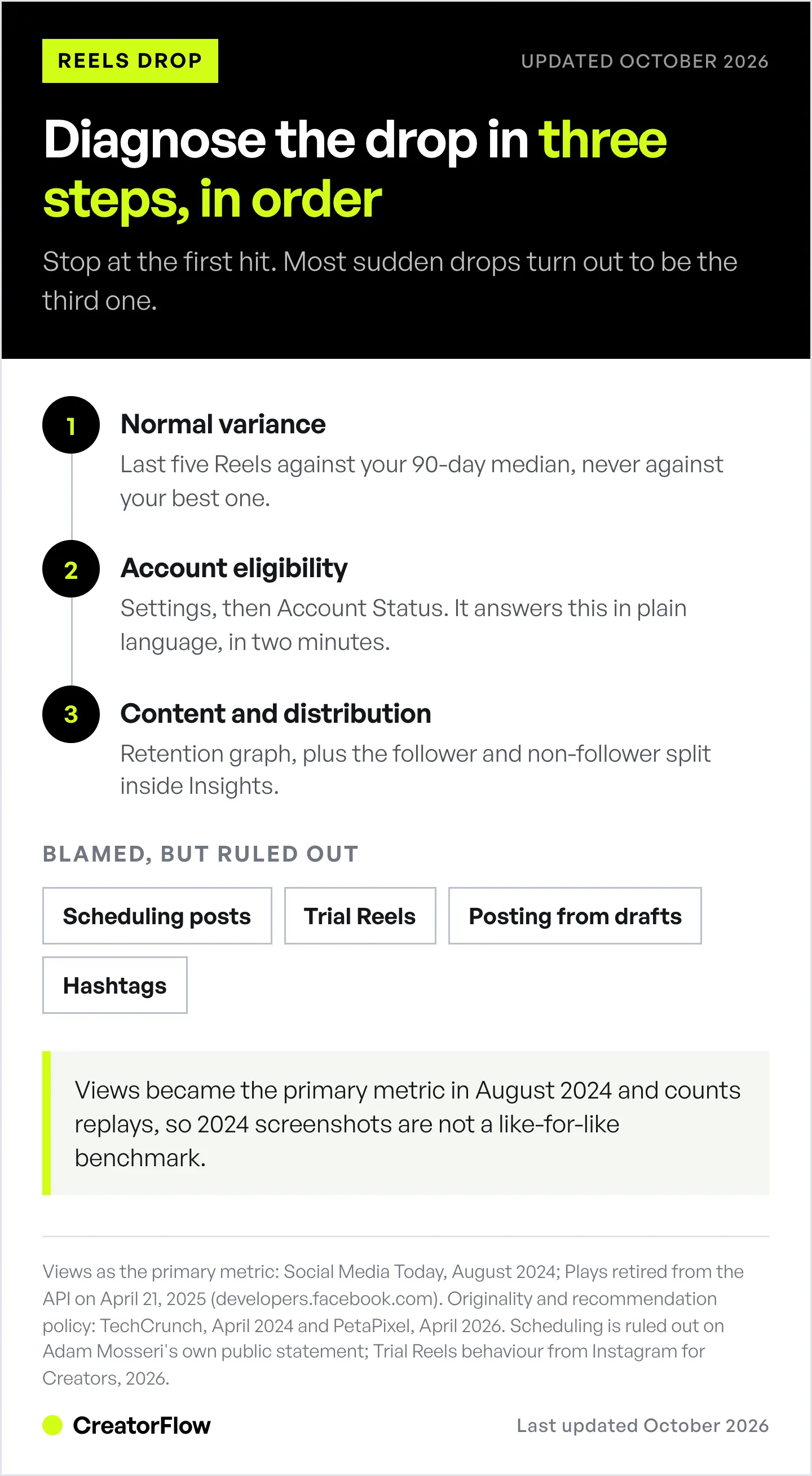
Run the check in this order and stop at the first hit.
| Step | Where to look | What tells you this is the cause |
|---|---|---|
| 1. Normal variance | Insights, last 5 Reels vs 90-day median | Only one or two posts are down. Your floor has not moved |
| 2. Account eligibility | Settings, then Account Status | It reads that your content is not eligible to be recommended |
| 3. Content and distribution | Retention graph plus follower/non-follower split | Non-follower reach fell while follower reach held, and retention drops inside the first three seconds |
Step 2 takes about two minutes and is worth doing before you touch your content. Instagram’s Account Status screen tells professional accounts in plain language whether their content is eligible to be recommended. If it says you are not eligible, no amount of hook rewriting will fix it, and you should work through the Instagram shadowban check and recovery guide instead. One new cause since August 31, 2026: if your account shows an AI-generated person without Instagram’s “AI-generated profile” label, Instagram limits its reach, and Account Status shows it (creators.instagram.com, August 2026). If it says you are clear, the problem is your content, and the rest of this guide is about that. For a wider sweep of the signals worth watching, run an Instagram account health check.
Before you rewrite anything, check the length of your recent Reels. Instagram does not recommend Reels longer than 3 minutes to new audiences, meaning people who don’t follow you (help.instagram.com, October 2026). If you moved to longer Reels around the time views fell, that is the likely cause. Cut the next Reel under 3 minutes and compare its non-follower reach.
How Instagram Decides Which Reels Travel
Instagram releases a Reel to a small initial audience, measures the response, and widens the circle only if the early signals hold. Mosseri has described this as an audition. A Reel that stalls at a few hundred views did not get suppressed. It got tested, and the test data told the system to stop spending distribution on it.
This is why the drop feels sudden and total. There is no gradual decline built into the mechanic. Either your Reel clears the first audition and keeps expanding, or it does not and stops near the size of the test group. The gap between 400 views and 40,000 is one threshold, not a slow slide.
Mosseri has consistently named three signals as the ones that carry the most weight: watch time, sends per reach, and likes per reach. Two details in that list matter more than creators realise. Sends per reach counts people forwarding your Reel in a DM, which is the strongest available proof that a stranger found it worth passing on. And these are ratios against reach, not raw totals, so a small Reel with a high send rate can outrank a big one with a low rate.
The practical read: watch time decides whether you clear the audition, and sends decide how far you go after that. If your retention graph falls off a cliff in the first three seconds, you are failing at step one and nothing downstream gets a chance to matter. Instagram analytics for creators covers which numbers in Insights are worth tracking week to week.
Four Things That Are Not Causing Your View Drop
Scheduling, Trial Reels, drafts and hashtags get blamed for view drops all the time, and none of them holds up.
Scheduling your posts. Mosseri addressed this directly in a March 2025 Q&A: “if you use something like scheduled posts, it will not affect your reach one way or the other.” Meta operates a publishing API precisely so approved tools can post on your behalf, and content published that way is ranked the same as content posted by hand.
Posting Trial Reels. Trial Reels go to non-followers only, so they will not appear on your grid or in your followers’ feeds, and their numbers do not read like a normal post. That is the feature working, not a penalty. Public accounts with at least 1,000 followers get metrics after roughly 24 hours, and a strong Trial Reel can auto-share to followers based on its first 72 hours (Instagram for Creators, 2026). One real trap sits here: re-uploading a Reel already on your feed as a Trial gets it suppressed as a duplicate. See how Trial Reels work before you run a batch.
Saving as a draft first. Publishing from a draft is publishing. There is no documented ranking difference between a Reel posted immediately and one that sat in drafts for a week.
Hashtags. Hashtags now play a minor role next to watch time, sends, and originality, and Instagram now allows only 5 per post (help.instagram.com, October 2026). Adding thirty of them will not rescue a Reel the system has already read as generic, and removing them will not cause a collapse.
Ruling these out matters because each one sends you tinkering with the wrong variable. Every week spent changing your posting tool is a week not spent on the thing that moved.
What Changed in How Instagram Ranks Content
For years Instagram’s algorithm ran on pattern matching. It identified the topic of your Reel, matched it to an interested audience, and checked whether the format resembled things that had performed before. Reusing a hook that worked for someone else raised your odds, which is why “study the outliers and recreate them” became the default growth advice. That mechanic still exists, but it no longer decides the outcome on its own. Instagram now weighs whether your content is genuinely different from what already exists, running duplicate detection while Mosseri’s public statements point the recommendation engine toward originality and credibility rather than raw engagement.
Instagram has not published a slide saying “we transcribe your script and score it for uniqueness,” so treat the precise mechanics as informed inference. What it has confirmed is enough. In April 2024 it announced two changes to its recommendation system (TechCrunch, April 2024):
- Aggregators lose recommendations. Accounts that repeatedly post content they didn’t create or meaningfully change (10 or more times in 30 days) stop appearing in recommendation surfaces like Explore and the Reels feed.
- Originals replace duplicates. When Instagram finds two or more identical pieces of content, it recommends only the original one. The original directly replaces the repost in recommendations.
On April 30, 2026, Instagram extended the policy from Reels to photos and carousels: “The same protections we introduced to reels in 2024 will now apply to photos and carousels” (creators.instagram.com, April 2026). Mosseri’s words: “If most of what you post to Instagram is someone else’s content, your account is no longer going to be recommendable” (PetaPixel, April 2026).
Reposting is the obvious target here. But the same logic strains anything that sits close to a duplicate, including content that copies a competitor’s idea, structure, and script closely enough that the system sees little new signal. You don’t have to be a repost account to land in the low-value bucket. You only have to be indistinguishable. For the full breakdown of the ranking surfaces and signals behind this, see how Instagram’s ranking systems work.
Why Copying Top Performers Stopped Working
Copying top performers stopped working because too many creators copy the same Reel at the same time. The standard advice was to find the best-performing Reels in your niche, break down the hook and structure, and recreate them. It worked while the algorithm rewarded proven patterns. Now run it forward. A thousand other creators got the same advice, watched the same outlier, and rebuilt the same hook in the same week. By the time you post your version, the platform has seen that angle hundreds of times in 24 hours, so there is nothing new to learn about your content and no reason to push it to a fresh audience.
Studying your niche is still useful. You need to know the formats people expect and the topics that land, and a library of hook structures is a fine starting point as long as you bring your own angle. The mistake is stopping there and shipping a slightly cleaner copy. Reach now comes from the gap between what your niche already does and what only you bring.
Why AI-Written Scripts Get Buried
A lot of creators now open ChatGPT or Claude, say “give me five Reel ideas and scripts for my niche,” and post the polished output. It feels efficient. It is one of the fastest ways to flatten your reach.
Mosseri’s December 31, 2025 year-end memo made Instagram’s direction explicit. Two lines matter most: “The bar is shifting from ‘can you create?’ to ‘can you make something that only you could create?’” and, on rawness, that it “isn’t just aesthetic preference anymore” because now “it’s proof. It’s defensive” (Adam Mosseri, December 2025). The platform is steering toward content that proves a real human made it.
There is a second problem AI scripts can’t solve. A general language model writes toward the average of everything it has read, producing the safe middle version of your point. It strips out the odd phrasing, the specific story, the joke that only makes sense if you were there. Those are the exact things that make a viewer remember you.
Use AI for the boring work: captions, grammar, research, repurposing a transcript. Do not use it to generate your ideas, hooks, or point of view. The moment your creative direction comes from a model, you are producing content built to blend in. For a fuller map of where AI helps and where it hurts, see how to make viral Instagram Reels using AI.
Two More Forces Working Against Generic Reels
Generic Reels also lose to two forces outside the algorithm: viewers who spot generic content fast, and AI assistants that already answered the basic question. Both point at the same missing ingredient.
Your audience’s pattern radar. Viewers have watched enough content to spot the generic. They often can’t explain why a video feels off. It feels hollow, like the personality was sanded down, and a real person reading an AI-written script still triggers it. People scroll, and a fast scroll-away is the exact signal that ends your audition.
ChatGPT replaced the first search. When someone wants to know how to lose weight or grow an account, they ask an AI assistant and get an answer tailored to their situation. Gartner forecast search engine volume dropping 25% by 2026 as people move to chatbots (Gartner, February 2024). By the time that person opens Instagram, they already have the basic information, so a 60-second Reel listing generic tips offers them nothing. Surface-level content now loses to the AI the viewer already consulted.
How to Find Your Content DNA
Your content DNA is the mix of hook type, structure and energy that makes a Reel recognisably yours. You find it with a repeatable move: stop pulling inspiration only from inside your niche, where everyone copies everyone, and start pulling structure from outside it.
Pick a niche that has nothing to do with yours. If you teach personal finance, study cooking creators, or carpentry, or stand-up comedy clips. Watch their best-performing content and ignore the topic completely. Look only at the mechanics:
- The hook type. Is it a contrarian statement, a visual cold open, a question, a number? What category of hook is doing the work?
- The structure. How fast is the first cut? Where does the pattern interrupt land? How is tension built and paid off?
- The energy. Is it deadpan, frantic, calm, conversational? What does the delivery feel like?
Those building blocks are your content DNA. Take a structure that works in a completely different world and transplant it into yours. A cooking creator’s “do this one weird step” format applied to a finance tip. A comedian’s setup-and-reveal timing applied to a product demo. Because nobody in your niche is doing it, the algorithm can’t pattern-match it against your competitors, and your viewer hasn’t seen it a hundred times this week.
This is the part you can’t outsource to an AI. Finding the move that fits your audience, your strengths, and your personality takes your own judgment. Knowing who your content is really for is what tells you which outside-niche format will land. Once you find a format that works, the algorithm has something new to push, and the organic reach strategies that used to feel dead start working again.
Here is the part that should make you move rather than panic. Because copying and AI scripts have flooded the feed with sameness, creators willing to be specific, personal, and a little weird stand out more than ever. The bar to be original is low and the field is level. That window does not stay open forever, and the accounts left standing are the ones that build a real audience while it is still easy.
Your 7-Day Fix for Instagram Reels Not Getting Views
A practical reset you can run this week. Do the triage at the top of this guide first, so you know you are fixing content and not an account flag.
- Audit your last 10 Reels. Put them next to 10 Reels from competitors in your niche. If a stranger couldn’t tell which were yours, that is your problem, in one image.
- Cut the AI from your creative work. Stop using a model to generate ideas, hooks, and scripts. Keep it for captions and admin only.
- Pick two outside niches. Choose niches unrelated to yours and save five high-performing Reels from each.
- Map the DNA. For each saved Reel, write down the hook type, the structure, and the energy. Topic doesn’t matter.
- Transplant one format. Take one outside-niche structure and rebuild a Reel for your niche around it. Add one specific story, opinion, or detail only you could give.
- Post and watch retention. Check the retention graph, not just views. A format that holds attention past three seconds is one to repeat. If retention dips in the middle of a Reel, layering in B-roll is the fastest fix.
- Double down on what feels like you. Keep the formats that are both original and natural to deliver. Drop the ones you were forcing.
You won’t fix months of flat reach in a week, but you will give the algorithm something it hasn’t seen, which is the entire point. For the engagement side of the equation, pair this with content built for saves and shares, the signals Mosseri has named as the ones that matter most. And before you judge a Reel a failure, compare your numbers against Instagram engagement rate benchmarks by follower count so you know what normal looks like at your size.
Turn New Reach Into an Audience You Own
Originality gets you the views back. It does not, by itself, build a business. A Reel that reaches 100,000 people is worth little if all 100,000 scroll on and the algorithm decides tomorrow not to show your next one.
The creators who survive the next crowded cycle are the ones who convert reach into a direct relationship while they have the attention. When a Reel lands and the comments fill with people asking for your guide, your link, or your steps, that is the moment trust is highest and most temporary. Answering it manually means most of those people are gone before you reply.
CreatorFlow, a tool that automates Instagram DMs, turns that moment into a connection you keep. When someone comments your trigger word, they get your link, your resource, or your next step in their DMs in seconds, and on the Pro and Growth plans the Email Gate collects their email on the way. The reach belongs to Instagram. The audience you build from it belongs to you. See how comment-to-DM automation works and turn your next original Reel into an audience no algorithm change can take away.
Run a recent Reel through the free Reel analyzer to see how its hook and structure hold up.
FAQ
Why did my Instagram Reels suddenly stop getting views?
Check three causes in order. First, confirm the drop is real by comparing your last five Reels against your 90-day median rather than your best post. Second, open Settings and then Account Status to see whether your content is still eligible to be recommended. Third, if you are eligible, the cause is your content, and unoriginal or AI-scripted Reels are the most common reason reach gets capped.
Am I shadowbanned or is it just the algorithm?
Instagram’s Account Status screen answers this directly for professional accounts by stating whether your content is eligible to be recommended. If it says you are eligible, you are not facing an account-level restriction and the problem is distribution. The other tell is the follower split in Insights. A true account-level issue drags down follower and non-follower reach together, while a content problem leaves follower reach roughly intact and collapses non-follower reach.
Why are my Reels getting 0 views all of a sudden?
Genuine zero, rather than low, usually means the Reel never entered distribution. Check whether it posted as a Trial Reel, since those go to non-followers only and do not appear on your grid. Then check Account Status for a restriction, and check whether the audio was muted or the video removed for a rights claim. A Reel that is merely underperforming will still show views in the hundreds.
Does Instagram penalize AI-generated content?
Instagram has not announced a blanket penalty for AI-assisted content. Mosseri’s December 2025 memo says raw, imperfect content is becoming proof that a real person made it, and lists better ranking for originality as a 2026 priority (Adam Mosseri, December 2025). Accounts that show an AI-generated person should turn on Instagram’s AI-generated profile label, or they can lose reach. Using AI tools for editing does not need the label (creators.instagram.com, August 2026). Use AI for captions and grammar, and keep your ideas and hooks your own.
Do scheduled posts or drafts get fewer views than live posts?
No. Mosseri said in a March 2025 Q&A that using scheduled posts “will not affect your reach one way or the other.” Meta runs a publishing API so approved tools can post on your behalf, and that content is ranked the same as anything posted by hand. Publishing from a draft carries no documented penalty either.
Should I delete a Reel that got no views?
Deleting rarely helps and removes the data you need. A single underperforming Reel does not drag down your account, and the retention graph on that post tells you where viewers left, which is the most useful diagnostic you have. Rebuild the Reel with one variable changed, usually the first three seconds, and post it as a new upload rather than re-uploading the same file.
Is reposting other creators’ content bad for reach?
Yes, if it is most of what you post. Instagram confirmed that accounts reposting content they didn’t create 10 or more times in 30 days are removed from recommendation surfaces, and that it replaces duplicates with the original creator’s version (TechCrunch, April 2024). On April 30, 2026 the rule expanded from Reels to photos and carousels (creators.instagram.com, April 2026).
How long does it take to recover Instagram reach?
There is no fixed timeline. Under the originality policy, accounts become eligible for recommendations again “when most of their recently posted photos, carousels, and reels are considered original in a 30-day period” (creators.instagram.com, April 2026). The check runs on a rolling basis, and Account Status shows where you stand. For low reach caused by generic content rather than a flag, recovery depends on how quickly you start posting genuinely different content. Expect weeks of testing, not days.
Instagram ranking, metric and policy details verified from creators.instagram.com, help.instagram.com, Meta’s developer changelog, TechCrunch, PetaPixel, Social Media Today, Adam Mosseri’s public statements and December 2025 year-end memo, and Gartner as of September 2026. The 5-hashtag limit, the Views metric change and the 3-minute Reels recommendation rule were re-checked in October 2026. Individual results vary.


