

Making viral Instagram Reels with AI means reverse-engineering the patterns behind outlier videos, then using AI to script, iterate, and ship those patterns faster, not asking AI to “make something viral.” Viral Reels follow five repeatable structures: POV, authority hook, micro-story loop, transformation reveal, and open loop. AI compresses the slow parts (ideation, scripting, variant testing) so you publish more attempts and let retention data find the winner.
Most “go viral with AI” advice is backwards. It treats AI as a slot machine: prompt it, post the output, hope for reach. That produces generic, forgettable Reels, and in 2026 Instagram’s algorithm actively buries them.
Here’s what actually works. Virality on Reels is not random. The videos that explode share a small set of structural patterns, and those patterns are learnable. AI doesn’t invent virality. It removes the friction between knowing a pattern and shipping ten clean attempts at it.
This guide breaks down the five patterns behind viral Reels, a seven-step method to reverse-engineer any outlier, where AI genuinely speeds up the workflow (and where it sabotages you), and how to turn the whole thing into a repeatable system.
Key Takeaways
- Virality is structural, not lucky. Most viral Reels use one of five patterns you can copy by structure.
- Reverse-engineer outliers, not trends. Translate the pattern, not the topic, into your niche.
- Retention is the metric that matters. Views are a lagging indicator; watch-through and replays drive reach.
- AI’s real job is iteration speed. Use it to ideate, script, and generate variants, not to auto-generate finished videos.
- Originality is now an algorithm signal. Instagram down-ranks recycled and obviously AI-spun content (Mosseri, as of May 2026), so AI must support an original idea, not replace it.
- A viral Reel is wasted without a capture system. Convert the comment spike into DMs while attention is hot.
What “Viral” Actually Means on Reels in 2026
A Reel is “viral” when its reach far exceeds your follower count because non-followers keep watching, replaying, and sharing it. Instagram measures interest through behavior, not vanity metrics. The signals that trigger amplification are watch-through rate, replays, shares, and saves, in roughly that order of weight. If you are new to the format, our guide on how to make Instagram Reels walks through the basics first.
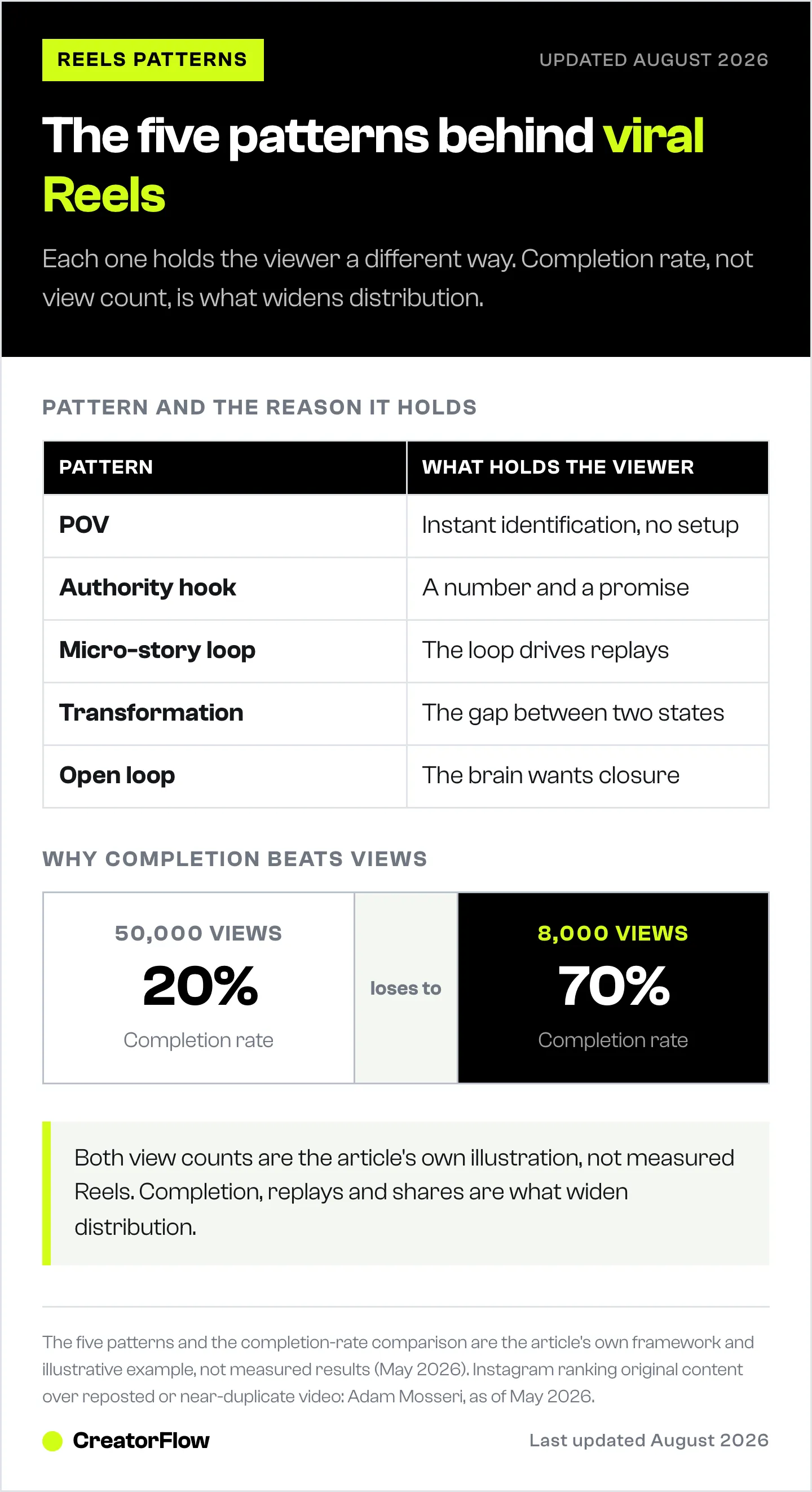
That distinction matters. A Reel with 50,000 views and a 20% completion rate underperforms a Reel with 8,000 views and a 70% completion rate, because completion tells the algorithm the content delivered. Chase retention, and views follow.
How the Reels Algorithm Amplifies Content
Instagram tests every Reel on a small audience first. If early watchers complete it, replay it, or share it, the system widens distribution in waves. Weak openings kill that test before it starts.
Two 2026 realities shape this:
- Originality is ranked. Instagram prioritizes original content and reduces reach for reposted or near-duplicate videos (Mosseri, as of May 2026). Lazy AI output that looks like everyone else’s gets throttled. See why Reels stop getting views for the full breakdown.
- The first second is the whole game. Retention is decided in the opening frame, before anyone reads a caption.
The 5 Patterns Behind Viral Instagram Reels
Almost every viral Reel maps to one of these structures. Learn them and you stop guessing.
1. The POV Format
You drop the viewer into a specific moment (“POV: you finally fired the client who paid late”). It works because it bypasses explanation and creates instant identification. The viewer is the subject.
2. The Authority Hook
You open with a credibility-loaded claim (“I’ve scripted 400 Reels. Here are the three openings that never fail.”). The specificity and stakes earn the watch. Numbers and a clear promise do the heavy lifting.
3. The Micro-Story Loop
A 7-15 second narrative with a setup, a turn, and a payoff that loops back to the opening. The loop drives replays, and replays drive reach.
4. The Transformation Reveal
Before-and-after, ugly-to-clean, confused-to-clear. The gap between the two states is the hook. The viewer stays to see the resolution.
5. The Open Loop Hook
You pose a question or tease an outcome the viewer must keep watching to resolve (“Don’t post another Reel until you fix this one setting.”). The open loop holds attention because the brain wants closure.
How to Reverse-Engineer Any Viral Reel (7 Steps)
This is the method. AI accelerates several steps, but the thinking is yours.
Step 1: Study Outliers, Not Averages
Find Reels that vastly outperformed the creator’s typical numbers. An account that usually gets 5,000 views with one Reel at 2 million is showing you a pattern, not a fluke.
Step 2: Break the Reel Into Components
Separate the hook (first 1-2 seconds), the structure (which of the five patterns), the pacing, the payoff, and the on-screen text. Strip away the topic.
Step 3: Identify the Retention Driver
Ask one question: what specifically made people not scroll? Usually it’s the open loop, the stakes, or the transformation gap. Name it.
Step 4: Translate the Pattern, Not the Topic
This is where most creators fail. Don’t remake the video. Take the structure and apply it to your niche. A fitness transformation Reel becomes a “messy spreadsheet to clean dashboard” Reel for a finance creator.
Step 5: Script With Intentional Friction
Write the hook first, then justify the rest. Build in a small open loop early and a clear payoff. This is where AI earns its place (more below).
Step 6: Pressure-Test the Hook
Read the first line alone. If it doesn’t create curiosity, stakes, or identification in isolation, rewrite it. Generate five hook variants and pick the sharpest.
Step 7: Optimize the Frame Around the Reel
Cover image, first caption line, and the comment CTA all shape the result. A great Reel with a dead caption leaves reach (and conversions) on the table.
Where AI Actually Speeds Up Viral Reels

AI is a workflow accelerator, not a creativity replacement. Used well, it collapses the slow parts of the process.
Where Creators Lose Time
Ideation, scripting, writing hook variants, drafting captions, and deciding what to test next. Each is hours of friction that kills consistency.
How AI Compresses the Workflow
- Ideation: Feed AI your five best-performing Reels and ask for ten new concepts that reuse the structure in different angles.
- Scripting: Turn a pattern and a topic into a 12-second script with a hook, loop, and payoff in seconds.
- Hook variants: Generate 10 openings for one idea, then pick or remix the best. Variant volume is where AI wins.
- Captions and CTAs: Draft the caption and comment trigger that frame the Reel for conversion.
For prompt frameworks, see AI prompts for Instagram content creation, and for the tool options, the best AI Instagram post generators.
The Real Advantage: Iteration
Virality is a numbers game played with structure. The creator who ships ten pattern-driven attempts a week beats the one who agonizes over one “perfect” Reel. AI’s contribution is volume with structure, more shots on goal without dropping quality.
The Trap to Avoid
Do not let AI generate finished, generic content you post unedited. Instagram’s originality ranking penalizes it, and viewers feel the hollowness. AI drafts; you direct, edit, and add the original spark. AI without structural awareness produces noise. For the production side of AI-generated video specifically, see AI video for Instagram.
Turn Viral Reels Into a Repeatable System
One viral Reel is luck. A system that produces them is a business.
- Build a swipe library. Save 30-50 outlier Reels in your niche, tagged by pattern.
- Create format buckets. Group your own attempts by the five patterns so you can see what works for your audience.
- Batch scripts with AI. Write a week of pattern-driven scripts in one session.
- Track retention, not just views. Watch completion rate and replays in Instagram Insights; double down on the formats that hold attention.
- Stack winners into series. When a format hits, turn it into a recurring series so the algorithm and your audience both learn to expect it.
Common Mistakes That Kill Reels
- Opening with context, not a hook. The first second decides everything. Lead with the hook; explain later.
- Copying trends instead of translating patterns. Trends expire; patterns compound.
- Overexplaining. Every second must move the story forward or the viewer scrolls.
- Weak or delayed payoffs. If the resolution doesn’t land, retention collapses.
- Inconsistent testing. One Reel proves nothing. Test formats in batches.
- Using AI without structural awareness. Generic output gets throttled and ignored.
The Step Most Creators Skip: Capturing the Spike
A viral Reel floods your post with comments, “link?”, “how?”, “send me the guide.” Reach is the easy part now; capture is where creators leak money. If you reply hours later, the interest is gone.
This is the loop that closes the system. Set a trigger word, and when a viral Reel sends a wave of comments, every commenter gets an instant DM with your link, lead magnet, or booking page, automatically, 24/7. The Reel earns the attention; the automation converts it before it cools.
CreatorFlow runs on Meta’s official Instagram API at a flat $15/month with no per-contact fees, so a Reel that does 10x your usual reach doesn’t cost you 10x to monetize. For the full playbooks, see turning Reels views into DM sales and Instagram Reels that sell.
Start your free trial at creatorflow.so
FAQ
Can AI make my Instagram Reels go viral on its own?
No. AI can’t manufacture virality, and in 2026 Instagram down-ranks generic AI-generated content (Mosseri, as of May 2026). What AI does well is accelerate ideation, scripting, and variant testing so you ship more structurally sound attempts. The pattern and the original idea still have to come from you.
What makes an Instagram Reel go viral in 2026?
Retention. Reels that hold attention through the first second and earn replays, shares, and completions get amplified to non-followers. Most viral Reels use one of five patterns: POV, authority hook, micro-story loop, transformation reveal, or open loop.
How do I reverse-engineer a viral Reel?
Find an outlier that beat the creator’s average, break it into hook, structure, pacing, and payoff, identify what stopped the scroll, then translate the pattern (not the topic) into your niche. Script the hook first and test multiple variants.
Which AI tools help create viral Reels?
Use AI for the slow steps: idea generation, scripting, hook variants, and captions. The specific tool matters less than the workflow. See our guides on AI Instagram post generators and AI prompts for Instagram content for current options and frameworks. To pick a tool that generates the footage itself, compare the best AI video generators for creators.
How many Reels should I post to go viral?
There’s no fixed number, but virality is a volume game played with structure. Creators who consistently ship pattern-driven Reels (several per week) and iterate on what retains attention reach virality far faster than those polishing one video at a time.
Does AI-generated content hurt Reels reach?
It can. Instagram’s algorithm rewards original content and reduces reach for recycled or obviously AI-spun videos (Mosseri, as of May 2026). Use AI to support an original idea, then edit and add your own voice so the final Reel doesn’t read as generic.
Disclaimer: Instagram algorithm behavior, features, and best practices mentioned in this article were verified as of May 2026 and may change without notice. Instagram is a trademark of Meta Platforms, Inc. CreatorFlow is not affiliated with, endorsed by, or sponsored by Meta Platforms, Inc. Strategies described are based on aggregate creator data and platform guidance; individual results vary by niche, audience, and content quality.


