
Your Instagram reach is dropping because Instagram ranks posts on watch time, sends per reach (DM shares) and likes per reach, and sends count slightly more for reaching people who don’t follow you. Posts that only collect likes from existing followers stop traveling. Average reach fell 14% in a year, to 4.9% of followers (Socialinsider, September 2026). The fix is not posting more. It is making content people share, then turning those shares into DM conversations that compound your reach.
One more variable landed in 2026: your audience can now switch topics off. See how Your Algorithm topic controls work before you rule out a classification problem.
You post the same way you did last year. Same cadence, same hashtags, same formats. The numbers slide anyway. A Reel that would have pulled 20,000 views now stalls at 3,000. Story views drop. New followers trickle instead of pour. It feels like a penalty, so the instinct is to post twice as often and hope volume forces the algorithm’s hand.
That instinct is wrong, and it makes the problem worse. This guide explains what changed, why the old playbook stopped paying off, and the reach strategy that works in 2026: building content around the DM, not the feed. It is written for solo creators, coaches, and small brands who do not have an agency running their account.
Key Takeaways
- Reach didn’t get penalized, it got re-priced. Instagram’s head names watch time, sends per reach and likes per reach as the top signals. Sends count slightly more for reaching new people, and follower count is not on the list, so posts that used to coast on likes from followers now flatline.
- Organic reach is structurally lower for everyone. Average reach is 4.9% of followers, down 14% year over year (Socialinsider, September 2026). This is the new baseline, not a temporary dip.
- Posting more amplifies a weak strategy. If content does not earn attention in the first seconds, extra posts just feed the algorithm more proof it should not distribute you.
- Sends per reach is the growth signal you’re under-optimizing. A DM share is a personal recommendation, and it reaches people who have never heard of you. Mosseri has called it one of the most important ranking signals on the platform (Adam Mosseri, July 2024).
- Reach follows conversations, not posts. Relationship strength, reply speed, and conversation depth all feed distribution. Content that starts a two-way DM thread compounds far past a single share.
- The winning loop: a clear point of view, a shareable asset, a comment-to-DM trigger, and a fast reply that keeps the thread alive. Automating the reply step is how small accounts run this loop at scale.

Your Reach Didn’t Get Penalized, It Got Re-Priced
Nothing is wrong with your account. Instagram changed what it pays for, and the content you make was priced for the old market.
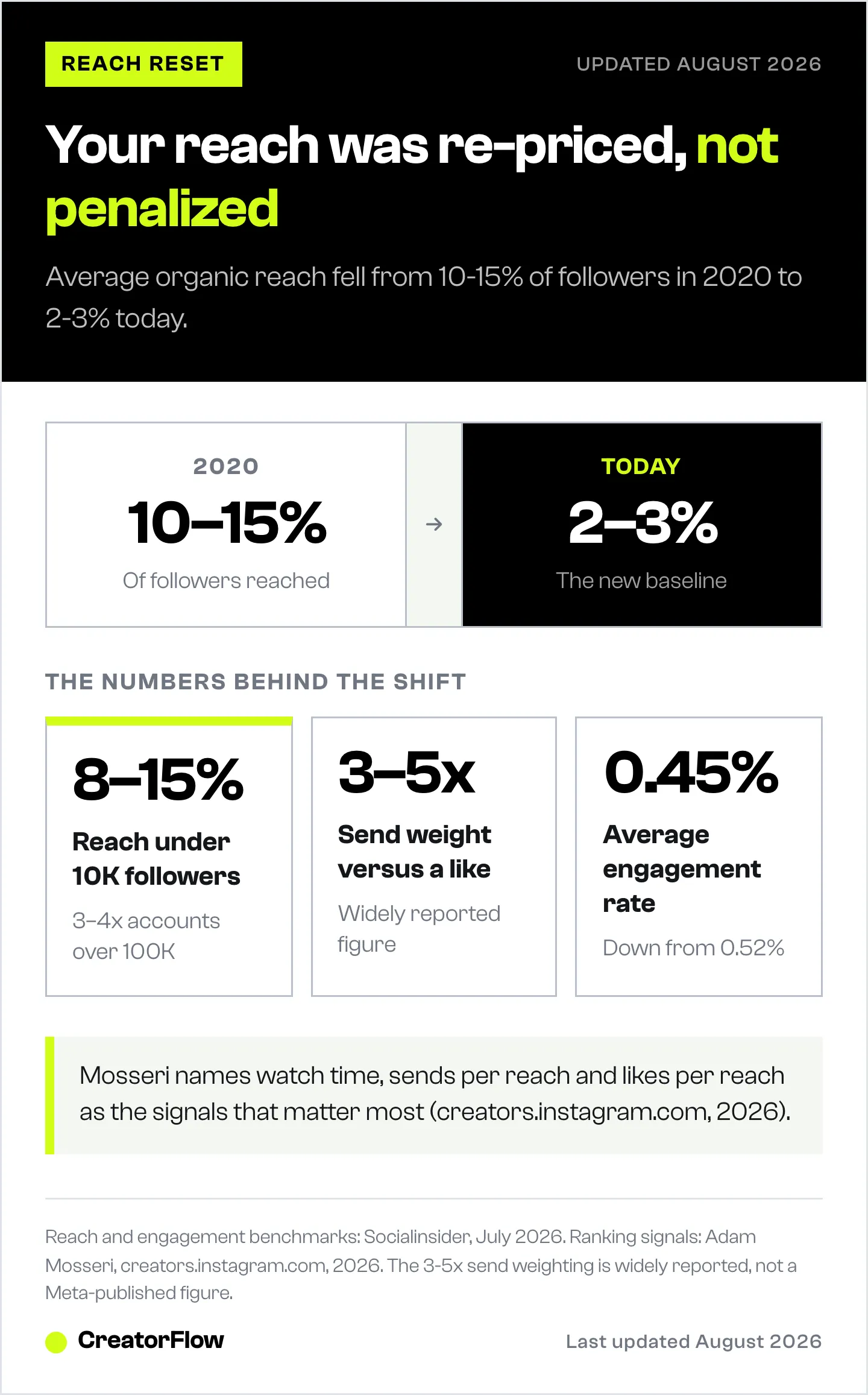
For most of Instagram’s history, popularity was a fair proxy for quality. Likes were cheap to earn, so the algorithm rewarded them. That era ended. Benchmark data shows average reach fell 14% in a year, to 4.9% of followers, and average engagement fell 24% in 2025 (Socialinsider, July and September 2026). Smaller accounts still do better: accounts with 1,000-5,000 followers reach 6.65% of their followers on average, above the 4.9% average (Socialinsider, September 2026). So a follower count you were proud of can work against your reach rate.
The reason is a signal swap. Instagram head Adam Mosseri named the three signals that matter most: watch time, sends per reach (DM shares), and likes per reach. Likes are “slightly more important for connected content, and sends are slightly more important for unconnected content” (Adam Mosseri, January 2025). Likes still count, but they mostly move a post among people who already follow you. Posts engineered to farm likes lost their engine. If you want the surface-by-surface mechanics, our breakdown of how each Instagram ranking system works covers Feed, Reels, Stories, and Explore separately.
The Old Playbook Stopped Paying Off
Three tactics defined Instagram growth for years. All three are dead levers now.
Posting more. Volume worked when reach was cheap and attention was patient. Today, every post that under-performs teaches the algorithm your account is a weak bet. More weak posts equals less reach, not more.
Hashtag stuffing. Hashtags were a discovery mechanism. Instagram now allows only 5 hashtags per post (help.instagram.com, September 2026), and it told creators in August 2026 that its search “uses captions as reference data for discovery” (Social Media Today, August 2026). A wall of 30 hashtags is no longer possible, and the words in your caption now do more for search.
Chasing follower count. Followers used to be the credibility metric. Follower count is not one of the signals Instagram names, and benchmark data shows reach rate falls as accounts grow. A 5,000-follower account with strong sends can out-reach a 50,000-follower account that only gets likes.
None of these levers are coming back. The accounts still growing swapped volume for intent, and the clearest measure of intent is the DM share.
Sends Per Reach Is the Signal You’re Under-Optimizing
Here is the one metric to build around. When someone sends your post to a friend in a DM, that is not a passive tap. It is a personal recommendation, and the person on the receiving end does not follow you yet. That is exactly how you reach new audiences.
Mosseri put it plainly: “One of the most important signals we use in ranking is sends per reach. So out of all the people who saw your video or photo, how many of them sent it to a friend” (Adam Mosseri, July 2024). Instagram has never put a number on it. Mosseri’s own word is that sends are “slightly more important” than likes for reaching people who don’t follow you, while likes mostly recirculate you to people who already do (January 2025).
That reframes the question you ask before you post. Not “will my audience like this?” but “will one person send this to one specific friend, and why?” Shareable posts tend to do one of three jobs:
- Solve a specific problem the sender’s friend is dealing with right now
- Put words to something people feel but cannot articulate, so sending it says “this is us”
- Deliver something so useful that keeping it private feels selfish
If a post does none of those, it may still please your existing followers, but it will not break out to new ones. Build the share trigger into the concept, not as an afterthought.
Reach Follows Conversations, Not Posts
This is where most reach advice stops, and it is the half that compounds. A DM share is one event. A DM conversation is a relationship signal that keeps paying. Who those conversations are with is the other half; see narrowing the audience instead of the topic.
Instagram’s Feed algorithm ranks content from accounts you follow by relationship strength, measured through DMs, comments, story replies, and profile visits. Instagram’s own ranking explainer lists your interactions with the person who posted, such as comments and messages, as a Feed signal (about.instagram.com, May 2023). Instagram has not published how it weighs a long thread against a one-word comment, but every reply brings people back to the post (see the sourced algorithm mechanics breakdown for the surface-level detail). Every DM exchange strengthens the tie that decides whether your next post even reaches that person.
So the accounts that hold reach are not just making shareable content. They are converting reactions into conversations:
- A comment gets a reply within the hour, which pulls the commenter back and cues others to join
- A story reply gets a real DM back, deepening the relationship signal for both Stories and Feed
- A “comment the word and I’ll DM it” prompt turns a public comment into a private thread that Instagram reads as a strong interaction
A content-only strategy leaves all of that on the table. It optimizes the share and ignores the conversation, which is why reach plateaus even when a post does well. If your Reels specifically are stalling, the format-level causes are covered in why your Reels aren’t getting views.
The Content-to-Conversation Loop: A 2026 Reach Strategy
Put the two halves together and you get a loop that feeds itself. Each stage sets up the next, and the conversation at the end restarts the cycle with more distribution than it began with.
| Stage | What you do | Signal it drives |
|---|---|---|
| Point of view | Define what your account promises in one sentence, so every post is unmistakably yours | Topic-cluster consistency, follows |
| Shareable asset | Make a post one person would DM to one friend | Sends per reach |
| Comment trigger | Add a “comment the keyword” or “DM me the word” call to action | Comments, DM opens |
| Instant reply | Respond in seconds with what they asked for, then keep the thread going | Response speed, relationship strength |
| Depth | Reply to comments and DMs fast enough to spark threads | Conversation depth, repeat reach |
The bottleneck is almost always the reply step. A single comment prompt on a Reel can pull 200 “send me the link” comments in an hour. Answer them four hours later and the window is gone, the sale is gone, and the conversation signal never fires. Answer in seconds and every one becomes a relationship signal.
That is the practical case for automating the reply, not the content. For a wider set of tactics that feed the same signals, our guide to Instagram organic reach strategies and the engagement rate playbook go deeper on formats and timing.
Where DM Automation Fits
You cannot manually reply to every comment and DM within seconds, and the seconds are what the algorithm measures. This is the gap DM automation fills.
When someone comments your trigger word, an automated DM sends them exactly what they asked for, a link, a PDF, a booking page, within seconds. That instant reply does four things at once: it strengthens the relationship signal, opens a DM thread that Instagram reads as a strong interaction, keeps your response time low, and often earns the save or share that started the loop. You are not automating the creativity. You are automating the conversation window so it never closes.
CreatorFlow runs this through Meta’s official Instagram API, so there is no password sharing and minimal ban risk. Comment-to-DM triggers, story reply automation, and keyword responses turn every post into a conversation starter that feeds the exact signals reach now depends on. Flat $15/month, Instagram-only, set up in minutes. It is the reply half of the loop, running while you focus on the content half.
Stop trying to out-post a shift that volume cannot fix. Build for the person who might send your post to a friend, then be ready to talk when they do.
FAQ
Why is my Instagram reach dropping in 2026?
Your reach is dropping because Instagram ranks posts on watch time, sends per reach (DM shares) and likes per reach, and sends count slightly more for reaching people who don’t follow you (Adam Mosseri, January 2025). Average reach fell 14% in a year, to 4.9% of followers (Socialinsider, September 2026). Content built only to earn likes from followers underperforms because it rarely travels to new people. It is a re-pricing of what the algorithm rewards, not a penalty on your account.
Does posting more increase Instagram reach?
Usually not. If your content is not earning attention in the first few seconds, posting more frequently just gives the algorithm more evidence that your posts do not resonate, which lowers distribution further. A value-first approach with fewer, stronger posts, each built to be shared and to start a conversation, outperforms high-volume posting in 2026.
What is sends per reach on Instagram?
Sends per reach measures how often people share your post in a DM relative to how many saw it. It is one of the strongest ranking signals because a DM share is a personal recommendation that reaches people who do not follow you yet. Mosseri has called it one of the most important signals Instagram uses, and says sends are slightly more important than likes for reaching people who don’t follow you (Adam Mosseri, July 2024 and January 2025). Instagram has published no numeric weight.
Does scheduling Instagram posts hurt reach?
No. Mosseri said in a March 2025 Q&A that scheduled posts “will not affect your reach one way or the other.” Posts published through approved tools on Meta’s official API are ranked like posts made by hand. For the mechanics, our breakdown of native Instagram post scheduling covers what the app can queue, the 25-per-day cap, and the 30-day window. Planning ahead can help reach indirectly by letting you review your content for weak hooks and keep the topic consistency the algorithm rewards.
Do likes still matter for Instagram reach?
Likes still count. They are one of the three signals Mosseri names, and they matter slightly more with your followers (Adam Mosseri, January 2025). Sends matter slightly more for reaching new people, and watch time matters everywhere. Likes mostly recirculate you to existing followers, whereas sends push you to new audiences. Optimize for shares and saves first, and treat likes as a secondary indicator.
How does replying to DMs and comments affect reach?
Replies feed the relationship strength and conversation depth signals that decide whether your future posts reach that person. Fast replies pull people back into the thread and encourage others to join, which the algorithm reads as strong engagement. Responding within the first hour, and within seconds where possible, compounds your reach over time.
What is the best Instagram growth strategy for 2026?
Build a content-to-conversation loop. Define a clear point of view so your account is unmistakable, make posts one person would send to a specific friend, add a comment or DM trigger, then reply fast enough to start a real conversation. Sends per reach gets you in front of new people, and the DM conversation that follows compounds the relationship signal that sustains reach.
Instagram reach and algorithm signals verified from Socialinsider, about.instagram.com, help.instagram.com, and Adam Mosseri’s public statements (via Social Media Today) as of September 2026. Individual results vary.


