

Price against the outcome your offer produces, not the hours it takes you. Start from what the result is worth to the buyer, check it against what similar offers sell for, then test the number in DMs before you build anything. An Instagram audience will pay well for a specific, named result and poorly for access to your time, which is why hourly pricing consistently underperforms here.
You have 14,000 followers, something worth selling, and no idea what to charge. So you look at what somebody else charges, land on £97 because it sounds reasonable, and then discover that £97 attracts people who need the most support and complain the most, while the person you most wanted to help would happily have paid £900.
This guide covers the four inputs that decide a price, how to test a number before you build the offer, why cheap is harder to sell than expensive, and what to do when the price you need is higher than your audience seems ready for.
Key Takeaways
- Price the outcome, not the delivery. What the result is worth sets the ceiling. Your time sets nothing.
- Cheap offers are harder to sell, attract heavier support demands, and need far more volume to matter.
- Test the number in DMs first. A price nobody has been quoted is a guess.
- Your audience size sets volume, not price. A 3,000-follower account can sustain a high-ticket offer.
- Never price from your own budget. What you would pay is irrelevant to what the offer is worth.
- Raise it in steps. Twenty percent at a time, watching conversion, beats one nervous leap.
How to Price an Offer: The Four Inputs
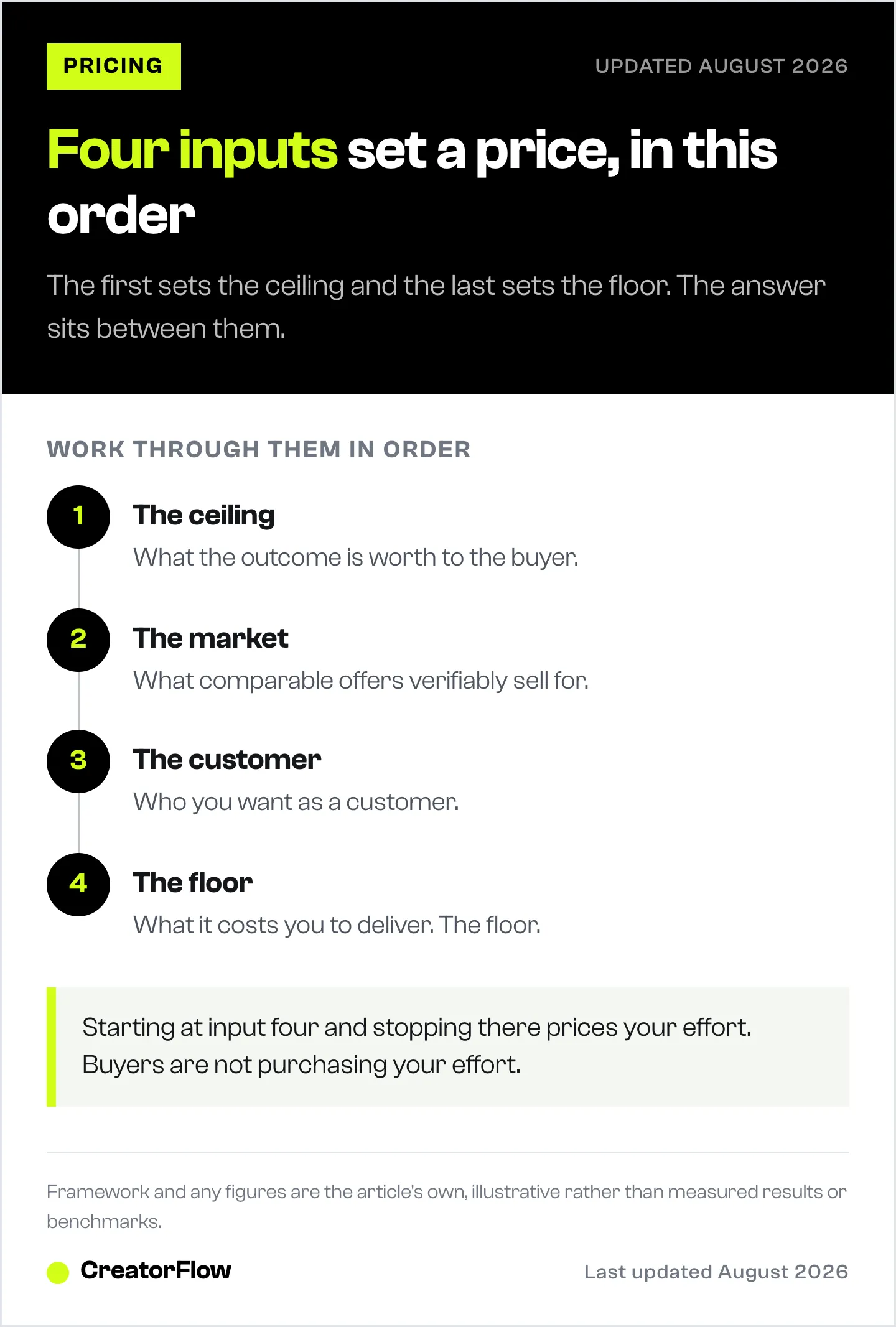
Work through these in order. The first sets the ceiling, the last sets the floor, and the answer sits between them.
1. What the outcome is worth to the buyer. If your programme helps a coach sign three clients at £500, the outcome is worth £1,500 in the first month and more over a year. That number is the ceiling and it has nothing to do with how long the programme takes you to run.
2. What comparable offers sell for. Not what other creators say they charge in Reels, but what things you can verify actually sell at. Look at checkout pages, published prices, and offers you have personally bought.
3. Who you want in the room. Price selects your customers. A low price brings volume and a heavier support load. A high price brings fewer people who are more committed and easier to help. Decide which business you want before you decide the number.
4. What it costs you to deliver. Time, tools, other people, support. This is the floor, and an offer priced near the floor is a job rather than a business.
The common mistake is starting at input four and stopping there. Cost-plus pricing produces a number that describes your effort, and buyers are not purchasing your effort.
Why Cheap Is Harder to Sell
Counterintuitive and consistent across offer types.
A low price raises doubt. A £27 price on something that promises a serious result reads as either too small to work or as something with a catch. Buyers use price as a quality signal because it is the only signal available before purchase.
Cheap buyers demand more. People who paid little are more likely to want extensive support, more likely to ask for refunds, and less likely to do the work that produces their result. That last one matters most, because their outcome is your evidence.
The maths does not work. At £27 you need 40 sales a month to make £1,080. At £900 you need one, plus a small number of conversations. The £27 business requires constant traffic; the £900 business requires a functioning DM conversation.
Low prices leave no room. No margin for ads, affiliates, support, or a bad month.
None of this means expensive is automatically better. It means “make it cheap so more people buy” is usually wrong, and it is the default instinct for a first offer.
Test the Price Before You Build
The most useful thing you can do with a price is quote it to a real person before the product exists.
The sequence:
- Post about the problem, not the product. Describe the situation your offer fixes and ask people who recognise it to comment a keyword.
- Reply with a short description and the price. “I am putting together X. It is £600 and starts in October. Want the details?”
- Count the reactions. Not the compliments, the responses to the number.
What you learn from about fifteen of those conversations:
| What happens | What it means |
|---|---|
| Most people ask a follow-up question | The price is in the right area |
| Most go quiet immediately | Too high for this audience, or the outcome is not clear enough |
| Nobody hesitates at all | Too low. Raise it |
| They ask “what is included” | Normal, and a buying signal |
| They ask “is there a cheaper option” | Real interest, wrong tier. Build the lower rung |
That last row is the one worth acting on. Repeated requests for something cheaper is a signal to build a second rung rather than to lower the price of the first, which is covered in turning one offer into three price tiers.
Pre-selling at the tested price is better still. Money is the only reliable answer, and a handful of paid places before you build tells you more than a hundred survey responses.
Audience Size Sets Volume, Not Price
A common belief is that a small account has to charge small amounts. It has the relationship backwards.
Price is set by the value of the outcome and the specificity of the audience. Size determines how many people you can reach, which determines volume. A 3,000-follower account of architects can sustain a £2,000 offer. A 200,000-follower general lifestyle account may struggle to sell a £40 one, because nothing connects the audience beyond enjoying the content.
Two things a small account should do instead of discounting:
- Get more specific. “Portfolio reviews for junior architects” prices above “design coaching” because the buyer can see themselves in it.
- Sell fewer things at higher prices. Ten sales at £600 is a business. Two hundred at £30 is a full-time job with a support inbox.
When the Price You Need Is Higher Than Feels Comfortable
Almost every creator underprices the first offer, and the reason is that they price from their own budget rather than the buyer’s.
Three ways through it:
Raise in steps. Twenty percent per cohort or per quarter, watching whether conversion actually falls. It usually does not, and the evidence from your own numbers dismantles the fear faster than any argument.
Add proof rather than discount. When the price feels hard to defend, the missing ingredient is normally evidence, not a lower number. A recorded result from one customer is worth more than £200 off.
Change the unit. £900 as a one-off feels large. Three payments of £320 feels manageable and produces more revenue. Payment structure resolves a great many objections that look like price, which is covered in handling price objections in Instagram DMs.
And say the number without flinching. A price delivered with an apology invites negotiation. The mechanics of quoting cleanly are in answering “how much?” in Instagram DMs.
Let the DMs Tell You What Is Wrong
Your inbox is the most honest pricing research you have, because the responses are unprompted and attached to real intent.
Three patterns and what each one means:
- Lots of price questions, few purchases. The outcome is not clear enough. People understand what they get and not what it does for them.
- Few price questions at all. The offer is not visible. Post about it more directly, and name it.
- People asking whether it works for their specific case. The offer is priced acceptably and needs proof rather than a change of price.
Running the first reply automatically is what makes this data usable, because you see how many people asked, on which posts, and what they clicked. CreatorFlow triggers on comments, keywords and story replies through Meta’s official Instagram API, and tracks the clicks per automation, so the question “which post produced buyers” has an answer rather than an impression. The setup is in the Instagram DM automation guide.
FAQ
How do you decide what to charge for an online offer?
Start from what the outcome is worth to the buyer, which sets the ceiling, then check comparable offers that verifiably sell, then decide who you want as a customer. Your cost to deliver is the floor. Pricing from cost alone produces a number that describes your effort rather than the result.
Should a small Instagram account charge less?
No. Audience size determines how many people you can reach, not what the outcome is worth. A small, specific audience frequently supports higher prices than a large general one, because the offer can be precisely aimed at a problem those people know they have.
Is it better to have a cheap offer or an expensive one?
An expensive one is usually easier to sell and always easier to deliver well, because it needs fewer customers and attracts more committed ones. Cheap offers need constant traffic volume and generate a heavier support load per pound earned.
How do you test a price before launching?
Quote it in DMs to people who raised their hand, before the product exists. About fifteen of those conversations tells you whether the number is in the right area. Pre-selling a small number of places at that price is the strongest test available.
How often should you raise your prices?
In steps of roughly twenty percent, each time watching whether conversion actually falls. Most creators find it does not, and their own numbers are more persuasive than any reassurance. Raising for new customers while honouring existing rates avoids most of the awkwardness.
What do you do when people say the price is too high?
Find out which of three things it is: no budget, no urgency, or no belief that it works. Each needs a different response and only one is about money. Offering a smaller scope protects your rate where a discount does not.
Should you show prices publicly or only in DMs?
Show a starting price publicly. It removes the most repetitive question you get, filters out people with no budget before they reach your inbox, and turns “how much?” into a more useful conversation about what is included.
Pricing figures and examples in this article are illustrative, not measured results or benchmarks. Individual results vary. This is general commercial information and not financial advice.


