
To monetize a blog you pick revenue streams and match them to your traffic level. The six that work are digital products, services, sponsored posts, physical products, affiliate links, and display ads. Digital products earn the most per reader by a wide margin. Display ads earn the least. Most blogs start with affiliate links and email capture, because both work at any size, then add a product once readers come back.
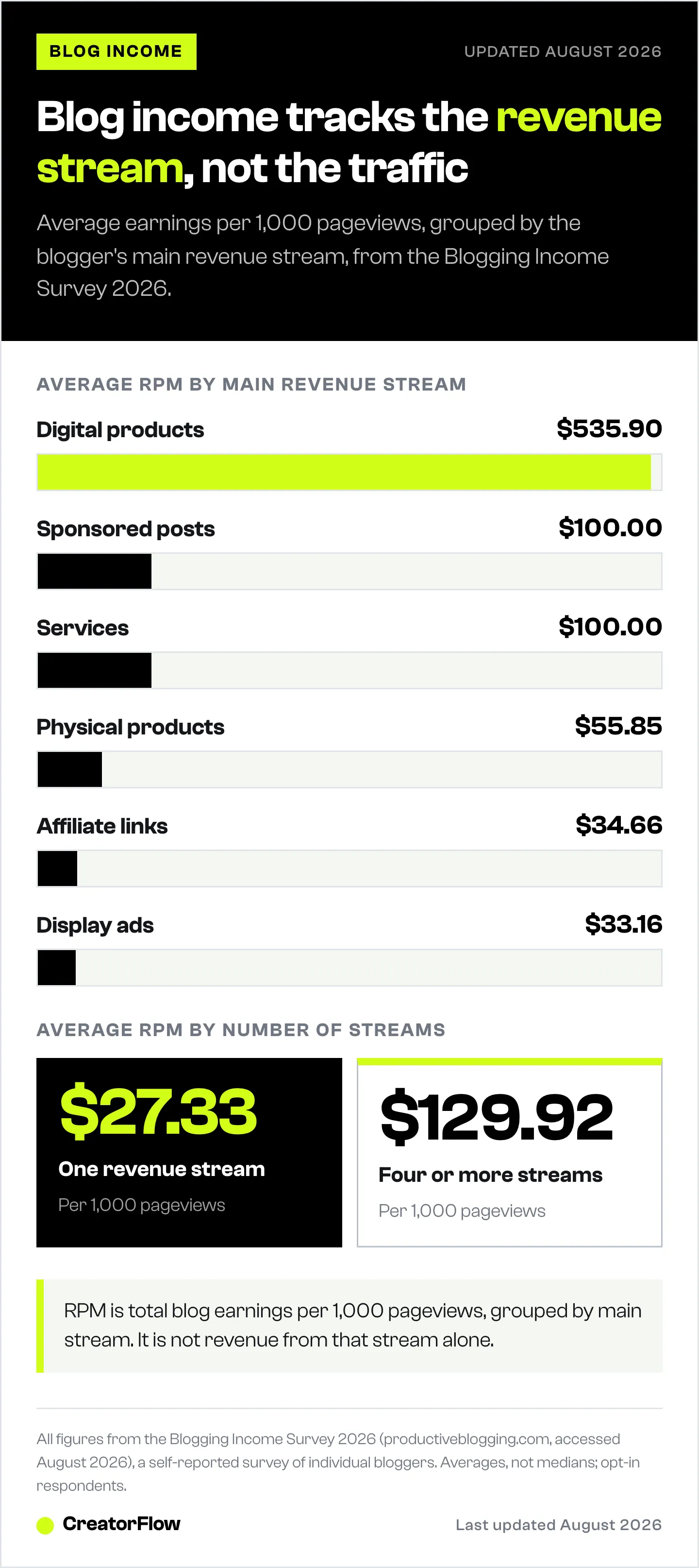
Here is the number that reorders everything you have been told about blogging income. Bloggers whose main revenue stream is digital products average $535.90 per 1,000 pageviews. Bloggers whose main stream is display ads average $33.16 (Blogging Income Survey 2026, productiveblogging.com, August 2026). Same effort, same readers, sixteen times the money. Most blog monetization advice hands you a list of six tactics in no particular order and lets you guess.
This guide ranks the six streams by what each one pays per 1,000 readers, shows the traffic each one needs before it makes sense, and covers the step that decides whether any of them pay: turning search visitors into readers you can reach again. It is written for people who already have a blog and want to know what to add next, not for people deciding whether to start one.
Key Takeaways
- Stream mix moves income more than traffic does: Average earnings per 1,000 pageviews swing from $33.16 (ads-led) to $535.90 (digital-product-led), a sixteenfold gap at identical traffic (productiveblogging.com, August 2026).
- Four streams beat one by more than four times: Bloggers running one revenue stream average $27.33 per 1,000 pageviews. Those running four or more average $129.92 (productiveblogging.com, August 2026).
- Display ads need real scale before they matter: Raptive requires at least 25,000 monthly pageviews and majority tier-1 traffic, and Mediavine’s main program now qualifies sites on prior-year ad revenue of $5,000 or more (raptive.com and help.mediavine.com, August 2026).
- Search traffic is no longer a safe foundation: AI Overviews correlate with a 58% lower click-through rate for the top-ranking page (ahrefs.com, February 2026), so a blog that only earns from search visitors is exposed.
- Sell your own thing: 45% of bloggers earning over $50,000 a year sell their own product or service, against 8% of lower earners (growthbadger.com, 2020 study of 1,117 bloggers).
- Money follows the audience you can reach twice: An email list, and a way to fill it from social, turns one-time readers into repeat buyers instead of one-time pageviews.
- Time it honestly: Median time to a first dollar is 12 months, and median time to a full-time income is 48 months (productiveblogging.com, August 2026).
What Does It Mean to Monetize a Blog?
Monetizing a blog means turning the attention your posts already earn into revenue, through one or more of six streams: display advertising, affiliate commissions, sponsored posts, digital products, services, and physical products. You do not need permission for most of them. Ads are the only stream with a hard traffic gate, and it sits higher than most bloggers expect.
The word that matters in every conversation about blog monetization is RPM, short for revenue per mille. It means total earnings per 1,000 pageviews. RPM is the only fair way to compare streams, because it strips traffic out of the comparison. Two bloggers with the same audience and different RPMs are not working different amounts. They are selling different things.
How Much Money Can a Blog Make?
Blog income is wide and slow. The median blogger earns a first dollar 12 months after starting, and a full-time income 48 months after starting, though roughly one in four earn something within six months and 24% reach full-time income inside two years (productiveblogging.com, August 2026). Averages sit higher than medians because a small number of large blogs pull them up.
Volume of published work tracks with income more cleanly than almost any other input. Bloggers with 500 to 999 published posts averaged $9,460.09 a month in the 2026 survey, against $1,987.52 for those in the 100 to 299 post range (productiveblogging.com, August 2026). That correlation runs out past 1,000 posts, most likely because nobody can keep 1,000 posts current.
Treat those numbers as direction, not forecast. They come from a survey of bloggers who opted in, which skews toward people already invested enough to answer. The useful part is not the absolute figures. It is the shape: income compounds slowly, then concentrates in whoever built something to sell.
The 6 Ways to Monetize a Blog, Ranked by Earnings
Every guide lists the same six options. Almost none of them tell you what each one pays. The table below sorts all six by average RPM from the Blogging Income Survey 2026, which measured total blog earnings per 1,000 pageviews for bloggers grouped by their main revenue stream.
| Revenue stream | Average RPM | Traffic needed to start | Ongoing effort |
|---|---|---|---|
| Digital products | $535.90 | Any | High to build, low to run |
| Sponsored posts | $100.00 | ~10,000 pageviews | High per deal |
| Services | $100.00 | Any | High, does not scale |
| Physical products | $55.85 | Any | High, fulfilment heavy |
| Affiliate links | $34.66 | Any | Low |
| Display ads | $33.16 | 25,000+ pageviews | Very low |
Source: Blogging Income Survey 2026 (productiveblogging.com, August 2026). RPM reflects a blogger’s total earnings per 1,000 pageviews, grouped by their primary stream, not revenue from that stream in isolation.
1. Digital Products
Digital products are courses, templates, ebooks, presets, meal plans, notion systems, printables, and anything else you build once and sell repeatedly. They top the table by an order of magnitude because the cost of the tenth sale is the same as the cost of the first: nothing.
They also work at any traffic level, which is the part most bloggers miss. A blog with 5,000 monthly readers cannot earn meaningfully from ads. It can absolutely sell a $47 template to 20 of them. If you want the build side of this, our guide on how to create and launch a digital product walks through the format, price, and delivery decisions.
2. Sponsored Posts
A sponsored post is content a brand pays you to publish. Rates scale steeply with traffic. Bloggers under 10,000 monthly pageviews averaged $208 per sponsored post, rising to $310 at 10,000 to 49,999 pageviews, $938 at 50,000 to 99,999, $1,674 at 100,000 to 299,999, and $1,800 at 300,000 to 999,999 (productiveblogging.com, August 2026).
| Monthly pageviews | Average sponsored post rate |
|---|---|
| Under 10,000 | $208 |
| 10,000 to 49,999 | $310 |
| 50,000 to 99,999 | $938 |
| 100,000 to 299,999 | $1,674 |
| 300,000 to 999,999 | $1,800 |
The jump between the 49,999 and 50,000 pageview brackets is roughly threefold. If you are close to that line, growing past it is worth more than adding another stream.
3. Services
Services means consulting, freelance work, coaching, done-for-you projects, or anything where the blog is the marketing and your time is the product. Same average RPM as sponsored posts, and the fastest stream to start, since it needs zero audience scale and zero approval.
The trade is that services do not scale. Every dollar costs an hour. Most bloggers who use services well treat them as the funding mechanism for a digital product, not the destination.
4. Physical Products
Physical products cover merchandise, printed books, kits, and anything shipped. The RPM sits mid-table at $55.85 because margins get eaten by manufacturing, storage, and shipping. Print-on-demand removes the inventory risk and removes most of the margin with it.
This stream works best when the product is the point rather than a logo on a mug: a cookbook from a recipe blog, a tool from a woodworking blog, a kit from a craft blog.
5. Affiliate Links
Affiliate marketing pays you a commission when a reader buys through your link. It is the most common starting point because it needs no product, no approval threshold, and no inventory. Rates vary widely by program. Amazon Associates pays a fixed rate by product category: 5% on handmade, digital video and music, 4.5% on physical books, kitchen, and automotive, 2% on televisions and digital video games, and 4% on all other categories (affiliate-program.amazon.com, August 2026).
Those percentages are why blogs that lean on Amazon alone plateau. A $40 kitchen sale returns $1.80. Independent programs in software, education, and finance routinely pay 20% to 30%, often recurring. Our breakdown of Instagram affiliate marketing covers how to pick programs by payout rather than by familiarity.
6. Display Ads
Display advertising pays per impression and requires nothing from the reader. That is its appeal and its ceiling. It also carries the only hard traffic gate in the list.
Raptive requires at least 25,000 monthly pageviews, Google Analytics installed correctly, fully original content, and the majority of traffic coming from the United States, Canada, the United Kingdom, Australia, or New Zealand (raptive.com, August 2026). Mediavine changed its structure in January 2026: program eligibility is now set by the prior calendar year’s ad revenue, with the Official program starting at $5,000 earned (help.mediavine.com, August 2026). Below those lines you are on self-serve networks earning a fraction of the rate.
Why Display Ads Pay the Least per Reader
Display ads sit at the bottom of the RPM table because the advertiser is buying a glance, and a glance is cheap. Ad-led blogs averaged $33.16 per 1,000 pageviews in 2026. Product-led blogs averaged $535.90. The reader is identical. What changed is who captures the value of their attention: the ad network, or you.
There is a second problem with an ads-first blog. Ad income is a straight multiple of traffic, so it inherits every risk your traffic carries. Nothing else in the list is that tightly coupled.
Run the arithmetic and the gap gets concrete. This is illustrative math using the survey averages, not a measured result from any one blog. A blog with 20,000 monthly pageviews earning at the ads-led average makes roughly $663 a month. The same 20,000 pageviews at the digital-product-led average makes roughly $10,718. To reach that second number while staying ads-led, you would need about 323,000 monthly pageviews. That is sixteen times the audience for the same money.
None of which makes ads worthless. They are genuinely passive, they stack on top of every other stream, and past 50,000 sessions they pay real money for zero ongoing work. They are a poor first stream and a good fourth one.
How Many Revenue Streams Should Your Blog Have?
Four or more. Bloggers running a single revenue stream averaged $27.33 per 1,000 pageviews in 2026. Two streams averaged $44.72, three averaged $53.19, and four or more averaged $129.92 (productiveblogging.com, August 2026). Blogs with four streams earn more than four times what single-stream blogs earn from the same traffic.
Some of that is selection: blogs that survive long enough to add four streams are already the more established ones. The rest is real, and the mechanism is simple. Different readers convert differently. One reader clicks an affiliate link, one buys the course, one never buys anything and only ever loads an ad. A single-stream blog monetizes one of those three.
The order matters as much as the count. Adding a fourth ad network is not adding a stream. Adding a product to a blog that only ran ads and affiliate links is.
Why “Get More Traffic” Stopped Being a Reliable Plan
Search traffic to blogs is being absorbed before it arrives. Ahrefs re-ran its study on December 2025 data across 300,000 keywords and found that the presence of an AI Overview correlates with a 58% lower click-through rate for the page ranking first, up from 34.5% in its April 2025 analysis (ahrefs.com, February 2026). Pew Research Center tracked 68,879 real Google searches and found users clicked a traditional result in 8% of visits where an AI summary appeared, against 15% where none did (pewresearch.org, July 2025).
The same Pew study found 26% of users ended their browsing session entirely after a page with an AI summary, against 16% without one. Your ranking can hold perfectly while the traffic behind it halves.
This is why the RPM data matters more now than it did five years ago. When traffic grew every year, an ads-led blog could grow into a real income by waiting. That path has narrowed. Earning more per reader is the lever that still moves.
It also changes where blog readers come from. Social platforms now send a meaningful share of the visitors that search used to. If most of your readers arrive from Instagram rather than Google, the playbook shifts, and our guide on how food creators drive blog traffic from Instagram shows the mechanics of that shift in one niche.
How to Turn Blog Readers Into an Audience You Own
The gap between a $33 RPM and a $535 RPM is not a marketing trick. It is whether you can reach the same person twice. Ads and affiliate links monetize a visit. Products monetize a relationship. You cannot sell a $200 course to someone who read one post and left, but you can sell it to someone on your list who has heard from you nine times.
That makes email capture the highest-return move on a blog that is not itself a revenue stream. It sits underneath four of the six. And email keeps paying: newsletter sponsorship CPMs typically run $10 to $75 per 1,000 subscribers depending on niche and audience quality (beehiiv.com, August 2026), so a list eventually becomes a stream of its own.
Two sources fill a list. On-site capture through a content upgrade, which is the offer tied to the specific post someone is reading. And social capture, which is where most blogs quietly lose the most.
Here is the leak. A Reel about your recipe, review, or template gets 40,000 views and 300 comments asking where to find it. You reply to the first twelve by hand and the rest go cold. Those are your highest-intent readers, they asked for the thing, and almost none of them reach the blog.
CreatorFlow closes that gap with comment-to-DM automation. You set a keyword, someone comments it, and an automated DM sends them the exact post link within seconds. On Pro plans the Email Gate collects an address inside the DM before the link goes out, so the same comment produces a blog visit and a subscriber. Link tracking shows which posts drive clicks, and geographic analytics shows where the clicks come from, which matters directly for ad rates given that premium networks price tier-1 traffic higher. CreatorFlow is a Meta Tech Provider (since December 2025) and connects through Meta’s official Instagram API, so no password sharing is involved.
The full mechanics of that hand-off live in our guide on building an Instagram to email funnel.
Which Revenue Stream to Add First
Pick by traffic, not by what you feel ready for. The table below maps the first move at each level.
| Monthly pageviews | Add this first | Reason |
|---|---|---|
| Under 5,000 | Affiliate links plus email capture | Both work at any size and need no approval |
| 5,000 to 25,000 | One digital product | Highest RPM in the survey, no traffic gate |
| 25,000 to 50,000 | Display ads through a managed network | Raptive’s floor is 25,000 pageviews |
| 50,000 to 100,000 | Sponsored posts | Average rate roughly triples past 50,000 |
| 100,000+ | A second product, then services | Product income is the only stream that scales without more traffic |
The pattern underneath: streams with no traffic requirement come first, streams with a gate come when you clear the gate, and the highest-RPM stream gets built as early as you can stand to build it.
This mirrors what separates high-earning bloggers from everyone else. 45% of bloggers earning over $50,000 a year sell their own product or service, against 8% of lower earners, and higher earners were 2.5 times more likely to sell something of their own than to run AdSense (growthbadger.com, 2020 study of 1,117 bloggers). That study is six years old and its finding has aged into the 2026 RPM data almost exactly.
A 90-Day Plan to Monetize Your Blog
Days 1 to 30. Fix capture before adding revenue. Put an email signup on your five highest-traffic posts, each with a content upgrade specific to that post. Connect an Instagram comment-to-DM automation on your three best-performing Reels so the people asking for links get them and land on your list. Apply to relevant affiliate programs, choosing by commission rate rather than brand recognition.
Days 31 to 60. Ship one small product. Not a course. A template, checklist, swipe file, or short guide priced between $19 and $49, built from the post that already gets the most questions. The goal is a working checkout and the first ten sales, which tells you whether the topic sells before you spend three months on something larger.
Days 61 to 90. Add the passive layer and measure. Apply to a managed ad network if you clear the traffic floor. Pitch two sponsored posts if you are past 10,000 pageviews. Then calculate your actual RPM, total monthly earnings divided by pageviews times 1,000, and compare it against the table above. That single number tells you which stream to add next.
By day 90 a blog that started with one stream should have three, an email list that grows without manual work, and a measured RPM to steer by.
FAQ
How much traffic do you need to monetize a blog?
None for most streams. Affiliate links, digital products, and services all work at any audience size and require no approval. Display ads are the exception: Raptive requires at least 25,000 monthly pageviews with majority tier-1 traffic, and Mediavine’s main program qualifies sites on $5,000 or more in prior-year ad revenue (raptive.com and help.mediavine.com, August 2026). If you have under 5,000 pageviews, start with affiliate links and email capture.
How long does it take to make money from a blog?
The median blogger earns a first dollar 12 months after starting, though the mean is 21 months and more than a quarter earn something within six months (productiveblogging.com, August 2026). Median time to a full-time income is 48 months, with 24% getting there inside two years. Selling your own product shortens the timeline, since it does not wait on a traffic threshold.
What is the most profitable way to monetize a blog?
Digital products, by a wide margin. Bloggers whose main stream is digital products averaged $535.90 per 1,000 pageviews in 2026, against $100.00 for sponsored posts and services, $55.85 for physical products, $34.66 for affiliates, and $33.16 for display ads (productiveblogging.com, August 2026). The gap comes from margin and repeatability: you build once and sell many times.
Can you monetize a blog with no traffic?
Yes, if you sell rather than rent attention. Services and digital products convert on intent rather than volume, so a blog with 500 monthly readers who trust you can outearn one with 20,000 passive visitors running ads. What a low-traffic blog cannot do is earn from display advertising, which pays per impression and needs scale to reach any meaningful number.
Is blogging still profitable in 2026?
For blogs that sell something of their own, yes. For blogs that depend entirely on search traffic and display ads, it has become harder. AI Overviews correlate with a 58% lower click-through rate for the top-ranking page (ahrefs.com, February 2026), which hits ad income directly since ad revenue is a straight multiple of pageviews. Blogs with an email list and a product absorb that hit far better.
How many blog posts do you need before you can monetize?
There is no minimum, but published volume tracks with earnings. Bloggers with 100 to 299 posts averaged $1,987.52 a month, while those with 500 to 999 posts averaged $9,460.09 (productiveblogging.com, August 2026). Start monetizing at post one with affiliate links and email capture. The gate is traffic and trust, not a post count.
Should you use Google AdSense or a managed ad network?
Managed networks pay substantially more per 1,000 pageviews, which is why most bloggers move as soon as they qualify. AdSense has no traffic minimum and is the practical option below 25,000 monthly pageviews. Once you clear Raptive’s 25,000 pageview floor or Mediavine’s $5,000 prior-year revenue threshold, applying is worth doing (raptive.com and help.mediavine.com, August 2026).
Blog earnings data from the Blogging Income Survey 2026 (productiveblogging.com). Ad network requirements verified at raptive.com and help.mediavine.com, affiliate rates at affiliate-program.amazon.com, search click-through data from ahrefs.com and pewresearch.org, and newsletter CPM ranges from beehiiv.com, all as of August 2026. Survey figures are self-reported averages from opt-in respondents. Individual results vary.


