

Content creators make money through nine core income streams: brand sponsorships, affiliate marketing, digital products, memberships and subscriptions, coaching and services, platform ad revenue, physical products, paid newsletters, and licensing or UGC work. Most full-time creators combine three to five of these at once. The streams that pay most reliably are the ones a creator owns outright, not the platform payouts they cannot control.
Here is the trap most creators fall into. They chase the streams that get the most attention (viral payouts, creator funds, big brand checks) and ignore the ones that quietly compound. Then a single algorithm change wipes out half their reach and most of their income with it. The money was never in the reach. It was in whether you could reach those people again on your own terms.
This guide breaks down all nine ways content creators get paid, what each one realistically earns in 2026, and a simple framework for sorting them by the one thing that decides whether your income survives a bad month: who owns the audience relationship. It is written for creators deciding what to build first, not for people who want another list of options with no order to them.
Key Takeaways
- Nine streams, three to five per creator: Full-time creators rarely rely on one income source. Diversifying across brand deals, products, and owned channels is what turns a hobby into a business.
- Most creators earn little, and that is the honest starting point: Only about 4% of creators earn more than $100,000 per year, and roughly 46% earn under $1,000 (Goldman Sachs 2023 projection; Linktree Creator Report). Monetization efficiency matters more than raw follower count.
- Brand deals dominate but depend on reach: Around 70% of creator revenue comes from brand partnerships (Goldman Sachs, 2023), which means most creators are one algorithm shift away from a pay cut.
- Owned income compounds, rented income resets: Platform payouts and reach-based deals reset every month. Products, memberships, and email lists keep earning from an audience you already converted.
- Owned channels out-convert rented reach: Email returns about $36 for every $1 spent (Litmus), because you reach people directly instead of renting access from a feed.
- Start with one owned stream, then stack: The fastest path to stable income is converting followers into a contact list you control, then selling to that list more than once.
How Much Do Content Creators Actually Make?
Most content creators make very little, and a small minority make almost all the money. Goldman Sachs estimated in 2023 that only about 4% of the world’s roughly 50 million creators qualify as “professional,” meaning they earn more than $100,000 a year (goldmansachs.com, 2023). Linktree’s Creator Report found that among full-time creators, only 12% earned over $50,000, while about 46% earned under $1,000 (linktr.ee via techcrunch.com, 2022).
That gap comes down to monetization, not talent or follower count. The creators who earn a living are not always the ones with the most reach. They are the ones who built multiple income streams and converted their audience into something they own.
The overall market is large and growing. Goldman Sachs projected the creator economy could roughly double from around $250 billion in 2023 to $480 billion by 2027 (goldmansachs.com, 2023). Treat that as a direction, not a promise. The number is a forecast, and most of that value flows to the top few percent. Your job is to get into that percent by monetizing efficiently, not by waiting for the market to lift you.
One more number that shapes everything below: roughly 70% of creator revenue comes from brand deals (goldmansachs.com, 2023). Brand deals are lucrative, but they are priced on reach. When your reach dips, so does your rate. That single fact is why the framework later in this guide sorts every income stream by how much of it you actually control. The same sorting applies to synthetic accounts, covered in how AI influencers make money.
The 9 Ways Content Creators Make Money
Content creators get paid through nine repeatable income streams. Some are high-margin and fully yours. Others are low-margin and controlled by a platform that can change the rules overnight. The table below sorts them by the two factors that matter most: profit margin and whether you own the customer relationship.
| Income stream | Margin | Rented or owned | Recurring | Best for |
|---|---|---|---|---|
| Brand sponsorships | High | Rented (reach-based) | No | Creators with engaged niches |
| Affiliate marketing | Medium | Semi-owned | No | Product recommenders, shoppers |
| Digital products & courses | Very high | Owned | No (repeatable) | Educators, experts |
| Memberships & subscriptions | High | Mixed | Yes | Community-driven creators |
| Coaching & services | Very high | Owned | Sometimes | Specialists, consultants |
| Platform ad revenue & funds | Low | Rented | No | High-volume video creators |
| Physical products & merch | Low-medium | Owned | No | Creators with strong identity |
| Paid newsletters | High | Owned | Yes | Writers, analysts, niche experts |
| Licensing & UGC | Medium | Owned skill | No | Creators who like production |
1. Brand Sponsorships and Partnerships
Brand sponsorships pay a creator to feature a product in their content. Rates scale with audience size and engagement. As of 2026, common per-post ranges run from $10 to $100 for nano creators (1K-10K followers), $100 to $500 for micro creators (10K-50K), and $500 to $5,000 for mid-tier creators (50K-500K), per Influencer Marketing Hub’s rate data (influencermarketinghub.com, July 2026).
Video and Reels typically command two to three times the rate of a static post (influencermarketinghub.com, July 2026). Sponsorships are the biggest slice of creator income, but they are rented: the brand is paying for access to your reach, and your reach lives on a platform you do not own. If you want to pitch and price deals properly, see our guide on how to land and price brand deals on Instagram.
2. Affiliate Marketing
Affiliate marketing pays a creator a commission when a follower buys through their unique link or code. Commission rates commonly run from 10% to 30% depending on the program and vertical, though rates vary widely. The affiliate software market alone is projected to reach $36.9 billion by 2030 (researchandmarkets.com, April 2025), which signals how much brand spend now flows through creator links.
Affiliate income is semi-owned. You control the recommendation and the audience trust behind it, but the payout terms belong to the brand. The bottleneck is almost always delivery. When 50 people comment “link please” on a Reel and you answer four hours later, most of them are gone. Getting the link into their hands the moment they ask is what separates affiliates who earn from affiliates who post. Smaller accounts can start here: read affiliate marketing as a micro-influencer.
3. Digital Products and Online Courses
Digital products (courses, templates, presets, ebooks, guides) are the highest-margin income stream a creator can build. You make the product once and sell it repeatedly at 70% to 90% margins. Course platform Kajabi reports its average creator earns around $37,000 per year (Kajabi Creator Report, 2025). Average course prices have climbed to roughly $89 (ruzuku.com, 2026).
This is owned income in its purest form. You set the price, you keep the margin, and you sell to the same audience again and again. The hard part is the first launch, not the tenth. If you want a fast path from idea to first sale, follow our walkthrough on how to launch a digital product in a week.
4. Memberships and Subscriptions
Memberships turn your most engaged followers into recurring revenue. Patreon charges new creators a flat 10% platform fee as of August 2025 (support.patreon.com, 2025), and the platform reports more than 10 million active monthly supporters (graphtreon.com, 2026). On Instagram, native Subscriptions let creators set one of eight monthly price points from $0.99 to $99.99 (influencermarketinghub.com, February 2026).
Membership income is mixed ownership. A subscription on your own site is fully owned. A subscription inside Patreon or Instagram is recurring but platform-controlled, and Apple or Google take up to 30% on in-app purchases. Recurring revenue is the prize here: it is the difference between earning once and earning every month. For the platform-native route, see our Instagram Subscriptions guide.
5. Coaching, Consulting, and Services
Coaching and consulting convert your expertise directly into income without a product to build. A fitness creator sells training plans. A social media strategist sells audits. A designer sells one-on-one reviews. Margins are very high because you are selling time and knowledge, not inventory.
This is fully owned income with the fastest path to your first dollar, because you do not need scale to start. Ten engaged followers who need what you know can fund a coaching offer before you ever hit 10,000 followers. The limit is that it does not scale past your calendar, which is why most creators use services to fund the products that eventually replace them.
6. Platform Ad Revenue and Creator Funds
Platform payouts pay creators for the views their content generates. YouTube’s Partner Program shares ad revenue once a channel hits 1,000 subscribers plus 4,000 public watch hours, or 1,000 subscribers plus 10 million Shorts views in 90 days (support.google.com, 2026), and creators keep 55% of ad revenue. TikTok’s Creator Rewards Program requires 10,000 followers and 100,000 views in 30 days (support.tiktok.com, 2026); the full TikTok picture, from Creator Rewards to Shop commissions, is in our guide to how to monetize TikTok content. Website owners face a parallel set of thresholds, covered in our breakdown of blog revenue streams ranked by earnings.
This is the lowest-margin, most-rented income on the list. Creator-reported TikTok RPMs run roughly $0.20 to $0.40 per 1,000 qualified views, higher in finance and business niches (miraflow.ai, 2026). YouTube long-form RPMs are commonly estimated at $1.50 to $4 (lenostube.com, 2026). Platform payouts are unpredictable, the platform sets the terms, and the money stops the moment your views do. Treat this as a bonus on top of real income, never the foundation.
7. Physical Products and Merch
Physical products turn audience identity into revenue: apparel, print, supplements, tools, anything your community wants to wear or own. Merch works best for creators with a strong personal brand or an inside-joke culture their followers want to signal membership in.
Margins are lower than digital because you carry production, inventory, and shipping. Print-on-demand removes most of the upfront risk but takes a bigger cut. Physical products are owned income, but they are operationally heavy, so most creators add merch after a digital product or membership is already working.
8. Paid Newsletters
Paid newsletters charge readers a monthly or annual fee for writing they cannot get elsewhere. The model is growing fast. Substack passed 5 million paid subscriptions in early 2025, up 67% year over year, with more than 50 creators earning over $1 million a year (sacra.com, 2025). Substack takes a 10% cut. Competitor beehiiv reported hosting around 140,000 newsletters (reuters via investing.com, 2025).
Newsletters are the clearest example of owned income. You hold the email list, so no algorithm sits between you and your reader. That direct line is exactly why creators are moving to newsletters to escape platform dependence, and it is the same reason the framework below rates owned channels so highly.
9. Licensing, UGC, and Sponsored Content
This stream pays creators to produce content for brands rather than for their own audience. User-generated content (UGC) creators shoot ad-style videos brands run on their own channels. Licensing lets brands pay to reuse your existing content. Speaking and paid appearances fit here too.
The advantage is that these do not require a large following of your own, because you are selling production skill, not reach. That makes UGC one of the most accessible ways for a newer creator to earn while their audience is still small. The income is owned in the sense that your skill travels with you, even if a single platform disappears.
Rented Income vs Owned Income: The Framework That Sorts Them
Every income stream above falls on a spectrum between rented and owned, and that single distinction predicts which creators survive a bad month.
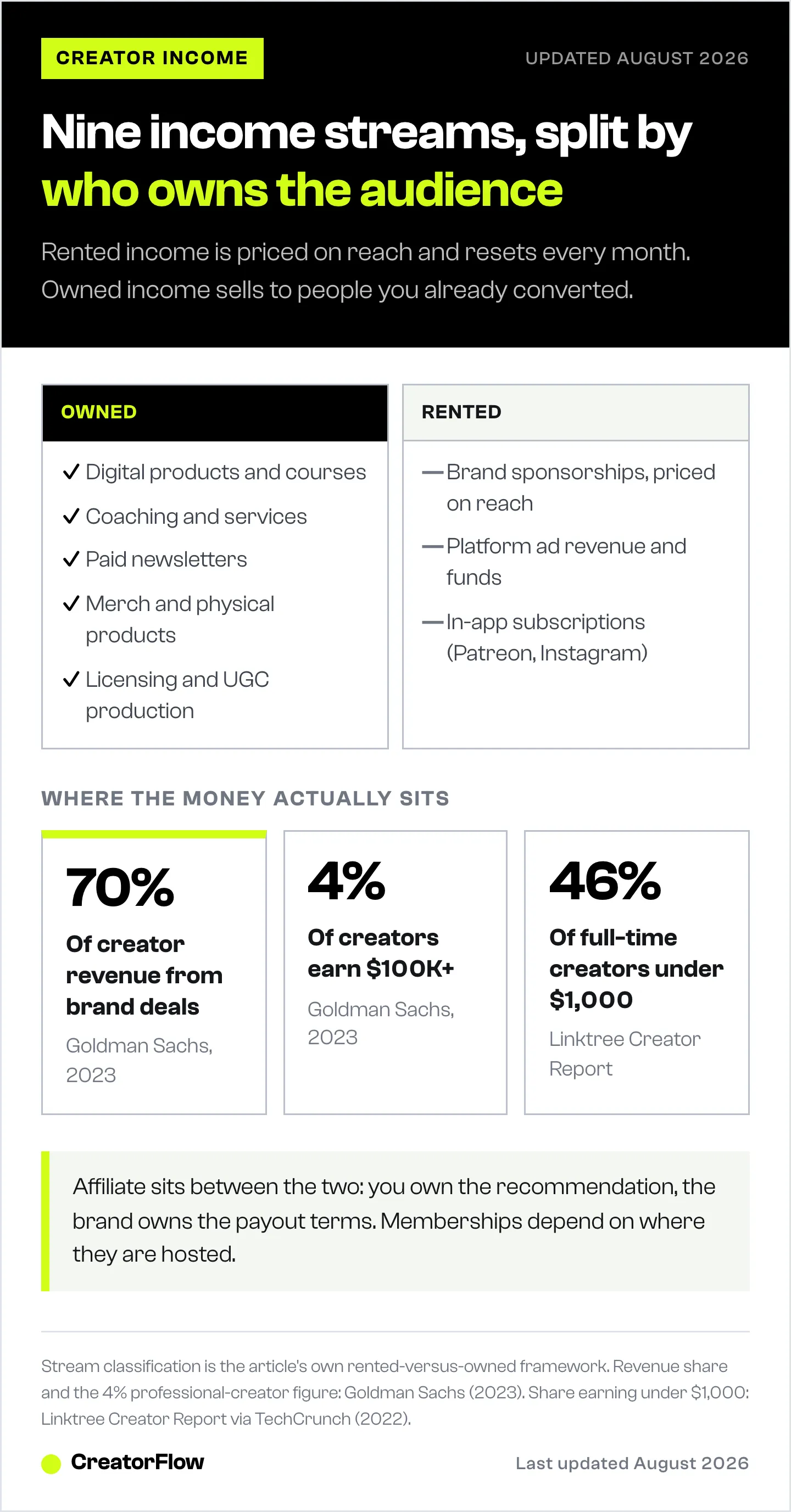
Rented income depends on a platform you do not control. Brand deals are priced on reach. Ad revenue and creator funds pay per view. Platform-native subscriptions live inside an app that sets the rules and takes a cut. When the algorithm changes, the feed reshuffles, or the payout terms shift, rented income drops and you have no recourse. Around 70% of creator revenue sits in this bucket (goldmansachs.com, 2023), which is why so many creators feel their income is out of their hands.
Owned income comes from an audience relationship you hold directly: a customer who bought your course, a member paying monthly on your own site, a subscriber on your email or newsletter list. You can reach these people again without asking a platform for permission. Owned income does not reset to zero when your reach dips, because it is built on people you already converted, not impressions you have to win back every day.
The pattern among creators who earn a stable living is consistent. They use rented reach as the top of the funnel and route it into owned channels as fast as possible. A viral Reel is not the income. It is the traffic. The income is what happens when a fraction of those viewers become a contact you can sell to next month.
Why Owning the Audience Relationship Changes the Math
The reason owned income compounds comes down to conversion economics. Email returns about $36 for every $1 spent (litmus.com, 2024), because you are reaching people directly instead of renting a slice of their attention from a feed that shows your post to a shrinking percentage of followers. A direct message or an email lands. A post gets throttled.
Here is where the two halves connect for creators who monetize on Instagram. When a follower comments or DMs asking for your link, that moment is the handoff from rented reach to owned relationship, and most creators waste it by replying hours late or not capturing anything. An Instagram DM automation tool closes that gap. When someone comments your keyword, CreatorFlow sends the link in seconds and can collect their email at the same time through an email gate, turning a one-time comment into a contact you own. That is the mechanic behind every owned stream above: products, memberships, and newsletters all need a list, and the list gets built one converted comment at a time. See how the full flow works in our Instagram DM automation guide.
CreatorFlow runs on Meta’s official Instagram API, starts free with 500 DMs a month, and moves to a $15 flat monthly rate rather than charging by contact count. The point is not the tool. The point is that the fastest way to move from the 46% of creators who earn under $1,000 into the group that earns a living is to stop letting rented reach evaporate and start converting it into something you keep.
How to Choose Your First Income Stream
Do not start nine streams at once. Start one owned stream that matches where you are today, then stack a second once the first works. Use this as a rough map:
- Under 1,000 followers: Sell a service or UGC. You do not need scale to trade expertise or production skill for money, and it funds everything else.
- 1,000 to 10,000 followers: Add affiliate marketing and a first digital product. Your audience is engaged enough to buy, and both build the habit of converting followers into buyers. This is also the range where you can make money on Instagram specifically with a small, tight niche.
- 10,000 to 50,000 followers: Layer in brand sponsorships and a membership. Your reach is now worth paying for, and your community is large enough to sustain recurring revenue.
- 50,000+ followers: Add physical products, a paid newsletter, and premium partnerships. At this stage the priority shifts from finding income to owning as much of it as possible.
Across every stage, the throughline is the same. Convert the reach into a relationship you control, then sell to that relationship more than once.
Recurring affiliate commissions are the cleanest version of selling more than once: recommend a tool one time, earn on every payment that customer makes. The honest math of recurring affiliate income breaks down how that compounds against one-time payouts.
If you want a number rather than a range, our free Instagram earnings calculator estimates what your follower count and engagement rate are worth.
FAQ
How do content creators make money with a small following?
Small creators make money by selling services, UGC, affiliate products, and digital products rather than waiting for brand deals or ad revenue. Engagement matters more than size at this stage, because a tight, trusting audience converts. Many creators earn $1,000 to $5,000 a month under 10,000 followers by converting engaged followers directly. See our guide on how to make money with a small following.
How many followers do you need to make money as a creator?
There is no minimum. Service, coaching, and UGC income require zero scale, since you are selling skill or time. Affiliate and product sales can start under 1,000 followers with an engaged audience. Platform ad revenue has real thresholds: YouTube requires 1,000 subscribers and 4,000 watch hours, and TikTok’s Creator Rewards Program requires 10,000 followers (support.google.com and support.tiktok.com, 2026).
What is the most profitable income stream for creators?
Digital products and services carry the highest margins, at 70% to 90%, because you keep almost everything after the sale. Platform ad revenue is the least profitable, with creator-reported RPMs often under $0.40 per 1,000 views on TikTok (miraflow.ai, 2026). The most profitable long-term stream is any owned channel that lets you sell to the same audience repeatedly.
Do creators make more from brand deals or their own products?
Most creators earn more from brand deals today, since roughly 70% of creator revenue comes from partnerships (goldmansachs.com, 2023). But brand deals are priced on reach and reset every month, while product income compounds. Creators who build owned products and lists tend to earn more stable income over time, even if brand deals are larger in any single month.
How long does it take to make money as a content creator?
Service and UGC income can start within weeks, because they do not need scale. Affiliate and product income usually takes two to six months of consistent posting and list-building. Brand deals and stable full-time income more often take one to two years. The timeline shortens when you convert followers into an owned contact list early instead of chasing reach alone.
How do content creators get paid?
Creators get paid through brand invoices, affiliate network payouts, product and course checkouts, membership platforms like Patreon, platform funds from YouTube and TikTok, and direct client payments for services. Owned streams (products, memberships, newsletters) pay directly into your own payment processor, which is part of why they carry higher margins than platform-controlled income.
Creator income data verified from Goldman Sachs, Linktree, Litmus, Patreon, Substack, and Influencer Marketing Hub as of July 2026. Platform payout figures (TikTok and YouTube RPMs) are creator-reported estimates, not platform-published rates. Individual results vary.


