

To monetize content as a creator, you turn audience attention into income through seven main revenue streams: affiliate marketing, brand deals, digital products, ad revenue, memberships, user-generated content, and consulting. Affiliate marketing is the fastest to start because it works at any audience size. The creators who earn the most do not rely on one method. They stack two or three and automate how they deliver links and offers to interested followers.
You already recommend products, tools, and ideas to your audience every week. The gap between doing that for free and getting paid for it is smaller than most creators think. It comes down to two things: picking revenue streams that fit your audience and your time, and fixing the one step where most creator income quietly leaks out.
This guide covers the seven revenue streams that work in 2026, verified earnings data, and the distribution layer that decides whether any of them actually pay. It is written for solo creators and side-hustlers who want a plan they can start this week, not a follower count they have to hit first.
Key Takeaways
- Seven revenue streams, ranked by speed: Affiliate marketing and UGC pay fastest (days). Brand deals, digital products, memberships, and consulting take weeks. Ad revenue takes months and platform thresholds.
- Affiliate marketing is the best starting point: US affiliate spend is projected near $13.2 billion in 2026 (eMarketer, via industry reports, July 2026), and most programs have no follower minimum.
- Small audiences convert better: Micro-influencers generate roughly 3.2x higher engagement at about 60% lower cost than larger accounts (Digital Applied, 2026). Engaged beats big.
- Stack two to three streams: One income source is one algorithm change away from zero. Diversifying protects the month when a brand ghosts or a platform shifts.
- Distribution is the hidden step: Every revenue stream assumes you can move an interested follower to a link. Bio links convert at 2-5%. Direct link delivery in DMs converts at 12-28% (industry-reported).
- The creator economy is still growing: Goldman Sachs projects the market could reach $480 billion by 2027, up from about $250 billion (goldmansachs.com, July 2026).
- Bottom line: Pick one stream, automate how you deliver it, then add a second. Monetize every post instead of waiting for one big deal.

Master Creator Monetization with CreatorFlow
Follow us on Instagram: @creatorflow.so
Join the conversation on Threads: @creatorflow.so
What Does It Mean to Monetize Content as a Creator?
Monetizing content means converting your audience’s attention into income. You publish something people trust, they engage with it, and when they act on your recommendation by clicking a link, buying a product, or subscribing, you earn money. Every creator can do this at any follower count. The work is choosing the right mix of income streams for your niche and delivering your offers before that attention fades.
Trust is the asset. A follower who believes your recommendation is worth far more than a follower who scrolls past. That is why a creator with 3,000 engaged followers often out-earns one with 100,000 passive ones. Monetization is the system you build on top of that trust.
7 Ways to Monetize Content as a Creator
Most successful creators combine several of these methods over time. Start with one, get it working, then layer in the next. Here is how the seven streams compare.
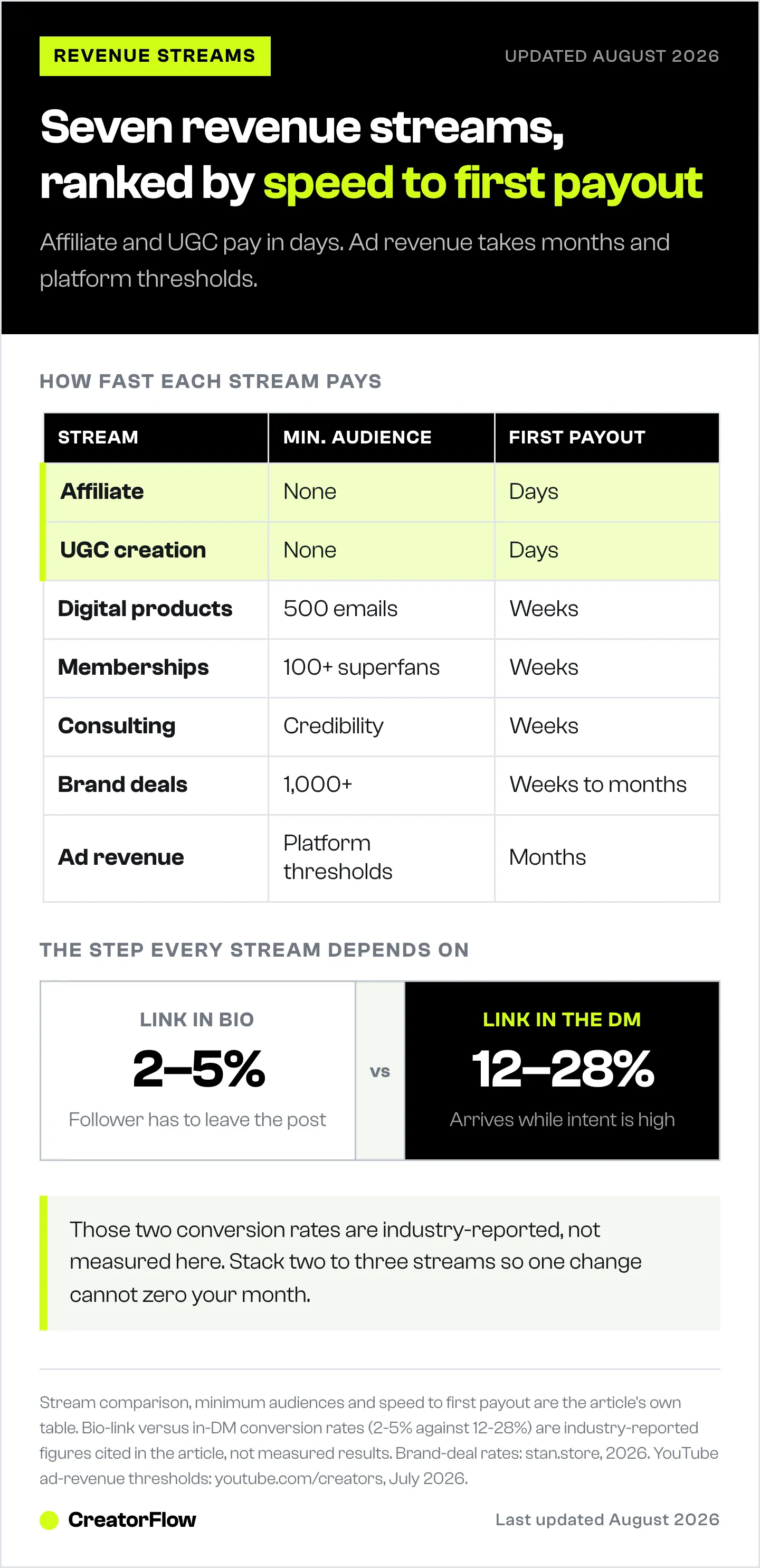
| Method | Best for | Min. audience | Speed to first payout | Scalability |
|---|---|---|---|---|
| Affiliate marketing | All creators | None | Days | High |
| Brand deals | Engaged niches | 1,000+ | Weeks to months | Medium |
| Digital products | Educators, experts | 500 emails | Weeks | Very high |
| Ad revenue | Video creators | Platform thresholds | Months | Medium |
| Memberships | Loyal communities | 100+ superfans | Weeks | High |
| UGC creation | Content makers | None | Days | Medium |
| Consulting | Specialists | Credibility-based | Weeks | Low |
1. Affiliate Marketing
Affiliate marketing pays you a commission when someone buys a product through your unique tracked link. You share the link, a follower buys, and you keep a percentage of the sale. It needs no inventory, no upfront cost, and on most programs no minimum following. That is why it is the fastest stream to a first dollar. For the mechanics of how tracking works, see how affiliate links work for creators.
Your earnings come down to two numbers: the commission rate and the cookie window, which is how long after a click you can still earn from a purchase. Rates vary widely by program, so it pays to compare terms before you commit. One rule is non-negotiable: disclose affiliate links clearly. The FTC requires creators to reveal material connections to the brands they promote (ftc.gov).
2. Brand Deals and Sponsorships
Brand deals are when a company pays you directly to feature its product. These range from free product in exchange for a post to ongoing paid ambassadorships. In 2026, micro-influencers (10,000 to 100,000 followers) typically charge $200 to $1,500 per post, and nano-influencers (1,000 to 10,000) charge $50 to $200 (stan.store, 2026).
Smaller, engaged accounts win more of these deals than raw follower counts suggest, because brands increasingly chase authentic recommendations over reach. A simple media kit with your audience demographics and past results helps you charge with confidence. For pitch templates and pricing benchmarks, see how to land and price Instagram brand deals.
3. Digital Products and Courses
Digital products turn your knowledge into something people buy once and you sell forever: ebooks, templates, presets, or full courses. The margins are high because there is no cost to produce the next copy. The trap is building something nobody wants, so validate first. Survey your audience or run a pre-sale before you spend weeks on production.
The proven structure is a product ladder. Offer a free resource to collect emails, then sell a low-ticket product, then a higher-ticket one. Each step serves a different budget while pulling buyers toward your best offer. See a full walkthrough on how to create and sell digital products.
4. Ad Revenue and Creator Funds
Platforms pay creators a share of ad revenue based on performance. On YouTube, full ad-revenue monetization requires 1,000 subscribers plus 4,000 valid public watch hours in 12 months, or 10 million public Shorts views in 90 days. A lower fan-funding tier opens at 500 subscribers (youtube.com/creators, July 2026). Instagram and TikTok run their own bonus and rewards programs with similar threshold and eligibility rules; what each TikTok method pays is broken down program by program in our TikTok monetization guide. If you also publish on a site you own, the same logic applies with different numbers, and our guide on how to monetize a blog ranks the six blog streams by earnings per 1,000 pageviews.
Treat platform payouts as a bonus, not a foundation. They depend on thresholds you have to hit, budgets that change month to month, and algorithms that decide your reach. A single policy update can cut this income overnight, which is exactly why the next streams matter more.
5. Memberships and Subscriptions
Memberships let your most committed fans pay a recurring monthly fee for exclusive access. This is the most predictable creator income because it recurs. You can run it through dedicated platforms (see our creator platform comparison for fees) or native tools on Instagram and YouTube, usually with tiered pricing: behind-the-scenes at the entry level, exclusive content and community in the middle, direct access at the top.
The metric that decides whether memberships grow is churn, the percentage of subscribers who cancel each month. Keep churn low by delivering consistent value every month, not just at signup. Recurring revenue compounds, so even 100 members at $10 is $1,000 a month that shows up whether or not you post.
6. User-Generated Content (UGC)
UGC is content you create for a brand to use on its own channels. The content lives on the brand’s account, not yours, which means your follower count does not matter. Brands pay for your ability to make authentic-looking reviews, unboxings, and lifestyle clips for their ads. That makes UGC one of the best entry points if you are still growing an audience.
The difference from a sponsorship is simple. A sponsor pays for your audience. A UGC client pays for your content skills. You can start earning as a UGC creator with zero followers, build a portfolio, and apply those skills to grow your own account in parallel.
7. Consulting and Services
As you learn to grow and monetize your own accounts, you develop skills other people will pay for: social media management, content strategy, or one-on-one coaching. Consulting monetizes that expertise directly through hourly rates, project fees, or monthly retainers. It trades time for money, so it does not scale like digital products, but your rates rise as your reputation grows and it can fund everything else while you build.
Why Affiliate Marketing Is the Best Place to Start
Affiliate marketing wins for beginners on three counts: no application gatekeeping, no follower minimum, and no product to build. With US affiliate spend projected near $13.2 billion in 2026 (eMarketer, via industry reports, July 2026), the demand for creator recommendations is already there. You can start today with whatever audience you have, even if that is friends and family.
It also aligns your incentives with your audience. You recommend products you genuinely use, and you earn only when your recommendation actually helps someone. That honesty is what makes it sustainable. Shoppable content like product roundups, story links, and answers to “where did you get that?” turns everyday recommendations into commissions. Micro-creators are especially well placed here: engaged small audiences convert at higher rates, which is why monetizing a 1,000 to 10,000 following with affiliate links works better than most creators expect.
One distinction worth knowing before you pick programs: physical products pay once per sale, while software subscriptions pay a commission on every payment the customer makes. The honest math of recurring affiliate income shows why the second model compounds.
The Step Most Creators Skip: Distribution
Every revenue stream above hides the same assumption: that you can move an interested follower to your link. That handoff is where most creator income leaks out. A follower comments “where is this from?” and by the time you reply hours later, the intent is gone. Distribution, not content, is the bottleneck for most creators.
The numbers make the gap concrete. Sending people to a link in your bio converts at roughly 2-5% because it adds friction: they have to leave the post, find your profile, tap the link, then scroll for the right one. Delivering the exact link straight into a follower’s DMs converts at 12-28% (industry-reported) because it removes every one of those steps and arrives while intent is still hot.
This is the layer CreatorFlow handles. When a follower comments a keyword or replies to a story, an automated DM sends them the right link within seconds, so buying intent never has time to cool. It is the difference between listing revenue streams and actually earning from them. For the full setup, see how to set up comment-to-DM automation. The same mechanic feeds your list too, since you can collect emails inside Instagram DMs before you hand over the link.
How to Choose Your First Revenue Stream
Do not try to run all seven at once. That path leads to burnout and mediocre results across the board. Pick one based on where you are today, master it, then expand. Use these factors to decide:
- Audience size: Small or new audiences do best with affiliate marketing and UGC. Larger audiences can add sponsorships and ad revenue.
- Content type: Educational creators convert well with courses and consulting. Lifestyle and product creators thrive on affiliate links and brand deals.
- Time available: Limited time points to affiliate marketing. More time opens up services and memberships.
- Income goal: Supplemental income can start with one stream. Full-time income realistically needs three or more.
If you want a structured starting point, 7 proven ways to make money on Instagram breaks the methods down with realistic income expectations by follower tier.
How to Maximize Your Creator Income
Once a stream is working, these habits compound your results:
- Stack two to three streams. One source is fragile. Three at $500 to $1,500 each is stable income that survives a bad month.
- Track what converts. Use link and content analytics to find your top-performing posts and products, then make more of what works.
- Disclose every partnership. Clear FTC disclosure protects you legally and builds the trust that drives long-term earnings.
- Own your audience. Followers are rented from the platform. Capture emails so a hack, ban, or algorithm change cannot erase your income overnight.
- Reinvest early. Better tools, editing, and education pay back over time.
The creators who earn the most treat content like a business. They read their data, fix the weak step, and deliver value consistently. For a week-by-week plan, follow the 90-day income roadmap from $0 to $5K per month.
Monetization Mistakes That Cost Creators Money
- Waiting for a follower milestone. Affiliate marketing, digital products, and UGC all work at a few hundred followers. Waiting for 10,000 costs you months of earnings.
- Betting on one big brand deal. One sponsor at $2,000 a month is one ghost away from zero. Diversify.
- Posting “link in bio” on repeat. Bio links leave most of your revenue on the table. Deliver links where intent is highest instead.
- Ignoring email capture. Without a list, you rebuild your audience from scratch if your account disappears.
- Chasing vanity metrics. Growth pods and engagement bots inflate numbers that never convert. Real income needs real trust.
FAQ
How much do content creators earn from monetizing content?
Earnings vary widely by niche, audience engagement, and how many streams you run. Many creators earn a few hundred dollars a month as side income, while those who stack affiliate marketing, brand deals, and digital products build it into full-time revenue. Micro-influencers commonly charge $200 to $1,500 per brand post in 2026 (stan.store, 2026), and affiliate income scales with how well you deliver links to buyers.
Do you need a large following to monetize content?
No. Affiliate marketing and UGC have no follower minimum, and small engaged audiences often convert better than large passive ones. Micro-influencers generate roughly 3.2x higher engagement at about 60% lower cost than bigger accounts (Digital Applied, 2026). Trust and engagement matter more than raw reach.
What is the fastest way for a new creator to earn income?
Affiliate marketing. You can start immediately with any audience size, no application and no product to build. UGC creation is the other fast option, since brands pay for your content skills rather than your follower count. Both can produce a first payout within days rather than months.
How do creators actually deliver affiliate links to their audience?
The highest-converting method is direct delivery in DMs. When a follower comments a keyword or replies to a story, an automated DM sends the exact link within seconds. This converts far better than a link in bio (roughly 12-28% versus 2-5%, industry-reported) because it removes friction and reaches the follower while their intent is still high.
How many revenue streams should a content creator have?
Start with one, master it, then build to two or three. A single stream leaves you exposed when an algorithm shifts or a brand stops paying. Three reliable streams at $500 to $1,500 each create stable income that survives any single source dropping off. More than four at once usually spreads a solo creator too thin.
Is monetizing content still profitable in 2027?
Yes. Goldman Sachs projects the creator economy could reach $480 billion by 2027, up from about $250 billion (goldmansachs.com, July 2026). Profitability depends on choosing the right monetization mix for your niche, delivering offers where intent is highest, and providing consistent value rather than chasing follower counts.
What is the best platform to monetize content on?
The best platform is the one where your audience already engages, since monetization follows trust, not any single feature set. Instagram suits product, lifestyle, and service creators because comments and DMs create a direct path to sales. YouTube favors long-form educators through ad revenue and courses. Most creators start on one platform, prove a revenue stream, then expand.
Revenue-stream benchmarks and creator-economy figures verified from Goldman Sachs, eMarketer (via industry reports), Digital Applied, Stan, and YouTube for Creators as of July 2026. Commission rates, brand-deal pricing, and platform thresholds change often, so confirm current terms before you rely on them. Individual results vary.


