
LTK Instagram comments stop converting because of three friction points between the comment and the purchase: response delay that lets buyer intent cool off, an LTK shop page carrying 50+ products instead of a curated collection of 5-8, and app download prompts that add a step for casual buyers. Send the exact product link within seconds and the same content earns more.
You posted a Nordstrom try-on haul. 400 comments flooded in. “Link!” “Where’s the jacket from?” “Need the boots!” Those are 400 people telling you they want to buy something right now. They saw your content, loved it, and took the time to type a request. Your commission check at the end of the month shows 12 sales. That’s a 3% conversion rate on people who actively asked for your links.
The problem is not your content. Your Reel clearly worked because 400 people engaged. The problem is not your audience. They commented because they wanted to buy. The problem is not your commission rate. LTK pays 10-25% depending on the retailer.
Three specific friction points are killing your conversions between the comment and the purchase: response delay, cluttered LTK shop pages, and app download prompts. Each one silently bleeds revenue, and most LTK creators don’t even realize they’re losing money at these stages.
This guide walks through a full conversion audit, pinpoints where your sales are leaking, and gives you copy-paste fixes for each friction point. You’ll know exactly where to focus by the time you finish reading.
Key Takeaways
- Response speed is your largest conversion lever: Every hour of delay drops purchase intent. Instant link delivery captures buyers while they’re still on your post.
- Cluttered LTK shop pages cause decision paralysis: Pages with 50+ products see click-through rates drop below 1%. Curated collections of 5-8 items convert 4-5x better.
- LTK app download prompts eliminate casual buyers: Requiring app installation adds friction that kills impulse purchases entirely.
- Product-specific links outperform “shop my feed” 4-5x: Sending the exact item removes all search friction from the buying process.
- A single follow-up DM recovers 15-30% of missed clicks: People get distracted, not disinterested. One reminder brings them back.
- Category collections solve organization: Group products by outfit, routine, or room. Not a 200-item dump.
- Email capture creates an audience you own: Building an email list through DM automation means no platform can take your revenue away.
The LTK Conversion Gap: Where Your Commissions Disappear
Your LTK commission funnel has six stages. Every stage has drop-off, and most creators only pay attention to stage one (content) and stage six (commission check). The stages in between are where the money disappears.
Stage 1: You post content. An outfit Reel, a home decor room tour, a skincare routine video. This part is working. Your content is generating engagement.
Stage 2: Followers comment. They type “link,” “need this,” or “where’s the rug from?” This is the highest-intent moment in the entire funnel. They are telling you they want to buy. For a post with strong engagement, you might get 100-400 link requests.
Stage 3: You respond with a link. Here’s where the first major leak happens. If you respond manually, your average response time is probably 1-4 hours. By then, 40-60% of commenters have moved on. They scrolled past 200 posts. They closed Instagram. They bought from someone who responded faster. Creators using instant DM responses earn up to 60% more in commissions (LTK via BusinessWire, August 2024).
Stage 4: They click the link. The second leak. If you sent a generic “shop my feed” link instead of the specific product, they land on a page with 50-200 products. They have to hunt for the item they wanted. Many give up. Focused product pages see click-through rates around 4-5%, while cluttered pages drop below 1% (Pop.Store, 2025).
Stage 5: They navigate LTK and reach the retailer. The third leak. LTK sometimes prompts users to download the LTK app. Casual buyers who wanted to click one link and buy a $34 sweater are not going to download an entire app first. They leave.
Stage 6: They purchase and you earn commission. The survivors. Out of your 400 comments, maybe 12 people made it through all five friction stages.
The math is brutal. If you fix stages 3, 4, and 5, you could realistically triple your conversions from 12 sales to 36-50 sales on the same 400 comments. Same content. Same audience. Same commission rates. Three times the revenue.
Friction Point 1: Response Delay Is Costing You Real Money
Picture this: someone is lying on their couch scrolling Instagram. They see your try-on haul. The cropped blazer catches their eye. They can already imagine wearing it to brunch this weekend. They comment “link please!” and keep scrolling, fully expecting to buy within the next 10 minutes.
Three hours later, you respond with the link. By now, they’re making dinner. They’ve seen four other blazers from other creators. They might still click your link, but the urgency is gone. The emotional spark that made them comment “link please!” has completely faded. Buying intent has an incredibly short half-life on social media.
LTK has confirmed this with data. Creators using instant DM responses earn up to 60% more in commissions compared to those who respond manually (LTK via BusinessWire, August 2024). That’s not a marginal improvement. That’s the difference between a $2,000 month and a $3,200 month for someone earning mid-range commissions.
The response time math on a real post:
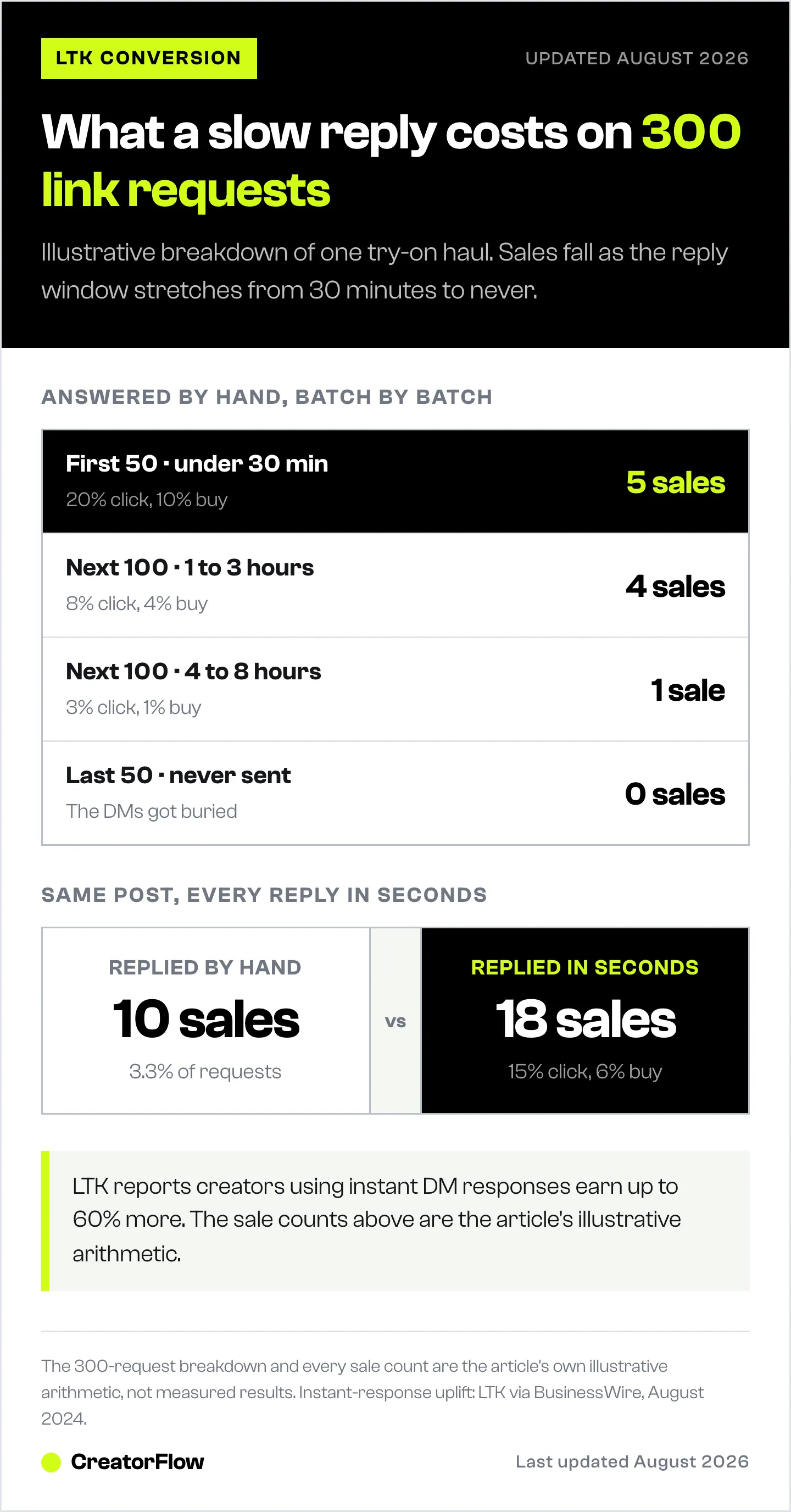
Say you get 300 link requests on a try-on haul. Here’s how response time typically breaks down for manual responders:
First 50 requests: You respond within 30 minutes (you’re still online when the post goes live). These people get links while they’re still browsing. Maybe 20% click and 10% buy. That’s 5 sales.
Next 100 requests: You respond 1-3 hours later. Buying intent has dropped significantly. Maybe 8% click and 4% buy. That’s 4 sales.
Next 100 requests: You respond 4-8 hours later (you went to bed, or had to work). Intent is minimal. Maybe 3% click and 1% buy. That’s 1 sale.
Last 50 requests: You never respond. You forgot, or the DMs got buried. Zero sales.
Total: 10 sales from 300 requests. A 3.3% conversion rate.
Now imagine every single one of those 300 people received a link within 5 seconds of commenting. The buying intent stays high for all 300. If 15% click and 6% buy, that’s 18 sales. Nearly double the revenue from the same post.
Why “I’ll respond faster” doesn’t work as a strategy.
You can’t outwork the math. Even if you’re extremely disciplined about checking DMs, you sleep. You film content. You eat meals. You have a life outside of Instagram. There will always be 4-8 hour gaps in your response time, and those gaps cost real money.
Automation tools solve this by responding in seconds, 24 hours a day. Tools in this category include CreatorFlow at $15/month flat rate (creatorflow.so, April 2026), LinkDM at $19/month flat rate (linkdm.com, July 2026), and ManyChat starting at $17/month for up to 250 contacts ($14 billed annually) and scaling to $199/month on its Advanced tier (manychat.com/pricing, July 2026). For a deeper comparison of how each tool handles LTK link routing, read the LTK DM tool alternatives guide.
The investment pays for itself on a single post. If automation helps you capture 8 more sales at an average $8 commission, that’s $64 from one Reel, more than covering the monthly cost.
Friction Point 2: Your LTK Shop Page Has Too Many Products
Someone comments “love the sweater!” on your cozy fall outfit post. You send them your LTK link. They tap it, excited to buy a $45 sweater they already decided they wanted.
They land on your LTK shop page. It has 247 products. Summer dresses from June. Sunglasses from a beach trip. Random Amazon finds from three months ago. The sweater they wanted is somewhere in there, buried between a yoga mat and a pair of earrings.
They scroll. They don’t find it immediately. They scroll more. After 15 seconds of searching, they close the tab and go back to Instagram. You lost a sale that was already yours.
This is decision fatigue in action. When you present someone with 247 options, they freeze. Research on product page performance shows that focused pages with a small number of items see click-through rates around 4-5%, while cluttered pages with dozens of products drop below 1% (Pop.Store, 2025). That gap represents thousands of dollars in lost commissions over a year.
The “shop my feed” trap.
Many LTK creators default to sending their main shop page for every request. It seems efficient. One link covers everything. But it creates a terrible shopping experience. When someone asks “where’s the jacket from?” they want one specific jacket, not a catalog of everything you’ve worn since January.
Think of it like a clothing store. If someone walks in and says “I want that blue dress in the window,” you wouldn’t hand them a map of the entire mall. You’d walk them directly to the dress. Your DM response should work the same way.
The fix is curated collections, not product dumps. You need small, focused collections of 5-8 items organized by category. Your fall outfit post links to your “Fall Outfits” collection, not your entire shop page. Your skincare routine video links to your “Morning Skincare” collection. This is how you match buyer intent with the right product page.

Friction Point 3: LTK App Download Prompts Kill Casual Buyers
Your follower is on the bus. They have 10 minutes before their stop. They see your story, tap your LTK link, and get a prompt asking them to download the LTK app before they can shop.
They close the browser. They’re not going to download an app, create an account, and sign in during a 10-minute bus ride for a $28 pair of earrings. That impulse purchase is gone forever.
LTK’s app download prompts exist for good reason from LTK’s perspective. App users shop more frequently and spend more per session. But from your perspective as a creator, every app download prompt is a conversion barrier between you and your commission.
App install completion rates typically sit around 50-60% for prompted installs. That means roughly half the people who see that prompt simply leave. Those are people who already wanted to buy. The friction of installing an app, creating an account, and navigating back to the product is too high for a casual purchase.
You can’t remove LTK’s prompts, but you can reduce their impact.
For high-value single items (a $200 coat, designer shoes), consider sending the direct retailer link instead of the LTK link. Yes, you lose the LTK commission tracking for that specific click, but you keep the sale. For collection-based purchases (a full outfit, a skincare routine with multiple products), LTK links still make sense because the shopping experience across multiple items is worth the app friction.
The key is matching your link strategy to the purchase value and complexity. A $15 lip gloss does not justify an app download. A $400 living room makeover with six items probably does.
The 5-Step LTK Instagram Conversion Audit (Run This Today)
Stop guessing where you’re losing money. Run this audit on your account right now. It takes 15 minutes and will show you exactly which friction points are hurting you most.
Step 1: Check your average response time.
Open your DMs. Look at your last 20 link requests. Note the time between the comment and your response. Calculate the average. If it’s over 30 minutes, response delay is your biggest leak. If it’s over 2 hours, you’re leaving significant money on the table.
Step 2: Count products on your main LTK page.
Open your LTK shop page on your phone (not desktop, your followers are on mobile). Count how many products are visible. If it’s over 30, your shop page is too cluttered. If it’s over 100, it’s actively hurting your conversions.
Step 3: Click your own LTK link from a mobile browser.
Send yourself a DM with your LTK link. Tap it. Count how many taps, scrolls, and page loads it takes to reach the actual product on the retailer’s website. If it’s more than 3 taps, you have too much friction.
Step 4: Count unanswered link requests from the last 7 days.
Scroll through your recent posts and count comments asking for links that you never responded to. Each one is a lost sale. If you find more than 20, manual response is not a sustainable strategy.
Step 5: Cross-reference your engagement with your commissions.
Compare your most-engaged posts (highest comment counts) with your LTK commission dashboard. If your most popular posts aren’t generating the most commissions, the bottleneck is between the comment and the purchase, not the content itself.
Fix 1: Product-Specific Link Routing
The single biggest upgrade you can make to your LTK conversion rate is switching from generic shop links to product-specific links. Instead of sending everyone to the same 200-product page, send them directly to the item they asked about.
How trigger word routing works:
You set up different trigger words that route to different LTK collection links. When someone comments “dress” on your post, they get your Fall Dresses collection link. When someone comments “boots,” they get your Footwear collection. When someone comments “jacket,” they get your Outerwear collection.
Here’s an example routing table:
Trigger word “dress” or “dresses” sends your Fall Dresses collection (5-8 current dresses). Trigger word “boots” or “shoes” sends your Footwear collection (5-8 pairs). Trigger word “jacket” or “coat” sends your Outerwear collection (5-6 pieces). Trigger word “bag” or “purse” sends your Accessories collection (6-8 items). Trigger word “link” or “shop” sends a curated “This Post” collection matching the specific post content.
The conversion difference is dramatic.
Take 300 comments on a try-on haul. With a generic shop link, click-through rate sits around 4%. That’s 12 people reaching the product page, and maybe 4-5 making purchases.
With product-specific routing, click-through rate jumps to 12-15%. That’s 36-45 people reaching the right product, and 12-18 making purchases. Three to four times the revenue from the same post.
For a step-by-step guide on setting up comment-to-DM triggers with custom routing, check our comment-to-DM automation setup guide. And for a full breakdown of which tools support multi-keyword routing for LTK creators, read the LTK DM tool alternatives comparison.
Setting up the “This Post” dynamic approach.
For every post you publish, create a mini collection on LTK with only the items featured in that specific post. Name it something memorable: “April 14 Office Outfit” or “Spring Capsule Wardrobe.” Then set your automation to send that specific collection link as the default for that post.
Yes, this takes 5 extra minutes per post. But those 5 minutes can mean the difference between 5 sales and 20 sales. It’s the highest-ROI task in your entire content workflow.
If you’re already using LTK DM (the built-in tool), be aware that it only triggers on the word “Shop” and sends your generic shop link. Tools like CreatorFlow give you multi-keyword routing with custom links per trigger, which is where the real conversion gains happen.
Fix 2: Curate LTK Collections That Actually Convert
Your LTK shop page should not be a dumping ground for every product you’ve ever worn, used, or looked at. It should be a curated shopping experience organized by category, season, and price range.
Collection structure by niche:
Fashion creators need about 5 core collections:
- Current Season Outfits (update monthly, 6-8 looks)
- Workwear / Office Looks (5-8 outfits)
- Weekend / Casual (5-8 outfits)
- Date Night / Going Out (5-6 outfits)
- Accessories Under $50 (6-8 items)
Beauty creators need about 5 collections:
- Morning Skincare Routine (5-7 products, in application order)
- Evening Skincare Routine (5-7 products)
- Everyday Makeup Look (6-8 products)
- Haircare Must-Haves (4-6 products)
- Under $25 Dupes (6-8 products)
Home decor creators need about 4 collections:
- Living Room (6-8 items)
- Bedroom (5-7 items)
- Kitchen / Dining (5-7 items)
- Under $50 Home Finds (6-8 items)
Why 5-8 items per collection?
Fewer than 5 feels sparse and doesn’t give enough options. More than 10 creates the same decision paralysis as your main shop page. The sweet spot is 5-8 items that all relate to a single theme or look. This gives your follower enough variety to browse without getting overwhelmed.
Update frequency matters.
Stale collections hurt conversions. If someone clicks your “Fall Outfits” collection and sees sold-out items or products from last year, they lose trust. Update your core collections weekly. Remove anything that’s sold out or discontinued. Add new items as you feature them in content.
The 15 minutes per week you spend curating collections will generate more commission revenue than an extra hour of content creation. Organized shopping experiences outperform disorganized ones every time.
For more on how affiliate link strategy affects your Instagram revenue, read our guide on how to add affiliate links on Instagram.
Fix 3: The Follow-Up DM Strategy That Recovers Lost Revenue
You sent 300 links this week. Your DM automation analytics show 120 of those links were never opened. That’s 120 people who asked for a link, received it, and then did nothing with it.
They’re not disinterested. They’re distracted.
They got the DM while they were in line at Starbucks. They meant to click it later. They forgot. Their phone buzzed with a text from their friend. Life happened between the moment they commented and the moment they opened your DM.
A single follow-up message recovers 15-30% of those missed clicks. That’s 18-36 more people reaching your product page. At a 30% purchase rate, that’s 5-10 more sales you would have lost entirely.
Follow-up timing:
Send your follow-up 3-4 hours after the initial DM. Not 30 minutes later (too aggressive, feels pushy). Not 24 hours later (they’ve completely forgotten which post they commented on). The 3-4 hour window hits the sweet spot where they remember the product but need a gentle nudge.
Follow-up template:
“Hey! Wanted to make sure you saw the link I sent earlier for the [product]. A few sizes are starting to sell out, so I wanted to flag it before it’s gone. Let me know if you have any questions about fit!”
Follow-up rules:
One follow-up maximum. Never send two. Don’t follow up if they already clicked the original link. Keep it conversational, not salesy. Include a practical detail (sizing, availability, sale ending) to give them a reason to click now.
For more strategies on scaling your affiliate DM workflow, read our guide on scaling affiliate marketing with DM automation.
Fix 4: Build Your Email List Through LTK Link Requests
Every person who comments “link” on your post is a warm lead. They’ve seen your content, liked your style, and want to buy what you’re recommending. Right now, that relationship lives entirely on Instagram. If Instagram changes its algorithm, restricts DMs, or your account gets hacked, that entire revenue stream disappears overnight.
Building an email list through your LTK link requests creates an audience you own. No algorithm can take it away. No platform change can destroy it.
Two approaches to email capture through DMs:
Approach A: Email before link (higher capture, adds friction).
Your automation asks for their email address before sending the LTK link. “I’d love to send you the link! Drop your email and I’ll send it along with early access to my next haul.” This captures more emails, but it adds a step between the comment and the link. Some people will bounce rather than type their email.
Approach B: Link first, email second (zero friction, lower capture).
Your automation sends the LTK link immediately, then follows up with an email capture message. “Here’s the link you asked for! [LTK link]. If you want early access to my weekly drops and exclusive deals, reply with your email and I’ll add you to my list.” This keeps the buying experience frictionless but captures fewer emails since the follow-up is optional.
Recommendation: Approach B for most LTK creators.
Your primary goal is commissions. Anything that slows down the link delivery hurts your conversion rate. Send the link first, always. Capture emails second.
Over time, even a 10-15% email capture rate builds a significant list. If you send 1,000 links per month and 12% of people share their email, that’s 120 new subscribers monthly. After six months, you have a 700+ person email list of people who actively shop your recommendations.
What to do with those emails:
Send a weekly roundup of your top 5 picks (with LTK links). Announce new collections before you post them on Instagram. Share exclusive sale alerts for retailers with high commission rates. LTK reports 40M+ monthly shoppers on their platform (company.shopltk.com, April 2026), so your audience is already primed to buy through affiliate links in their inbox.
For a comparison of DM link strategies vs bio link strategies and how each affects your affiliate revenue, read our bio link vs DM automation analysis.
LTK DM Templates for Every Product Category
These eight templates cover the most common LTK link request scenarios. Customize them with your voice and product details. The key is specificity: mention the exact product, include a personal note, and keep it under 4 sentences.
Template tips before you start:
Keep messages under 150 words. Include the specific product name in the first sentence. Add one personal detail (why you love it, how you style it, or sizing notes). End with the link, not a question. Test each template on a friend before activating it for your audience.
Template 1: Fashion Outfit Breakdown
Hey! Here’s everything from today’s outfit:
The blazer is the Aritzia Babaton Sculpt Knit (I wear size S, fits true to size): [LTK link] The jeans are Agolde 90s Pinch Waist (I sized down one): [LTK link] The bag is Polene Numero Neuf in Chalk: [LTK link]
The blazer runs a little long in the sleeves, so I’d recommend your normal size unless you have long arms. Happy shopping!
Template 2: Beauty/Skincare Routine
Here’s my full morning routine in order of application:
- CeraVe Hydrating Cleanser: [LTK link]
- The Ordinary Niacinamide 10%: [LTK link]
- Supergoop Unseen Sunscreen SPF 40: [LTK link]
- Rare Beauty Soft Pinch Blush in Joy: [LTK link]
The niacinamide and sunscreen are the two non-negotiables. I’ve used both for over a year and they’ve made the biggest difference in my skin. The cleanser is great but any gentle cleanser works.
Template 3: Home Decor Room Tour
Thanks for asking! Here’s everything from the living room makeover:
The sofa is the Article Sven in Charme Tan: [LTK link] The coffee table is West Elm’s Avery: [LTK link] The throw pillows are from H&M Home (such a steal): [LTK link] The rug is Loloi Chris Loves Julia in Natural/Ivory, 8x10: [LTK link]
The rug pulls the whole room together. Worth every penny. The pillows are under $20 each if you want to start with a small upgrade.
Template 4: Sale/Promo Alert with Urgency
Heads up! That jacket you asked about is part of Nordstrom’s spring sale right now.
Originally $189, currently $118 (37% off): [LTK link]
It’s one of their best sellers so sizes are going fast. I grabbed mine in XS and it fits perfectly over a tee or sweater. Sale ends this Thursday!
Template 5: Sizing/Fit Conversational Reply
Great question about the fit! I’m 5’7”, 130 lbs and I wear a size S in this brand. Their stuff runs slightly oversized, so if you like a more fitted look, I’d size down one.
Here’s the link: [LTK link]
For reference, I usually wear S in Zara and M in Free People, and this brand is closer to the Zara fit.
Template 6: Story Reply (Personal Tone)
Ahh thank you! That sweater is my favorite thing I’ve bought this month. I’ve worn it like four times already and it’s SO soft.
Here you go: [LTK link]
It comes in 6 colors but the oatmeal one is the best in person. The photos online don’t do it justice.
Template 7: Follow-Up Reminder
Hey! I sent you the link to the [product name] earlier today. Just wanted to make sure it didn’t get buried in your DMs!
Here it is again: [LTK link]
A few sizes have been selling out, so wanted to make sure you saw it. No pressure at all, just didn’t want you to miss it if you were still interested!
Template 8: Email Capture After Link Delivery
Here’s the link you asked for: [LTK link]
BTW, I put together a weekly email with my top 5 picks and exclusive deals that I don’t always post on Instagram. If you want in, just reply with your email and I’ll add you. No spam, just good finds.
For niche-specific template variations and advanced customization tips, check our Instagram DM automation templates collection. Fashion influencers can also explore templates designed specifically for outfit link delivery.
How to Track What’s Working (And What’s Not)
Tracking is what separates creators who earn consistent LTK commissions from creators who post and hope. Set aside 15 minutes every week to review your numbers. This one habit will tell you exactly which posts, templates, and products generate the most revenue.
Weekly 15-minute review framework:
Block time on Sunday evenings or Monday mornings. Open two tabs: your DM automation analytics and your LTK commission dashboard.
Source 1: DM automation analytics.
Look at three numbers: total DMs sent, click-through rate per template, and click-through rate per trigger word. These tell you which messages resonate and which products people are most interested in. If your fashion template gets a 22% CTR but your beauty template only gets 8%, lean into fashion content.
Source 2: LTK commission dashboard.
Look at three numbers: total commissions earned, commissions per product category, and average order value. These tell you which products actually convert to purchases (not just clicks) and which retailers pay the highest commissions.
Cross-reference to find winners.
Your best content is the intersection of high DM engagement and high commission revenue. A post that generates 200 link requests AND high commissions is your template for future content. A post that generates 200 link requests but low commissions means people are clicking but not buying, which usually points to a product-link mismatch or a pricing issue.
The key metric: revenue per DM sent.
Calculate this weekly. Take your total LTK commissions and divide by total DMs sent. If you sent 500 DMs and earned $400 in commissions, your revenue per DM is $0.80. Track this number over time. Improving your templates, collections, and response speed should push this number higher each month.
For detailed setup instructions on link tracking and click analytics, read our Instagram DM link tracking guide. You can also explore CreatorFlow’s Insights dashboard for a visual breakdown of which links and templates generate the most clicks.
Try CreatorFlow free (500 DMs/month) and see your click-through rates within the first week. Plans start at $15/month flat if you need higher volume (creatorflow.so, April 2026).
Working with LTK creators? We keep a dedicated setup page for exactly that: CreatorFlow for LTK creators.
FAQ
Why are my LTK link clicks high but commissions low?
High clicks with low commissions usually means one of three things. First, you might be sending people to high-traffic, low-commission retailers. Commission rates vary from 3% to 25% depending on the retailer, so a shift in product mix changes everything. Second, your followers might be clicking but not completing purchases because the product page is confusing or the item is out of stock. Third, there may be a cookie/attribution gap where your follower buys later but your referral window expired. Check your LTK dashboard for conversion rates by retailer and focus your content on higher-commission brands.
How fast should I respond to Instagram comments asking for LTK links?
As close to instant as possible. LTK’s own data shows creators using instant DM responses earn up to 60% more in commissions (LTK via BusinessWire, August 2024). Every hour of delay reduces purchasing intent significantly. If you’re responding manually and averaging over 30 minutes, you’re losing substantial revenue. Automation tools deliver links in 3-8 seconds, which captures the buyer while they’re still engaged with your content. Even improving from 2-hour to 30-minute average response time will meaningfully increase your conversion rate.
Should I send my LTK shop page link or individual product links?
Individual product links almost always outperform your general shop page. When someone asks “where’s the jacket from?” they want one specific jacket, not a catalog of 200 products. Sending them to a curated collection of 5-8 items related to the post they commented on keeps the experience focused. Focused product pages see click-through rates around 4-5% compared to under 1% for cluttered pages (Pop.Store, 2025). If setting up individual links per post feels like too much work, start by creating 4-5 category collections and routing trigger words to the right one.
How many products should be on my LTK collection page?
Keep it to 5-8 products per collection. Fewer than 5 feels sparse and gives too few options. More than 10 starts creating decision fatigue, and anything above 20-30 products drops click-through rates dramatically. Think of each collection as a curated recommendation, not a comprehensive catalog. Update collections weekly to remove sold-out items and add new products featured in your content. The goal is a clean, focused shopping experience that matches the specific content your follower engaged with.
Does the LTK app download requirement hurt my conversions?
Yes, for casual and impulse buyers. When someone taps your LTK link and gets prompted to download the LTK app, a percentage of them will leave rather than install a new app. App install completion rates for prompted installs sit around 50-60%, meaning you lose roughly half of casual clickers at this stage. You cannot remove LTK’s app prompts, but you can mitigate the impact by sending direct retailer links for single high-value items and reserving LTK links for multi-product collections where the browsing experience justifies the app friction.
Can I use DM automation and still sound personal?
Yes, if you write your templates the way you actually talk. The biggest mistake creators make is switching to a formal, corporate tone in automated messages. Read your template out loud. If it doesn’t sound like something you’d text a friend, rewrite it. Include specific product details, personal sizing notes, and honest opinions (“this runs big” or “the color is way better in person”). Use casual language, contractions, and sentence fragments. Your followers know automation exists. They don’t mind receiving automated messages as long as the content is helpful and sounds like you. For more on writing natural automated DMs, check our complete Instagram DM automation guide.
How do I know which DM template works best for LTK links?
Track click-through rates per template over 2-4 weeks. Most automation tools show you how many people opened the link in each message. Run two versions of the same template (one with sizing info, one without, for example) and compare CTR after 100+ sends. The template with the higher click rate wins. Common patterns: templates with specific product names outperform generic ones, templates with personal notes (your size, how it fits) outperform plain product links, and templates with urgency (sale ending, selling out) outperform standard messages. Review and update your best-performing templates monthly.
What is the best time to post for maximum LTK conversions?
The best time to post for LTK conversions is when you can respond to comments fastest, not necessarily when you get the most reach. A post at 7am that gets 300 comments while you’re sleeping converts worse than a post at 12pm that gets 200 comments while you’re actively online. If you use automation, posting time matters less because responses are instant regardless. That said, general high-engagement windows for shopping content tend to be weekday mornings (7-9am), lunch breaks (11am-1pm), and evenings (7-9pm). Test your own audience for 2-3 weeks and track which posting times generate the highest commission-to-comment ratio, not just the most comments.
Should I use “link in bio” or DM automation for LTK links?
DM automation outperforms link in bio for LTK conversions by a significant margin. Link in bio requires your follower to leave the post, navigate to your profile, find the link, tap it, and then search for the specific product they wanted. That’s 4-5 friction steps. DM automation sends the product link directly to their inbox in seconds with one specific item. The click-through rate difference reflects this: direct DM links typically convert 3-5x better than bio links for specific product requests. Use link in bio as a backup for general browsing, and DM automation for any post where you’re recommending specific products. For a full analysis, read our bio link vs DM automation comparison.
How do I recover commissions from unanswered link requests?
Start by auditing your last 7 days of posts. Go through comments and identify every link request you never responded to. Respond now, even if it’s days later, with a personalized message: “So sorry for the delay! Here’s the [product] link you asked about: [link]. Let me know if you need sizing help.” Some of those people will still buy. Going forward, set up DM automation to ensure zero requests go unanswered. Then add a follow-up DM sequence that sends a gentle reminder 3-4 hours after the initial link delivery to catch people who got distracted. A single follow-up recovers 15-30% of missed clicks, which can translate to meaningful commission revenue over a month.
Related Articles
- LTK Creator Instagram DM Automation - Full setup guide for automating LTK link delivery with trigger words and templates.
- LTK DM Alternatives Comparison - Side-by-side comparison of LTK DM, CreatorFlow, LinkDM, and ManyChat for LTK creators.
- Instagram DM Automation for Fashion Influencers - Fashion-specific templates and outfit link delivery strategies.
- Bio Link vs DM Automation for Affiliate Clicks - Data-backed comparison of link-in-bio vs direct DM delivery for affiliate revenue.
- Comment-to-DM Automation Setup Guide - Step-by-step instructions for configuring keyword triggers and custom responses.
- Instagram DM Link Tracking - How to track click-through rates, conversion data, and revenue attribution for DM links.
- Instagram DM Automation Templates - 50+ customizable templates for every niche and product category.
- Scale Affiliate Marketing with DM Automation - Strategies for growing your affiliate income without proportional time investment.
- How to Add Affiliate Links on Instagram - Complete guide to affiliate link placement across posts, stories, DMs, and bio.
- Complete Instagram DM Automation Guide - The definitive resource for understanding and implementing Instagram DM automation.


