
Beauty bloggers make money on Instagram through five income streams: affiliate commissions (3-30% per sale), sponsored posts ($100-$5,000 each), brand partnerships, owned products, and ad revenue. Top earners do not stack all five at once. They sequence streams as their audience grows, starting with affiliate at 5K-10K followers, adding sponsored deals at 25K, and launching owned products at 100K+. Each stream rewards a different stage of audience trust.
You post a foundation routine Reel. Sixty followers ask for the shade. You drop the link three hours later. Half have moved on, the other half tap and bounce because the page loads slowly. Three days later a brand emails offering a $400 sponsored post. You have no idea if that is a fair rate, so you take it. Three weeks later your engagement dropped because the post felt off, and the brand ghosts. This is the income gap most beauty bloggers live in: real audience, no system.
This guide breaks down the five income streams beauty creators use on Instagram, what each one actually pays in 2026, the follower count where each stream starts to make sense, and the order to layer them in. Numbers and source citations throughout.
Key Takeaways
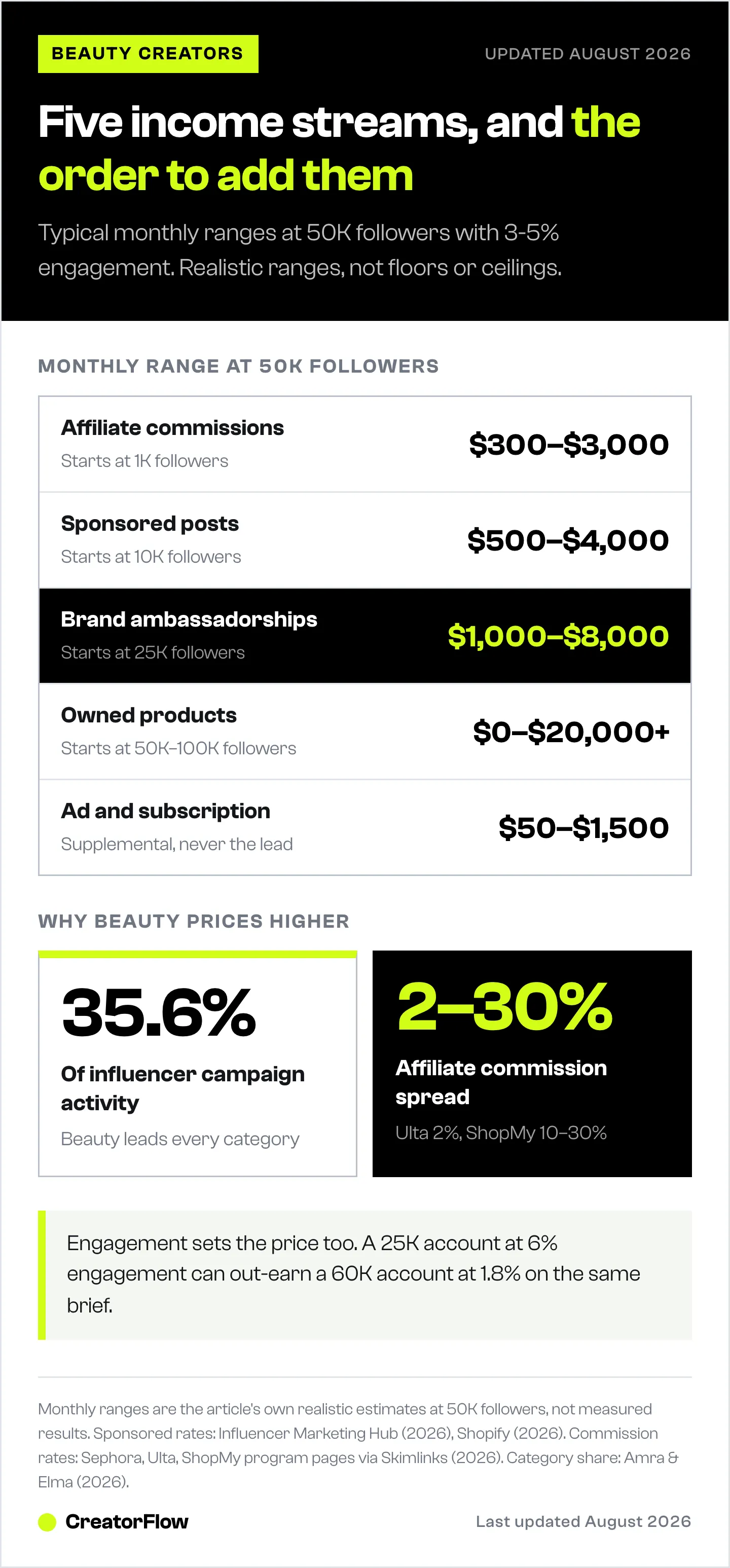
- Beauty is the #1 influencer category by spend, claiming 35.6% of all influencer campaign activity globally (Amra & Elma, 2026)
- Sequence beats stacking: affiliate first (1K-10K), sponsored second (10K-25K), brand ambassadorships third (25K-100K), owned products fourth (100K+), ads/subscriptions last
- Affiliate spread is huge: Ulta pays 2%, Sephora pays 5-10%, ShopMy pays 10-30%, Amazon beauty pays 3-10% (Skimlinks, 2026; Sephora.com, 2026)
- Sponsored rates by tier: nano (1K-10K) $25-$300/post; micro (10K-100K) $100-$5,000/post; Reels cost 2-3x static posts (Influencer Marketing Hub, 2026)
- DM speed is the conversion lever: beauty buying intent peaks within minutes of seeing a product. Slow DMs lose sales the same way a broken link page would
- The trap most creators fall into: chasing sponsored deals before the audience can convert affiliate links. If you cannot move 50 affiliate sales a month, you cannot prove sponsored ROI either

How Beauty Bloggers Make Money on Instagram (Quick Answer)
Beauty bloggers turn an Instagram audience into income through five distinct revenue mechanisms:
- Affiliate commissions — a percentage of any sale driven through a tracked link
- Sponsored posts — a flat fee for a single piece of brand-funded content
- Brand partnerships — ongoing ambassadorships, multi-post deals, or retainers
- Owned products — selling your own makeup line, courses, presets, or guides
- Ad and subscription revenue — ad share from Reels Bonuses, Subscriptions, or off-platform monetization (YouTube, blog, newsletter)
The global beauty and personal care market is projected at over $677 billion in 2026, and beauty leads every other vertical in influencer ad spend (Statista via Amra & Elma, 2026). The opportunity is real. The trap is treating all five streams as equal options at every audience size. They are not.
The 5 Income Streams Ranked by Revenue Potential
Rough revenue potential per stream at the same audience size (50K followers, 3-5% engagement, beauty niche):
| Stream | Typical Monthly Range (50K beauty) | Effort to Maintain | Audience Size It Starts At |
|---|---|---|---|
| Affiliate commissions | $300 — $3,000 | Low (compounds) | 1K+ |
| Sponsored posts | $500 — $4,000 | Medium (1-2 deals/mo) | 10K+ |
| Brand ambassadorships | $1,000 — $8,000 | Medium-High | 25K+ |
| Owned products | $0 — $20,000+ | High | 50K-100K+ |
| Ad/subscription revenue | $50 — $1,500 | Low (passive) | Varies |
These are realistic ranges, not floors or ceilings. Beauty creators with a tight niche (clean beauty, dermatology, mature skin, textured hair, professional makeup) often outperform generalist beauty creators at the same follower count because their audience converts harder. Source for sponsored ranges: Influencer Marketing Hub, 2026 and Shopify, 2026. Affiliate program ranges sourced from official program pages and Skimlinks, 2026.
Stream 1: Affiliate Commissions (Start Here)
Affiliate is the foundation of beauty creator income because it requires no negotiation, no minimum follower count, and pays per sale rather than per post. The catch is that commission rates vary 15x across programs.
What beauty programs actually pay in 2026:
| Program | Commission | Cookie Window | Notes |
|---|---|---|---|
| Sephora | 5-10% | 24 hours | Direct affiliate, broad catalog |
| Ulta | 2% | 30 days | Lower rate, longer cookie |
| Amazon (beauty) | 3-10% | 24 hours | Huge catalog, low rates |
| ShopMy | 10-30% (varies by brand) | Per-brand | Aggregator, higher payouts |
| LTK | 3-14% (typical range) | Per-brand | Aggregator, broader retailer set |
| Mavely | Per-brand, varies | Per-brand | Affiliate-app model |
Sources: Sephora affiliate page, 2026; Skimlinks beauty affiliate roundup, 2026; Stack Influence ShopMy vs LTK comparison, 2026; Salty Vagabonds creator analysis, 2026.
The conversion bottleneck no one talks about:
Affiliate revenue is a function of three numbers: traffic, click-through rate, and conversion rate. The piece most beauty creators control worst is the speed from comment to link. When a follower comments “shade?” on a foundation Reel, buying intent is highest in the first 5-10 minutes. A bio link tap rate of 2-3% versus a DM open rate of 80-90% is the difference between $80 and $800 from the same Reel.
This is where DM automation for beauty influencers earns its keep. The mechanism is simple: trigger word in the comment, instant DM with the affiliate link, click tracked. Most beauty creators see 5-8x conversion improvement compared to “link in bio” responses, because the DM lands while the follower is still scrolling.
For the affiliate platform decision itself, see ShopMy vs LTK for beauty creators. Short version: ShopMy generally offers higher per-sale commission, LTK offers broader retailer coverage. Run both for 60 days, then double down on whichever pulls more for your niche.
Stream 2: Sponsored Posts (Add at 10K-25K Followers)
A sponsored post is a flat fee in exchange for a single piece of brand-mandated content. Sponsored becomes a meaningful revenue stream once you cross 10K followers, because that is the threshold most brand search platforms use to filter creators.
Beauty sponsored rates by audience tier (2026):
| Tier | Followers | Static Post | Reel | Story |
|---|---|---|---|---|
| Nano | 1K — 10K | $25 — $150 | $50 — $300 | $15 — $75 |
| Micro | 10K — 100K | $100 — $1,500 | $250 — $5,000 | $50 — $500 |
| Mid | 100K — 500K | $1,000 — $5,000 | $2,500 — $15,000 | $500 — $2,000 |
| Macro | 500K+ | $5,000+ | $10,000+ | $1,500+ |
Source: Influencer Marketing Hub Instagram rates report, 2026 and Influence Flow 2026 sponsored guide.
Reels consistently price 2-3x the static rate because brands track their better completion and reach. Beauty and skincare creators command engagement-based pricing of roughly 10-15 cents per engagement, higher than general lifestyle (5-8 cents per engagement) due to commercial intent of the audience.
The pricing mistake most micro creators make:
Quoting your rate based on follower count alone undersells you when you have above-average engagement. A 25K follower with 6% engagement should out-earn a 60K follower with 1.8% engagement on the same brief, because the brand reaches more real eyeballs. If your engagement rate is more than 2x the platform median for your tier, charge in the upper third of the range above. Brands know engagement is the real currency.
Stream 3: Brand Partnerships and Ambassadorships
Brand ambassadorships are multi-month or multi-post deals at a flat retainer or per-deliverable rate. They typically start around 25K followers and become the dominant income stream for beauty creators between 50K and 250K. Why this stream pays better than one-off sponsored posts:
- The brand pays for predictability, not just reach
- You batch content production once instead of negotiating per drop
- Renewal rates are high if you hit deliverables, which compounds month over month
- Many ambassadorships add an affiliate code on top, so you double-dip
Typical structures:
- Retainer: $1,500 — $8,000/month for 4-8 deliverables
- Per-deliverable: $750 — $4,000 per Reel + Story bundle
- Hybrid: lower flat fee + percentage of sales from a unique discount code
Brand ambassadorships are won mostly through inbound interest, not pitching. The way you signal “I’m ambassador material” is to (a) use the brand organically in 3-5 pieces of content over 30-60 days before any ask, (b) tag the brand cleanly each time, and (c) drive measurable traffic through an affiliate code so the brand can see your conversion in their dashboard. Ambassadors are usually picked from the existing affiliate roster.
Stream 4: Owned Products (Cosmetics, Courses, Presets)
Owned products flip the economics of every other stream. Instead of earning a slice (5-30%) of someone else’s margin, you keep 60-90% of yours. The trade is operations: inventory, customer service, returns, shipping, payment processing.
Realistic owned-product paths for beauty creators:
| Product | Typical Margin | Audience Needed | Operational Lift |
|---|---|---|---|
| Digital guides (routines, shade-match PDFs) | 90%+ | 5K+ | Low |
| Presets and Lightroom packs | 85%+ | 10K+ | Low |
| Online course (technique, business) | 80%+ | 25K+ | Medium |
| Merch (apparel, tools) | 30-50% | 50K+ | Medium |
| Cosmetics line (private label) | 40-60% | 100K+ | High |
| Cosmetics line (own formulation) | 50-70% | 250K+ | Very High |
The realistic monthly income from a $25 digital guide selling at 1% of a 25K-follower audience (250 sales) is roughly $5,000-$6,000. The same audience converting at 0.3% on a $90 course brings in roughly $5,500-$6,750. Both math out to comparable revenue with very different operational models.
The Instagram launch funnel for course creators covers the structural side. For broader monetization architecture across niches, see the Instagram monetization guide.
Stream 5: Ad Revenue and Subscription Income
Ad and subscription revenue is the smallest stream for most beauty creators on Instagram itself. Three places it shows up:
- Instagram Reels Bonuses and Subscriptions — variable, market-dependent, usually a few hundred dollars per month for mid creators when active
- YouTube ads (long-form) — $2 — $8 RPM on beauty content, real money once a creator sustains 50K+ monthly views
- Newsletter sponsorships — if a beauty creator builds an email list off Instagram, sponsored placements run $0.10 — $0.50 per subscriber per send for niche audiences
This stream rewards owned audience over follower count. A creator with 8K engaged email subscribers earned via DM email gating routinely out-monetizes one with 80K passive Instagram followers, because email open rates and click rates dwarf social.
How to Sequence Income Streams as You Grow
Most beauty creators try to skip stages. The sequencing that compounds:
1K — 10K followers: affiliate-only. Pick one or two programs (e.g., Sephora plus an aggregator). Set up automated DM replies for the 3-5 most-asked product categories. Track click-to-purchase rate. Stop posting “link in bio” forever.
10K — 25K followers: add sponsored posts. Start saying yes to product gifting in exchange for one Story. Quote $200-$500 for the first paid Reel. Do not over-discount. Brands assume you are worth what you charge; under-pricing tells them your audience is weak.
25K — 100K followers: pursue ambassadorships. Audit which brands you have driven the most affiliate sales for and reach out for a longer deal. Add an email gate inside DMs to start owning your audience before launching anything.
100K+ followers: launch owned products. Start with the lowest-lift option (digital guide or preset pack). Validate demand at $25-$50 before committing inventory or formulation. Use email and DM lists you have built to launch, not Reels alone.
Always-on: ad/subscription revenue. Treat as supplemental. Never the lead.
For creators starting from a smaller base, making money on Instagram with a small following covers the first $500-$5,000/month playbook in more detail. Beauty and fashion audiences overlap heavily, so the fashion creator monetization guide is worth a read too; it ranks 8 income streams using the same staged approach.
Where DM Automation Fits in Each Stream
Different streams need DMs to do different jobs:
| Stream | Job DM Automation Does | Trigger Type |
|---|---|---|
| Affiliate | Send tracked product link in 5 seconds | Comment keyword (SHADE, ROUTINE, LINK) |
| Sponsored | Capture lead emails for the brand | Story reply or Reel comment |
| Ambassadorships | Distribute discount code on demand | Comment keyword (BRAND name) |
| Owned products | Send sales page + collect email | Comment keyword (GUIDE, COURSE) |
| Ad/subscription | Drive to YouTube or newsletter signup | Story reply, Reel comment |
The unifying point: every income stream lives or dies on the speed and accuracy of follower-to-link delivery. Manual DMs work at 100 followers. They break at 10K and bury you at 100K. Automation is the only way the math holds across all five streams.
Working with bloggers? We keep a dedicated setup page for exactly that: CreatorFlow for bloggers.
To sanity-check any figure here against your own account, use the free Instagram earnings calculator.
A practical setup that supports all five at once:
- Run separate triggers per stream (avoid keyword collisions)
- Use the follow gate on affiliate triggers to convert link-takers into followers
- Use email gating on owned-product triggers so you build a list as you sell
- Track click-throughs per trigger so you know which streams the audience actually wants
FAQ
How much do beauty bloggers make on Instagram?
Beauty bloggers earn anywhere from a few hundred to over $20,000 per month depending on follower count, engagement, and which income streams are active. A 25K-follower beauty creator with affiliate, sponsored, and ambassador deals running typically earns $2,000-$8,000/month. A 100K+ creator with owned products on top can clear $15,000-$50,000/month. Beauty pulls higher rates than general lifestyle because audience commercial intent is higher (Influencer Marketing Hub, 2026).
What are the best affiliate programs for beauty bloggers?
Sephora (5-10% commission, 24-hour cookie), Amazon Associates (3-10%, broad catalog), and ShopMy (10-30% per brand) cover most beauty creator needs. LTK is strong for retailer coverage but typical commissions sit lower (3-14%). Ulta is brand-trusted but pays only 2% with a 30-day cookie (Skimlinks, 2026; Sephora.com, 2026).
How many followers do beauty bloggers need to make money?
You can earn affiliate income from your first 1,000 followers if your audience is engaged and tightly niched (clean beauty, dermatology, textured hair). Sponsored posts become realistic at 10K. Brand ambassadorships open up around 25K. Owned product launches typically need 50K-100K to validate at scale, though digital guides can sell from a 5K audience.
Do beauty bloggers make more from affiliate or sponsored posts?
Below 25K followers, sponsored posts often produce more cash per piece of content but affiliate compounds. A single Reel with strong affiliate triggers can generate sales for 12+ months while a sponsored post pays once. Above 25K, sponsored and ambassador deals usually overtake affiliate as the largest single line item, but creators who keep affiliate running on the same content double the revenue per Reel.
How do beauty bloggers get brand deals?
Most brand deals come inbound, not from cold pitching. The path that works: use the brand organically across 3-5 pieces of content, tag cleanly, run their affiliate code if available, and let your conversion data appear in their dashboard. Brand teams pull ambassador candidates from their best-performing affiliate roster more often than from outreach.
Can you make money as a beauty blogger with under 10K followers?
Yes. Affiliate works at any size. The constraint is conversion rate, not follower count. A 4K-follower creator who sells 30 foundation units a month at a 7% Sephora commission earns more than a disengaged 50K creator with no automated link delivery. The variable that matters is how fast and reliably you deliver the link when followers ask.
What is the best platform for beauty creator affiliate links?
There is no universal answer. Run ShopMy and LTK in parallel for 60 days, push equivalent content through both, and double down on whichever produces more revenue per click for your specific niche. ShopMy tends to win on per-sale payout, LTK tends to win on retailer breadth (Stack Influence, 2026). For a deeper breakdown, see ShopMy vs LTK comparison.
Affiliate program rates and influencer pricing data verified from Sephora, Skimlinks, Influencer Marketing Hub, Stack Influence, and Salty Vagabonds as of May 2026. Beauty industry market size verified via Statista summaries reported by Amra & Elma, May 2026. Individual creator results vary by niche, engagement, and audience commercial intent.


