

Volume-based growth advice tells creators to post more, longer, and everywhere. It works at the scale where teams close every signal. For a solo creator on Instagram, it breaks. Each new follower adds comments, story replies, and DMs that one person cannot answer fast enough. Throughput, the number of buy signals you can actually respond to in time, is the ceiling. Reach is not.
You posted three Reels this week. One went semi-viral. 312 comments, 47 of them asking “link?”. You replied to 14 before bedtime. The other 33 saw your message the next morning, by which point most had scrolled past the moment. The post earned 180,000 impressions and roughly nine sales. The math feels off because it is.
This guide breaks down the throughput ceiling solo creators hit between 30K and 80K followers, why posting more makes the problem worse, and the response-layer fix that lets one person operate like a team.
Key Takeaways
- Volume is not the bottleneck: Solo creators stall around 30-50K followers because reply latency, not reach, caps revenue per post
- Throughput math: Buy signals per post grow linearly with audience; one human can answer 30-60 DMs per hour at most, leaving 70%+ of high-intent comments unanswered after a viral post
- Speed compounds: Responding within 5 minutes makes a creator 21x more likely to convert a lead vs. 30 minutes (Lead Response Management Study, cited in our DM response time analysis)
- The algorithm rewards response density: Active comment and DM activity in the first hour signals quality content, which lifts reach further
- What to automate first: Repetitive trigger phrases (link, price, info) are 80% of inbound DMs and the single highest-impact task to remove from a creator’s hands
- Bottom line: A solo creator with throughput automation runs the same content output as a 5-person team running everything manually

How a Solo Instagram Creator Scales Past the Reply Ceiling
A solo Instagram creator scales by fixing throughput before volume. Reach grows linearly with your audience, but one person can only answer 30-60 DMs an hour, so a 40K-follower creator fielding 80 buy signals per post typically replies to 25. Automate the predictable 80%, the link, price, and info questions, with comment and story-reply triggers. Keep the relational 20% by hand, then raise posting output on a funnel that converts.
The Volume Gospel and Where It Fails Solo Creators
The dominant growth playbook in 2026 sounds like this: publish daily, optimize hooks, repurpose into long-form, narrow the niche, measure revenue per thousand views instead of vanity reach. The framing is sound. The advice gets repeated by founders running content teams of five to twenty people who post, edit, repurpose, and reply across platforms.
Solo creators read the same advice and try to execute it with one set of hands.
The first 5,000 followers, it works. The next 25,000, the cracks show up. Reach grows. Engagement grows faster, because Instagram rewards accounts that can sustain it. Comments per post climb from 8 to 80 to 400. DMs per day climb from 5 to 50 to 300. The creator is now spending three to four hours a day in the inbox just to hit a 60% reply rate, and the unreplied 40% includes the people who would have bought.
The volume playbook assumes a closing layer. A team. An assistant. An automation. Without one, more reach increases the gap between what people ask for and what gets answered. Posting more multiplies the gap.
Throughput, Defined
Throughput on Instagram is the number of high-intent inbound signals (comments, story replies, DMs) you can respond to inside the buying window. The buying window is short. Buying intent on impulse-driven content drops roughly 50% every hour after the first interaction. By 24 hours, around 90% of interested viewers have moved on.
Three numbers determine throughput:
- Inbound signal rate: Comments and DMs per hour during the window the post is hot
- Response speed: Time from signal to your reply
- Reply capacity: How many replies you can physically send in that window
A creator at 5K followers might field 6 comments and 4 DMs per hot post. A 50K creator with the same engagement rate fields 60 comments and 40 DMs. Same percentage. Ten times the work. The reply capacity of one human did not change.
Reach scales linearly. Reply capacity does not. The math collapses somewhere between 30K and 80K depending on niche, post frequency, and how many of the comments are buy signals vs. emoji.
The Throughput Math (Run It Yourself)
Estimate your own ceiling in three lines:
| Input | How to find it |
|---|---|
| Buy-signal rate per 1K reach | Count comments and DMs asking for a link, price, or info on your last 5 posts. Divide by reach. |
| Hot window | Time from post going up to engagement dropping below 10% of peak. Usually 2-6 hours. |
| Reply rate | Replies you send in that window divided by signals received. |
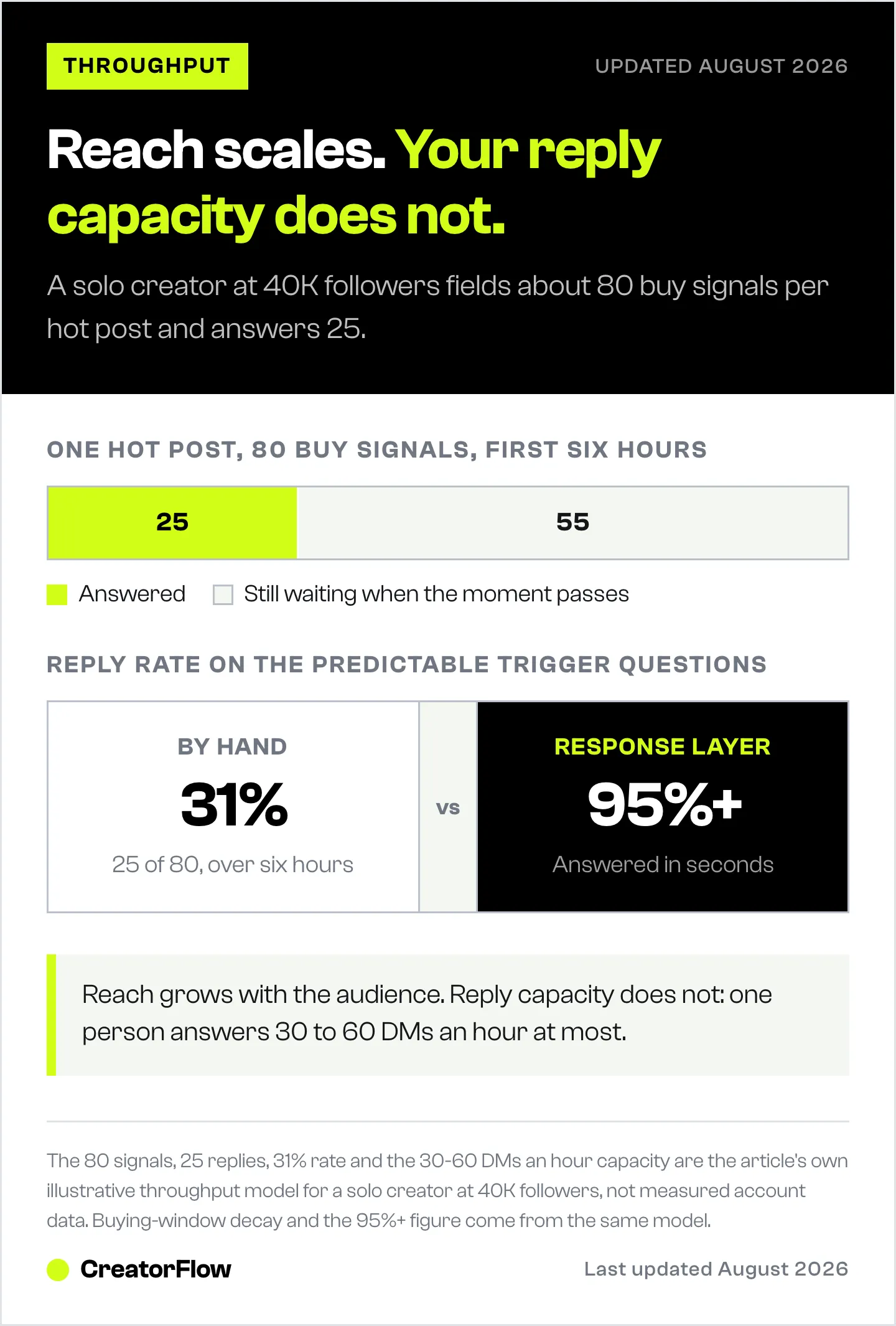
A typical solo creator at 40K followers fielding 80 buy signals per hot post replies to 25 in the first 6 hours. Reply rate: 31%. Of the 55 unanswered, the algorithm sees the silence, the asker scrolls past your DM, and the post peaks lower than it should have.
That same content with a response layer hitting 95%+ replies under 2 seconds does not need more reach to convert better. It needs the gap closed.
Where the Ceiling Is, Concretely
Three failure points show up in the same order for almost every creator who scales past 25K:
1. The first-hour comment wall. A Reel hits the For You feed. Comments arrive in waves of 5-15 per minute. Manually replying to even half of them is impossible while also doing anything else. Instagram’s algorithm reads the silence as low quality and throttles further reach. The post peaks at maybe 40% of what it could have done.
2. The DM mountain. A 24-hour engagement window means every signal you do not answer today is gone tomorrow (per Meta’s own messaging API rules). Coaches, affiliates, and e-commerce sellers all describe the same scene: opening Instagram in the morning to 200 new DMs, scanning for the few that look high-intent, and deleting the rest of the day to triage.
3. The audience size penalty. Counterintuitively, the bigger you get, the lower your reply rate goes. A 100K creator who answers 5% of DMs has a worse follower experience than a 5K creator who answers 80%. The algorithm and your audience both notice.
The Four Things Volume Cannot Fix
More posts do not solve any of these:
- Reply latency: A 4-hour wait on a buy signal is the same loss whether you posted once or ten times
- Repetition tax: 80% of a creator’s DMs are the same five questions. Manually typing the same answer 200 times per week is not content work
- Time-zone gap: Half your audience comments while you sleep. Volume of posts does not extend your waking hours
- Algorithm punishment: Slow comment response correlates with reduced organic reach, so each unanswered comment compounds losses on the next post
These are throughput problems. The fix is not “post more.” The fix is closing the response loop.
What to Automate First, and What to Keep Manual
A useful split: automate the predictable, keep the relational.
Automate (the 80%):
- Trigger words like “link,” “price,” “info,” “guide,” “recipe” that map to a single response
- Story reply replies sending the lead magnet or product link
- First-touch outreach that delivers the asset and qualifies whether more is needed
- Email or phone capture before sending paid links
Keep manual (the 20%):
- Replies after the asset has been sent, where someone wants context or coaching
- Long-form questions where the answer changes per person
- DMs from collaborators, brands, or anyone you recognize personally
- Negative or sensitive messages that need human judgment
Done right, the creator spends their inbox time on the 20% of conversations that actually matter and lets the response layer handle the rest. Reply rate on the predictable 80% goes from 30% to 95%. Reply latency goes from hours to seconds. The creator’s hours go back into making the next piece of content. For a teardown of which inbound message types to route where, see manual vs automated Instagram DMs.
The Throughput Stack for One Person
A working setup for a solo creator looks like this, in order:
- Comment-to-DM trigger for the 5-10 keywords that map to your offers or content (recipe, link, price, plan)
- Pre-written DM templates for each trigger that send the asset, ask one qualifying question, and capture the email if the link is paid
- Story-reply automation for the same keywords, since story DMs are the fastest-decaying buy signal
- An exclusion list so VIPs, brands, and known collaborators never get the bot
- A weekly inbox triage hour for the 20% of messages that the automation flagged for human reply
Setup time is roughly under an hour. The full walkthrough is in the comment-to-DM automation setup guide, and if you are still researching whether automation is right for your stage, the complete Instagram DM automation guide covers tool selection.
When Automation Replaces a VA
The most expensive throughput fix is hiring a virtual assistant to manage DMs. It works, sort of. Cost is $400-1,200/month for someone who responds in 30-60 minutes (still slow vs. seconds), can only cover a slice of the day, and produces inconsistent message quality across shifts. A creator earning $3-10/click on affiliate links breaks even on a VA somewhere around 100K followers. Most stall earlier.
DM automation tools handle the same volume at $15-30/month flat rate, respond in under 2 seconds 24/7, and never produce off-brand replies. A VA still makes sense for the qualitative tier (long replies, sales calls, partnerships). For the predictable 80%, the math heavily favors software.
The Volume Playbook Still Applies, Just Later
None of this argues against producing more content. It argues against producing more content while leaving the conversion layer broken. A creator who fixes throughput first runs the volume playbook on a working funnel. A creator who runs volume first chokes their own funnel and blames the algorithm.
The order matters. Throughput, then volume.
FAQ
Should I stop posting more if my throughput is low?
No. Keep your current posting cadence and fix the response layer first. Once replies on inbound buy signals are above 90% and under 2 seconds, scaling content output starts producing proportional revenue gains. Until then, more posts mostly increase the gap between attention and conversion.
What is a realistic reply rate to aim for at 50K followers?
Manually, even disciplined creators top out around 40-60% reply rate on inbound DMs at 50K followers. With automation handling the predictable trigger-based questions, total reply rate moves to 90%+ on those signals, and the creator can hold a higher manual rate on the qualitative tier because their inbox volume is lower.
Will Instagram penalize me for using DM automation?
Not when the tool uses Meta’s official Instagram Graph API and stays inside the documented limits. Instagram’s anti-spam systems trigger on behavioral patterns like cold outbound DMs and password-sharing third-party tools. Reply automation responding to direct user actions (comments, story replies, keyword DMs) within the 24-hour engagement window is sanctioned. The Instagram API rate limits guide covers the per-hour ceilings in detail.
How does response speed affect Instagram’s algorithm?
Comment activity in the first 30-60 minutes correlates with extended reach. Posts that sustain rapid back-and-forth in the comment section signal quality to the algorithm and get pushed further. Slow or absent creator replies have the opposite effect. Throughput is partly an algorithmic input, not just a sales one.
When does it make sense to hire a VA instead of automating?
A VA earns their cost when the inbound work is qualitative: long custom replies, sales conversations, partnership outreach, community management. For repetitive trigger-based DMs (link, price, info), automation is faster, cheaper, and more consistent. Most creators end up with both: automation on the 80%, a part-time human on the 20%.
Will automated replies feel robotic?
Only if they are written that way. Good automation uses the creator’s actual voice, sends one message at a time (not three at once), and acknowledges the question before linking the asset. Followers who get a 2-second reply with their requested link almost never notice it was automated. The creators who do test note that complaints drop after switching to automation, because the alternative was no reply at all.
Does this mean the volume framework is wrong for Instagram?
Not wrong, incomplete for solo creators. The framework assumes the conversion layer is staffed. On Instagram, volume in front of a broken response layer compounds losses. Solo creators benefit from the framework as much as anyone, once throughput is fixed. The order of operations is what matters.
Throughput math, response time benchmarks, and Instagram API limits verified from Meta developer documentation and CreatorFlow’s existing rate-limit and response-time analyses, accessed June 2026. Individual results vary by niche, audience composition, and offer.


