
An Instagram aesthetic is the repeatable visual and tonal system across your feed: colors, lighting, typography, image style, caption voice, and the values they signal together. For creators who sell, it does two jobs at once. It earns recognition (so people remember you between scrolls), and it earns trust (so people click your link, send a DM, or save the post). A good aesthetic is not decoration. It is conversion architecture.
You post a clean product flat-lay on Monday. A bright meme on Wednesday. A grainy selfie with a moody caption on Friday. Each post lands fine on its own. Together, they teach your audience nothing about who you are or what to expect. That is not a taste problem. That is a system problem, and it shows up in flat saves, slow DM growth, and a follower count that creeps instead of compounds.
This guide is for creators who treat Instagram as a revenue channel: affiliate marketers, coaches, e-commerce sellers, and UGC creators. It covers what an Instagram aesthetic actually is in 2026, the six styles that are working right now, a five-decision framework you can finish in an afternoon, and how to connect the feed to the DM funnel that turns attention into income.
Key Takeaways
- Aesthetic affects revenue, not just looks: 69% of Gen Z and 58% of Millennial social media users say social trends drove them to spend money in 2024, and 36% of Gen Z use Instagram to discover products (Harris Poll on behalf of Credit Karma, November 2024; Electroiq, 2025).
- Algorithm rewards cohesion through saves and sends: Instagram’s three biggest ranking signals as of 2026 are watch time, sends per reach, and likes per reach — and recognizable feeds get more saves and shares (Buffer, 2026; Later, 2026).
- Visual congruence is measurable: Peer-reviewed research found visual consistency between an influencer’s posts and brand identity meaningfully increases follower engagement with sponsored posts (Argyris et al., Computers in Human Behavior).
- Smaller creators win on engagement, not polish: Accounts with 10K-100K followers average 6.89% engagement vs. 2.61% for accounts above 5M. The advantage is intimacy, not production value (Amra & Elma, 2025).
- Pick a system, not a mood board: Three brand words, a 4-color palette, one type pairing, three image rules, and one CTA pattern is enough to look intentional without burning hours per post.
- Bottom line: An aesthetic that converts is one that makes someone instantly understand who you are, what you sell, and what to do next, without reading a word.

What an Instagram Aesthetic Actually Is in 2026
Most “aesthetic guides” stop at colors and presets. That worked when Instagram was a 9-grid gallery and your feed was the only thing people saw. It is not enough now.
In 2026, your aesthetic shows up in five places, not one:
- The 9-grid feed (still the trust signal when someone hits “follow”)
- Reels covers and the Reels grid (which is now most accounts’ dominant traffic)
- Stories (where most DM conversations actually start)
- Highlight covers (a permanent shop window above the grid)
- DMs sent by your automation (yes, the message itself is part of the aesthetic)
That last one is the part competitor articles miss. The image style, copy tone, and link presentation in the DM your follower receives 8 seconds after commenting is the aesthetic too. If your feed is calm and minimal but your DM looks like a coupon blast, you broke the brand at the moment of truth.
Aesthetic does three jobs simultaneously:
| Layer | What it answers | Who it serves |
|---|---|---|
| Visual | What does this account look like? | Cold scrollers deciding whether to stop |
| Voice | What does this account sound like? | New followers deciding whether to stay |
| Values | What does this account stand for? | Warm followers deciding whether to buy |
A creator focused only on the visual layer gets followers who like the look and never convert. A creator with strong voice and values but no visual signal gets ignored before anyone reads the caption. You need all three.
Why Aesthetic Now Affects Revenue, Not Just Reach
Three shifts have changed what aesthetic does for creators in the last 24 months.
1. Discovery moved off the grid. A first-time visitor lands on a Reel, not your profile. They scroll your Reels grid, not your 9-grid. Reel cover design is now load-bearing. If your Reel covers are random screenshots, your aesthetic dies before anyone reaches your feed.
2. The algorithm learned to read intent. Instagram’s three highest-weighted ranking signals across feed, Reels, and Explore as of 2026 are watch time, sends per reach (DM shares), and likes per reach (Buffer, 2026; Later, 2026). Saves and shares are the actions a recognizable, useful aesthetic gets. Pretty but generic content gets neither.
3. Aesthetic became a buying cue. A 2024 Harris Poll on behalf of Credit Karma found 69% of Gen Z and 58% of Millennial social media users say social trends led them to spend money, and “Old Money” was the single most spend-driving aesthetic of the year. 48% of Gen Z said social media drove them to spend money they did not have (creditkarma.com, November 2024). Aesthetic is no longer just a vibe. It is a purchase cue.
For creators selling something — affiliate links, courses, products, coaching — this is the part that matters. Visual consistency between your posts and the products or services you promote measurably increases engagement with sponsored content, per peer-reviewed work using deep-learning image classification on Instagram influencer content (Argyris et al., Computers in Human Behavior).
Translation: when your feed and your offer look like they belong to the same world, people convert. When they look mismatched, the click never happens.
The 6 Instagram Aesthetics Working in 2026 (With Conversion Notes)
You do not need to invent a new look. You need to pick a direction and execute it consistently. Here are the six aesthetics performing right now, with notes on what each one converts well for.
1. Editorial Minimalist
Look: Muted neutrals (cream, sand, ivory, charcoal), generous negative space, restrained type, single-focus images. Fewer posts. Each one breathes.
Voice: Short, declarative captions. No emoji walls. Specific over generic.
Best for: Premium coaches, founders, consultants, high-ticket service providers, skincare/wellness brands.
Conversion strength: Trust and authority. Works for offers above $300 because it signals competence without effort.
Watch out for: Sterile. Fix with one human element per three posts — a portrait, a hand in frame, a behind-the-scenes BTS Reel.
2. Warm Vintage
Look: Film grain, warm color cast, soft contrast, serif type, tactile objects (paper, ceramics, books, fabric). Feels collected, not curated.
Voice: Reflective, slower, story-led captions.
Best for: Lifestyle creators, indie brands, ceramicists, café and restaurant owners, photographers, book creators.
Conversion strength: Emotional attachment. Works for taste-driven purchases (homewares, prints, slow fashion).
Watch out for: Looking dated by accident. Mix in one current-feeling Reel format weekly to avoid drift.
3. Vibrant Pop
Look: Bold color blocking, bright lighting, large readable text, dynamic crops, expressive shapes. Controlled energy, not chaos.
Voice: Confident, fast, punchy. Caption written to be read in one breath.
Best for: UGC creators, entertainers, event promoters, fitness coaches, youth-focused DTC, food creators.
Conversion strength: Save rate and sends. Bold posts get screenshot and shared in DMs, which is now a major ranking signal.
Watch out for: Every post screaming. Use one quiet post per three loud ones for rhythm.
4. Authentic Raw (Photo Dump)
Look: Unedited or barely edited photos, mixed lighting, multi-image carousels that feel like a camera roll. Looks made by a person, not a brand.
Voice: Conversational, off the cuff, occasionally mid-sentence.
Best for: Personal-brand creators, micro-influencers under 100K, podcasters, coaches who sell access.
Conversion strength: Smaller creators with 10K-100K followers average 6.89% engagement vs. 2.61% for accounts above 5M (Amra & Elma, 2025). Raw aesthetic compounds that intimacy advantage.
Watch out for: Looking lazy instead of intentional. Raw still requires good lighting and one reusable composition pattern.
5. Cinematic Dark
Look: Deep shadows, low-key lighting, rich color depth, film-still framing, slow motion in Reels. Premium without being polished.
Voice: Sparse, atmospheric, often a single line. Lets the visual carry weight.
Best for: Music creators, photographers, fashion brands, fitness coaches with a serious brand, hospitality.
Conversion strength: Builds anticipation. Works for launches and limited drops where scarcity is part of the offer.
Watch out for: Killing readability. Test every post in a bright room and on a phone at 50% brightness.
6. Modern Editorial Mix (the working creator’s default)
Look: Hybrid of minimalist structure and authentic photography. Consistent palette, consistent type, varied image styles within rules.
Voice: Professional with personality. The brand has a point of view.
Best for: Affiliate marketers, online educators, e-commerce, anyone selling more than one type of product.
Conversion strength: The most flexible aesthetic for creators with multiple revenue streams. Supports affiliate links, courses, and physical products without breaking the brand.
Watch out for: Drift. Without a written style guide, this aesthetic slowly slides into chaos. Document the rules.
The choice is not which one is “best.” It is which one matches the offer. A skincare affiliate doing Editorial Minimalist will out-convert the same affiliate doing Vibrant Pop, because the look matches the buyer’s expectation of the category.
The 5-Decision Framework: Build Your Aesthetic in One Afternoon
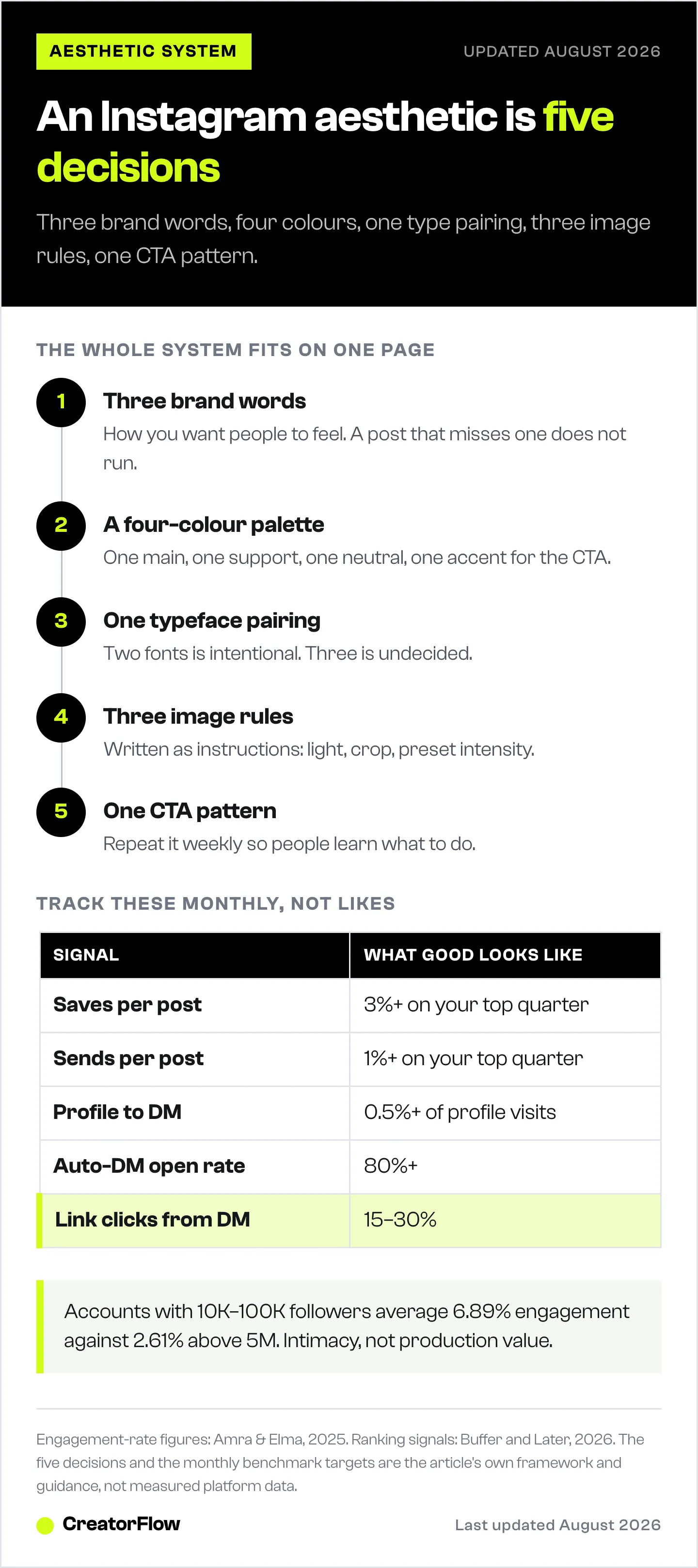
You do not need a mood board with 200 images. You need five decisions, written down, that you can repeat next week without thinking.
Decision 1: Three brand words
Not what you sell. How you want people to feel.
Three is enough. Examples that work for selling creators:
- Calm, expert, modern (high-ticket coach)
- Bold, useful, fast (affiliate marketer)
- Warm, considered, personal (lifestyle brand)
- Sharp, unfiltered, confident (founder personal brand)
These three words become your veto. If a post does not match all three, it does not belong on the feed.
Decision 2: A 4-color palette
Pick four. No more.
- One main color (used in 60% of posts)
- One support color (used in 25%)
- One neutral (background, type)
- One accent (used sparingly, draws the eye to the CTA)
Save the hex codes in your phone notes. Build a quick Canva brand kit. From now on, any image, graphic, or Reel cover uses only these four.
Decision 3: One typeface pairing
A single primary font for headlines and graphic posts. Optionally one secondary for body type. That is it.
Two fonts is intentional. Three is undecided. Five fonts means you do not have a brand.
Decision 4: Three image rules
Write them as instructions you could send to an assistant.
Examples:
- Always shoot in soft natural light, no overhead artificial light.
- Crop tight on the subject, leave 15% breathing room top and sides.
- Use the same Lightroom preset on every photo, intensity 60%.
The rules turn taste into a workflow. New post? Apply the three rules. Done. (For more on filter consistency, see the most popular Instagram filters and how to pick one.)
Decision 5: One CTA pattern
This is the one almost every aesthetic guide skips. Aesthetic without a consistent call-to-action is decoration.
Pick a single CTA pattern your audience learns to recognize. Examples:
- Comment a keyword to get the link in DM (highest converting for affiliates and digital products)
- Tap the link in bio (works for content with low intent, weakest of the three)
- Reply to this Story to get [thing] (highest intent, best for warm audiences)
The CTA pattern is part of your aesthetic because it is part of how your feed sounds. Pick one, repeat it weekly, and let your audience train themselves to act on it.
A complete aesthetic system fits on one page: three words, four hex codes, one font pairing, three image rules, one CTA pattern. That is the entire deliverable.
Aesthetic by Creator Type
Generic aesthetic advice produces generic results. Here is how each major creator type should bias the framework.
Affiliate Marketer (Amazon, LTK, Mavely)
Lean Modern Editorial Mix or Vibrant Pop. Your job is to make the product the hero in a feed that still looks like a brand. Use the same product-shot composition every time so people learn to recognize “Sarah’s Amazon picks” at a glance. CTA is non-negotiable: comment to DM, every post.
Pair the aesthetic decisions in this guide with the Instagram automation playbook for affiliate creators so the look and the funnel are built together, not in sequence.
Coach or Course Creator
Editorial Minimalist or Cinematic Dark. Your aesthetic is your authority. Avoid heavy graphic templates — they look like Canva, not expertise. Use one Reel format consistently for educational content (your “house format”) and one for personal moments. Two formats, alternating, builds recognition fast.
Plan your output around a content calendar that supports a launch funnel so the aesthetic does not get diluted in busy weeks.
E-commerce / DTC
Modern Editorial Mix wins. You need a feed that handles three asset types without breaking: product photography, lifestyle context, and UGC from customers. Define a master color palette and force every UGC partner to shoot within it, or you will spend your aesthetic budget every time you reshare.
UGC Creator
Authentic Raw or Vibrant Pop, depending on the brands you target. Brands hiring UGC are not buying polish. They are buying the look of a real person using their product. A too-polished feed makes you look like you charge agency rates — it can shrink your inbound.
Service-Based Personal Brand
Editorial Minimalist with one human element per three posts. People hire people. Your face needs to be on the feed weekly, but inside a system that signals competence. The hardest aesthetic to execute well, but the highest-converting for premium services.
Before you commit, run the niche-fit check that filters out aesthetic decisions that will not pay you back.
Aesthetic + DM Funnel: Where the Feed Hands Off to Revenue
This is the part Postiz, Later, and Hootsuite all leave out. A beautiful feed is a leaky bucket without a connection point. The aesthetic earns the click. The DM closes the deal.
The handoff looks like this:
- Post (aesthetic earns the save and the comment)
- Comment (your CTA pattern says “comment WORD for the link”)
- Auto-DM (a tool sends the link in 8 seconds)
- Click or reply (the buyer either acts or asks a follow-up)
If the DM that arrives in step 3 looks and sounds like a different brand than the post in step 1, conversion drops. The DM message is part of the aesthetic.
What that looks like in practice:
- Match the visual. If your feed is Editorial Minimalist, the DM is short, signed, no emoji vomit. If your feed is Vibrant Pop, the DM has personality, an image, maybe one emoji, and the link is the hero.
- Match the voice. A premium coach’s DM should not say “OMG yes here’s the link bestie.” A UGC creator’s DM should not read like a legal disclaimer.
- Match the CTA cadence. If you trained your audience that comments turn into DMs, every post needs to honor that promise.
The plumbing for this is automation through Instagram’s official Graph API. The mechanics are covered end-to-end in the comment-to-DM setup guide, and the broader funnel sits inside the full Instagram DM automation playbook.
A working aesthetic plus a working DM handoff is the real flywheel. Aesthetic alone is wallpaper.
Mistakes That Quietly Kill Conversion
These show up in audits over and over, and most creators do not see them in their own feed because they are too close to it.
- Three competing visual directions in the last nine posts. A Reel cover with red headlines, a quote graphic with serif type on cream, and a product shot with a heavy filter. Each fine. Together, three brands. Pick one and rebuild backwards.
- Reel covers nobody designed. Default video frames as covers means your Reels grid looks like a stranger’s camera roll. Build three Reel cover templates and use them on every Reel.
- Story aesthetic that contradicts the feed. A premium feed with chaotic Stories full of stickers and screenshots reads as inauthentic. Stories are the warm-up to the DM, not a free-for-all.
- Inconsistent CTA placement. Sometimes link in bio, sometimes “comment WORD,” sometimes “DM me.” Audiences need to be trained, and training requires repetition.
- Aesthetic chosen for the creator’s taste, not the buyer’s expectation. The most common version of this is a coach selling $2K services with a meme-heavy Vibrant Pop feed. The aesthetic and the offer are at war.
- Polish without a point of view. A perfectly cohesive feed that says nothing is more forgettable than a messy feed with strong opinions.
How to Measure if Your Aesthetic Is Working
Likes are noise. The signals that matter for a working aesthetic are the same signals that move the algorithm in 2026.
Track these monthly:
| Metric | What it tells you | What good looks like |
|---|---|---|
| Saves per post | Does the aesthetic feel useful enough to keep? | Top 25% of your posts: 3%+ save rate |
| Sends per post | Is the post screenshot-worthy in a DM thread? | Top 25%: 1%+ send rate |
| Profile-to-DM rate | Does the feed convert visitors into conversations? | 0.5%+ of profile visits start a DM |
| Comment-to-DM open rate | Is the handoff working? | 80%+ open rate on automated DMs |
| Link click-through from DM | Is the aesthetic earning trust? | 15-30% CTR on automated link DMs |
The diagnostic flow:
- Saves up, sends flat: People find you useful but not shareable. Push aesthetic toward stronger visual identity, not more information.
- Sends up, profile visits flat: Posts travel but the feed does not pull. Audit the 9-grid and Reels grid coherence.
- Profile visits up, DMs flat: The feed earns curiosity but not trust. Strengthen voice and add a clearer CTA pattern.
- DMs up, link clicks flat: The aesthetic broke at the handoff. Rewrite the auto-DM to match the feed’s voice.
This is the part that justifies the work. Aesthetic is not a finished painting. It is a system you tune against revenue, not against your own taste.
FAQ
What is an Instagram aesthetic and why does it matter for monetization?
An Instagram aesthetic is the consistent visual and tonal system across your feed — colors, lighting, typography, image style, voice, and values. It matters for monetization because aesthetic acts as a purchase cue: 69% of Gen Z and 58% of Millennials say social trends drove them to spend money in 2024, and visual consistency between an influencer’s posts and the brands they promote measurably increases engagement with sponsored content (Credit Karma, 2024; Argyris et al., Computers in Human Behavior).
How many colors should an Instagram aesthetic use?
Four. One main color (about 60% of posts), one support color (25%), one neutral, and one accent for CTAs. Three colors looks underdeveloped, five or more looks indecisive. Save the hex codes in a Canva brand kit and treat the palette as non-negotiable for any post, Reel cover, or graphic.
What’s the difference between a polished and an authentic Instagram aesthetic, and which converts better?
Polished aesthetics signal authority and work for premium offers above $300. Authentic aesthetics signal intimacy and work for personal-brand sales, coaching, and UGC. Authentic does not mean lazy. Smaller creators with 10K-100K followers average 6.89% engagement vs. 2.61% for accounts above 5M, and that gap is largely about perceived intimacy (Amra & Elma, 2025). The best converting aesthetic is the one that matches the buyer’s expectation of your category, not the trendier one.
Does having a cohesive Instagram feed actually grow followers in 2026?
Yes, indirectly. Instagram’s three biggest ranking signals across feed, Reels, and Explore as of 2026 are watch time, sends per reach, and likes per reach (Buffer, 2026; Later, 2026). A recognizable feed is more saved, sent, and shared, which is what the algorithm now rewards. Cohesion does not grow you on its own. Cohesion plus useful content gets compounded distribution.
What aesthetic works best for affiliate marketing on Instagram?
Modern Editorial Mix or Vibrant Pop, depending on niche. The product needs to be the hero, but inside a feed that still looks like a brand. Use one repeating product-shot composition so viewers learn to recognize your “picks” at a glance, pair every post with a comment-to-DM CTA, and match the auto-DM voice to the feed.
Do I need the same filter on every post to have an aesthetic?
No, but you do need the same color logic. One Lightroom preset at 60% intensity across every photo is the cleanest path. If you want variety, define two presets — one for product, one for lifestyle — and stay inside them. Switching filters per post is the fastest way to break a feed.
What are the most popular Instagram aesthetic types in 2026?
Six are working right now: Editorial Minimalist, Warm Vintage, Vibrant Pop, Authentic Raw (photo dump), Cinematic Dark, and Modern Editorial Mix. The mix is the most flexible default for creators with multiple revenue streams. Pick the one that matches your buyer’s expectation of your category, not the one that matches your personal taste.
Aesthetic-to-conversion data verified from Credit Karma / Harris Poll (November 2024), Buffer Instagram algorithm 2026 guide, Later 2026 algorithm research, Amra & Elma engagement-rate statistics (2025), Electroiq Instagram shopping statistics (2025), and Argyris et al. visual congruence research published in Computers in Human Behavior, all accessed May 2026. Individual results vary by niche, audience size, and offer.

