

Instagram DM automation for beauty and skincare brands answers shade, skin type, ingredient, and scent questions the moment a shopper asks them. Beauty returns at roughly 4% to 12%, far below the 19.3% recorded across all online sales in 2025, because hygiene policies block most returns. That low number is not a sign of health. It means the buyer carries the entire risk, so pre-purchase certainty is the whole conversion lever.
A shopper watches your foundation Reel three times. She comments “what shade is she?” She is not browsing. She is trying to work out whether she can buy a sealed product she will never be allowed to send back. Nobody replies for six hours. She buys the drugstore version, because at least the pharmacy takes returns.
This guide covers why beauty’s return numbers describe a demand problem rather than a healthy one, the five automations that give shoppers certainty before checkout, and the claims you must keep out of an automated message. It applies to colour cosmetics, skincare, haircare, and fragrance.
Key Takeaways
- Low returns mean high pre-purchase risk. Beauty and personal care returns run roughly 4% to 12% against 19.3% for online sales overall (nrf.com, October 2025). Hygiene rules refuse the return; they do not remove the doubt.
- Shade and skin-type uncertainty is the checkout blocker. It is answerable in a DM in under ten seconds, and unanswerable on a product page alone.
- Ingredient questions are trust questions. Actives conflicts, pregnancy safety, and fragrance-free status decide the sale for a large share of skincare buyers.
- Fragrance needs a sampling path, not a description. No message can convey a scent. It can route the buyer to a discovery set that converts to full size.
- Never automate a treatment claim. Anything that reads as diagnosing or curing a condition belongs nowhere in a pre-written message. Automate the routing, not the promise.
- Capture the email inside the conversation. Beauty is a replenishment category, and the reorder is worth more than the first order.
What Beauty’s Return Rate Is Really Telling You
The National Retail Federation put 2025 ecommerce returns at 19.3% of online sales, worth $849.9 billion across US retail (nrf.com, October 2025). Category benchmark compilations published through 2026 place beauty and personal care at roughly 4% to 12%, the lowest band of any major category, and home and furniture at 15% to 23%.
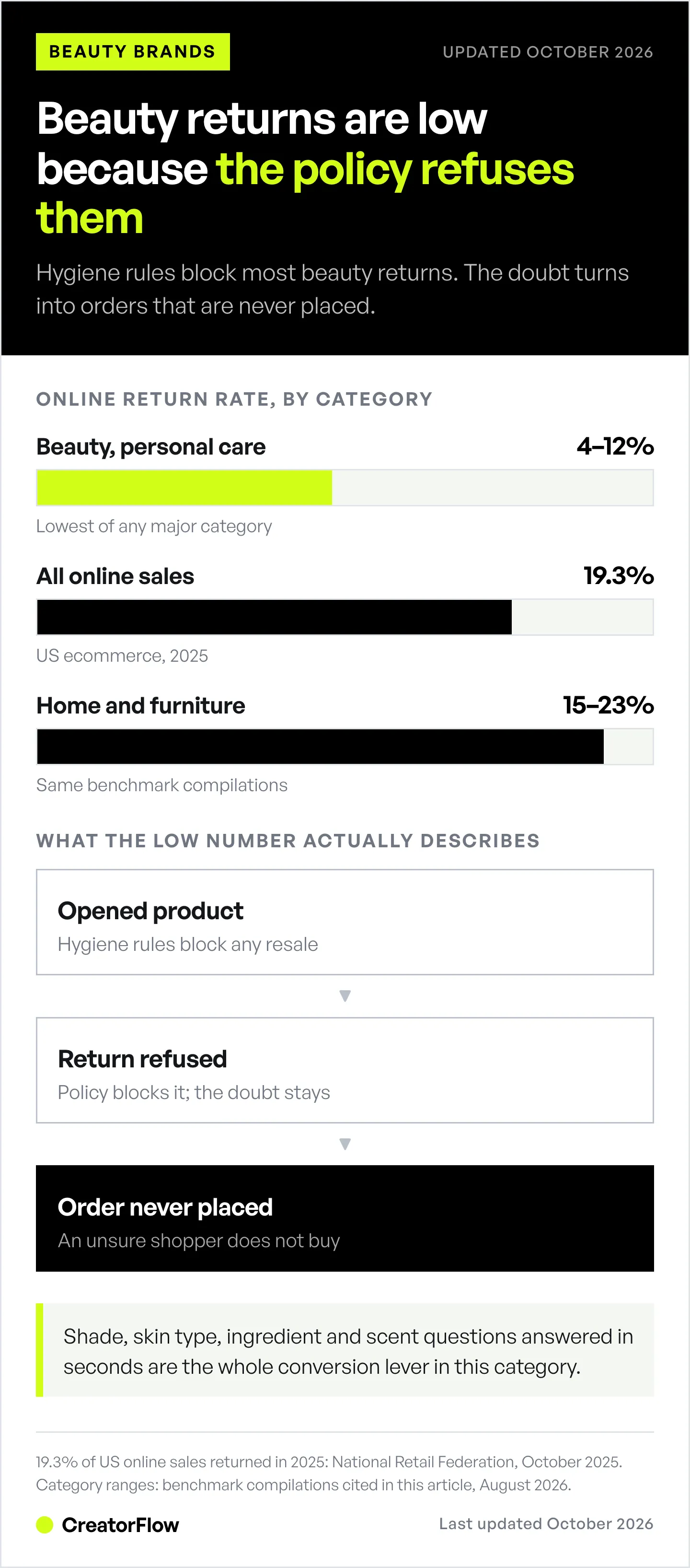
Most category write-ups read the beauty number as good news. Read the mechanism instead. Beauty returns are low because opened cosmetics cannot be resold, so brands refuse them by policy. The return did not fail to happen because the shopper was satisfied. It failed to happen because it was not allowed.
That has a direct consequence for demand. In apparel, a shopper can order two sizes and send one back, so uncertainty costs the brand margin but not the sale. In beauty, uncertainty costs the sale outright, because a shopper who is unsure about a shade and knows she cannot return it will not order at all.
So the conversion lever in beauty sits entirely before checkout. Every question a shopper cannot get answered is an order that never gets placed. That is the argument for putting a fast, specific answering system on your comment section, and it is a stronger argument here than in any category where returns are permitted.
What Instagram DM Automation Does for Beauty Brands
Instagram DM automation for beauty brands turns your comment section into an answering desk. A shopper comments a keyword such as SHADE, SKIN, INGREDIENTS, SCENT, or SAMPLE, and the answer she needs lands in her DMs within seconds: the exact shade worn in the post, a skin-type triage, the full ingredient list, scent notes with a discovery set, or sampling options. You collect her email in the same conversation for the reorder.
The Five Questions That Block a Beauty Purchase
| Question in the comments | Trigger keyword | What the DM sends | What it unblocks |
|---|---|---|---|
| ”What shade is she wearing?” | SHADE | Shade worn, undertone guide, closest matches in common brands | Colour uncertainty on a non-returnable product |
| ”Will this work for oily/dry/sensitive skin?” | SKIN | Short triage plus the two products that fit that answer | Wrong-product risk on a routine purchase |
| ”Can I use this with retinol?” / “Is it pregnancy-safe?” | INGREDIENTS | Full INCI list, actives guidance, fragrance-free status | Safety and compatibility doubt |
| ”What does it smell like?” | SCENT | Notes, family, wear time, and a discovery-set link | The one thing a photo cannot carry |
| ”Do you have samples?” | SAMPLE | Sampling options and the credit-toward-full-size offer | First-purchase risk for a new customer |
Every row is a risk transfer. The shopper is asking you to take on some of the uncertainty she cannot offload through a return policy. Answering fast is how you take it on cheaply.
Shade Matching in a DM
Shade is the highest-volume trigger for any colour brand and the one worth building carefully.
The SHADE message should carry:
- The shade worn in the post, named exactly. Not “one of our mid tones.”
- An undertone guide the shopper can self-administer. Vein colour, jewellery preference, and how skin behaves in sun are the three quick tests. Keep it to three lines.
- Cross-brand reference points. “If you wear NC25 in a common drugstore formula, you are our Shade 4.” This is the single most effective line in a shade message, because it lets a shopper match against a product already on her shelf.
- A route to a human. “Send a photo in natural light and we will match you.”
- The link, direct to the shade, not the collection.
That fourth line does the heavy lifting for the shoppers automation cannot reach. Anyone between two shades is high-intent and worth a real answer, and a photo request converts far better than another chart.
The trigger setup is covered step by step in our comment-to-DM automation setup guide.
Skin Type and Concern Triage
Skincare buyers rarely ask for a product. They ask for a result. “Will this help with texture?” is a routing question wearing a product question’s clothes.
Build a SKIN keyword that runs a short triage. Three questions, no more:
- Skin type, offered as options rather than an open field
- Primary concern, again as options
- Whether they currently use any actives
Then return two products, with a reason attached to each. Two beats five. A shopper handed five options is back to where she started.
Keep the language descriptive rather than clinical. Describe what the formula contains and what it is designed for. Do not describe what it will cure. That line matters legally and it also matters commercially, because overclaiming is the fastest way to earn the returns that beauty policies are built to avoid.
Ingredients, Actives, and the Questions You Must Answer Precisely
Ingredient questions carry more purchase weight in skincare than in any other category, and they are the questions most brands answer worst, usually by saying “check the product page.”
The INGREDIENTS message should include:
- The full INCI list, or a link straight to it rather than to the homepage
- Actives concentrations where you publish them
- Compatibility guidance for the common conflicts shoppers ask about
- Fragrance-free, essential-oil-free, and nut-derivative status stated explicitly
- Whether the formula is generally avoided during pregnancy, with a clear instruction to check with a doctor
Publish the specifics and route the medical judgment away. A pre-written message can list what is in a bottle. It cannot assess whether a particular person should use it, and it should never try.
That distinction is the compliance line for this whole category. Automate the facts about the product. Never automate a statement about the shopper’s body.
Fragrance: Sell the Sample, Not the Scent
No message describes a smell well enough to sell a $140 bottle to a stranger. Fragrance brands that treat the DM as a description exercise lose. Brands that treat it as a routing exercise win.
The SCENT keyword should send:
- The fragrance family and top, heart, and base notes
- Wear time and projection, stated plainly
- Two comparison anchors from widely known scents, so the shopper has a reference frame
- A discovery set or sample link, with the sample cost credited against a full bottle
That credit mechanic is the conversion device. It converts an unaffordable risk into a small one, and it gives you a named contact who has your scent on their skin for a week.
Sampling belongs in skincare too. A sachet shipped alongside a sealed full-size product lets the buyer test before breaking the seal, which resolves the exact tension that makes beauty returns impossible and beauty purchases hesitant.
Reorders Are Where the Money Is
Beauty is a replenishment category. A serum that lasts eight weeks has a natural repurchase rhythm, and the brand that owns the contact owns the repeat.
Capture the email inside the DM conversation, not on a landing page afterwards. The shopper is already talking to you, already interested, and already at the point of highest willingness. Ask once, in the message that answered her question.
Then use it. A reorder reminder timed to the size of the bottle is one of the highest-return emails a beauty brand can send, and it does not depend on Instagram at all. Our guide to collecting emails in Instagram DMs covers the email gate and the export path into your marketing platform.
If your brand also works with creators on affiliate terms, the creator-side setup is covered separately in our guide to DM automation for beauty influencers. For supplements and ingestible wellness, which carry different claim rules entirely, see DM automation for supplement and wellness brands.
Tools and Pricing
CreatorFlow is $15/month on Pro, flat, with unlimited automations, two workspaces, comment-to-DM, Story reply automation, keyword triggers, link tracking, a follow gate, an email gate, and geographic click analytics. The Free plan runs 500 DMs a month on one workspace. Flat pricing holds through a launch spike, which matters when a single shade-match Reel can multiply comment volume for a week (creatorflow.so, October 2026).
ManyChat covers Instagram, Facebook, WhatsApp, SMS, TikTok, Telegram, and email with a multi-channel flow builder. ManyChat’s pricing page prices per active contact: Free at 25 contacts, Essential $17/month for 250, Pro $39/month for 2,500, Business $99/month for 7,500, and Advanced $199/month for 25,000, billed monthly, or $14, $29, $69, and $139 per month billed annually (checked October 2026). Plans apply to accounts created on or after March 2, 2026. Best for brands running one campaign across email, SMS, and Instagram together.
LinkDM reports over 60,000 creators, brands, and agencies. Its pricing page lists Free at 1,000 DMs a month, Pro at $19/month for 25,000 DMs, and Platinum+ at $99/month for 300,000 DMs (checked October 2026). Best when message volume is the main cost variable.
Platform Rules That Shape the Setup
Meta publishes per-second rate limits on the Instagram API with Instagram Login path: 100 calls per second for text and links, 10 per second for audio and video, and 750 per hour for private replies to comments on posts and Reels (developers.facebook.com, October 2026). Tools including CreatorFlow pace sends at roughly 200 DMs an hour as a conservative behavioural cap, which is a tool-side convention rather than a Meta-published hourly figure.
Meta allows one private reply to each comment, within 7 days of the comment. After that, you can message the shopper again only within 24 hours of her last message. That is why the email capture inside the DM carries the replenishment cycle. Since 5 October 2026, Meta no longer offers the one-tap email quick reply in Instagram DMs, so the shopper types her email into the chat (developers.facebook.com, October 2026). Meta also finished removing in-app checkout in August 2025, so the DM link lands on your own product page and that page does the converting (ppc.land, August 2026).
FAQ
Why is the beauty return rate so low if shoppers are uncertain?
Because opened cosmetics generally cannot be resold, most beauty brands refuse returns by policy. The low rate reflects the policy, not shopper satisfaction. The uncertainty shows up earlier, as orders that are never placed, which is why answering pre-purchase questions quickly matters more in beauty than in categories where returns are permitted.
How do I automate shade matching on Instagram?
Set a SHADE keyword that sends the shade worn in the post, a three-line undertone self-test, cross-brand reference points, and an offer to match from a photo taken in natural light. The cross-brand reference is the highest-converting element, because it lets the shopper match against a product she already owns.
Can I answer ingredient and safety questions with automation?
You can send facts about the product: the full INCI list, actives concentrations you publish, fragrance-free status, and known compatibility guidance. Do not automate any statement about whether a specific person should use a product. Route pregnancy, medication, and skin-condition questions to a person and to a doctor.
Does DM automation work for fragrance brands?
Yes, when the message routes rather than describes. Send the fragrance family, notes, wear time, two well-known comparison anchors, and a discovery-set link with the sample cost credited against a full bottle. No written description sells a scent; a sample does.
What should a beauty brand never put in an automated DM?
Any treatment or cure claim, any before-and-after promise, and any statement about a shopper’s medical condition. Also avoid absolute language about results. Automate what the product is and who it is formulated for, then let a person handle anything that requires judgment.
How do I get repeat purchases from Instagram DMs?
Capture the email address inside the conversation that answered the shopper’s question, while intent is highest. Then send a reorder reminder timed to how long the product lasts. The repeat purchase runs on your email list rather than on Instagram, since Meta’s 24-hour window will have closed long before the bottle runs out.
Is this different from DM automation for beauty creators?
Yes. Creators automate affiliate link delivery and product recommendations across brands they do not own. Brands automate shade, skin type, ingredient, and sampling questions about their own catalogue, and own the customer record afterwards.
Return-rate figures verified from the National Retail Federation’s 2025 Retail Returns Landscape (nrf.com) and category benchmark compilations as of August 2026. CreatorFlow, ManyChat and LinkDM pricing, and Meta’s rate limits and messaging rules, were checked in October 2026. This article is not medical or regulatory advice. Individual results vary.


