
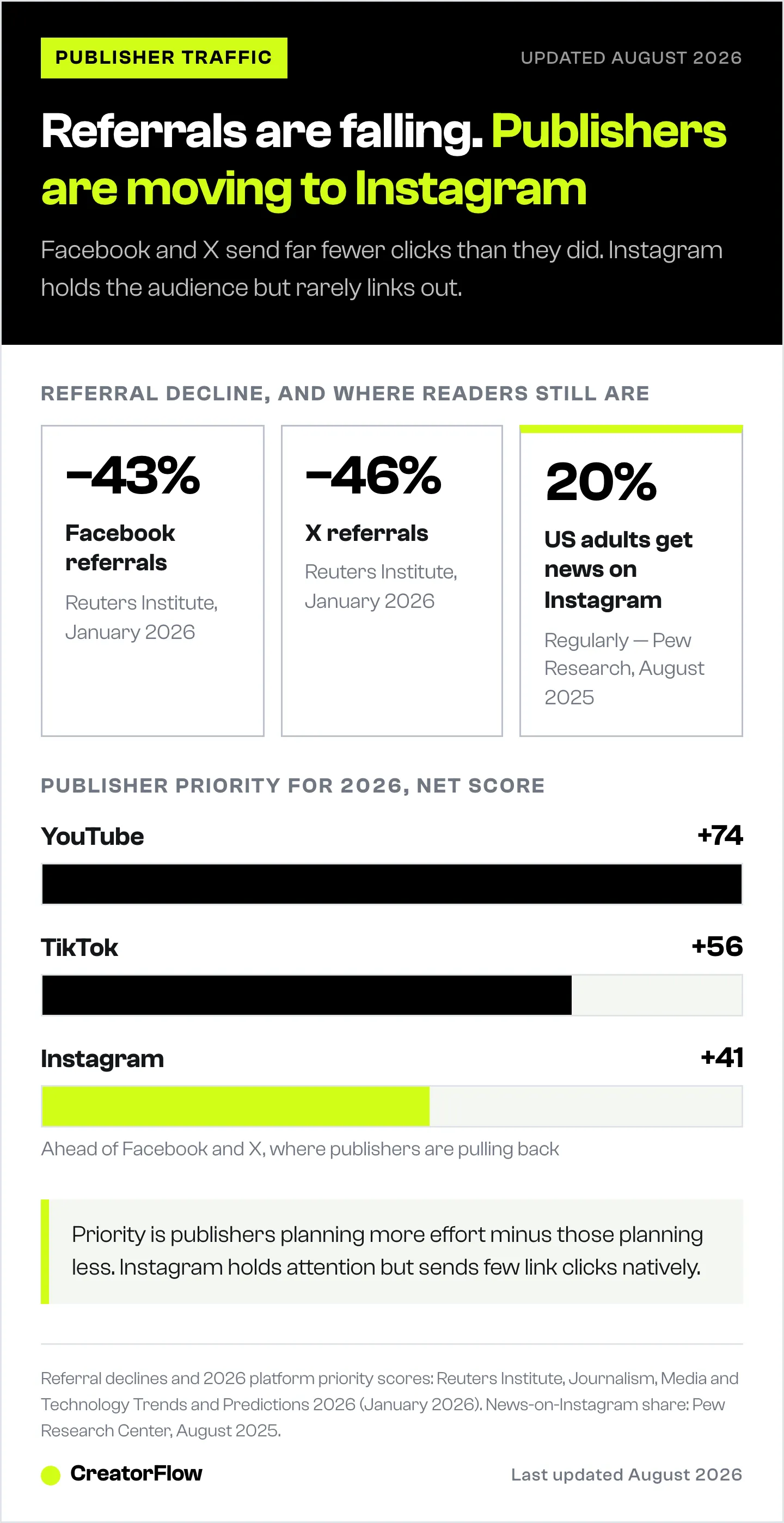
Instagram DM automation lets media publishers convert comment engagement into newsletter signups, push subscriptions, and app installs by replying instantly with a relevant link in the DM. It uses Meta’s official Instagram API, runs at conservative pacing of about 200 DMs per hour, and respects the 24-hour messaging window. For publishers losing referral traffic from Facebook (down 43%) and X (down 46%), it converts ephemeral engagement into owned audience before the news cycle moves on.
Your audience team is watching the chart drop. Facebook referrals down 43% in two and a half years. X down 46% (Reuters Institute, January 2026). Your Reels still pull views, but the link in bio drives a trickle. The newsletter team wants signups. Push wants installs. The audience is on the post for ninety seconds, then they swipe to the next thing.
This guide is for editors, audience development leads, and platform editors at digital publishers. It covers why the creator playbook does not transfer cleanly, the three DM automation patterns that work for publisher economics, the stack you need to run them, and the compliance limits that change how editorial uses this. Individual book publishers and self-published writers run a leaner version of the same playbook, covered in our guide to DM automation for authors selling books. Sources are cited inline.
Key Takeaways
- Social referral is collapsing: Facebook referrals fell 43%, X fell 46% over the last two and a half years (Reuters Institute, January 2026). Instagram is one of the few platforms still growing for publishers, but it sends almost no link clicks natively.
- DM beats bio link: A pinned bio link converts a fraction of viewers because the path is “tap profile, tap bio link, scroll, tap article.” DM automation collapses that to one comment and one tap inside the inbox.
- Three patterns matter for publishers: per-article distribution for breaking news, evergreen comment-to-newsletter for signature content, and Story-reply for paywalled or member-only pieces.
- Owned audience is the goal: 20% of US adults regularly get news on Instagram (Pew Research, August 2025). The DM is a bridge from that 20% into newsletter, push, and app-the channels you actually own.
- Pacing is real: Tools cap automated sends at about 200 DMs per hour as a safety convention, well under Meta’s per-second per-user limits (developers.facebook.com, May 2026). For a top-of-feed Reel that pulls 8,000 comments, you need to plan throughput.
- Compliance shifts the model: the standard 24-hour messaging window plus one automated reply per user per trigger means you cannot use DMs as a broadcast channel. Use them as a per-event reply layer.
- Editorial governance applies: a DM is an outbound message from your masthead. The same review standards that apply to push notifications and tweets apply here.

Why the Creator Playbook Does Not Transfer to Publishers
Creators optimize for relationship and recurring monetization. Publishers optimize for headline-driven distribution and converting attention into owned audience. The difference matters.
A creator’s Reel typically promotes one offer, has months of shelf life, and the comment-to-DM trigger sends the same affiliate link week after week. A publisher’s Reel promotes a specific article that may be irrelevant in 72 hours. The trigger keyword has to be tied to the post, the link has to be the article (or a section landing page), and the automation logic has to handle dozens of triggers running in parallel because the newsroom is publishing all day.
Three operational realities shape the publisher version:
Article shelf life. A breaking news Reel hits its peak engagement window in the first 6 hours. If your DM automation is set up for a single evergreen offer, you miss the moment. Publishers need per-article triggers that the social team can spin up in five minutes and retire when the story cycles out.
Multi-author velocity. A 30-person digital newsroom posts 50+ pieces a day. The audience team cannot manually wire a DM trigger to every Reel. The pattern that works: a small set of standing automations (newsletter, app, push, paywall) plus per-article triggers for tentpole pieces.
Editorial standards. A DM that goes out under your masthead is editorial output. The phrasing has to match the brand voice. The link has to point to the right place. Mistakes are public, get screenshotted, and turn into a post about your post.
Reuters Institute’s 2026 Trends report puts Instagram at +41 in the publisher priority diff (planning more effort vs less), behind YouTube (+74) and TikTok (+56) but well ahead of Facebook and X, where publishers are actively pulling back (Reuters Institute, January 2026). Instagram is the priority because the audience is there. The DM layer is what turns that audience into something you can keep.
The Three DM Automation Patterns That Work for Publishers
Most publisher experimentation with DM automation fails because they treat it as a single feature rather than three distinct patterns with different goals. The three:
| Pattern | Goal | Trigger | Link target | Time to deploy |
|---|---|---|---|---|
| Per-article distribution | Drive traffic to a specific story | Reel comment with article-specific keyword | The article URL with a UTM | 5 minutes per Reel |
| Evergreen audience capture | Convert engagement into newsletter or app | Comment “newsletter” or “app” on any post | Newsletter signup or app store link | Set once, run forever |
| Story-reply for premium | Convert engaged readers into subscribers | Story reply to a paywalled-piece teaser | Paywall landing or trial offer | Set once per series |
Pattern 1: Per-Article Distribution
Use case: a feature story, scoop, or breaking news piece that needs to drive direct article traffic in the first 24 hours.
The setup runs in five minutes. The social editor posts a Reel about the story, sets a trigger keyword tied to the slug (“HOUSING” for a housing investigation, “FED” for a Fed decision piece), and pins a comment: “Comment HOUSING and we will DM the full investigation.” The DM goes out within seconds with the article link plus a UTM source so the analytics team can attribute traffic.
This pattern matters most for big tentpole pieces that you actually want to drive traffic toward. It is overkill for routine posts. The signal that justifies the setup time: you would normally write a long caption pointing to the article and watch the link-in-bio convert at low single digits.
For setup mechanics, see our comment-to-DM automation setup guide.
Pattern 2: Evergreen Audience Capture
Use case: convert any Instagram engagement into a newsletter subscriber, push subscriber, or app install. Runs all day, every day, on every post.
The setup is one-time. You create three to five standing keyword triggers that the social team trains the audience to use:
- “NEWSLETTER” returns a DM with the signup link to your flagship newsletter
- “APP” returns the App Store / Play Store link with a tracking source
- “PUSH” returns a guide to enabling browser push notifications
- “DAILY” or your newsletter brand name returns the signup landing page
Train the audience by mentioning these keywords in standing copy: “Want our morning briefing? Comment NEWSLETTER on any post.” Over weeks, regular followers learn the system.
The math here is the publisher version of what creators do for affiliate links. If a Reel hits 100,000 views and 1% of viewers comment “NEWSLETTER,” that is 1,000 DMs going out and a meaningful share converting to signup. Conversion varies by audience and offer; track yours and optimize the welcome email rather than the DM copy.
For the email-capture mechanics, see our guide on collecting emails through Instagram DMs and the Beehiiv-to-Instagram newsletter playbook.
Pattern 3: Story-Reply for Premium Content
Use case: convert engaged readers into paying subscribers or trial signups for paywalled, member-only, or subscription content.
Story replies are higher intent than feed comments because the audience took two actions (watched the Story, replied). Publishers running a paywall or membership tier should treat this as their warmest inbound channel.
The pattern: post a Story with a teaser of a premium piece, ask a question or run a poll, and let the reply trigger an automation. The DM offers a trial link, a free first issue, or member-only piece. Because Story interactions read as private conversation rather than broadcast, the conversion intent on the receiving end is meaningfully higher than on a public Reel comment.
For the operational pattern, see our Story DM automation use cases.
The Stack a Publisher Needs to Run This
A working publisher DM automation setup has four pieces. Most publishers already own three of them.
1. An Instagram Business or Creator account connected to Meta Business Suite. This is required to authorize any third-party automation tool through the Graph API. If you are still on a Personal account, switch first.
2. A DM automation tool that uses Meta’s official API. The risk-mitigation reason for using the official API is straightforward: tools that scrape or impersonate-login your account get suspended; tools that use OAuth through Meta’s sanctioned API do not. CreatorFlow ($15/month flat, creatorflow.so May 2026) handles this for editorial teams that want a simple flat-rate setup. ManyChat (Essential $17/mo, Pro $39, Business $99, Advanced $199, or $14/$29/$69/$139 per month billed annually, manychat.com July 2026) is the deepest in workflows for teams that already use it for Facebook and SMS. Other Meta-API tools work the same way; the choice is operational fit.
3. A pipe to the audience system. Whether you push to Beehiiv, Mailchimp, Klaviyo, your custom CRM, or a push notification provider like OneSignal or Iterable, you need a way to get the captured email or device token from the DM tool into the system that owns the audience. Zapier, Make, or a direct API integration all work.
4. Editorial governance. A documented process for who can spin up a per-article trigger, what the brand voice in DMs looks like, and how to retire automations when the story cycles out. This is the part most publishers underestimate. Without it, you end up with stale triggers from three months ago still pinging readers with broken article URLs.
For a deeper look at how the audience-development side of this works, see our Instagram-to-email funnel guide.
Compliance and Operational Limits Publishers Hit
Three constraints reshape how publishers can use this. None of them are dealbreakers, but they change the model.
The 24-hour messaging window. Meta’s API only lets you message users who interacted with you (commented, replied to a Story, sent a DM) in the last 24 hours through standard messaging. The Human Agent tag extends to 7 days for human-handled conversations (developers.facebook.com, May 2026). What this means: you cannot use DM automation as a one-to-many broadcast channel. It is strictly a per-event reply layer triggered by user action.
The pacing convention. Most automation tools cap sends at around 200 DMs per hour per account as a behavioral safety convention. Meta’s published limits are per-second per user on the Instagram Login path (100 per second for text and links, 10 per second for audio and video), but tools enforce the conservative hourly cap to stay well under platform thresholds and avoid spam-classifier triggers (developers.facebook.com, May 2026). For a top-of-feed Reel that pulls 8,000 comments in the first hour, the queue will catch up over several hours rather than going out instantly.
One automated reply per user per trigger. From comment and Story triggers, the API allows one automated message per user per 24-hour period for the same trigger. For publishers, this matters when a regular reader engages multiple times. They will get the DM the first time and a quieter response (or nothing) afterward. Plan the automation so the first DM lands the value.
For the full rate-limit breakdown, see our Instagram API rate limits explainer and the DM compliance guide for Meta rules.
The Argument for Owned Audience
The Reuters Institute 2026 framing puts it directly: publishers are losing direct referral traffic on the platforms designed for it (Facebook, X) and gaining attention on platforms that do not link out (Instagram, TikTok). The strategic move is not to chase clicks where the platform is fighting against them. It is to convert attention into channels you own.
DM automation is one of the few mechanisms that lets a publisher use Instagram natively while still pulling the audience into newsletter, push, and app, all of which you own and none of which depend on a platform algorithm staying friendly. That is the entire reason the editorial value here is higher than the conversion-rate math alone suggests.
For a parallel view of how this works alongside Instagram Broadcast Channels, see our Broadcast Channels guide for creators and publishers.
FAQ
Can news publishers use Instagram DM automation safely?
Yes, when the tool uses Meta’s official Instagram API and the publisher’s account is a Business or Creator account in good standing. The risk vector is unofficial scraping or browser-bot tools, which can result in suspension. Tools like CreatorFlow, ManyChat, and other Meta-API partners authenticate through OAuth and do not require password sharing.
How does DM automation compare to Instagram Broadcast Channels for publishers?
Broadcast Channels are one-to-many push to opted-in followers, useful for editorial alerts and member updates. DM automation is one-to-one reply triggered by user action (comment, Story reply, keyword DM), useful for distribution and audience capture per post. Most publishers should run both: Broadcast Channels for the engaged inner audience, DM automation for the larger pool of casual commenters.
Do Instagram DMs count as a referral source in Google Analytics?
No, not natively. The DM itself is inside Instagram and the click resolves as direct or as Instagram referrer depending on the user agent. The fix is UTM tagging on every link sent through the DM (utm_source=instagram, utm_medium=dm, utm_campaign=article-slug). Without UTMs, the audience team cannot attribute traffic from this channel.
What is the realistic conversion rate from comment to DM open?
DM open rates from comment-to-DM triggers run noticeably higher than email open rates because the message lands in the same app the user just engaged in. Click-through to the linked article or signup page varies by offer, audience, and message copy. Track per-Reel rather than relying on industry averages.
Is one DM tool enough or do publishers need multiple?
For most publisher use cases, one tool is enough if it supports comment, Story-reply, and keyword-DM triggers with multiple parallel automations. A 30-person newsroom can run all three patterns (per-article, evergreen, Story-reply) in a single tool. The question to ask vendors: how many active automations can run in parallel, and what is the per-automation editing UX for non-technical social editors?
How do publishers handle editorial review of automated DMs?
The same way push notifications and tweets get reviewed: a documented brand-voice spec, a small set of approvers, and a rollback process. The DM template is editorial output. Treat the social team as the writing team and the audience director as the editor.
Does this work for paywalled or subscription publishers?
Yes, and arguably better than for ad-supported publishers. The Story-reply pattern in particular is built for converting engaged readers into trials. The DM can deliver the article behind a metered paywall directly (raises propensity to subscribe at the paywall) or offer a trial directly inside the DM thread.
Sources verified May-June 2026: reutersinstitute.politics.ox.ac.uk (2026 Trends and Predictions report, social referral declines, publisher priority data); pewresearch.org (Social Media and News Fact Sheet, August 2025 survey); developers.facebook.com (Graph API rate limits and messaging window documentation); creatorflow.so and manychat.com (current pricing). Conversion-rate ranges are observed across publisher and creator deployments; track per-post for your audience.


