
ManyChat charges by active contact count, so a post that brings in new contacts can move you into a higher tier. The Free plan now caps at 25 contacts and 4 automations. Essential starts at $17/month for 250 contacts ($14 billed annually), Pro at $39/month for 2,500 ($29 annually), Business at $99/month for 7,500 ($69 annually), and Advanced at $199/month for 25,000 ($139 annually), with overage fees of $0.018 to $0.10 per extra contact (manychat.com/pricing, July 2026). Flat-rate alternatives hold the same monthly price at any contact count, which suits Instagram-only creators whose audience is growing.
You used ManyChat because it was the default. The Free plan was generous, the Flow Builder did things no one else could. Then the March 2026 pricing change landed. The Free plan dropped to 25 contacts. Essential moved to $17/month for 250 ($14 billed annually). Pricing now scales with your audience instead of your usage. One viral Reel can move you a tier up the same month.
If you are weighing ManyChat against one specific flat-rate tool, our comparison of the two billing meters behind LinkDM and ManyChat works through the arithmetic. ManyChat is a profitable, well-funded company shipping good multi-channel software with a deep visual Flow Builder. The question here is narrower: does a per-contact meter fit an Instagram-only creator in 2026, or does a flat rate cost less as the audience grows? This guide walks through the actual math, the five cost patterns creators run into, and a decision matrix on whether to stay or switch.
Key Takeaways
- The Free plan changed: ManyChat’s Free tier dropped to 25 active contacts and 4 automations on March 2, 2026. Past that, you pay $17/month minimum, or $14/month billed annually (manychat.com/pricing, July 2026)
- Pricing scales with audience, not usage: Every active contact counts toward your tier limit, so growth pushes you up the price ladder even if you only run one automation
- Overage rates apply past your tier: Going past your tier costs $0.018 to $0.10 per extra contact, depending on plan and billing cycle (manychat.com/pricing, May 2026)
- Channels are bundled into the tier: Pro and Business prices include WhatsApp, Messenger, and SMS. An Instagram-only creator pays the same tier price whether or not those channels are connected
- Flat-rate is the other model: CreatorFlow charges $15/month for 5,000 DMs regardless of contact count, so the price stays the same when a post performs well
- Migration is recoverable: CreatorFlow Rewind retroactively sends DMs to comments up to 7 days old, so the gap between cancelling ManyChat and going live elsewhere does not lose leads
ManyChat Pricing in 2026: What Changed in March
ManyChat ran on a relatively generous freemium model for most of its life. On March 2, 2026, the company restructured pricing into five plans (a Free tier plus four paid tiers) built around active contact thresholds (manychat.com/pricing, July 2026).
| Plan | Monthly | Annual | Active contacts | Channels | Automations |
|---|---|---|---|---|---|
| Free | $0 | $0 | 25 | 2 | 4 active |
| Essential | $17/mo | $168/yr | 250 | 2 | Unlimited |
| Pro | $39/mo | $348/yr | 2,500 | 3 | Unlimited |
| Business | $99/mo | $828/yr | 7,500 | Unlimited | Unlimited |
| Advanced | $199/mo | $1,668/yr | 25,000 | Unlimited | Unlimited |
Overage rates on top of plan limits, per the live pricing page (manychat.com/pricing, May 2026):
- Essential: $0.082 per contact (annual) / $0.10 (monthly)
- Pro: $0.038 per contact (annual) / $0.05 (monthly)
- Business: $0.018 per contact (annual) / $0.025 (monthly)
The change creators notice most is the new Free tier limit. A creator who ran on Free with a few hundred DM contacts now has 25 active contacts and four automations on that plan. There is no halfway plan between $0 and $17/month ($14 billed annually).
For context: an active contact is anyone who has interacted with one of your automations in the last 30 days. One viral post that drives 500 commenters into your DM funnel turns into 500 active contacts that month. On Essential, that is 250 included plus 250 in overage at $0.10 each, or roughly $42/month on monthly billing ($17 base plus $25 in overage).
The Per-Contact Math at Every Audience Size
The headline price is what you pay while your contact count sits inside the tier. The number changes once a Reel pushes it past the limit. Here is the worked math at common audience sizes, comparing ManyChat’s tiered model against a flat-rate model like CreatorFlow.
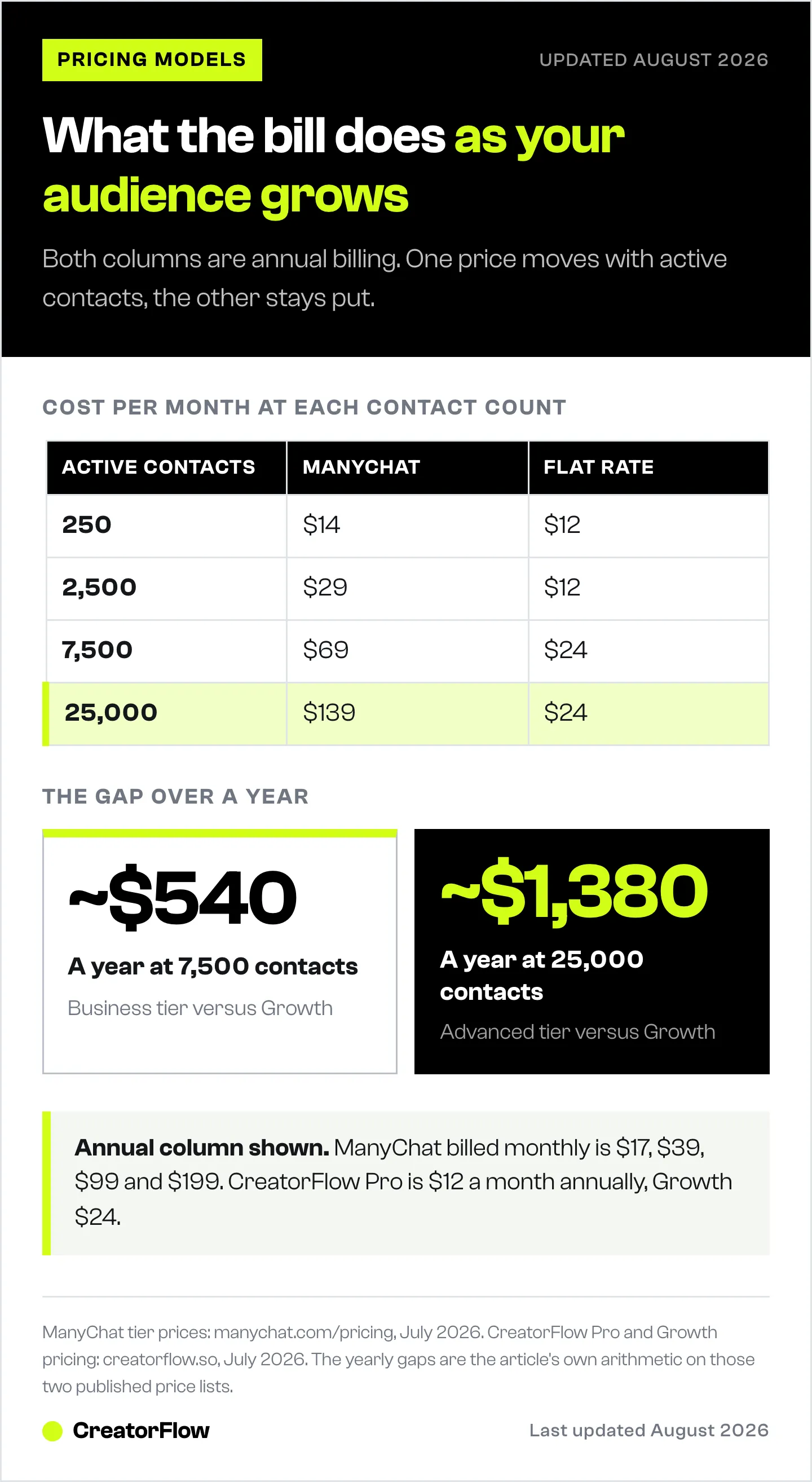
| Active contacts/mo | ManyChat (annual billing) | Flat-rate (CreatorFlow Pro/Growth) | Difference |
|---|---|---|---|
| 250 | $14/mo (Essential, included) | $12/mo (Pro annual) | -$2/mo |
| 1,000 | $29/mo (Pro, included) | $12/mo (Pro annual) | -$17/mo |
| 2,500 | $29/mo (Pro, included) | $12/mo (Pro annual) | -$17/mo |
| 5,000 | $69/mo (Business, included) | $24/mo (Growth annual) | -$45/mo |
| 7,500 | $69/mo (Business, included) | $24/mo (Growth annual) | -$45/mo |
| 10,000 | $139/mo (Advanced tier) | $24/mo (Growth annual) | -$115/mo |
| 25,000 | $139/mo (Advanced, 25,000 included) | $24/mo (Growth annual) | -$115/mo |
ManyChat pricing from manychat.com/pricing (May 2026). CreatorFlow’s pricing reference: Pro is $15/month or $144/year for 5,000 DMs/month, Growth is $30/month or $288/year for 10,000 DMs/month, both with unlimited automations and flat-rate billing regardless of contact count.
The numbers are not the entire picture. ManyChat’s tiers include features beyond Instagram (WhatsApp Marketing Messages, advanced AI replies, broadcast messaging) that some creators do use. But for an Instagram-only operator, the difference between $69-139/month on annual billing ($99-199 month-to-month) and $24/month at the same scale is real. At 7,500 contacts the gap is roughly $540/year. At 25,000 it is around $1,380/year.

Five Cost Patterns Creators Hit
Pricing is rarely the only reason a creator switches. It is usually the moment the model gets checked against the funnel. These are the five patterns we see most often when Instagram creators reconsider ManyChat.
1. A Viral Post Raises Your Active Contact Count
You posted a Reel that did 200K plays. Your DM funnel pulled in 3,800 commenters who triggered your automation. Your active contact count went from 800 to 4,600. On Pro, you are now over the 2,500 limit by 2,100 contacts, and overage on the monthly plan runs $0.05 per extra contact (manychat.com/pricing, May 2026). At that point ManyChat moves you up to Business, which is $99/month billed monthly ($69/month billed annually).
Per-contact pricing ties the monthly bill to audience size. A post that performs well moves the contact count, and the contact count moves the price.
2. Paying the Tier Price for Channels You Do Not Connect
ManyChat’s tiers bundle WhatsApp, Facebook Messenger, and SMS. Most Instagram-only creators do not use any of those. According to ManyChat’s pricing page (manychat.com/pricing, May 2026), Essential includes 2 channels, Pro includes 3, Business includes unlimited. You pay for all of them whether or not you connect them.
For a coach running comment-to-DM on Instagram only, that is $39/month billed monthly ($29 billed annually) for a tier that also covers channels they never connect. If you run Instagram only, compare that tier price against a flat-rate plan at the same contact count.
3. The Free Plan Caps at 25 Active Contacts
The March 2026 change lands hardest on creators who had built their automation stack on Free. A single comment-to-DM funnel running for two years, no upsell, no team, no ambition to scale. The Free plan let them run it.
Now that plan caps at 25 active contacts and 4 automations. A creator who changed nothing about their setup now picks between $17/month ($14 billed annually) and staying inside 25 active contacts a month.
That is the part long-running free setups feel most: the new limits apply to flows that were already built and running.
4. Follow-to-DM Eligibility Sits With Meta
ManyChat offers a Follow-to-DM trigger that sends a welcome DM when someone follows you. ManyChat launched it in October 2025 as Meta’s exclusive launch partner (prnewswire.com, October 2025), and it is a genuinely useful capability for accounts that want to greet new followers automatically. It is free on every ManyChat plan, including Free.
The constraint is access, not billing. Follow-to-DM is still a beta, and eligibility sits with Meta rather than with ManyChat: accounts are admitted case by case, accounts under roughly 1,000 followers or with low engagement are generally not admitted, and it requires connecting through ManyChat’s newer Unified Instagram Onboarding flow (manychat.com/use-case/follow-to-dm and help.manychat.com, July 2026). ManyChat states plainly that general availability is not guaranteed and that eligibility is outside its control.
So it is worth knowing before you pick a plan around it: if a follow-triggered welcome is central to your funnel, confirm your own account is admitted first. If it is not, the same job is done by greeting new followers through comment, story-reply, and keyword triggers, which run on any account. How to auto-DM new Instagram followers covers both routes in detail.
5. Overage Charges Between Tiers
Overage charges accumulate between tiers. You sign up for Essential on annual billing at $14/month ($17 month-to-month). Your funnel works. You hit 400 active contacts. Now you are paying $14 plus 150 contacts at $0.082 each (annual) or $12.30 in overage. Total: $26.30/month.
Three months later you are at 800 contacts. $14 base plus 550 contacts of overage at $0.082 ($45.10) comes to $59.10/month. Still on Essential, but paying roughly double the Pro rate because moving up the tier requires the annual upfront commitment.
Overage pricing rewards moving up a tier promptly. The creator who stays on Essential while their contact count drifts upward pays more than they would on Pro. Per-contact billing is worth a monthly check of contact count against tier limit.
Should You Stay or Switch? A Decision Matrix
Not every creator should leave ManyChat. The question is whether the per-contact model fits your usage. Use this matrix as a starting point:
| Your situation | Recommended move |
|---|---|
| Instagram-only, under 5,000 contacts, simple comment-to-DM flows | Switch. The table above puts flat-rate $2 to $45/month lower across this range, and the price holds when a post performs well |
| Instagram-only, 5,000-25,000 contacts, no advanced flows | Switch. The gap is $45/month at 7,500 contacts and $115/month at 10,000 |
| Multi-platform (Instagram + WhatsApp + Messenger), under 2,500 contacts | Stay. ManyChat’s multi-channel value is real here |
| Heavy Flow Builder user with conditional logic, tag-based segmentation, native integrations | Stay. ManyChat’s Flow Builder is built for exactly this shape of funnel |
| Agency managing 5+ client accounts | Mixed. Run each client’s contact count and channel list through both models separately |
| Free-tier creator affected by the March 2026 limits | Switch. Other free tiers are larger: CreatorFlow 500 DMs/month, LinkDM 1,000 DMs/month |
The cleanest signal: if your Instagram comment-to-DM flow is the entire reason you pay ManyChat, run your own contact count through the table above and compare it against a flat rate. If you use WhatsApp Marketing Messages, AI replies, or multi-channel broadcasts, the per-contact tiers buy you more.
If you have already decided to switch, the migrate from ManyChat to CreatorFlow guide covers the step-by-step rebuild and the recovery flow for comments that arrive during the gap. The head-to-head comparison covers feature parity at every tier. For a wider field, see the ManyChat alternatives roundup.
What Flat-Rate Looks Like
The counter-model to per-contact pricing is flat-rate billing tied to DMs sent rather than contacts stored. CreatorFlow charges $15/month (Pro) for 5,000 DMs and $30/month (Growth) for 10,000 DMs across up to five workspaces. The bill does not move when a Reel takes off. The price stays the same whether you have 500 active contacts or 50,000.
A few specific differences matter for the migration moment:
Rewind. CreatorFlow’s Rewind feature retroactively sends DMs to commenters whose comments are within Instagram’s 24-hour messaging window (7 days with the Human Agent tag). If you cancel ManyChat on Tuesday and rebuild your automations on Wednesday, you do not lose the comments that came in during the gap. Rewind scans them and sends the DMs you would have sent if the automation had been live. This is the safety net most migrations need but few tools offer.
Unlimited automations on every paid plan. ManyChat’s Free plan caps at 4 automations. CreatorFlow’s Free plan and every paid plan ship unlimited automations. For a creator running 20-30 small automations (one per product post, common for Brazilian affiliates), the cap matters more than the price.
Meta Tech Provider status. Both tools use Meta’s official Graph API. CreatorFlow has been a Meta Tech Provider since December 2025. Account safety is functionally equivalent between the two tools at this level, with minimal ban risk when you use the official API and respect its rate limits.
Channel coverage. ManyChat spans Instagram, Facebook Messenger, WhatsApp, TikTok, Telegram, SMS, and email. CreatorFlow is Instagram-first, with every feature built around how Instagram behaves. If your funnel lives on Instagram, that focus saves setup time and money. If it runs across several messaging channels at once, ManyChat is built for that shape.
The pricing model difference is not better or worse in the abstract. It is better or worse for your specific funnel. Per-contact pricing costs less at small contact counts and increases as your audience grows. Flat-rate pricing costs the same regardless of size, which favors growth and costs relatively more if you barely use it. Pick the one that aligns with where your audience is going.
For more context on Instagram DM automation in general, the complete setup guide covers how the underlying API works, rate limits, and the trigger types most creators use.
For a direct feature-by-feature breakdown, see our CreatorFlow vs ManyChat comparison.
FAQ
Is ManyChat still safe to use in 2026?
Yes. ManyChat is a Meta Business Partner using the official Instagram Graph API; CreatorFlow is a Meta Tech Provider on that same API. Account risk is minimal when you respect the official API and its rate limits. The reasons creators leave are pricing, complexity, and feature fit, not safety. If your only concern is account security, ManyChat is fine.
What if I use ManyChat for WhatsApp or Messenger, not just Instagram?
Stay on ManyChat. Multi-channel automation is exactly what their pricing model is built for, and Pro or Business tiers make sense at that scope. WhatsApp Marketing Messages and Messenger broadcasts are ManyChat’s territory. The decision matrix above flags this as a “stay” case.
Can I export my ManyChat contacts before I cancel?
Yes, on paid plans. ManyChat’s Audience tab supports CSV export of subscriber data. Export before you cancel so you keep the email list, tags, and engagement history. Most other DM tools accept CSV import for the email portion. Note that conversational state (where a contact is in a flow) does not transfer because flow architectures differ.
Will my DMs disappear during the switch?
Active conversations stay in your Instagram inbox regardless of which automation tool is connected. What pauses is the automation itself. Comments that come in during the gap between cancelling ManyChat and activating a new tool are not lost if you use a tool with a recovery feature. CreatorFlow Rewind sends DMs to qualifying comments up to 7 days old, which covers most migration windows.
What about the AI add-on?
ManyChat’s Pro tier includes AI-powered conversations, with deeper AI features on Business (manychat.com/pricing, July 2026). If open-ended AI conversation is a core part of your funnel, that is ManyChat’s territory. CreatorFlow takes the template-first route instead: you write the message, and every follower gets exactly the text you approved, which is what most comment-to-DM flows need since the value sits in instant link delivery rather than conversation.


