

Turning high-value Instagram followers into customers starts with identifying purchase intent signals: saves, DM questions, comment keywords like “price” or “link,” and consistent engagement over time. These followers convert at much higher rates than passive followers. Segment them into cold (likes only), warm (saves and shares), and hot (DMs and keyword comments) tiers, then use DM automation to deliver personalized offers instantly when buying signals appear.
You have 10,000 Instagram followers. Maybe 200 actually buy from you. The other 9,800 cost you reach without generating revenue. In 2026, Instagram’s algorithm actively punishes this mismatch. Dead followers signal “low-quality content” to the algorithm, reducing your visibility. The solution isn’t more followers. It’s converting the high-value ones you already have.
High-value followers show purchase intent through behavioral signals: saves, comment questions, DM initiation. They convert at much higher rates than passive followers. The 2026 algorithm rewards creators who focus on quality over quantity. Nano-influencers with 1,000 engaged followers now outperform creators with 100,000 ghost followers. This guide shows you how to identify purchase intent signals, segment followers by conversion readiness, and use DM automation to turn engagement into revenue.
Key Takeaways
High-value Instagram followers convert to customers when you segment by purchase intent (cold/warm/hot) and use DM automation to respond instantly to buying signals. A DM link goes to someone who just asked for it, so measure its click and sale rate against the same link in your bio.
Who Are High-Value Followers:
- Behavioral signals: Saves, shares, DM questions, comment keywords (“link please”, “price?”)
- Engagement quality: Consistent interaction over time, not one-off likes
- Purchase intent: someone who DMs you about a product is already asking a buying question
- Conversion rate: much higher than passive followers
2026 Algorithm Changes:
- Quality now outweighs quantity (nano-influencers get 5.1% engagement vs 0.5% for macro)
- Audience mismatch penalty: Wrong followers = reduced reach
- Saves and shares weighted higher than likes and comments
- Intent-based distribution tracks behavior after engagement
Conversion Benchmarks (2026):
- Average Instagram conversion: 1-2%
- DM link clicks and email capture: measure your own baseline for 30 days
- ROI benchmark: $5.78 per $1 spent (top campaigns: $18-20)
Quick Actions:
- Segment followers: Cold (nurture) → Warm (educate) → Hot (convert)
- Set up comment-to-DM automation for keyword triggers
- Capture emails before delivering high-value content
- Track ROI metrics: Engagement rate, save rate, DM response rate, CPA

What Makes Instagram Followers High-Value in 2026
The 2026 algorithm shifted the dynamics. Instagram now penalizes creators with large but disengaged audiences. A follower who never interacts actively hurts your reach. The algorithm interprets low engagement as “content this audience doesn’t want” and reduces distribution.
High-value followers are the opposite. They signal to Instagram that your content resonates.
Purchase Intent Signals (Ranked by Value)
Tier 1, Highest Intent:
- DM initiation: They message you first
- Link clicks: Tapped your bio link or Story link sticker
- Comment keywords: “Link please”, “How much?”, “Where to buy?”, “Price?”
- Saves: Bookmarked your post for later reference (strongest algorithm signal)
Tier 2, Medium Intent:
- Shares: Sent your post to friends or shared to Stories
- Question comments: Asked about your product/service
- Story poll/quiz engagement: Voted or answered on product-related Stories
- Repeat profile visits: Came back multiple times
Tier 3, Low Intent:
- Likes: Passive signal, minimal predictive value
- Story views: Awareness, not necessarily interest
- Generic comments: “Nice” or emoji-only responses
According to Social Insider’s 2026 benchmarks, the average Instagram engagement rate dropped to 0.48% (down from 0.50% in 2024). But quality beats quantity. Nano-influencers (1K-10K followers) maintain 5.1% engagement rates, 10x higher than macro-influencers with 1M+ followers at 0.5-1%.
The math: 1,000 followers at 5% engagement = 50 engaged people. 100,000 followers at 0.5% = 500 engaged people. You need 100x more followers to get 10x more engagement. That’s why Instagram now rewards quality over scale.
What Instagram’s Algorithm Actually Measures
Instagram doesn’t just count likes anymore. The 2026 algorithm uses layered quality signals:
Primary Signals (Weighted Heaviest):
- Saves: “This content is valuable enough to reference later”
- Shares: “This content is good enough to recommend”
- DM conversations: “This creator builds real relationships”
- Rewatch/revisit rate: “This content deserves multiple views”
Secondary Signals:
- Comment depth: Long, thoughtful comments > one-word responses
- Time spent on post: Dwell time indicates content quality
- Interaction velocity: How quickly people engage after posting
Negative Signals (Penalized):
- Skip rate: People scroll past your content quickly
- Unfollow after viewing: They saw your post and unfollowed
- No engagement from followers: Large audience, low interaction
According to WhyOptimize’s analysis of the 2026 algorithm: “Watch time matters, but rewatch matters more. Likes matter, but saves and shares matter more. Comments matter, but comment depth matters more.”
The 2026 Algorithm Shift: Quality Over Quantity
Instagram made a fundamental change in 2026. The algorithm now actively punishes audience mismatch.
Here’s the problem: You ran a giveaway in 2023. You gained 5,000 followers overnight. Those followers wanted the free product, not your content. Now they never engage. Instagram sees this and thinks: “This creator’s content doesn’t resonate with their audience. Reduce distribution.”
Your reach drops. Even your engaged followers stop seeing your posts. All because the algorithm averages engagement across your entire follower base.
The Audience Mismatch Penalty
When you have:
- 10,000 total followers
- 500 engaged followers (5%)
- 9,500 ghost followers (95%)
Instagram doesn’t say “This creator has 500 great fans.” It says “This creator’s content fails with 95% of their audience.”
Result: Reduced reach, even to your engaged 500.
Compare this to a creator with:
- 1,000 total followers
- 500 engaged followers (50%)
Instagram sees: “This content resonates with half the audience. Amplify it.”
Result: Higher reach, more growth, better brand deals.
Regional Engagement Benchmarks (2026)
Engagement rates vary by region according to Loyoly’s 2026 data:
| Region | Average Engagement Rate |
|---|---|
| France | 7.45% |
| North America | 6.50% |
| Spain | 6.39% |
| UK/Ireland | 5.52% |
| Global Average | 6.01% |
These rates apply to highly engaged niche communities. Mass-market accounts see far lower engagement.
Why Nano-Influencers Win in 2026
Brands now prefer nano-influencers (1K-10K followers) over mega-influencers (1M+). Why?
Engagement rates:
- Nano: 5.1%
- Micro (10K-100K): 2-4%
- Mid-tier (100K-1M): 1-2%
- Macro (1M+): 0.5-1%
Authenticity perception: 73% of brands say nano-influencers feel more authentic than celebrities (DemandSage 2026).
ROI: Nano-influencers deliver $5.78 return per $1 spent on average, with top campaigns reaching $18-20 (Archive 2026).
The 2026 algorithm reflects this. Small, engaged audiences now get better organic reach than large, disengaged ones.
Segmenting Followers by Purchase Intent
Not all engaged followers are ready to buy. Some need nurturing. Some need education. Some are ready to purchase right now.
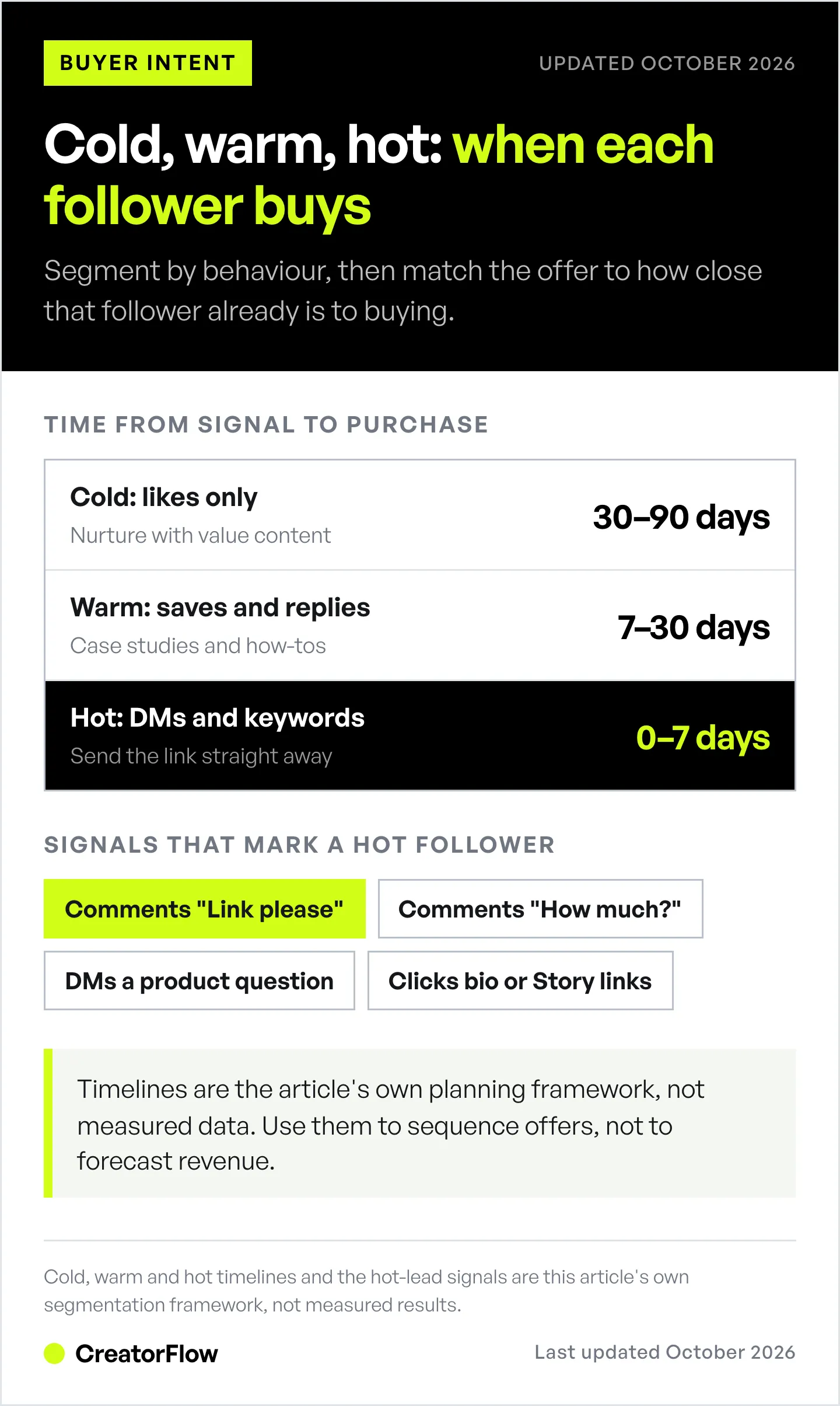
Treating them all the same wastes conversion opportunities.
The Cold-Warm-Hot Framework
Cold Followers: Awareness Stage
Behavior:
- Occasional likes (no comments or saves)
- Story views but no poll votes or replies
- Followed you recently, minimal interaction history
What they need: Value content to build trust Action: Nurture with educational posts, behind-the-scenes Stories Conversion timeline: 30-90 days
Warm Followers: Consideration Stage
Behavior:
- Consistent likes AND comments
- Saves your posts
- Replies to Stories with questions or opinions
- Asks “How do I…?” or shares their struggles
What they need: Social proof and education Action: Share case studies, testimonials, detailed how-to content Conversion timeline: 7-30 days
Hot Followers: Decision Stage
Behavior:
- DMs you with product questions
- Comments “Link please” or “How much?”
- Clicks your bio link or Story links
- Engages with all product-related content
What they need: Easy path to purchase Action: Instant DM with link, booking calendar, or offer Conversion timeline: 0-7 days (often immediate)
Buyer Followers: Retention Stage
Behavior:
- Already purchased from you
- Opens every email
- Engaged with post-purchase content
What they need: Upsells, loyalty rewards, referral incentives Action: Exclusive offers, early access, community invitations
Identifying Hot Leads in Real-Time
The most valuable conversion opportunities happen at specific moments:
High-Intent Moments:
- Someone comments “LINK” on your product post → They want to buy NOW
- Someone DMs “How much does this cost?” → Active purchase research
- Someone saves your pricing comparison post → Building buying justification
- Someone watches your product Story 3+ times → Deep consideration
These moments last minutes, not days. Respond in 5 minutes: High conversion. Respond in 5 hours: Opportunity gone.
This is why DM automation matters. It captures high-intent moments the instant they happen.
Purchase Intent Keywords to Track
Set up automation triggers for these comment keywords:
Direct buying intent:
- “Link”, “Link please”
- “Price”, “How much”, “Cost”
- “Where to buy”, “Where can I get this”
- “Available”, “In stock”
Research intent:
- “More info”, “Tell me more”
- “Does it work for [use case]”
- “Difference between X and Y”
- “Reviews”, “Testimonials”
Booking intent (for coaches):
- “How do I work with you”
- “Call”, “Consultation”, “Discovery call”
- “Availability”, “Book”
Someone who comments one of these words is asking a buying question in public. These aren’t casual browsers. They’re active buyers.
Conversion Benchmarks: What to Expect
Let’s set realistic expectations with 2026 data.
Instagram Conversion Rates by Method
| Method | Conversion Rate | Source |
|---|---|---|
| ”Link in bio” posts | 2-3% | Industry average |
| Instagram Shopping tags | 1.3% | Top e-commerce brands |
| Story link stickers | 3-5% | Higher intent than bio links |
The DM-link conversion figures published online come from automation vendors. Track your own DM clicks next to your bio-link clicks.
Why a DM link can beat a bio link:
- Instant response: Captures 2AM impulse buyers
- Personalized feel: Feels like 1:1 conversation
- Reduced friction: Content delivered directly, no clicks away from Instagram
- High intent capture: Only people who comment/DM qualify themselves
Example: A Skin-Quiz Launch Funnel
Here is how a skincare brand can run comment-to-DM automation for a product launch:
Setup:
- Post a Reel about “finding your skin type”
- CTA: “Comment SKINTEST for a free skin quiz via DM”
- Automation instantly sends the quiz link via DM
- The quiz asks for an email before it shows the result
- An email sequence follows, based on the quiz result
What to measure:
- How many people commented “SKINTEST”
- How many finished the quiz
- How many gave an email address
- How many bought within 7 days
Divide each number by the one above it. The step with the biggest drop is the one to fix first.
Instagram Shopping Statistics (2026)
According to Cropink’s 2026 research on Instagram shopping:
- 87% of users have purchased products they discovered on Instagram
- 54% buy after seeing a product on the platform
- 81% research new products on Instagram before buying
Instagram is where many buyers find and research products. The purchase itself now finishes on the seller’s own website: Meta removed native Instagram checkout for US merchants in August 2025. That makes the link you send in a DM the bridge from interest to sale.
ROI Benchmarks for Influencer Marketing
According to Archive’s 2026 influencer marketing ROI study:
- Average ROI: $5.78 return per $1 spent
- Top-performing campaigns: $18-20 per $1 invested
- Influencer marketing ROI vs traditional digital ads: 11x higher
- Creators using analytics tools: 34% better ROI than those who don’t
Key insight: Measurement matters. Creators who track conversion metrics see significantly better results than those who focus on vanity metrics (likes, follower count).
DM Automation: Converting Intent to Sales
DM automation is the conversion mechanism. It captures high-intent moments before they cool off.
Why Response Time Kills or Converts
Someone comments “LINK” on your product post at 11 PM. They’re lying in bed scrolling, ready to buy. Two scenarios:
Scenario A: Manual response
- You’re asleep
- You wake up at 8 AM and see the comment
- You manually send the DM at 9 AM
- They’ve already lost interest or bought from a competitor
- Conversion: 2-5%
Scenario B: Automated response
- Automation detects “LINK” keyword instantly
- DM with affiliate link sent within 2 seconds
- They click, browse, purchase
- All while the impulse is fresh
- Typical conversion depends on niche, offer, and audience quality
The data: Instagram DMs reach followers directly in their inbox with push notifications, inside the app they already have open. An email competes with every other message in the inbox. DMs capture attention when interest is highest.
DM automation captures attention when it’s available, not when it’s convenient for you.
Comment-to-DM Automation Workflow
Standard flow:
- Trigger: User comments keyword (“LINK”, “INFO”, “GUIDE”, “PRICE”)
- Instant DM: Automation sends within 2 seconds
- Value delivery: Link, PDF, booking calendar, video
- Optional email gate: “Reply with your email to receive [bonus]”
- Follow-up sequence: If they don’t convert, nurture sequence begins
Advanced flow:
- Trigger: User comments keyword
- Segmentation check: Automation checks if they’re a past customer
- Personalized response:
- New followers → Educational content + soft CTA
- Engaged followers → Direct offer
- Past customers → Upsell or loyalty reward
- Email capture with incentive
- CRM sync: Add to email list, tag by segment
- Multi-channel nurture: Email + Instagram Story mentions
Email Capture Strategy
Your Instagram audience is rented. You don’t own it. Email is owned.
Asking for an email inside a DM works because the person has already raised their hand. Track how many commenters give an email, and compare that with your website sign-up rate.
How to implement:
Before delivering value, ask for email:
“Hey! I’d love to send you the [guide/discount/resource]. What’s your email?”
Why it works:
- They already expressed interest (commented)
- They’re in conversation mode (DM thread)
- The value exchange is clear (email for resource)
- Friction is low (just typing email, not form fields)
Best practices:
- Only gate high-value content (comprehensive guides, exclusive discounts)
- Don’t gate everything (feels spammy)
- Deliver the promised value immediately after email submission
- Add new emails to your email service provider the same week
ManyChat publishes integrations with email platforms such as Kit (formerly ConvertKit), Mailchimp, Klaviyo and HubSpot for automatic list syncing. CreatorFlow collects emails through its Email Gate on Pro and Growth. You export them as a CSV file and import it into whichever email platform you already run.
DM Funnel Structure
Instagram DMs work best as part of a full funnel:
| Funnel Stage | Content Type | Goal | Conversion Mechanism |
|---|---|---|---|
| Top (Awareness) | Reels, carousels | Attract attention | Follows, saves |
| Middle (Consideration) | Educational Stories with CTAs | Encourage engagement | Story replies, poll votes |
| Bottom (Decision) | Comment-to-DM triggers | Capture intent | Instant DM with offer |
| Retention | Email sequences + exclusive Stories | Repeat purchases | Upsells, referrals |
The mistake most creators make: They stop at the top. They create great Reels, gain followers, but never move people down the funnel. No CTAs, no DM triggers, no conversion mechanism.
The fix: Every piece of content should have a next step. Educational Reel → “Comment GUIDE for the full breakdown” → Instant DM with guide + email capture → Email sequence with paid offer.
Conversion Strategies by Creator Type
How you convert followers depends on what you sell.
For Affiliate Marketers
Goal: Send affiliate links to people who show buying intent
Strategy:
- Post product review or demo (Reel or carousel)
- CTA: “Comment LINK for my affiliate discount”
- Automation instantly sends DM with affiliate link + UTM tracking
- If they reply with a question, answer it in the same chat (Meta allows follow-ups only after the person replies)
What to measure: the share of commenters who click your affiliate link, next to clicks on the same link in your bio.
Advanced move: Segment by product interest. Someone who comments “LINK” on your protein powder review gets protein-related products in future campaigns. Someone who comments on skincare gets skincare offers.
Tools to use:
- CreatorFlow: Flat $15/mo for 5,000 DMs
- LinkDM: $19/mo with simple setup
- Track clicks with UTM parameters in your links
Internal resource: See our full guide to scaling affiliate marketing with Instagram DM automation.
For Coaches and Consultants
Goal: Book discovery calls with qualified leads
Strategy:
- Post authority content (case study, transformation story)
- CTA: “Struggling with [problem]? Comment CALL to book a free 15-min chat”
- Automation sends DM with Calendly link
- Optional: Ask 2-3 qualifying questions before sending calendar
- “What’s your biggest challenge right now?”
- “Have you tried [solution] before?”
- “What’s your timeline to solve this?”
Expected conversion: 30-40% of people who comment will book. 20-30% of booked calls will convert to paid clients.
Why it works: People who publicly comment are pre-qualified. They’re willing to raise their hand in front of their followers. That’s a strong buying signal.
DM template:
“Hey [Name]! Saw you commented about [topic]. I’d love to help. I have a few 15-minute slots open this week for a quick strategy call. No pitch, just value. Here’s my calendar: [Calendly link]. Grab a time that works!”
Internal resource: Instagram DM automation for coaches and consultants
For E-commerce and Digital Products
Goal: Drive traffic to product pages and reduce cart abandonment
Strategy for product links:
- Post product demo or use case
- CTA: “Want this? Comment SHOP”
- Automation sends DM with direct product link + discount code
- Follow-up: “Did you have questions about sizing/shipping/features?”
Strategy for cart abandonment:
- Set up the Meta Pixel on your store (if you run ads)
- When someone adds to cart but doesn’t purchase:
- Send targeted Story ad: “Still thinking about [product]?”
- CTA: “DM me DISCOUNT for 15% off”
- Automation sends exclusive discount code
Expected conversion: E-commerce brands report about 1.3% conversion from Instagram Shopping tags. A DM sent to someone who asked for the link starts from higher intent, so track it separately and compare.
Advanced: Quiz funnels
Example for a skincare brand:
- Post: “Not sure which serum is right for you? Comment QUIZ”
- Automation sends 5-question quiz via DM
- Based on answers, recommends specific product
- Captures email before showing recommendation
- Measure: the share of quiz takers who buy within 7 days
Digital product launch sequence:
- Week 1: Educational content, build anticipation
- Week 2: Behind-the-scenes, social proof
- Week 3: “Cart opens Monday. Comment EARLY for launch-day discount code”
- Automation captures emails and sends discount code
- Result: Pre-qualified buyer list before cart opens
ROI Metrics Creators Should Track
Vanity metrics (follower count, likes) don’t pay bills. Track metrics that correlate with revenue.
Primary ROI Metrics for 2026
| Metric | Benchmark | Why It Matters | How to Track |
|---|---|---|---|
| Engagement Rate | 2.5%+ | Brands prioritize this for partnerships | (Likes + Comments + Saves) / Followers |
| Save Rate | Track vs. likes | Strongest algorithm signal | Instagram Insights → Saved |
| DM Response Rate | 90%+ | Direct conversion channel | Automation tool analytics |
| Click-Through Rate (CTR) | 1-2%+ | Shows CTA effectiveness | Link tracking (Bitly, UTM) |
| Email Capture Rate | Track your own | Builds owned audience | Email service provider data |
| Cost Per Acquisition (CPA) | Varies by niche | True customer cost | Total spend / Customers |
| Customer Lifetime Value (CLV) | 3x+ CPA | Long-term profitability | Revenue per customer over time |
| Return on Ad Spend (ROAS) | 3x+ | For paid ads | Revenue / Ad spend |
Follower Value Calculation
According to Influencer Marketing Hub’s 2026 data, average earnings per follower per sponsored post:
| Tier | Followers | Earnings per Post | Per-Follower Value |
|---|---|---|---|
| Nano | 1K-10K | $25-$200 | $0.025-$0.02 |
| Micro | 10K-50K | $200-$800 | $0.02-$0.016 |
| Mid-tier | 50K-500K | $500-$3,000 | $0.01-$0.006 |
| Macro | 500K+ | $3,000-$10,000+ | $0.006-$0.002 |
Key insight: Nano-influencers earn MORE per follower ($0.02-$0.025) than macro-influencers ($0.002-$0.006) due to higher engagement rates.
Your 1,000 engaged followers are worth more than someone else’s 100,000 ghost followers.
What to Track Weekly
Build a simple tracking dashboard:
Week of [Date]:
- Posts published: [#]
- Total reach: [#]
- Engagement rate: [%]
- Saves: [#]
- DMs received: [#]
- Links clicked: [#]
- Emails captured: [#]
- Revenue generated: $[#]
- Cost per acquisition: $[#]
Month over month, track:
- Follower growth rate (aim for quality, not quantity)
- Engagement rate trend (should stay consistent or grow)
- Email list growth (owned audience building)
- Revenue per follower (efficiency metric)
Tools like Later, Iconosquare, and native Instagram Insights provide most of this data. Export weekly and look for trends.
Tools for Converting High-Value Followers
You need three types of tools:
1. DM Automation Tools
| Tool | Free Tier | Pro Price | Best For | Safety |
|---|---|---|---|---|
| CreatorFlow | 500 DMs/mo | $15/mo (5K DMs) | Solo creators, flat pricing | Official Meta API |
| ManyChat | 25 contacts | $17-199/mo billed monthly (4 paid tiers) | Agencies, multi-platform | Official Meta API |
| LinkDM | 1,000 DMs/mo | $19/mo | Simple comment-to-DM | Official Meta API |
| Inro | 100 active contacts/mo | From €12.99/mo billed monthly | AI features, coaches | Official Meta API |
Prices come from each vendor’s pricing page: ManyChat, LinkDM and Inro (checked October 2026).
Safety warning: Only use tools built on Meta’s official Instagram Graph API. Browser automation bots violate Instagram’s terms and risk account suspension.
Verify before using any tool:
- Does it say it uses Meta’s official API, or name a Meta program such as Tech Provider or Business Partner?
- Does it require your Instagram password? (Red flag, official API uses OAuth)
- Does it mention “Instagram Graph API” in documentation?
2. Link Tracking Tools
Track which links convert:
- Bitly: Free short links with click tracking
- UTM parameters: Add to URLs to track in Google Analytics
- CreatorFlow built-in: Link click tracking on Pro and Growth
Why tracking matters: You need to know if your “LINK” comments are converting to sales, not just clicks.
3. Email Service Providers (ESP)
Capture emails from Instagram, nurture off-platform:
- Kit (formerly ConvertKit): Free up to 10,000 subscribers. Creator plan from $33/month billed yearly at 1,000 subscribers (kit.com/pricing, checked October 2026). Creator-focused.
- Klaviyo: Free for 250 active profiles and 500 email sends a month; paid plans priced by a calculator (klaviyo.com/pricing, checked October 2026). E-commerce focused.
- Mailchimp: Free for 250 contacts and 500 sends a month (Mailchimp help center, checked October 2026)
- HubSpot: Free CRM + email
Some DM automation tools, such as ManyChat, sync new emails to these platforms automatically.
Internal resource: See our Instagram automation pricing guide for detailed tool comparisons.
Common Mistakes Killing Conversions
Mistake 1: Treating All Followers Equally
The problem: Broadcasting the same message to 10,000 followers when only 500 are engaged.
The fix: Segment by engagement level. Send premium offers to hot leads. Send nurture content to cold followers.
How: Use automation tools that track engagement history and trigger different messages based on behavior.
Mistake 2: Slow DM Responses
The problem: Someone comments “LINK” at 10 PM. You respond at 10 AM. They’ve moved on.
The fix: DM automation responds in 2 seconds, capturing high-intent moments.
Data: An often-quoted 2007 study by Dr. James Oldroyd with InsideSales.com data found that web-form leads contacted within 5 minutes were 21 times more likely to qualify than leads contacted after 30 minutes. That study measured phone follow-up and did not measure sales, but the direction holds for DMs: the faster reply wins.
Mistake 3: No Email Capture
The problem: Building your entire audience on rented Instagram land. If Meta changes the algorithm (or bans your account), you lose everything.
The fix: Capture emails from every high-intent interaction. Build an owned audience.
What to measure: the share of commenters who give you their email when you ask in the DM.
Mistake 4: Generic Broadcast Messages
The problem: Mass DMing your entire follower list with “Check out my new product!” feels spammy and converts poorly.
The fix: Only DM people who show intent. Let them raise their hand first (comment, Story reply, keyword trigger).
Why it works: They opted in. They’re expecting a DM. It’s not cold outreach.
Mistake 5: Not Tracking ROI Metrics
The problem: “I got 1,000 likes on that post!” Cool. How many people bought?
The fix: Track metrics that correlate with revenue:
- DMs received
- Links clicked
- Emails captured
- Sales generated
- Cost per acquisition
Tool: Set up conversion tracking with UTM parameters or native platform analytics.
FAQ
What is a high-value Instagram follower?
A high-value follower shows purchase intent through behavioral signals: saves your posts, asks questions in comments, DMs you directly, or clicks your links. They’re 5-10x more likely to convert than passive followers who only like posts. In 2026, Instagram’s algorithm rewards creators who focus on these engaged followers over raw follower counts.
How do I convert Instagram followers into customers?
Segment followers by purchase intent (cold/warm/hot), then use DM automation to respond instantly when they show buying signals like keyword comments (“LINK”, “PRICE”), DM questions, or link clicks. Warm leads convert 5-10x better than cold outreach.
What’s a good conversion rate for Instagram in 2026?
A good Instagram conversion rate is one that beats your own baseline. Published DM conversion figures come from automation vendors, not independent studies. Send the same link by DM and from your bio for 30 days, then compare the click and sale rate of each. Keep the channel that wins and test a new offer against it.
How many followers do I need to make money on Instagram?
Nano-influencers (1K-10K followers) earn $25-$200 per sponsored post with 5.1% engagement rates, often higher per-follower earnings than macro-influencers. Quality beats quantity in 2026. Focus on 1,000 engaged followers over 10,000 ghost followers. Brands now prefer engagement rate (2.5%+) over follower count when selecting partners.
Is Instagram DM automation safe?
When you use tools built on Meta’s official Instagram Graph API like CreatorFlow, ManyChat, or LinkDM, ban risk stays minimal. These tools comply with Instagram’s rate limits and terms of service. Browser bots and unofficial scraping tools risk account suspension. Verify a tool holds official Meta API status before using it.
How do I identify followers with purchase intent?
Look for these behavioral signals: (1) Comments with keywords like “link please”, “how much?”, “where to buy?”, (2) DM initiation about products/services, (3) Saves on product posts (highest intent signal), (4) Link clicks from bio or Stories, (5) Repeat views/engagement on product content. Set up comment-to-DM automation to capture these moments instantly.
What ROI metrics should I track for Instagram?
Track engagement rate (benchmark: 2.5%+), save rate (strongest algorithm signal), DM response rate (90%+), click-through rate (1-2%+), email capture rate (share of commenters who give an email), cost per acquisition (varies by niche), and customer lifetime value (should be 3x+ CPA). Focus on metrics that correlate with revenue, not vanity metrics like follower count or likes.
Conclusion
High-value Instagram followers aren’t the ones with the biggest following. They’re the ones who actually buy from you. In 2026, Instagram’s algorithm rewards this reality. Quality beats quantity. 1,000 engaged followers who convert outperform 100,000 ghost followers who scroll past.
The conversion framework is simple: Identify purchase intent signals (saves, comment keywords, DMs). Segment by readiness (cold/warm/hot). Use DM automation to capture high-intent moments instantly. Track ROI metrics, not vanity metrics.
Most creators already have high-value followers. They’re commenting “link please” while you sleep. They’re saving your posts for later reference. They’re DMing questions about your services. The opportunity is there. You just need the system to capture it.
Start with comment-to-DM automation. Pick one keyword trigger (“LINK”, “INFO”, “GUIDE”). Set up instant responses. Capture emails before delivering value. Compare the click rate of your DM links with your bio link for 30 days.
Your top 20% of followers will generate 80% of your revenue. It’s time to focus on them.


