Instagram DM automation for boutiques answers product questions, delivers checkout links, and builds restock waitlists the moment a shopper comments or replies to a Story. With apparel advertisers paying $22 to $35 to acquire one customer through Meta ads (topgrowthmarketing.com, September 2026), boutiques are using automated DMs to convert the engagement they already earn, at no cost per message.
Here is the situation most boutique owners recognize. You post a try-on Reel of Thursday’s new arrivals. Forty comments land in two hours: three sizing questions, a dozen “price?”, two “do you ship to Canada?”, and a handful of “is the green one still available?”. You answer eight of them between steaming inventory and packing orders. By the time you reply to the rest, the shopper who wanted the green dress bought something else somewhere else.
This guide covers why boutiques are pulling budget out of paid placements, the five DM flows that do the selling, where an AI agent genuinely helps, and how to set up your first flow in an afternoon.
Key Takeaways
- Paid reach keeps getting more expensive. Average Meta CPM rose 20% year over year, from $11.82 to $14.19, and Q4 pushes CPMs another 40 to 80% above baseline (topgrowthmarketing.com, September 2026)
- Speed decides who gets the sale. Sales teams that respond within five minutes are 21 times more likely to qualify a lead than teams that wait half an hour (chilipiper.com, September 2026). On limited inventory, the first boutique to answer wins
- Five flows cover most boutique DM volume: the new-arrival keyword, the sizing reply, the restock waitlist, the Story reply, and the live-sale claim
- Conversation converts better than browsing. Live shopping events convert at 9 to 30%, against 2 to 3% for standard e-commerce traffic (getstream.io, September 2026)
- Automate the repetitive, keep the personal. Automation sends links, sizes, and shipping answers in seconds. Styling advice and high-ticket decisions stay with you
- The channel is already busy. More than 150 million people message a business on Instagram every month (sproutsocial.com, September 2026)
Why Boutiques Are Moving Budget Out of Paid Ads
The economics of paid reach have shifted against small retailers. Average Meta CPM climbed 20% in a single year, from $11.82 to $14.19, and Instagram placements run $6 to $10 per thousand impressions before any click happens (topgrowthmarketing.com, September 2026).
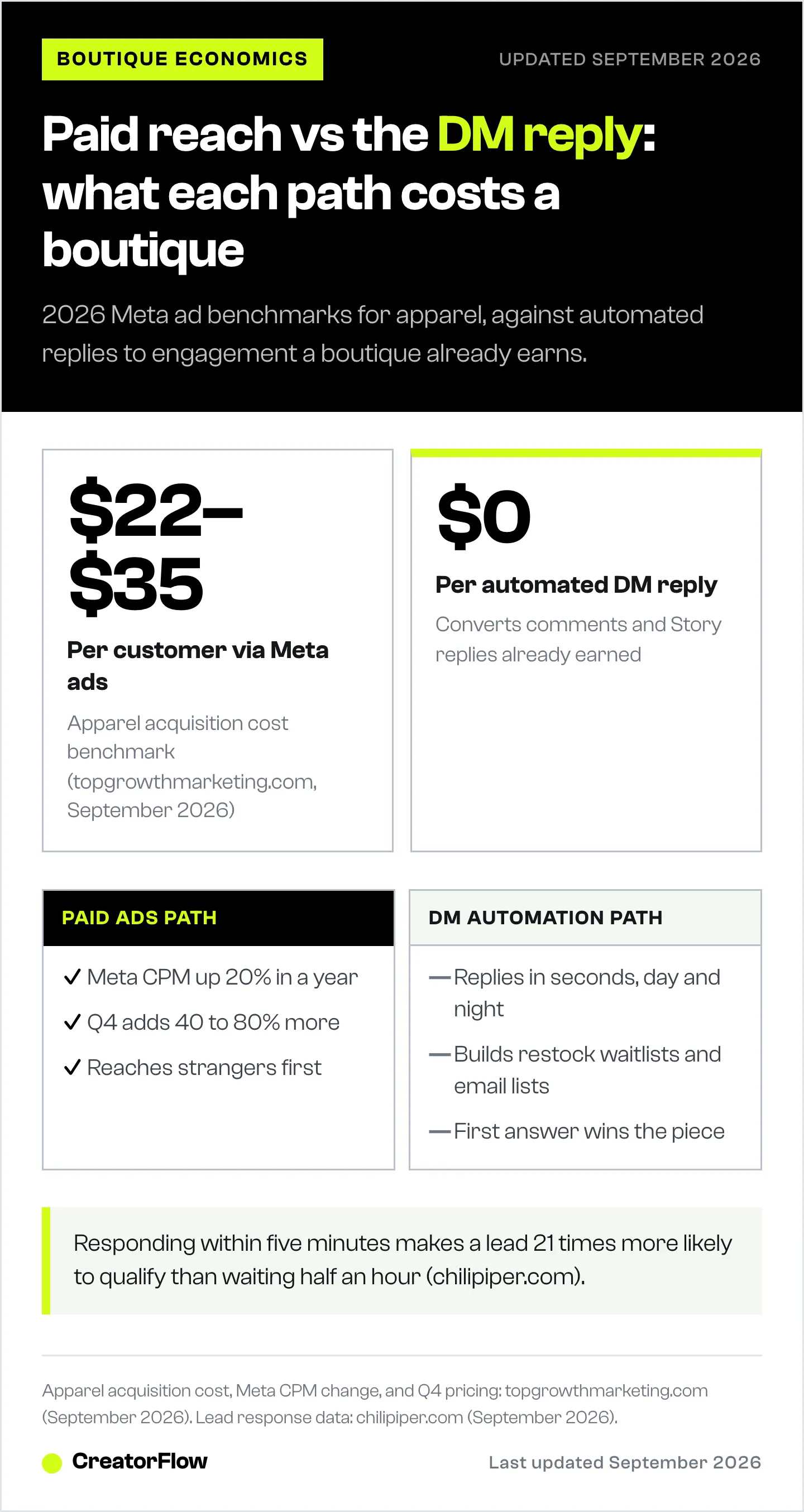
For apparel specifically, the numbers get tighter. Apparel advertisers average $0.45 per click and $22 to $35 to acquire a single customer (topgrowthmarketing.com, September 2026). On a boutique’s margins, that acquisition cost can swallow the profit on a first order. And the pressure peaks exactly when a boutique needs reach most: Q4 CPMs run 40 to 80% above baseline during the holiday season.
A DM system attacks the problem from the other side. Instead of paying to put products in front of strangers, it converts the followers, commenters, and Story viewers a boutique already has. Every automated reply costs nothing per message, and the shopper it reaches has already raised a hand. The same logic drives our zero-budget Instagram marketing playbook for local businesses, and it applies twice as hard to fashion retail, where interest expires fast.
How Instagram DM Automation Works for a Boutique
Instagram DM automation watches for a trigger you define, then sends a message you wrote. The trigger can be a comment containing a keyword, a reply to a Story, or a word someone DMs your account. The message can carry a product link, a size chart, a waitlist confirmation, or a question that moves the conversation toward checkout. Tools built on Meta’s official Instagram API do this without your password and within Instagram’s messaging rules.
In practice, a boutique runs a handful of these triggers at once. A shopper comments “PRICE” on a Reel and gets the product link in seconds. Another replies to a Story with a fire emoji and gets a friendly nudge with the checkout link. A third comments “RESTOCK” under a sold-out midi dress and joins a waitlist that messages her on drop day.
The compliance question matters for a business account, so it is worth stating plainly: this runs through Meta’s official Instagram API with Instagram Login, using OAuth rather than your password. Meta publishes per-second rate limits for the messaging path, and reputable tools pace sends well below them, commonly around 200 DMs per hour as a behavioral safety convention (developers.facebook.com, September 2026). Replies also respect Meta’s 24-hour messaging window.
The Five DM Flows That Sell for a Boutique
Boutique DM volume collapses into five repeatable conversations. Each one gets its own trigger and its own message.
| Flow | Trigger | What the DM sends |
|---|---|---|
| New-arrival drop | Comment “NEW” on the drop post | Lookbook or collection link, sized to shop in one tap |
| Sizing reply | Comment “SIZE” | Size chart, model height and size worn, fit notes |
| Restock waitlist | Comment “RESTOCK” on sold-out piece | Waitlist confirmation plus email capture |
| Story reply | Any reply to a product Story | Product link with a personal-toned opener |
| Live-sale claim | Comment a claim word during a Live | Checkout link for the claimed item |
The new-arrival drop. Announce the drop post with one instruction: “Comment NEW and I’ll DM you the collection.” Every commenter gets the link while the post is still climbing, and the comment volume itself pushes the post to more feeds. This is the highest-volume flow for most boutiques because it turns your best weekly post into a list of warm conversations.
The sizing reply. Fit questions are the most expensive question in apparel, because an unanswered one blocks the sale and a wrongly answered one becomes a return. Automate the first half: chart, model reference, fabric notes. Our DM automation guide for clothing and apparel brands breaks down the four buying questions in depth, including when to hand a between-sizes shopper to a person.
The restock waitlist. A sold-out piece still collects comments. A RESTOCK keyword converts each one into a named contact: the DM confirms the waitlist, asks for size and color, and captures an email inside the conversation. On drop day you message a list of people who already asked to buy, instead of paying to find new ones.
The Story reply. Stories are where boutiques post daily outfits, and replies to them open a DM thread automatically. An automated reply with the product link answers in seconds, at 9 p.m. on a Sunday included, which is when a lot of boutique shopping happens.
The live-sale claim. Live selling is the closest Instagram gets to a trunk show, and the numbers behind the format are strong: live shopping events convert at 9 to 30% of viewers, against the 2 to 3% typical of standard e-commerce traffic (getstream.io, September 2026). A claim keyword lets viewers type one word to get the checkout link for the piece on screen, so you keep hosting instead of typing links into chat.
Where an AI Agent Helps and Where a Person Should Answer
AI DM agents are the newer layer on top of keyword automation. They use large language models to read a message and compose a reply, which suits open-ended questions that no keyword anticipates. Our guide to how AI agents handle Instagram DMs for brands covers the tools and what they cost.
For a boutique, the useful split is by stakes, and the division of labor is clean. Automation, whether template-based or AI-composed, should own the repetitive layer: prices, links, size charts, shipping zones, restock timing. These questions repeat daily, have one correct answer, and reward speed above everything. Speed is measurable money: sales teams responding within five minutes are 21 times more likely to qualify a lead than teams waiting more than half an hour, while the average B2B team takes 42 hours to respond at all (chilipiper.com, September 2026).
A person should own the judgment layer. Styling advice for a wedding guest outfit, a between-sizes call on a $240 leather jacket, an upset customer with a damaged parcel: these conversations build the relationship a boutique runs on, and a shopper can tell when they are talking to a machine about something that matters to them.
The practical rule: automate every conversation that has one right answer, and read every conversation that does not.
How to Set Up Your First Boutique DM Flow
Start with one flow, not five. For most boutiques the new-arrival drop is the right first pick, because it attaches to the post you already make every week.
- Connect your Instagram business account. In CreatorFlow, this is an OAuth login through Meta’s official Instagram API. No password sharing, and setup takes under five minutes.
- Create a keyword trigger. Set the keyword to NEW (or ARRIVALS, or the collection name) on your drop post.
- Write the message in your shop’s voice. Two sentences and the link. “Hey! Here’s everything from today’s drop, sizes are moving fast:” reads like you. A paragraph of corporate copy does not.
- Test it yourself. Comment the keyword from another account and check the DM lands the way you wrote it.
- Add the second flow once the first one runs clean. For most boutiques that is the restock waitlist, with an email gate so every waitlist entry becomes a contact you own off-platform.
CreatorFlow’s Free plan covers 500 DMs a month at $0, which is enough to test the drop flow on a real post. The Pro plan is $15/month flat and adds the email gate, follow gate, CSV export for your email platform, and geographic click analytics, which tell you where your shoppers are before you commit to international shipping. If your storefront runs on Shopify, the Shopify Instagram automation guide covers link setup from comment to checkout.
What Results to Expect
Honest expectations beat inflated ones, so here is what the evidence supports.
The reliable win is response time. A boutique answering DMs manually responds in hours; automation responds in seconds, every time, including the hours the shop is closed. Given that first responders are dramatically more likely to win the sale (chilipiper.com, September 2026), and that boutique inventory is often shallow enough that “first” is the whole game, speed alone justifies the setup.
The second win is capture. Comments and Story replies that used to evaporate become links delivered, waitlists filled, and emails collected. Whether those conversations then convert depends on the same things it always did: product, price, photography, and how you handle the conversations that need a human. The 4-stage framework for selling in Instagram DMs covers the conversion side, from qualifying question to follow-up.
Treat any tool promising a specific revenue multiple with suspicion. Results vary by boutique, and the vendors quoting universal conversion lifts rarely publish the data behind them.
Common Mistakes Boutiques Make With DM Automation
One catch-all keyword. LINK on every post forces one generic message to do every job. Run one keyword per job so the sizing DM can talk about fit and the restock DM can capture an email.
Sounding like a bank. The DM should read like the person who runs the shop. Write it yourself, keep the emoji you’d normally use, and re-read it out loud before turning it on.
No human fallback. Every automated flow needs an obvious way to reach a person, and someone checking the inbox for the conversations automation should not touch.
Over-messaging. One triggered reply plus one follow-up is a service. Four messages in a day is a block waiting to happen. Respect the 24-hour window and let email carry the long-term relationship.
Set and forget. Read your DM threads weekly. The questions shoppers ask are a free market-research feed, and the phrasing they use tells you what your next keyword should be.
FAQ
Can a boutique really sell on Instagram without running paid ads?
Yes, if the account already earns engagement. DM automation converts existing comments, Story replies, and messages into sales conversations, which makes it a monetization layer rather than a reach layer. A boutique with quiet posts should fix content first, since automation multiplies engagement that already exists rather than creating it.
Is Instagram DM automation allowed by Meta?
Yes, through the official route. Tools using Meta’s Instagram API with Instagram Login authenticate by OAuth, respect Meta’s published per-second rate limits, and operate inside the 24-hour messaging window (developers.facebook.com, September 2026). Risk concentrates in unofficial tools that automate a logged-in session instead of using the API.
What should a boutique automate first?
The new-arrival drop keyword. It attaches to the post you already publish weekly, produces the most DM volume per week, and gives you a clean read on how your audience responds before you add sizing, restock, Story, and live-sale flows.
Do AI DM agents replace a human team?
No. AI agents compose replies to open-ended questions, which extends automation beyond fixed keywords, but styling advice, fit judgment calls on expensive pieces, and complaint handling still convert better with a person. The strongest boutique setups automate the repetitive layer and route everything else to the owner or team.
How much does Instagram DM automation cost for a small boutique?
Entry pricing is low relative to ad spend. CreatorFlow starts at $0 for 500 DMs a month, with a $15/month flat-rate Pro plan for email capture and analytics. Compare that with the $22 to $35 it costs to acquire one apparel customer through Meta ads (topgrowthmarketing.com, September 2026).
How does a restock waitlist work inside a DM?
A shopper comments the restock keyword on a sold-out post. The automated DM confirms she is on the list, asks for her size and color, and collects an email address. When the piece lands, you message the list by email, since Instagram’s 24-hour window will usually have closed by restock day.
Does DM automation work during Instagram Live sales?
Yes, and live sales are one of the strongest use cases. A claim keyword sends each viewer the checkout link for the piece being shown, so the host keeps presenting instead of pasting links. The live shopping format converts at 9 to 30% of viewers in well-run events (getstream.io, September 2026), and instant link delivery is part of what keeps that number high.
Ad cost benchmarks verified from topgrowthmarketing.com, lead response statistics from chilipiper.com, live shopping conversion data from getstream.io, Instagram messaging volume from sproutsocial.com, and Meta API rate limits from developers.facebook.com, all as of September 2026. Individual results vary.