

Instagram DM automation for clothing brands sends sizing charts, restock alerts, and product links automatically when shoppers comment or reply to a Story. Apparel carries the highest return rate of any online category at 20 to 40 percent, and fit uncertainty drives most of it. Answering fit questions in seconds, before the order is placed, protects both the sale and the margin.
You post a Reel of the new drop. It gets 400 comments. Roughly 250 of them are some version of four questions: what size is she wearing, does it run small, when is the black one back, and do you ship to my country. Your team answers 40 of them by Thursday. The other 210 shoppers bought something else.
This guide covers the four buying questions apparel brands get in every comment section, the automation that answers each one, and how to handle fit conversations without sending a robotic reply to someone about to spend $180. It applies to dresses, hoodies, footwear, activewear, swimwear, lingerie, and bridal. Independent boutiques running shallow inventory get their own five-flow system in our Instagram DM automation guide for boutiques.
Key Takeaways
- Fit is the expensive question. An estimated 19.3% of all online sales were returned in 2025, and apparel runs well above that average (nrf.com, October 2025). Coresight Research puts the online apparel return rate at 24.4% (coresight.com).
- Four questions cover most of your comment volume: size and fit, restock timing, drop dates, and shipping. Each maps to one keyword trigger.
- Answer before the order, not after. A size chart delivered in eight seconds prevents a return. A size chart emailed after delivery pays for one.
- Waitlists beat “sold out.” A restock keyword turns a dead comment into a named contact you can email on drop day.
- Never automate the final fit judgment. Send the measurements and the model’s height, then hand the conversation to a person if the shopper is between sizes.
- Instagram is the discovery layer, your site is the checkout. Meta finished removing in-app checkout in August 2025, so every DM link has one job: land the shopper on a fast mobile product page (ppc.land, August 2026).
The Four Questions Every Clothing Brand Gets in the Comments
Sort a week of your comment section and the volume collapses into four buckets. Each one has a different trigger, a different message, and a different revenue effect.
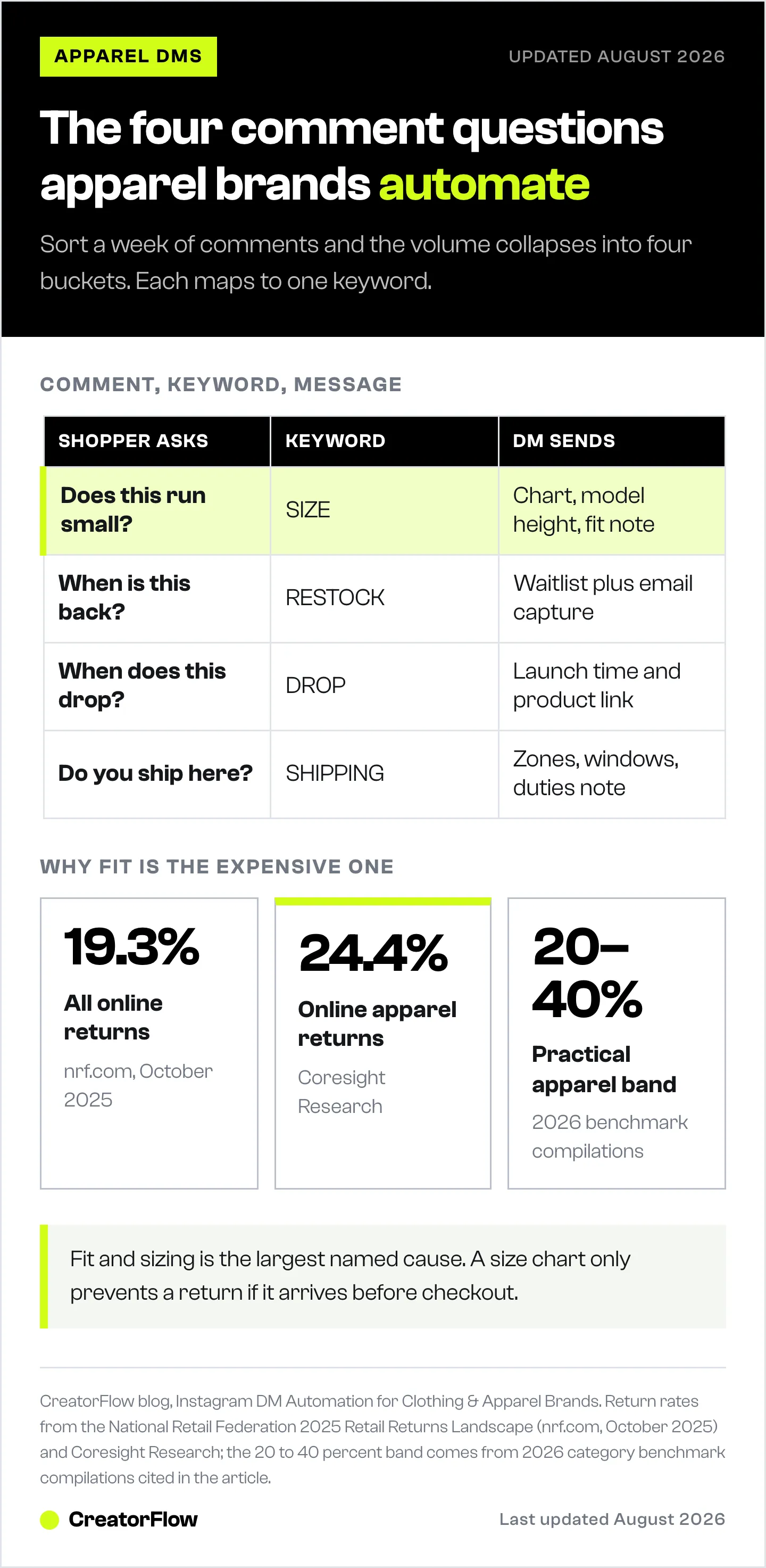
| Comment pattern | Trigger keyword | What the DM sends | Revenue effect |
|---|---|---|---|
| ”What size is she wearing?” / “Does this run small?” | SIZE | Size chart, model height and size worn, fit notes | Prevents a return before it happens |
| ”When is this back?” / “Restock the black?” | RESTOCK | Waitlist confirmation plus email capture | Converts a sold-out view into a drop-day buyer |
| ”When does this drop?” / “Link?” | DROP | Launch time, direct product link, early-access option | Concentrates demand into the first hour |
| ”Do you ship to Ireland?” | SHIPPING | Shipping zones, delivery windows, duties note | Removes the last objection before checkout |
Most brands treat all four as customer service. Three of the four are sales conversations that arrive with the buyer already holding the product in their head.
Why Fit Questions Cost Apparel Brands More Than Any Other Category
The National Retail Federation put the 2025 ecommerce return rate at 19.3% of online sales, worth $849.9 billion across US retail (nrf.com, October 2025). That is the blended figure. Apparel sits above it, and the gap is not small: Coresight Research measured a 24.4% online apparel return rate, nearly eight percentage points above the online average it compared against (coresight.com).
Category benchmark compilations published through 2026 put the practical apparel band at 20 to 40 percent, footwear at 17 to 30 percent, and accessories and jewelry at 12 to 15 percent. Fit and sizing is consistently named the single largest cause.
That changes what a DM is worth. In a category returning 4 to 10 percent, a fast reply mostly wins an incremental order. In apparel, the same reply does two jobs at once. It wins the order, and it stops the version of that order that comes back three weeks later with a prepaid label attached and no resale value at full price.
A size chart is the cheapest return-prevention tool you own. It only works if it arrives before checkout.
Setting Up Sizing and Fit Automation
The trigger is a keyword the shopper already types without prompting. Put SIZE in your caption on every product Reel and carousel, and the comment volume routes itself.
Build the message in this order:
- Model reference first. “She is 5’8” and wearing a size S.” This answers more fit questions than a chart does, because shoppers compare themselves to a person, not a table.
- Flat measurements, not letter sizes alone. Chest, waist, and length in both centimetres and inches. Letter sizes mean nothing across brands.
- One fit note. “Runs true to size” or “size up if you are between sizes and want length.” One sentence, plainly worded.
- The link. Straight to the product page, not the homepage.
- An exit to a human. “Between sizes? Reply here and we will tell you which one to take.”
That last line matters more than the rest. Automation carries the shopper to the edge of the decision. The person who is genuinely stuck between a medium and a large is the highest-intent shopper in your inbox, and they are worth a real reply.
For the mechanics of setting the trigger up, our comment-to-DM automation setup guide walks through the whole flow in about five minutes.
Turning Sold-Out Into a Waitlist
“When is this back?” is the most wasted comment in apparel. The product is gone, so the brand says “soon” or says nothing, and the demand evaporates.
A RESTOCK keyword changes the shape of that exchange. The shopper comments, the DM confirms the waitlist, and the message asks for an email address in the same breath. Now the sold-out post is a list-building asset instead of a dead end.
The message pattern that works:
- Confirm the specific product and colour, not a generic “you are on the list.”
- Ask for size at the same time. Restocking without knowing the size split is guesswork.
- Capture the email in the DM, so the drop notice does not depend on Instagram delivery.
- Give a rough window if you have one. “Mid-October” beats “soon” and beats silence.
Collecting the address inside the conversation is the part most brands skip. Our guide to collecting emails in Instagram DMs covers the email gate setup and the export path into your marketing platform.
Drop Day Automation
Apparel drops concentrate a month of demand into an hour. The automation job on drop day is to remove every step between the announcement and the product page.
Three triggers cover it:
Pre-drop (the week before). Keyword DROP sends the exact launch time in the shopper’s terms (“Friday 6pm UK”) plus a calendar reminder link. Ask for the email here too, since this is your warmest list.
Launch hour. The same keyword now sends the live product link. Change the message content, keep the keyword, so every pre-drop comment thread stays valid.
Sell-through. When sizes start going, switch the message to route remaining stock. “S and M are gone. L and XL are live here.” Shoppers who would have bounced on a sold-out grid land on the sizes you still hold.
Story replies work the same way and often convert better on drop day, because a Story reply is already a private message. If you run paid support behind a launch, click-to-DM ads for ecommerce start the same conversation from the feed.
What Not to Automate
Apparel is a taste category, and an automated message that reads like a warehouse system damages the brand it is selling.
Keep these human:
- Between-sizes advice. A judgment call about someone’s body deserves a person.
- Returns and exchanges in progress. Someone with a fit problem is already annoyed. An automated reply confirms their suspicion that nobody is listening.
- Custom and made-to-order work. Bridal and made-to-measure conversations are consultations. Automate the intake, never the advice.
- Complaints. Route them out of the automation entirely.
The message itself should sound like your captions. Same vocabulary, same sentence length, same level of formality. If your brand writes in lowercase, the DM writes in lowercase. Our guide to protecting brand voice in Instagram automation covers the review process for keeping automated copy on-brand as the library grows.
Tools and Pricing for Apparel Brands
Three practical routes, with prices checked in October 2026.
CreatorFlow is $15/month on Pro, flat, with unlimited automations and two workspaces. It covers comment-to-DM, Story reply automation, keyword triggers, link tracking, and geographic click analytics, plus a follow gate and email gate on paid plans. The Free plan runs 500 DMs a month on one workspace. Pricing does not change as your follower count or contact list grows, which suits apparel brands whose audience spikes hard around a drop (creatorflow.so, October 2026).
ManyChat covers Instagram, Facebook, WhatsApp, SMS, TikTok, Telegram, and email, with a flow builder built for multi-channel journeys. ManyChat’s pricing page prices per active contact across five plans: Free at 25 active contacts, then Essential $17/month for 250 contacts, Pro $39/month for 2,500, Business $99/month for 7,500, and Advanced $199/month for 25,000, billed monthly. Billed annually those become $14, $29, $69, and $139 per month (checked October 2026). These plans apply to accounts created on or after March 2, 2026. Best for brands running the same campaign across several channels at once.
LinkDM reports over 60,000 creators, brands, and agencies on the platform. Its pricing page lists a Free tier at 1,000 DMs a month, Pro at $19/month for 25,000 DMs, and Platinum+ at $99/month for 300,000 DMs (checked October 2026). Best for brands whose main variable is raw DM volume.
The contact-based and volume-based models behave differently during a drop. A launch that adds 8,000 new contacts in a weekend prices differently on a per-contact plan than on a flat plan. Model your biggest drop, not your average month.
Measuring Whether It Worked
Four numbers tell you if apparel DM automation is earning its place.
| Metric | What it tells you | Healthy direction |
|---|---|---|
| Trigger rate (comments containing your keyword / total comments) | Whether your caption CTA is clear | Rising after each caption rewrite |
| DM click-through to product page | Whether the message earns the tap | Compare per product, not per month |
| Return rate on products with an active SIZE automation | Whether fit answers are landing | Falling against your category baseline |
| Waitlist-to-purchase on drop day | Whether restock capture converts | The number that justifies the email gate |
The return-rate comparison is the one worth building. Run SIZE automation on half your catalogue for a quarter and compare return rates against the untriggered half. That is a controlled read on the most expensive number in apparel, and it is a number no competitor can quote back at you. Our breakdown of Instagram DM metrics that matter covers the rest of the reporting stack.
How Instagram’s Rules Shape the Setup
Two platform facts govern what any tool can do.
Meta publishes per-second rate limits on the Instagram API with Instagram Login path: 100 calls per second for text and links, 10 per second for audio and video, and 750 per hour for private replies to comments on posts and Reels (developers.facebook.com, October 2026). Tools including CreatorFlow pace sends at roughly 200 DMs an hour as a conservative behavioural cap. That figure is a tool-side convention, not a Meta-published hourly limit.
Meta also limits when you can message. A comment gets one private reply, sent within 7 days of the comment. From then on, a new DM is possible only within 24 hours of the shopper’s latest message. Reaching her on drop day next month requires her to write to you again, which is exactly why the email capture inside the DM matters for drop-day planning. Since 5 October 2026, Meta no longer offers the one-tap email quick reply in Instagram DMs, so shoppers type their email into the chat (developers.facebook.com, October 2026).
FAQ
Does Instagram DM automation work for clothing brands or only for creators?
It works for both, and the use case differs. Creators automate affiliate link delivery on outfit posts. Brands automate the four buying questions: sizing, restocks, drop timing, and shipping. Brands generally see higher revenue per triggered DM because the shopper is buying from you rather than through a commission link.
What is the best keyword for a clothing brand to use?
Use the word your shoppers already type. SIZE, FIT, RESTOCK, DROP, and SHIP outperform branded keywords because nobody has to learn them. Run one keyword per job rather than a single catch-all, so each message can be specific.
Can DM automation reduce apparel returns?
It can reduce the share caused by fit uncertainty, which is the largest single cause in the category. Sending model height, size worn, and flat measurements before checkout gives the shopper the information that would otherwise arrive with the parcel. Measure it by comparing return rates on products with and without an active sizing automation.
How do I automate restock alerts on Instagram?
Set a RESTOCK keyword on sold-out product posts. The DM confirms the waitlist, asks for the size and colour, and captures an email address inside the conversation. When stock lands, message the list from your email platform rather than relying on Instagram, since Meta’s 24-hour window will usually have closed.
Do I need a Shopify integration?
No. Link-based automation sends the shopper to any product URL, which covers Shopify, WooCommerce, Etsy, and custom storefronts equally. Deeper platform integrations add catalogue sync and cart recovery. Our comparison of DM automation across Shopify, Etsy, and WooCommerce covers which setup fits which platform.
Will automated DMs get my brand account banned?
Tools connecting through Meta’s official Instagram API with Instagram Login use OAuth and never ask for your password, which keeps ban risk minimal when you respect the pacing and the 24-hour window. Risk rises with unofficial tools that automate through logged-in sessions rather than the API.
How many keywords should a clothing brand run at once?
Start with two: one for sizing and one for restocks. Those two cover the majority of apparel comment volume. Add drop and shipping triggers once the first two are producing clean numbers.
Return-rate figures verified from the National Retail Federation’s 2025 Retail Returns Landscape (nrf.com) and Coresight Research as of August 2026. CreatorFlow, ManyChat and LinkDM pricing, and Meta’s rate limits and messaging rules, were checked in October 2026. Individual results vary.


