Fashion affiliate marketing works best when Instagram and Pinterest do different jobs. Pinterest brings in shoppers searching for outfit ideas, because it works like a search engine. Instagram converts them: outfit Reels collect “link” comments, and DM automation delivers the affiliate link in seconds. Fashion creators run LTK, ShopMy, or Amazon Associates links through both platforms and connect them into one repeatable loop.
Most fashion creators run one platform hard and ignore the other. The Instagram-only creator rides the algorithm and starts every post from zero reach. The Pinterest-only creator gets steady search traffic but has no way to turn a pin viewer into a follower who buys again next week. Each platform alone leaves commissions on the table.
This guide shows you how to run both as one system: which affiliate platform to join, how to set up Pinterest so outfit pins earn directly, how to turn Instagram into the conversion layer, and the weekly workflow that keeps both fed from a single photo shoot. It is written for fashion and outfit creators in the US, UK, and EU who already post consistently on at least one of the two platforms.
Key Takeaways
- Split the jobs: Pinterest is the search engine where shoppers find outfit ideas; Instagram is the conversion layer where comments become DM link deliveries
- Pinterest is bigger than most creators think: 640 million monthly active users as of Q2 2026, with 96% of top searches unbranded, which means shoppers are searching “fall outfit ideas,” not brand names (businesswire.com and business.pinterest.com, 2026)
- Affiliate links are allowed on Pinterest: you can pin direct affiliate links, and since July 2026 US LTK creators can publish affiliate-enabled pins straight from LTK (techcrunch.com, July 2026)
- Commission rates differ widely: ShopMy pays 10-30%, LTK rates are set by each brand, and Amazon Associates pays 4% on fashion categories (platform sites, September 2026)
- Instagram converts through DMs, not captions: caption links are not clickable, so “comment LINK” plus DM automation is how outfit posts turn into affiliate clicks
- Disclose on both platforms: the FTC requires a clear disclosure on every affiliate post, and violations can cost up to $53,088 each (ftc.gov, February 2025)
How Fashion Affiliate Marketing Works Across Instagram and Pinterest
The two-platform system gives each app one job. Pinterest handles discovery: shoppers type outfit searches, find your pin, and either click the affiliate link on the pin or land on your profile. Instagram handles conversion: followers watch your try-on Reel, comment your trigger word, and receive the affiliate link by DM. Pinterest fills the top of the funnel with new shoppers while Instagram turns attention into tracked clicks and repeat buyers.
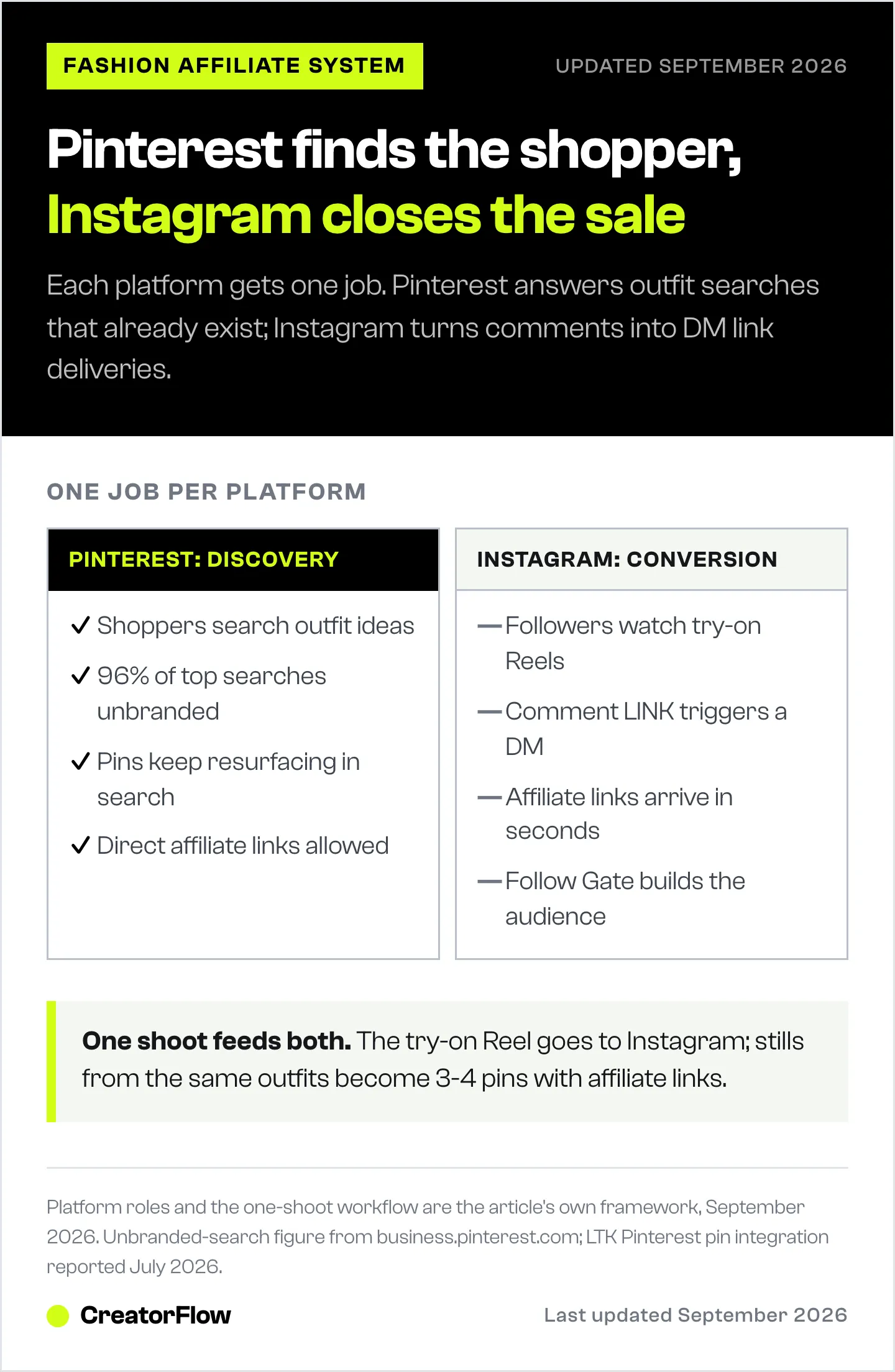
The reason this split works is behavioral. People open Pinterest with a purchase or a project in mind, then search for it. People open Instagram to watch creators they follow, then act on what they see. A pin answers a search that already existed. A Reel creates the want, then the DM answers it. Run both and you cover the shopper at both moments.
One shoot feeds both sides. The try-on Reel goes to Instagram with a comment trigger. The stills from the same outfit become three or four pins with direct affiliate links. Nothing gets filmed twice.
Why Pinterest Belongs in Every Fashion Affiliate Stack
Pinterest reached 640 million monthly active users in Q2 2026, growing 11% year over year (businesswire.com, August 2026). Gen Z is its fastest growing audience at 42% of the global user base, and Pinterest reports that the main reason Gen Z uses the platform is to find information about products and brands (business.pinterest.com, September 2026). For a fashion creator, that is a growing pool of shoppers researching what to wear next.
Two more numbers matter for outfit content specifically. Pinterest reports that 80% of weekly Pinners feel inspired by the shopping experience on the platform, and that 96% of top searches are unbranded (business.pinterest.com, September 2026). Unbranded is the key word. A shopper searching “office capsule wardrobe” has not picked a brand or a creator yet. Your pin can be the answer, no matter how small your following is.
Pins also behave differently from posts. A Reel earns most of its reach in the first days. A pin keeps resurfacing in search results as long as people keep running that query, so a strong outfit pin from last autumn can earn again this autumn. That compounding is what Instagram-only creators give up.
Which Affiliate Platform Should Fashion Creators Use
Most full-time fashion affiliates run two or three platforms at once, because each covers a different part of the closet. ShopMy publishes a 10-30% commission range, LTK lets each brand set its own rate, and Amazon Associates pays a flat 4% on fashion categories but converts well on basics and dupes. Pick based on the brands you already wear, then add a second platform once the first pays monthly.
| Platform | Commission on fashion | Payout | Where the links work |
|---|---|---|---|
| LTK | Set by each brand; creator reviews report 10-25% typical (shopltk.com, September 2026) | Monthly | Instagram DMs, LTK app, and direct Pinterest pins since July 2026 |
| ShopMy | 10-30% (shopmy.us, September 2026) | Weekly, $25 minimum (guide.shopmy.us, September 2026) | Any link placement: DMs, bio, pins, email |
| Amazon Associates | 4% on apparel, shoes, handbags, jewelry (affiliate-program.amazon.com, September 2026) | Monthly | Direct links anywhere, plus Pinterest’s Amazon integration |
The rate gap looks decisive, but the platforms sell different things. Amazon wins on volume: everyone has an account, and checkout friction is near zero. LTK and ShopMy win on price point, since a $180 boutique dress at 15% beats a $30 Amazon find at 4%. The full ShopMy vs LTK comparison breaks down which one pays more at each follower size.
How to Set Up Pinterest for Outfit Affiliate Links
Pinterest allows direct affiliate links in pins. The platform’s rules target deception, not affiliates: community guidelines prohibit links with excessive or deceptive redirection and shortener services abused for spam (policy.pinterest.com, September 2026). Pin the raw affiliate link, skip the cloaking tools, and disclose the relationship in the pin description.
Here is the setup, in order:
- Convert to a Pinterest business account. It is free and adds analytics, so you can see which outfit searches send clicks.
- Build boards around searches, not around your brand. Name boards the way shoppers type: “fall outfits 2026,” “capsule wardrobe basics,” “wedding guest dresses.” Remember that 96% of top searches are unbranded; board names should match that behavior.
- Pin outfit stills with direct affiliate links. Each outfit from your weekly shoot becomes 3-4 pins with different crops and text overlays, each linking to the product.
- Connect the platform integrations. If you are a US LTK creator, you can publish affiliate-enabled pins directly through LTK, and Pinterest takes no cut of the commission (techcrunch.com, July 2026). Amazon affiliates can connect their account so eligible pins apply the affiliate link and add the disclosure automatically (help.pinterest.com, September 2026).
- Point everything else at Instagram. Your Pinterest profile link, and any pin without a product link, should send people to your Instagram, where the follow relationship and the DM conversion live.
Expect Pinterest to build slowly. Search traffic compounds over weeks as your pins accumulate impressions for the queries they answer, which is a different rhythm from an Instagram post spiking on day one.
How to Turn Instagram Into the Conversion Layer
Instagram does not allow clickable links in captions. Links work in three places: the bio, the Stories link sticker, and DMs. For outfit content, DMs convert best because the link arrives attached to the exact outfit the person asked about, at the moment they asked. That is why “comment LINK and I’ll send it” became the standard fashion creator call to action.
Manually answering those comments does not scale past a few posts. A try-on Reel that performs will pull dozens or hundreds of link requests, and each one expects the dress, the shoes, and the bag as separate links. This is the job DM automation for fashion influencers exists to do: someone comments your trigger word, and the full outfit link list arrives in their DMs within seconds.
CreatorFlow is built for exactly this loop. You set a trigger word per post, write the DM once with your LTK, ShopMy, or Amazon links, and every future “LINK” comment gets answered while you shoot the next outfit. The Follow Gate can ask the commenter to follow you before the link arrives, which turns Pinterest-sourced visitors into followers, and the Email Gate collects an email address for the sales you make off-platform. Pro runs $15/month flat, and the free plan is enough to test your first outfit post.
The content side matters as much as the delivery side. Certain formats reliably pull more “link please” comments than others, and try-on hauls lead the ranking. The guide to outfit posts that drive link requests covers the seven formats with caption templates.
How to Connect Both Platforms Into One Loop
The loop has five stops: a shopper finds your pin in search, visits your Instagram from your Pinterest profile, follows you, comments on an outfit Reel, and gets the affiliate link by DM. From then on they see your content without searching, which is what a pin alone can never deliver. Each platform hands the shopper to the other at the moment it stops being the best tool for the job.
Two practical rules keep the loop tight:
- Give the direct route and the relationship route different jobs. Pins of specific products carry the affiliate link directly, since that shopper wants that item now. Pins of full aesthetics, lookbooks, and styling guides send people to Instagram, since that viewer is a future follower, not a today buyer.
- Match seasons to search behavior. Pinners search ahead of the season, so pin autumn outfits in late summer while your Instagram content stays current. The same shoot serves both timelines: Reel now, pins scheduled for when the searches arrive.
The four-stage version of this system, including tracking and the mistakes that break it, is mapped in the Pinterest to Instagram DM funnel guide. This article’s fashion-specific loop is that funnel with the outfit economics filled in.
A Weekly Workflow That Runs Both Platforms From One Shoot
You do not need double the content to run two platforms. You need one shoot, split two ways. A workable week looks like this:
- Shoot day (60-90 min): film 2-3 try-on Reels and shoot stills of each outfit. Photograph every item flat or on a hanger for pin variety.
- Instagram (30 min): edit and schedule the Reels with comment triggers, and write the DM for each with the affiliate links for every item shown.
- Pinterest (30 min): create 3-4 pins per outfit from the stills, write search-shaped descriptions with the disclosure, and attach the affiliate or LTK links.
- Review (15 min): check which pins earned outbound clicks and which Reels pulled the most trigger comments, then plan next week’s outfits around the winners.
Treat the time figures as a starting plan, not a promise. The point of the structure is that Pinterest never requires its own shoot, so the marginal cost of the second platform is about an hour a week.
Affiliate Disclosure Rules on Pinterest and Instagram
The FTC requires a clear and conspicuous disclosure whenever you earn a commission from a link, on every platform, in every post. Bare “#affiliate” may not be understood by everyone; wording like “paid link” or “I earn commissions from these links” is safer (ftc.gov, September 2026). Civil penalties for violations run up to $53,088 each (ftc.gov, February 2025), and enforcement targets creators as well as brands.
On Pinterest, put the disclosure in the pin description where it is visible without expanding anything. Pins created through the Amazon integration feature an affiliate link disclosure automatically (help.pinterest.com, September 2026), but pins you build by hand need the line written in. On Instagram, the disclosure belongs at the start of the caption and inside the DM that carries the links, so it travels with the link itself.
Disclosure does not suppress clicks the way many creators fear. A shopper who commented “LINK” on a try-on Reel already wants the product; the disclosure line changes their trust in you, not their intent to buy.
FAQ
Can you post affiliate links directly on Pinterest?
Yes. Pinterest permits direct affiliate links in pins. Its community guidelines prohibit deceptive redirection and spam-abused link shorteners, so use the raw affiliate link rather than a cloaking tool, and include a disclosure in the pin description (policy.pinterest.com, September 2026).
Is Pinterest or Instagram better for fashion affiliate marketing?
They answer different moments, so run both. Pinterest reaches shoppers who are searching for outfit ideas before they know which creator or brand to buy from. Instagram converts an audience that already follows you through outfit Reels and DM link delivery. Creators who connect the two get search traffic and repeat buyers from the same content.
Can you use LTK links on Pinterest?
Yes, since July 2026. US LTK creators can publish affiliate-enabled pins directly to Pinterest through the LTK integration, with tracking handled by LTK and no commission cut taken by Pinterest (techcrunch.com, July 2026). Creators outside the US can still pin other permitted affiliate links while the integration rolls out.
How many followers do you need to start fashion affiliate marketing?
Fewer than most creators assume. Pinterest search traffic does not depend on follower count at all, since pins rank by relevance to the query. On the platform side, requirements vary: some programs review engagement and content quality more than audience size. Numbers on what creators earn at each tier are in how much LTK creators make.
Do you have to disclose affiliate links on every pin and post?
Yes. The FTC requires a clear disclosure of any material connection on each piece of content that carries an affiliate link, not once per account (ftc.gov, September 2026). Put it in the pin description, at the top of the Instagram caption, and in the DM that delivers the links.
How much commission do fashion affiliate programs pay?
As of September 2026: ShopMy publishes a 10-30% range, LTK rates are set by each brand with creator reviews reporting 10-25% as typical, and Amazon Associates pays 4% on apparel, shoes, handbags, and jewelry (shopmy.us, shopltk.com, and affiliate-program.amazon.com, September 2026). Higher rates on boutique price points usually beat Amazon’s volume at equal traffic.
Platform statistics and affiliate program terms verified from Pinterest’s Q2 2026 earnings release, business.pinterest.com, policy.pinterest.com, help.pinterest.com, shopltk.com, shopmy.us, affiliate-program.amazon.com, techcrunch.com, and ftc.gov as of September 2026. Individual results vary.