
A Pinterest-to-Instagram DM funnel uses Pinterest as the discovery layer and Instagram as the conversion layer. Pins drive saves and outbound clicks from people actively searching for products and ideas. Those visitors land on your Instagram, follow, and comment on a Reel. DM automation then sends the affiliate link, product link, or lead magnet in seconds.
Pinterest reached 619 million monthly active users at the end of Q4 2025 (yahoo.finance via Pinterest earnings, May 2026), and weekly Pinterest users spend 40% more than non-users (business.pinterest.com, May 2026). That makes it one of the highest-intent traffic sources you are not yet using.
Most creators treat Pinterest and Instagram as parallel channels. They post the same content twice, see weak Pinterest results, and quit. The mistake is treating Pinterest as a publishing platform when it is a search engine. People do not scroll Pinterest the way they scroll Instagram. They go there with a question, a project, or a purchase in mind, and they save and click pins that answer it. If your pin sends them to your Instagram, where automation converts the comment into an instant DM with the link, you have a system Postiz-style single-platform Pinterest strategies cannot match.
This guide walks through the full Pinterest-to-Instagram DM funnel, the four stages that make it work, the affiliate rules Pinterest enforces in 2026, and the niches where it produces the strongest returns. It is written for affiliate marketers, Etsy sellers, course creators, and DTC brands who are already running Instagram and want a second discovery engine feeding it.
Key Takeaways
- Pinterest is search, Instagram is conversion: Pinterest brings high-intent visual searchers who want to buy or learn. Instagram converts them with social proof and 1:1 DM automation.
- The funnel has four stages: Discovery on Pinterest, click to your Instagram, follow + comment, automated DM with the link or lead magnet.
- DM automation closes the loop: DM automation outperforms bio links for affiliate clicks by sending the link inside the DM where intent is highest.
- Pinterest allows affiliate links in 2026: Direct affiliate links are permitted. Link cloakers and shortened URLs are not (policy.pinterest.com, May 2026).
- Audience fit matters: Pinterest skews 70% female with strong purchase intent in fashion, home, food, beauty, weddings, and travel.
- Fresh pins beat repins: A fresh pin requires a unique image plus a unique URL plus a unique description (passhulk.com, 2026).
- Tracking is non-negotiable: Use UTM parameters on every pin URL so you can attribute Instagram followers and DM conversions back to specific Pinterest content.

Why Pinterest Plus Instagram Beats Pinterest Alone
Pinterest is built for discovery. Pins surface in search results and home feeds based on keywords, image quality, and saves. The top metric is the save, not the click. People save pins for later, build mood boards, and revisit weeks or months later. That delayed-action behavior is great for evergreen visibility but terrible for fast monetization.
Instagram is the opposite. It is built for relationship and conversion. Followers see your face, your voice, your daily output. When they comment on a Reel, intent is high and immediate. DM automation turns that comment into an automated reply in 1-8 seconds.
Combining the two means you get the discovery scale of a search engine plus the conversion immediacy of a social feed. The handoff is the entire game. A pin that links straight to an Amazon product page or a generic blog post leaks out of your funnel after one click. A pin that drives someone to your Instagram bio or a specific Reel keeps them inside your own channels, where automation can capture the email, send the link, and book the call.
Pinterest’s own data backs the intent signal. Weekly Pinterest users have 20% larger baskets than non-users, and 82% of Pinterest ad campaigns across 17 Matched Market Tests delivered positive incremental ROI (business.pinterest.com, May 2026). That is buyer behavior, not browsing behavior.
The 4-Stage Pinterest to Instagram DM Funnel
The funnel has four discrete stages. Each stage has one job. If any stage breaks, the whole system stalls.
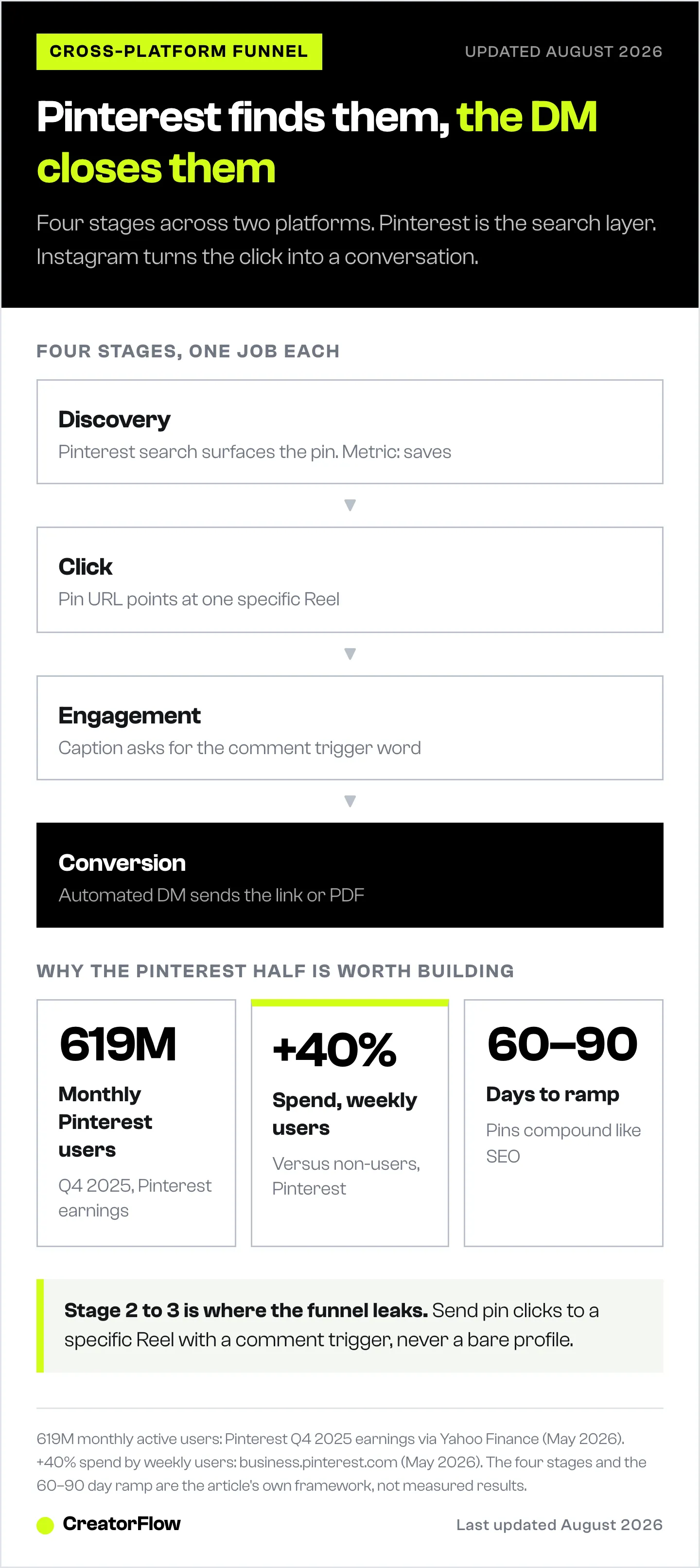
| Stage | Platform | Goal | Key Metric |
|---|---|---|---|
| 1. Discovery | Get found by searchers | Impressions, saves | |
| 2. Click | Pinterest → Instagram | Move pinners to your IG | Outbound clicks |
| 3. Engagement | Get a comment or DM trigger | Comments, follows | |
| 4. Conversion | Instagram DM | Deliver link, capture email, book call | DM opens, link clicks |
The transition between stages 2 and 3 is where most creators lose people. A Pinterest pin that drops a visitor onto a generic Instagram profile will lose them. A pin that drops them onto a specific Reel with a clear comment-to-DM trigger pulls them into your DM funnel.
Stage 1: Build a Pinterest Presence That Actually Drives Clicks
Pinterest rewards consistency, keywords, and fresh assets. Volume alone does not work in 2026. Saves and outbound clicks are the strongest ranking signals (sproutsocial.com, 2025).
Set up a Pinterest Business account. Free, takes ten minutes, and turns on analytics, rich pins, and the ability to run ads later. Verify your website and connect your Instagram if you want auto-attribution on pins.
Build keyword-rich boards. Each board name should target a search term someone in your niche actually types into Pinterest. “Outfit Ideas” is weak. “Coastal Grandma Outfit Ideas Summer” is strong. Pinterest functions as a visual search engine, so long-tail keywords outperform broad terms (pingroupie.com, 2026).
Design pins that earn the click. Vertical 2:3 ratio (1000x1500 px), readable text overlay, high contrast, brand-consistent fonts. Boring pins die in the feed. Pins with text overlays explaining the value proposition outperform image-only pins.
Post fresh pins, not repins. A fresh pin is a unique image plus a unique URL plus a unique description. Changing only the URL on an old image no longer qualifies as fresh in Pinterest’s algorithm (passhulk.com, 2026). One to two fresh pins per day outperforms batched posting.
Write descriptions like search results. Front-load the keyword, describe the click destination, and end with a soft CTA. Hashtags are largely deprecated on Pinterest in 2026 (pingroupie.com, 2026), so spend that space on real keywords instead.
Stage 2: Move Pinners From Pinterest to Your Instagram
This is the bridge stage. Most Pinterest creators send pin clicks to a blog post or a product page. That works for ad revenue and direct sales, but it ignores the long-term play. Sending pin clicks to your Instagram builds a follower base you can sell to repeatedly.
Three places to send Pinterest traffic that route into Instagram:
- A specific Instagram Reel. Best for affiliate creators. Pin shows a recipe screenshot. Pin URL goes to the Reel where the recipe is. Reel caption says “Comment RECIPE for the full PDF.” DM automation handles the rest.
- Your link-in-bio page. Standard but works. Pin URL goes to your Linktree or Beacons, where the top button is a Reel or your latest content.
- A bridge blog post on your own site. This is the most defensible option. Pin URL goes to a blog post. Blog post embeds the Reel and includes the affiliate link plus a “Want updates? Follow on Instagram” CTA.
The blog-post route gives you the most control because you own the page. You also get SEO compounding from Pinterest backlinks. The trade-off is that fewer visitors complete the journey to Instagram. Test both and measure which produces more followers and more DM-driven sales.
For affiliate creators specifically, sending Pinterest traffic to an Instagram Reel with a comment-to-DM trigger is the highest-converting path. Cold pinners turn into warm Instagram commenters in one hop.
Stage 3: Convert Followers in the DMs
Once a Pinterest visitor lands on a Reel and comments your trigger word, automation takes over. This is the same Instagram DM automation system that powers comment-to-DM, story replies, and keyword DMs. Pinterest traffic flows into the same pipeline as your organic Instagram traffic.
The setup is identical to any comment-to-DM automation setup. The only thing that changes is where the traffic originates. CreatorFlow, ManyChat, and LinkDM all handle this through Meta’s official Instagram Graph API, and each paces sends at roughly 200 DMs per hour as a tool-side safety cap.
A simple Pinterest-to-DM script for an affiliate creator:
- Pinterest pin: Recipe photo with overlay “Easy 15-Minute Salmon Bowl”
- Pin description: “Save for dinner ideas. Get the full recipe + my exact pan link in the DMs.”
- Pin URL: Direct link to your Instagram Reel showing the dish
- Reel caption: “Comment SALMON for the recipe + my Amazon pan link”
- Automation trigger: “salmon” (case-insensitive)
- DM 1: “Hi! Here’s the recipe PDF + the exact pan I use [link]. Tap the heart if it was useful so I know to send more like this.”
- DM 2 (delayed 24 hours, optional): “Did you try the recipe? I just dropped a new one for chicken thighs. Comment THIGHS on this post if you want it.”
The structure is repeatable across any Pinterest-friendly niche. The DM is where you deliver the affiliate link, capture the email behind a follow gate, or push a deeper offer.
For longer-running funnels, the same pattern feeds into Instagram affiliate strategy for micro-influencers and how to add affiliate links on Instagram the right way.
Stage 4: Track and Refine the Funnel
You cannot improve what you do not measure. The Pinterest-to-Instagram funnel breaks across two platforms, so attribution requires manual setup.
UTM every pin URL. Pinterest does not natively pass referrer data to Instagram. Add UTM parameters to every pin URL: utm_source=pinterest, utm_medium=pin, utm_campaign=salmon-bowl. When the visitor lands on your Reel or blog post, the UTM survives and shows in your analytics.
Track Instagram followers gained per Pinterest campaign. This is hard to measure precisely. The proxy is to launch new pin campaigns in waves and watch follower growth in the same window. If you publish 30 fresh pins on Tuesday and gain 200 followers Tuesday-Thursday vs. a baseline of 30 per day, the spike is attributable.
Measure DM conversion inside CreatorFlow or your automation tool. The DM tool tracks open rate, click rate, and email capture rate per automation. If you tag the trigger word per source (“salmon-pinterest” vs. “salmon-organic”), you can split conversion by traffic origin.
Look at outbound clicks in Pinterest Analytics. This is the cleanest stage-2 metric. Outbound click rate is your pin’s click-through rate. Anything below 0.5% means the pin is not earning the click and needs a better thumbnail or hook.
The full attribution model takes a month to dial in. Most creators do not bother and just track the rolled-up metric: Instagram revenue per month. That is acceptable when starting out, but the per-stage view is what lets you scale specific pin styles or kill weak ones.
Pinterest’s Affiliate Rules in 2026
Pinterest explicitly allows affiliate links. The rules below are the ones that get accounts suspended (policy.pinterest.com, May 2026).
Allowed:
- Direct affiliate links (Amazon Associates, ShareASale, LTK, Mavely, Impact, etc.)
- Pinning your own affiliate content as long as it is original and adds value
- Multiple affiliate disclosures per pin (#ad, #affiliate)
Not allowed:
- Link cloakers and shortened URLs that hide the destination
- Quid-pro-quo save schemes (“save mine, I save yours”)
- Repetitive, high-volume affiliate pin creation that looks like spam
- Fake accounts or accounts dedicated solely to affiliate spam
The link cloaker rule matters most. If you use Pretty Links, Bitly, or any redirector to hide affiliate URLs, Pinterest can flag and remove pins. Use the raw affiliate URL or a destination on a domain you own.
The FTC also requires clear disclosure on affiliate content (ftc.gov, accessed May 2026). Add #ad or #affiliate to every pin description. The same disclosure rules apply to your Instagram side of the funnel, covered in Instagram affiliate disclosure rules.
Niches Where This Funnel Works Best
Pinterest’s audience skews about 70% female with concentrated purchase intent in specific verticals (statista.com, 2025). The Pinterest-to-Instagram DM funnel works hardest in those verticals because both stages are aligned to the same intent.
High-fit niches:
- Fashion and outfit affiliates. LTK, Amazon Fashion, and Mavely creators see compounding pin saves over months. The fashion-specific playbook for running both platforms covers platform rates and the weekly two-platform workflow.
- Home and interior design. Furniture affiliate links, paint colors, organization products.
- Food bloggers and recipe creators. Recipe pins are evergreen. Pin clicks land on the Reel; DM delivers the recipe PDF and kitchen tool affiliate links.
- Wedding planners and bridal affiliates. Wedding searches are 12-18 months ahead of the event, so Pinterest visibility is sustained.
- Travel creators. Booking platform affiliate links and gear recommendations convert through the same pin-to-DM flow.
- DIY, crafts, and Etsy sellers. Pinterest sends product searchers directly to Instagram for the seller’s brand story.
- Beauty and skincare. Tutorial pins drive Reel views; DM delivers Sephora or affiliate product links.
- Course creators in lifestyle niches. Pin a free guide or template, drive to Instagram, capture email through DM email gate.
Lower-fit niches:
- B2B SaaS, developer tools, finance, and crypto. Pinterest audience does not match.
- Local services. Pinterest does not localize search well.
- News and time-sensitive content. Pinterest rewards evergreen, not topical.
If you are unsure about your niche, search Pinterest for your top three keywords. If the first page of results is full of pins from creators in your space with strong save counts, the audience is there.
Common Mistakes That Break the Funnel
Sending Pinterest clicks to an Instagram profile instead of a specific Reel. Profile landing pages have no DM trigger and weak conversion. Always link to a specific piece of content with a clear comment-to-DM CTA.
Posting the same content to Pinterest and Instagram with no adaptation. Instagram captions die on Pinterest. Pinterest descriptions are search-optimized; Instagram captions are story-driven. Rewrite for each platform.
Ignoring Pinterest SEO. Pinterest is a search engine. Posting beautiful pins with no keyword research is like writing a blog post with no title tag.
Using link cloakers. Pinterest will flag and remove cloaked affiliate URLs (policy.pinterest.com, May 2026). Use raw affiliate URLs or your own domain.
No UTM tracking. Without UTMs, you cannot tell if Pinterest is driving 5% or 50% of your Instagram conversions. Tag every pin URL.
Quitting after 30 days. Pinterest takes 60-90 days to compound. Pins that get zero traction in week one often pull thousands of saves in month three. Treat it like SEO, not social.
For the broader playbook on what happens once traffic hits Instagram, see the Instagram sales funnel complete guide.
FAQ
Can you use affiliate links on Pinterest in 2026?
Yes. Pinterest’s commercial guidelines explicitly permit direct affiliate links from Amazon Associates, ShareASale, LTK, Mavely, Impact, and similar networks. Disclosure is required (#ad or #affiliate). Link cloakers and shortened URLs that hide the destination are not allowed and can result in pin removal or account flagging (policy.pinterest.com, May 2026).
Do Pinterest pins drive Instagram followers?
Yes, when the pin URL points to a specific Instagram Reel or your bio link, and the destination has a clear follow CTA. Pinterest does not natively report Instagram follower attribution, so you need UTM parameters and matched-window tracking to estimate conversion. Expect 1-3% of pin clickers to follow your Instagram, depending on the bridge.
How long does Pinterest take to drive traffic?
Pinterest is slow on day one and compounds over months. Most fresh pins gain traction in weeks 4-12 as Pinterest’s algorithm tests and surfaces them in search results and related-pin feeds. Plan for a 60-90 day ramp before measuring funnel ROI. Pins that perform often keep performing for 6-18 months.
Should I send Pinterest traffic to a landing page or Instagram?
Both work. Send to a landing page if you want direct sales attribution and full control of the conversion. Send to Instagram if you are building a long-term audience and using DM automation. The hybrid: send to a blog post on your own domain that embeds the Reel and includes a “Comment X on Instagram for the link” CTA. That captures email-list and follower-list growth in one step.
How many pins per day should I post for this funnel?
One to two fresh pins per day is the consensus standard for 2026. Fresh means unique image, URL, and description. Volume above five per day risks being throttled by Pinterest’s spam filters. Quality and keyword-targeted descriptions outperform raw volume.
Can I automate Pinterest pinning?
Pinterest allows scheduling through approved tools like Tailwind, Buffer, and Pinterest’s native scheduler. Avoid scrapers and unofficial bots. Automation here means scheduling the publishing cadence, not generating fake engagement, which violates Pinterest’s community guidelines.
Does this funnel work for small Instagram accounts?
Yes. Pinterest is keyword-driven, not follower-driven. A new pin from an account with 100 followers can outrank pins from accounts with 100,000 followers if the image, keywords, and saves perform. The Instagram side of the funnel does require enough activity for Reels to get reach, but the bottleneck is content quality, not account size. Start with 3-5 Reels and 30 fresh pins, then scale what works.
Pinterest stats and policy details verified from business.pinterest.com, policy.pinterest.com, Pinterest Q4 2025 earnings, and statista.com as of May 2026. Individual results vary by niche, content quality, and Instagram engagement.


