
Instagram goals are specific, measurable targets that tie your posting to a real outcome: more reach, higher engagement, more DM conversations, more leads, or more income. The goals that actually move a creator’s business sit low in the funnel, where attention turns into action. Write each one in SMART form (specific, measurable, achievable, relevant, time-bound) and attach a single metric so you can tell if it is working.
Most creators set the wrong goal. They chase follower count, watch it climb, and still cannot explain how last month’s growth paid a single bill. Nearly half of creators earn under $10,000 a year (Influencer Marketing Factory, 2026), and a big reason is that their goals stop at reach. Reach feels like progress. On its own, it rarely converts.
This guide is built for creators, not brand social teams reporting to a boss. You will get a four-rung goal framework, a SMART template with Instagram-native examples, the eight goals worth setting this year, and a review rhythm that does not need a full-time analyst. If you already run Instagram DM automation, you will see exactly which goals it moves.
Key Takeaways
- Goals are outcomes, metrics are numbers. “Get more engagement” is a wish. “Reach a 4% engagement rate on Reels by Q4” is a goal.
- Creators need a different goal set than brands. You are not proving ROI to leadership; you are turning attention into income, so your goals should climb toward conversion.
- Use the goal ladder. Reach, engagement, conversation, and income sit on four rungs. Each rung feeds the next, and the money lives on the top two.
- Write every goal in SMART form. Specific, measurable, achievable, relevant, time-bound. Attach one metric, not ten.
- Track the metric that maps to the goal. Awareness goals watch reach; income goals watch conversions and revenue. Ignore the rest for that goal.
- Review weekly, adjust monthly. A five-minute weekly pulse check plus one longer monthly review beats staring at dashboards every day.
What Are Instagram Goals, and Why Creators Need Different Ones
Instagram goals are the specific outcomes you want your account to produce, written so you can measure them. A brand’s social team sets goals to justify budget and report to leadership. A creator sets goals to turn a following into a living. That difference matters: your goals should push past awareness and toward the actions that pay you, like DM replies, link clicks, signups, and sales.
Brands can afford a pure brand-awareness goal because a separate sales team closes the revenue. Most creators are the whole funnel. You make the content, answer the DMs, and deliver the offer. So a goal like “grow to 50,000 followers” is only useful if those followers do something. Tie every top-of-funnel goal to a downstream action, or it becomes a vanity target that looks good in a screenshot and does nothing for your income.
The Creator Goal Ladder: Reach, Engagement, Conversation, Income
Most goal guides hand you a flat list of eight objectives and let you pick. That hides the fact that goals stack. You cannot hit an income goal without conversations, and you cannot start conversations without engagement. Picture four rungs:
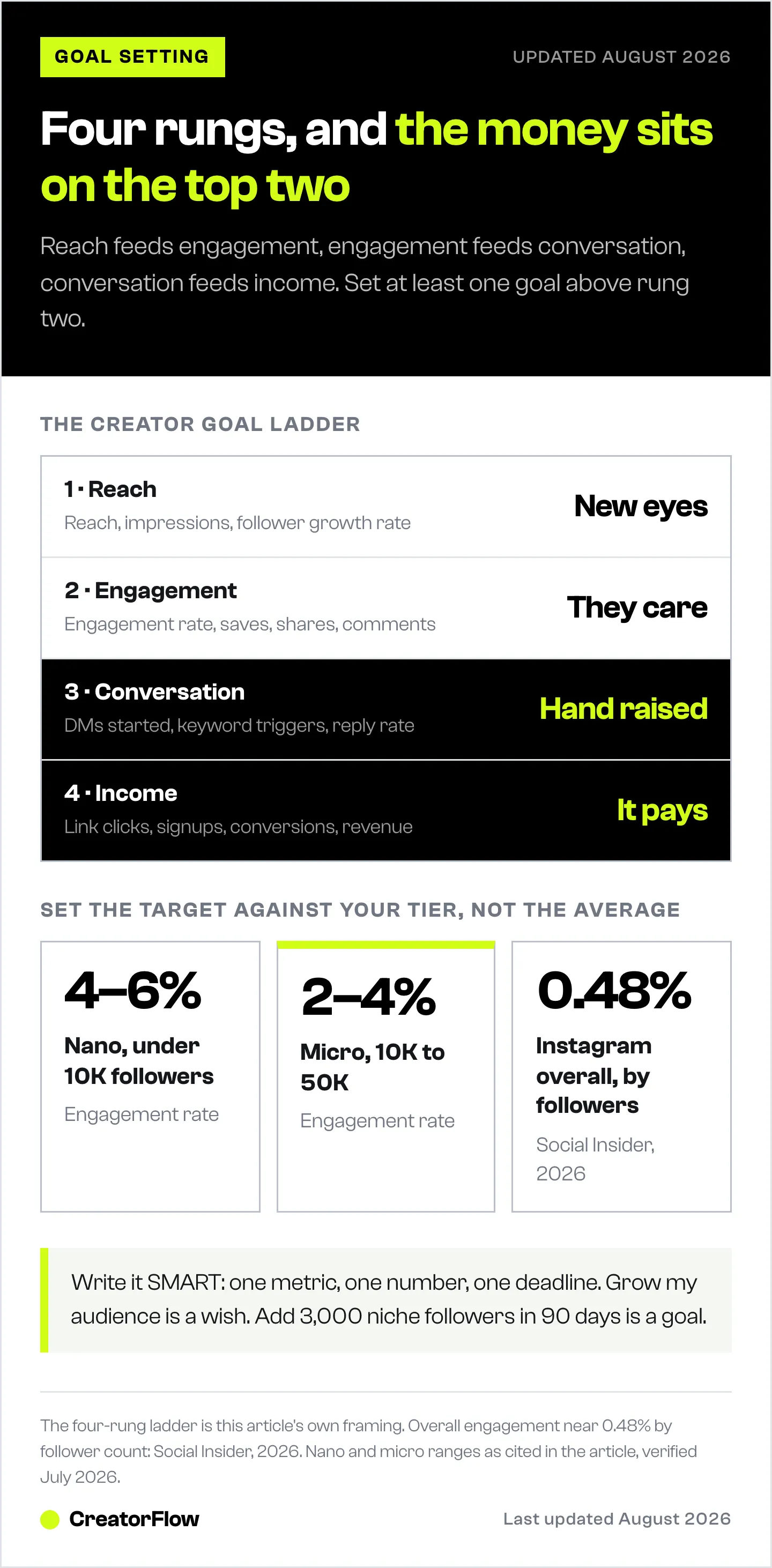
- Rung 1: Reach. New eyes on your content. This is the top of the funnel, and Reels do most of the work. Metrics: reach, impressions, follower growth rate.
- Rung 2: Engagement. Proof that the right people care. Metrics: engagement rate, saves, shares, comments per post. Use current Instagram engagement rate benchmarks to set a target you can actually hit.
- Rung 3: Conversation. The rung almost no guide names. A comment, a keyword, a Story reply, a DM. This is where a stranger becomes a lead. Metrics: DM conversations started, keyword triggers fired, reply rate.
- Rung 4: Income. The payoff. Leads, bookings, sales, revenue. Metrics: link clicks, email signups, conversions, revenue attributed to Instagram.
| Rung | What it measures | Example metric | Content that drives it |
|---|---|---|---|
| 1. Reach | How many new people see you | Reach, impressions | Reels, trends, collabs |
| 2. Engagement | Whether they care | Engagement rate, saves | Carousels, hooks, Stories |
| 3. Conversation | Whether they raise a hand | DMs started, reply rate | Comment prompts, Story polls, keyword CTAs |
| 4. Income | Whether it pays | Clicks, signups, revenue | Offers, lead magnets, links |
Two things follow from the ladder. First, set at least one goal on the top two rungs, because that is where income comes from. Second, a reach goal is only worth setting when a conversation and income goal sit above it to catch the traffic. Most creators over-invest in rung one and neglect rung three, which is why they get views and no revenue. The DM metrics that actually matter all live on rungs three and four.
How to Write a SMART Instagram Goal (With Creator Examples)
SMART turns a vague intention into a target you can track. Each letter forces a decision:
- Specific: name the exact outcome, not a direction.
- Measurable: attach a number and a metric.
- Achievable: stretch, but stay inside reach given your account size.
- Relevant: it has to serve your income, not just your ego.
- Time-bound: set a deadline so you know when to judge it.
Here is the same goal, before and after:
| Vague goal | SMART version |
|---|---|
| ”Grow my audience" | "Add 3,000 followers in 90 days from niche Reels, without buying followers" |
| "Get more engagement" | "Reach a 4% engagement rate on feed posts by end of Q3 with a carousel-first plan" |
| "Make money from Instagram" | "Book 10 discovery calls a month from Story-reply DMs by September" |
| "Grow my email list" | "Capture 300 email signups from comment-to-DM lead magnets in 60 days” |
The “achievable” test is where most creators overshoot. Set your target against your follower tier, not the platform average. Instagram’s overall engagement rate sits near 0.48% by follower count in 2026 (Social Insider), but smaller accounts run far higher: roughly 4% to 6% for nano creators under 10,000 followers and 2% to 4% for micro creators at 10,000 to 50,000. A 3% target at 80,000 followers is realistic. A 6% target at that size is not.
8 Instagram Goals Worth Setting
You do not need all eight. Pick one reach or engagement goal and one conversation or income goal, then ignore the rest until you hit them. Chasing every objective at once is how creators end up measuring everything and improving nothing.
| Goal | Ladder rung | Primary metric | Creator example |
|---|---|---|---|
| Increase reach | 1 | Reach, impressions | ”Grow monthly reach 40% by Q3 with three Reels a week” |
| Boost engagement | 2 | Engagement rate | ”Hit 4% engagement on carousels by end of Q4” |
| Start more DM conversations | 3 | DMs started, reply rate | ”Trigger 500 comment-to-DM conversations a month” |
| Grow the audience | 1-2 | Net new followers | ”Add 5,000 the-right-niche followers in 90 days” |
| Capture leads and emails | 3-4 | Signups, cost per lead | ”Collect 300 emails from Story lead magnets in 60 days” |
| Book calls or consults | 4 | Bookings from DMs | ”Book 10 discovery calls a month from DMs by September” |
| Drive affiliate or product sales | 4 | Link clicks, conversions | ”Generate 1,000 link clicks a month from Reel CTAs” |
| Deepen community | 2-3 | Saves, replies, UGC | ”Grow Story replies 50% with weekly question prompts” |
The middle goals are the ones creators skip and brands ignore. “Start more DM conversations,” “capture leads,” and “book calls” all live on the conversation rung, where a follower stops watching and raises a hand. That is the moment you can turn those conversations into leads. If you want a repeatable structure behind it, build a DM funnel so every goal on rungs three and four runs the same way each time.
Match Each Goal to One Metric, Not Ten
Every goal has one metric that proves it and a pile of metrics that only distract. Pick the one, watch it, and let the rest sit in your analytics for context.
| Goal | Watch this | Skip this (for this goal) |
|---|---|---|
| Brand awareness | Reach, impressions | Sales, replies |
| Engagement | Engagement rate, saves | Follower count |
| Conversation | DMs started, reply rate | Impressions |
| Lead generation | Signups, cost per lead | Likes |
| Sales and revenue | Conversions, attributed revenue | Reach |
Follower count is the most seductive metric and the weakest goal on its own. A 100,000-follower account at a 0.5% engagement rate reaches fewer buyers than a 12,000-follower account at 5%. Set a follower goal only when it sits under an engagement and a conversion goal. Vanity metrics work fine as inputs. They fail as finish lines.
How Often Should You Review Your Instagram Goals
You do not need a daily dashboard habit. A lightweight rhythm keeps you honest without eating your week:
- Weekly (five minutes): a pulse check. Are the leading metrics moving in the right direction? Catch a stalled goal before you waste a month on it.
- Monthly (thirty minutes): the full review. Compare month over month, decide what to keep, cut, and double down on, and adjust the target if it was too soft or too steep.
- Quarterly: reset. Retire goals you hit, promote a rung-two winner into a rung-four goal, and set fresh numbers.
Before you set any new targets, run a quick account audit so your baseline is real. You cannot set an achievable goal against numbers you have not looked at. When it is time to package that review for a client or your own records, follow this social media report structure.
Where DM Automation Fits Your Conversion Goals
Rungs three and four are where most creators leak. Someone comments “guide” on your Reel, and you see it four hours later. The conversation never happens, so the lead never converts, and the income goal quietly slips. This is the gap DM automation closes: when a follower comments a keyword, replies to a Story, or sends a trigger word, the reply goes out in seconds instead of hours.
CreatorFlow handles that on Instagram: comment-to-DM, Story-reply automation, keyword triggers, email capture, and link tracking, all on Meta’s official Instagram API. It is Instagram-only by design, built for solo creators and small teams rather than multi-platform brand desks. The free plan covers 500 DMs a month, and Pro is $15 a month flat with a follow gate, email gate, CSV export, and geographic analytics.
If your goals live on the conversation and income rungs, the job is simple: make sure every triggered conversation actually happens, then track which posts and keywords turn into clicks and signups. Turn comments into conversations, and conversations into customers. Start free with CreatorFlow.
FAQ
What are Instagram goals?
Instagram goals are specific, measurable outcomes you want your account to produce, written so you can track them. They differ from metrics: metrics are the numbers you watch, while goals are the results you are working toward. “Engagement rate” is a metric. “Reach a 4% engagement rate by Q4” is a goal.
What are good Instagram goals for creators?
Good creator goals climb toward income rather than stopping at reach. Strong examples: add 3,000 niche followers in 90 days, hit a 4% engagement rate on carousels, trigger 500 comment-to-DM conversations a month, capture 300 email signups from lead magnets, or book 10 discovery calls a month from Story-reply DMs. Each names an outcome, a number, and a deadline.
How do you set SMART goals for Instagram?
Make each goal Specific (name the exact outcome), Measurable (attach a number and a metric), Achievable (realistic for your follower size), Relevant (it serves your income), and Time-bound (set a deadline). Then benchmark the target against your account tier, not the platform average, so the number is a stretch you can actually reach.
What is the difference between Instagram goals and KPIs?
Goals are the outcomes you want, like growing your email list or booking more calls. KPIs, or key performance indicators, are the specific metrics you track to measure progress toward those goals, like signups or reply rate. Think of the goal as the destination and the KPI as the mile marker.
Which Instagram metrics should I track for each goal?
Match the metric to the goal. Awareness goals track reach and impressions, engagement goals track engagement rate and saves, conversation goals track DMs started and reply rate, lead goals track signups and cost per lead, and revenue goals track conversions and attributed revenue. Pick one primary metric per goal and let the rest sit as context.
Should follower count be a goal?
Only as a supporting goal, never the headline. Follower count is easy to track and easy to inflate, but it does not pay you. A smaller, highly engaged account often out-earns a larger passive one. Set a follower goal underneath an engagement and a conversion goal so growth has somewhere to convert.
How often should I review my Instagram goals?
Review weekly for a quick pulse check and monthly for a deeper analysis, then reset targets quarterly. Weekly reviews catch a stalled goal early, monthly reviews reveal real trends, and quarterly resets let you retire goals you have hit and promote winning tactics into bigger targets.
Instagram engagement and creator income figures verified from Social Insider and the Influencer Marketing Factory as of July 2026. CreatorFlow features and pricing verified from creatorflow.so as of July 2026. Individual results vary based on niche, audience, and offer.


