

Instagram Trial Reels let you publish a Reel to non-followers only, so you can test new content before your existing followers see it. Meta launched the feature on December 10, 2024. You need a public account with at least 200 followers on a professional account, or 1,000 on a personal one (creators.instagram.com, December 2024; help.instagram.com, September 2026). Within 24 hours you get performance data, and Instagram can auto-share a strong Trial Reel to your followers if it performs well soon after publishing. They work best for testing fresh hooks. Meta warns that a trial may get limited reach if it repeats content you already shared.
You post content all week and the numbers barely move. The same few hundred people watch, a handful like it, and almost nobody new finds you. It feels like the algorithm has already decided who you are and stopped looking. Trial Reels are the closest thing Instagram has given creators to a reset button: a free test with strangers that does not affect how your regular Reels rank.
This guide explains what Trial Reels are, how the 24-hour test works, what to post, and how to turn the new reach into real followers and leads. It also covers the one mistake that limits Trial Reel reach, so you do not waste a month of tests.
Key Takeaways
- What they are: Trial Reels publish to non-followers only. Your followers do not see them in Feed or the Reels tab, so a flop costs you nothing.
- Built for new content: Meta’s Help Center tells you to create a new reel. It warns that a trial may get limited reach if Instagram detects content you shared before.
- Fix the profile first: New reach is wasted if your bio and recent grid do not give a stranger a reason to follow. Sort that before you test.
- Repurpose, do not duplicate: Rebuild your best ideas into new Reels with new hooks. Reworking your own original content is fine; exact re-uploads are not.
- Read the 24-hour data: Insights arrive within 24 hours. Strong trials can auto-share to your followers. Weak ones stay out of your followers’ Feed and Reels tab.
- Capture the new reach: Trial Reels surface strangers. DM automation turns their comments into conversations before they scroll away.
- Reach is driven by sends and watch time: Test hooks that earn shares and hold attention, since those signals carry content to non-followers.
- The 1,000-follower rule is out of date: A public professional account needs 200 followers. A personal account needs 1,000. An account that cannot appear in recommendations loses access until it can again.
- Keep posting to your grid: Trials are invisible to your followers, so a week of trials only looks like a week of silence. Run them alongside your normal schedule, never instead of it.

What Are Instagram Trial Reels?
Instagram Trial Reels are Reels shown first to people who do not follow you. When you publish one, your existing followers do not see it in their Feed or in the Reels tab. Instagram pushes it out to non-followers, measures how it performs, and reports back.
Meta announced the feature on December 10, 2024 and rolled it out globally to eligible creators over the following weeks (creators.instagram.com, December 2024). In April 2026, Instagram added the ability to schedule Trial Reels in advance, so you can batch a week of tests in one sitting (Social Media Today, April 2026).
Instagram has published numbers on how the feature performs. In June 2025 it reported that 40% of creators who tried Trial Reels went on to post Reels more often, and that 80% of that group saw their Reels reach from non-followers increase (creators.instagram.com; Social Media Today, June 2025).
Who Can Actually Use Trial Reels
Nearly every guide online says you need 1,000 followers. That is out of date, and the correct number is lower for most creators.
Here is what Meta currently publishes. The account must be public. On a professional account, meaning Creator or Business, you need at least 200 followers. On a personal account you need at least 1,000 (help.instagram.com, August 2026). The 1,000 figure was accurate in July 2025 and has been repeated ever since.
Two practical consequences. If you sit between 200 and 1,000 followers and have a personal account, switching to a Creator account is what gives you the feature. If you are well past 1,000 and still cannot see the toggle, rollout has been account by account since launch, so check again after an app update.
Once a Trial Reel proves a hook works on strangers, the next step is buying more of that reach. That handoff is covered in Instagram Trial Reels to Meta Ads. The point of the feature is low-risk experimentation. Normally a weak Reel sits on your profile and drags down how the algorithm reads your account. A Trial Reel never touches your grid, so you can test a risky hook, a new format, or an unfamiliar topic without your audience watching you miss.
How Trial Reels Work: The 24-Hour Test
A Trial Reel runs as a 24-hour test. You record a Reel, choose the Trial option before posting, and Instagram distributes it to non-followers instead of your audience.
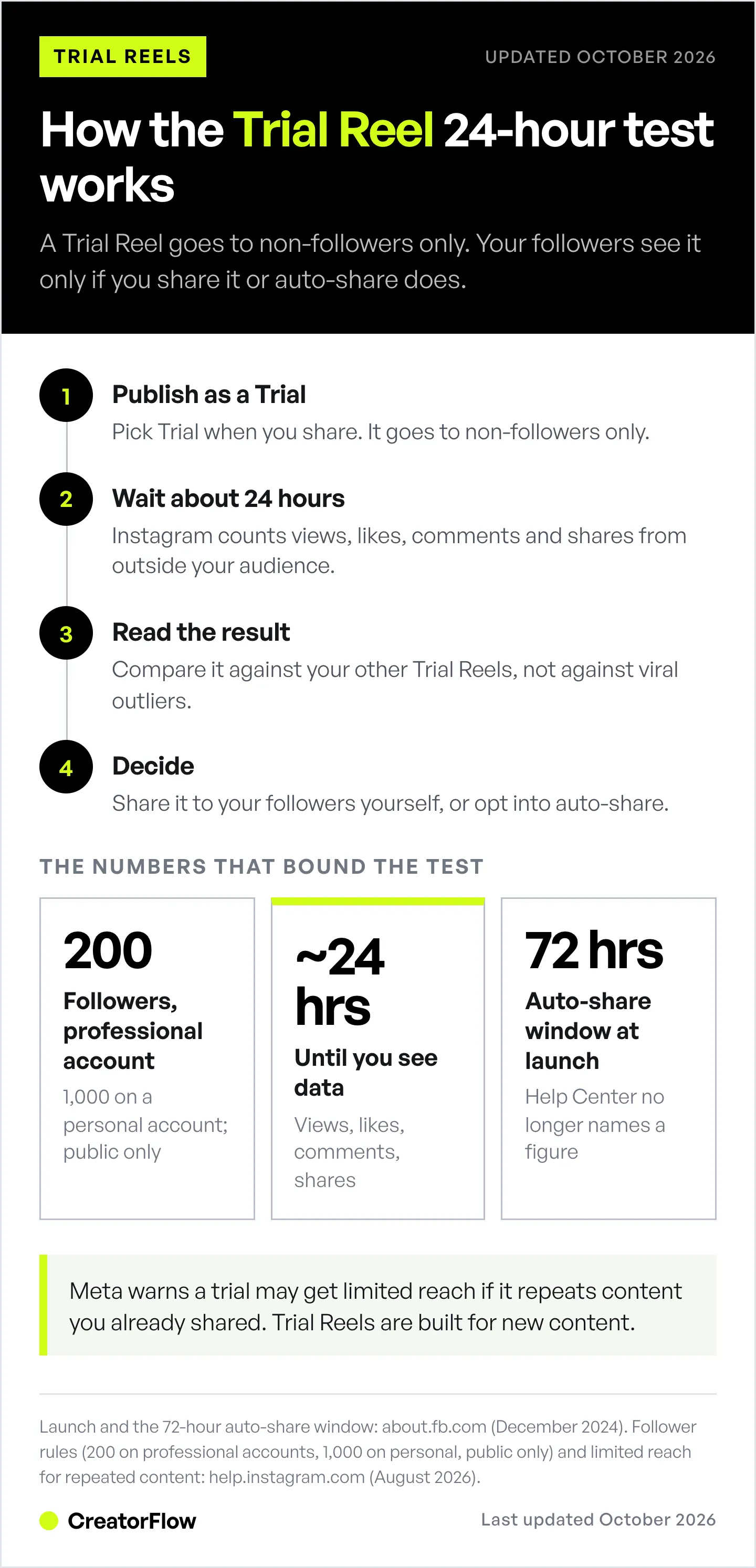
Here is the cycle:
- Publish. Select “Trial” when you share the Reel. It goes out to non-followers only.
- Wait about 24 hours. Instagram collects views, likes, comments, and shares from people outside your audience.
- Read the result. You get a performance summary you can compare against your other Trial Reels.
- Decide. If it performed well, you can share it to your followers. You can also opt into auto-share, where Instagram releases a strong Trial Reel to your followers automatically if it performs well soon after publishing. The launch announcement put that window at the first 72 hours; the current Help Center wording no longer names a figure (about.fb.com, December 2024; help.instagram.com, August 2026).
Treat each Trial Reel as one data point in an experiment. One test tells you little. Ten tests tell you which hooks, topics, and formats earn reach with strangers, which is exactly the audience you need to grow. Judge the results against the engagement rate benchmarks for your niche rather than against viral outliers. Pay attention to sends and watch time, not just views. Adam Mosseri named watch time, likes per reach, and sends per reach as the three signals that matter most, and sends carry more weight for unconnected reach, which is exactly what a Trial Reel is measuring (Adam Mosseri, January 2025).
When Trial Reels Do Not Work: Four Real Problems
Trial Reels go wrong in four common ways: a missing toggle, a quiet result after sharing, a duplicate-content flag, and followers who think you stopped posting. Here is what to do about each.
The Trial toggle is missing
The toggle appears in the sharing screen when you post a Reel, not in Settings. If it is not there, work through this order:
- Check the account basics. Meta requires a public account with at least 200 followers on a professional account, or 1,000 on a personal one (help.instagram.com, August 2026). A personal account under 1,000 followers will not see the option. If you have 200 or more, switch to a Creator account.
- Update the app. The toggle ships with the Instagram app, so an old build will not show it.
- Wait, and check again on your next Reel. Access has rolled out account by account since December 2024, and it has arrived at different times for accounts of similar size.
Do not buy anything that claims to give you the feature. Meta does not sell access to Trial Reels.
The trial performed well, then went quiet after you shared it with everyone
This is the most common complaint, and the honest answer is that Meta documents no penalty for converting a trial. Nothing in Instagram’s material says a converted Reel is down-ranked.
The likeliest explanation is simpler, and it is reasoning rather than a documented rule: the trial already spent its run at non-followers. Sharing it with everyone mainly adds your own audience to a Reel that has finished its stranger distribution. You are not getting a second wave, you are getting the followers you always had.
What to do with it: judge a converted trial over several days rather than a few hours, and when a trial wins by a wide margin, get more out of the idea by rebuilding it as a fresh Reel with a new hook instead of relying on the conversion alone. The idea is the asset. The individual upload is not.
Instagram flags your Trial Reel as duplicate content
This is the re-upload problem covered below in full. Short version: Trial Reels are built for new content, and re-posting a file already on your feed gets the near-duplicate suppressed. Rebuild the idea instead of re-uploading the file.
Your followers think you went quiet
Trial Reels are invisible to your audience by design. Run nothing but trials for a week and, from your followers’ side, you posted nothing for a week. Feeds get filled by whoever did post, and the people who used to watch you drift.
The fix is scheduling, not restraint. Keep your normal posting rhythm on the grid and run trials on top of it. Since April 2026 you can schedule trials in advance (Social Media Today, April 2026), which makes it practical to batch a week of tests without touching your regular calendar.
How to Read a Trial Reel Result
There is no published view count that marks a Trial Reel as good, and any specific number you see quoted online is somebody’s account, not a benchmark. Instagram itself only compares a trial against your own previous trials.
So use your own baseline. Run three or four trials before you judge any of them, then read each new one against that set. Three things are worth more than the view count:
- Sends and shares. These carry a Reel to people the algorithm has not shown it to yet, and Instagram weighs sends more heavily for reach to non-followers (Adam Mosseri, January 2025). A trial with modest views and strong sends is a better idea than a trial with the reverse.
- Watch time. A hook that holds strangers is the thing you are actually testing.
- Comments from strangers. Every one is a person you can reach directly, which the next section covers.
A simple decision rule. Compare each trial with the average of your last four trials:
- Sends and watch time above your average: share it to your followers, then test the same idea with a second hook.
- Views above average, sends below: the hook works, but the content does not earn shares. Keep the hook and rework the middle.
- Both below average: drop the idea and test a new one.
Ignore likes as a primary signal. They are the cheapest action on the platform and the least predictive of reach.
Fix Your Profile Before You Run a Single Test
Trial Reels send strangers to your profile. If that profile does not give them a reason to follow, the extra reach leaks straight out the bottom. Fix the profile first, then test.
A stranger lands on your page and decides in seconds. They are answering one question: why should I watch more of this person’s content? Your bio and your most recent posts have to answer it fast.
Two things matter most:
- A bio with a human edge. Generic bios look alike, and people skim past them. The fix is a detail only you could write: an odd fact, a strong opinion, a specific result, a quirk. Something imperfect and real. It does not need to be clever. It needs to be yours, and it needs to make the niche and the payoff obvious.
- A consistent recent grid. The last six to nine posts should make your topic unmistakable. If a visitor cannot finish the sentence “this account is about ___,” they will not follow, no matter how good the Reel that brought them was.
There is no reliable public benchmark for how many profile visitors convert into followers, so ignore any specific percentage you see quoted online. The principle stands without a number: every point of follow-rate you gain multiplies every Trial Reel you ever run after it. For more on turning attention into a following, see how to increase Instagram engagement.
What to Post as a Trial Reel
Post new content as a Trial Reel: fresh hooks, risky formats and adjacent topics. The advice circulating online to “repost your old Reels as Trial Reels” is wrong, and following it will hurt you.
Instagram designed Trial Reels for new, experimental content. When you re-upload a Reel that is already on your feed, Instagram detects the near-duplicate and suppresses its reach. Creators who do this report in-app warnings telling them to post original content to Trial Reels instead. Re-running existing feed Reels as Trial Reels teaches the algorithm to ignore you.
Keep trials under 3 minutes. Instagram allows Reels up to 20 minutes, but it does not recommend Reels over 3 minutes to new audiences, and new audiences are the only people a Trial Reel reaches (help.instagram.com, October 2026).
What you should post:
- Fresh hooks for proven ideas. Take a topic that worked before and build a brand-new Reel around it with a different opening line, a different angle, or a different format. The idea is reused. The Reel is new.
- Risky formats you would not risk on your feed. A new editing style, a talking-head take, a faster cut. The Trial is the safe place to find out if it lands.
- Topics adjacent to your niche. Test whether a nearby subject pulls non-followers before you commit feed slots to it.
Whatever you test, export at the right dimensions. The Instagram post size guide covers Reels resolution and the safe zones that keep your hook text from being cropped.
This is a real distinction. Instagram’s originality policy, which it expanded from Reels to carousels on April 30, 2026, penalizes accounts that repost other people’s content (Instagram via PetaPixel, April 2026). It does not penalize you for reworking your own original ideas into new content. Repurposing your own material is encouraged. Duplicating an existing post is not. Keep those two apart and you stay safe.
Use Trial Reels to A/B Test Hooks and Trends
The single highest-value use of a Trial Reel is a controlled test: change one thing, hold everything else steady, and let strangers tell you which version wins.
A/B test the hook. The opening line decides whether anyone watches past the first second. Take one video and cut two versions with different hooks:
- Version A: “Three things I wish I knew before I started on Instagram.”
- Version B: “Are you making these Instagram mistakes?”
If you are short on opening lines to test, the free Instagram hook generator drafts variants you can cut against each other.
Same footage, same audio, same caption. Post both as Trial Reels at the same time of day, let them run 24 to 48 hours, then compare watch time, shares, and saves. Publish the winner to your feed and keep the weaker line out of your next ten Reels. The one rule that makes this work: change a single variable per test. Swap the hook, the audio, and the caption all at once and you learn nothing about which one moved the numbers.
Test the first episode of a series. Episode 1 decides whether anyone watches the rest, so run it as a Trial Reel before you build an Instagram series around it.
Test trends before you commit. Not every trend fits your brand, and a flop on your main feed can cost you followers. Trial Reels let you try a trending sound, format, or text overlay in front of non-followers first. If it lands, share it to your audience. If it does not, your followers never saw the miss. This is most useful when you have built a tight niche and feel boxed in by it, because the Trial is a no-risk way to find out whether an adjacent topic pulls strangers in. Trial Reels are one of several shifts changing how creators grow this year; the 8 Instagram trends defining 2026 cover the rest.
The 10-Minute Repurposing Routine
A 10-minute daily routine keeps Trial Reels running without a new idea every day. You need a short, repeatable routine that turns your best past content into fresh tests. Ten minutes a day is enough.
Pick one move each day:
| Day | Move | Time |
|---|---|---|
| Monday | Pull your top 3 Reels from the last 6 months. List what made each one work. | 10 min |
| Tuesday | Take the best idea and rewrite only the hook. Refilm the first 3 seconds. | 10 min |
| Wednesday | Rebuild one older Reel fully: same idea, new script, current knowledge. | 10 min |
| Thursday | Turn a winning Reel’s idea into a carousel with a fresh angle. | 10 min |
| Friday | Schedule the week’s rebuilt Reels as Trial Reels. | 5 min |
The fastest high-value edit is the hook. A Reel that underperformed often had a strong idea and a weak first line. Refilming three seconds of footage can change everything, and it costs you almost nothing. You skip the research, ideation, and scripting because the idea is already proven. You are only upgrading the delivery. If you are still learning the mechanics, our step-by-step guide to making Instagram Reels covers filming, editing, and posting.
Run this loop and you always have new Trial Reels to test without the burnout of constant original production. For hook ideas to test, see these proven Instagram content hooks, and to understand what the algorithm rewards, read how the Instagram algorithm works.
Turn New Reach Into Followers and Leads
Trial Reels do one thing exceptionally well: they put your content in front of people who have never heard of you. That is the whole point, and it is also a problem. A stranger who watches, maybe comments, and scrolls on is reach you paid for with effort and got nothing back.
You need a way to catch them in the moment of interest. That moment is the comment.
When a non-follower comments on your Trial Reel, that is a raised hand. DM automation lets you answer it instantly. Set up a keyword so that anyone who comments a specific word gets a direct message with whatever you promised in the Reel: a checklist, a template, a guide, a free resource. The comment becomes a conversation, and the conversation is where following and buying happen.
Two tactics make this work harder on Trial Reels specifically:
- Lead with a giveaway. A Trial Reel that promises something concrete (“comment GUIDE and I will send it over”) gives strangers a reason to comment, which feeds the algorithm the engagement it uses to widen reach.
- Use a follow gate. Because Trial Reels reach non-followers by design, a follow gate fits perfectly. The person comments, and before the resource is sent, they are asked to follow. They opted in for something they want, so the ask is fair, and more of the new reach can turn into followers.
This is the layer that converts borrowed attention into an audience you own. CreatorFlow is an Instagram DM automation tool built for this step: when a stranger comments your keyword on a Trial Reel, it sends them a DM within seconds through Meta’s official Instagram API. On Pro ($15/month), Follow Gate asks them to follow before the link arrives, and Email Gate asks them to type their email in the chat, so a stranger who found you today is reachable tomorrow. The job is to turn every Trial Reel into a distribution channel instead of a one-time view. For the full setup, see the Instagram DM automation guide, and for comment prompts that pull replies, see these comment-to-DM CTAs.
Trial Reels Mistakes That Kill Your Reach
Five habits undo Trial Reel reach. Avoid these.
- Re-uploading feed Reels as Trial Reels. Covered above, and worth repeating. Instagram suppresses near-duplicates. Trial Reels need new content.
- Judging a single test. One Trial Reel is noise. Patterns only appear across ten or more. Do not kill a format because one test was quiet.
- Testing with a broken profile. Reach with a weak bio and an inconsistent grid converts poorly. The leak is upstream of the Reel.
- Ignoring comments. Trial Reels surface strangers who will never see your content again unless you catch them. Comments left unanswered are followers lost.
- Chasing views over sends. Views feel good, but sends and watch time are what carry a Reel to new people. Build hooks worth sharing, not just watching.
Run Trial Reels as a steady experiment, fix the profile, feed them fresh content, and capture the reach they generate. That is a growth system you can run in minutes a day, and it compounds.
FAQ
What are Instagram Trial Reels?
Instagram Trial Reels are Reels shown only to people who do not follow you. Your existing followers do not see them in Feed or the Reels tab. Meta launched the feature in December 2024 so creators could test new content with strangers before releasing it to their audience. After about 24 hours, you get performance data and can choose to share the Reel with your followers.
How many followers do I need to use Trial Reels?
You need at least 200 followers on a professional (Creator or Business) account, or at least 1,000 on a personal account, and the account must be public (help.instagram.com, August 2026). The 1,000 figure that most guides repeat is the old rule. Private accounts cannot use the feature, since the whole point is reaching non-followers. When you have access, Trial appears as a toggle on the screen where you share a new Reel.
Can you repost old Reels as Trial Reels?
No, and you should not try. Trial Reels are built for new content. When you re-upload a Reel already on your feed, Instagram detects the near-duplicate and suppresses its reach, and creators report receiving in-app warnings about it. Instead, rebuild the idea into a fresh Reel with a new hook or format, then post that as the Trial Reel.
Do Trial Reels hurt your reach or get you down-ranked?
Posting genuinely new content as a Trial Reel does not down-rank you. Trial Reels that fail simply never reach your followers, so there is no cost to your account. The exception is re-uploading existing feed Reels as Trial Reels, which Instagram suppresses. Stick to fresh content and no known penalty applies.
How long do Trial Reels take to show results?
Instagram typically returns Trial Reel performance data after about 24 hours. If you opt into auto-share, Instagram decides whether to release the Reel to your followers based on how it performs soon after publishing, a window the December 2024 launch announcement put at 72 hours. Treat any single result as one data point and look for patterns across many tests.
Can my followers see my Trial Reels?
No, not unless you choose to share one with them. A Trial Reel stays out of your followers’ Feed and Reels tab, and off your profile grid. After the test, you can share a strong Trial Reel to your audience yourself, or use auto-share so Instagram does it when a Reel performs well. The side effect is that a week of nothing but trials looks like a week of silence, so keep your usual posting schedule running alongside the tests.
Why can’t I find the Trial Reels toggle on Instagram?
The toggle is missing when the account does not meet Meta’s rules or the app is out of date. Check three things in order. The account must be public, with 200+ followers on a professional account or 1,000+ on a personal one (help.instagram.com, August 2026). Update the Instagram app, because the toggle ships with the app. Then check again on your next Reel, as access has rolled out account by account since December 2024. Meta does not sell access.
Should you use DM automation with Trial Reels?
Yes. Trial Reels reach non-followers, so the comments come from strangers who will not see you again unless you catch them. DM automation sends an instant reply when someone comments your keyword, can apply a follow gate, and captures emails. It converts one-time Trial Reel reach into followers and leads instead of letting it scroll away.
Sources verified August 31, 2026. Trial Reels launch, mechanics, and the 72-hour auto-share: about.fb.com (December 10, 2024) and creators.instagram.com. Access requirements: help.instagram.com. Instagram’s June 2025 performance figures and the April 2026 scheduling release: Social Media Today. Reels ranking signals: Adam Mosseri, January 2025. Originality policy: reporting on Meta’s April 2026 update. Reel length and the 3-minute recommendation rule: help.instagram.com, checked October 2026. Instagram features and rules change frequently, and individual results vary.


