
Niching down on Instagram means narrowing who each post is addressed to, then keeping the range of topics wide. Instagram maps content and people into the same interest space and matches posts to people it expects to care (creators.instagram.com, accessed September 2026). A narrow topic with a mixed audience trains that match on the wrong people. A narrow audience with wide topics trains it on the right ones.
You picked a niche two years ago. You post about that niche and nothing else. Your reach is fine, your follower count climbs, and the day you put something up for sale, eleven people click and one buys. The account looks correct from the outside. The audience inside it was assembled by posts that were one notch too broad, and one notch is enough.
This guide covers what Instagram publicly says about how it decides who sees your work, why a disciplined topic list can still collect the wrong crowd, and a method for narrowing the audience instead. Written for creators, coaches and affiliates who already have a niche and a following that will not convert.
Key Takeaways
- Instagram files you by who responds, not by what you declare: Your bio says who you are for. Distribution is decided post by post, by the people who watch, like and send each one.
- Two audiences, two signals: Watch time, likes and sends are the top three ranking signals for both follower and non-follower reach. Likes weigh slightly more with followers, sends slightly more with non-followers (@mosseri, January 2025).
- Instagram now reads topics semantically: Head of Instagram Adam Mosseri describes ranking as similarity in an embedding space, and says topics can now be mapped into the same space as videos (Armchair Expert, February 2026).
- Creators see none of it: Instagram Insights reports age, city, country and gender. There is no interest or topic breakdown anywhere in the app or the API (help.instagram.com and developers.facebook.com, accessed September 2026).
- Narrow the who, widen the what: Fix the person, then range across every problem that person has. Wide topics addressed to one person still land on one crowd.
- Sends per reach is the alignment number: It is the signal that carries most weight with people who do not follow you, which is the group that decides who joins next.
- Bottom line: Topic discipline builds a content calendar. Audience discipline builds a list of people who buy.
What Niching Down on Instagram Really Means
Niching down is usually taught as topic restriction. Pick one subject, post only that subject, and the audience sorts itself out. The version that changes revenue is audience restriction. You fix the person every post speaks to, then let the subjects range as widely as that person’s problems range. Topic narrowing shrinks what you can say. Audience narrowing sharpens who answers, and who answers is the input Instagram reads.
The two look identical on a content calendar and produce opposite results. A finance creator posting only about money can pull in students, retirees, salaried employees and freelancers in the same week. Every one of those posts is on topic. None of them agrees on who the account is for.
If you have not picked a subject area yet, start with choosing a creator niche from scratch and come back to this once you have one. This piece is for the account that already has a niche and a conversion problem.
How Instagram Decides Who Sees Your Posts
Instagram distributes to two groups: accounts that follow you, which it calls connected reach, and accounts that do not, which it calls unconnected reach. For both, the three signals that matter most are watch time, likes and sends. Likes count slightly more with followers. Sends count slightly more with people who do not follow you. Unconnected reach is where a niche is decided, because that is the moment Instagram guesses who else wants this.
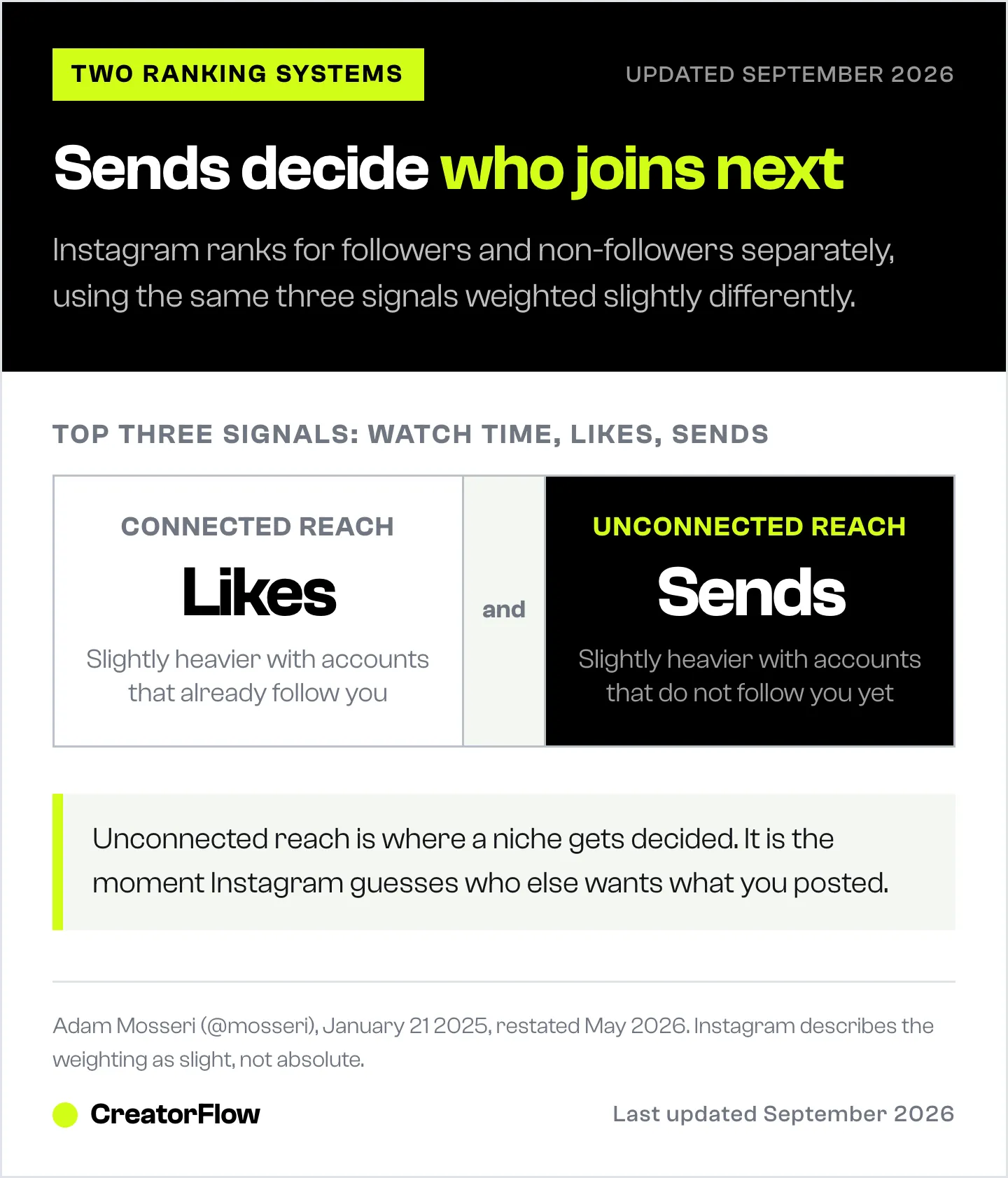
That breakdown comes from Adam Mosseri directly. “There are two types of ranking on Instagram: Connected reach (accounts that follow you), Unconnected reach (accounts that don’t yet follow you). For both, the top three signals that matter most for ranking are watch time, likes and sends,” he wrote, adding that “likes are slightly more important for connected content, and sends are slightly more important for unconnected content” (@mosseri, January 21, 2025). He restated the same hierarchy in May 2026.
| Connected reach | Unconnected reach | |
|---|---|---|
| Who it reaches | People who follow you | People who do not |
| Heaviest of the three signals | Likes | Sends |
| What it grows | Depth with existing followers | The composition of the next cohort |
| Where it shows in Insights | Views split by followers | Views split by non-followers |
Source: @mosseri, January 2025 and May 2026. Signal weighting is described by Instagram as slight, not absolute.
A popular clip circulating in creator circles claims the algorithm has no idea what your content is about, that it holds a meaningless number that happens to correlate with a subject. The full quote says the opposite about 2026. Mosseri describes ranking as similarity search in an embedding space, then says the machine-readable state has moved on: “two years ago, it would have just been this giant number. I wouldn’t have been able to tell you what it means. Now I can say, oh, that’s pretty close to surfing” (Armchair Expert with Dax Shepard, February 25, 2026). In the same conversation he explains that topics can now be placed on the same map as the videos, which is what makes the Your Algorithm feature possible.
Instagram shipped the consumer half of that in June 2026. Users can open a topic list, see labels such as “From Running” or “From Street Style” on recommended posts, and edit what they are interested in (@mosseri, June 10, 2026). Every viewer now carries an editable interest profile.
Instagram also states the matching plainly in its creator FAQ: “we also use audience-matching techniques to make sure that we’re showing content to people who are most likely to be interested in it. For example, if you or another creator within your niche have previously posted content that’s earned more distribution from the audience that you’re looking to engage, sharing content around a similar theme could get similar distribution” (creators.instagram.com, accessed September 2026).
Read that as an instruction. The audience you have already earned distribution with is the audience your next post inherits. For the mechanics of each surface, see how Instagram’s ranking systems work.
The Asymmetry Nobody Plans Around
Instagram tells viewers which topics it has assigned them. It tells creators nothing of the kind. Insights reports top countries, top cities, age ranges and gender, and that is the complete list (help.instagram.com, accessed September 2026). The API is the proof by enumeration: the two audience metrics accept exactly four breakdowns, age, city, country and gender, and no interest, topic or affinity dimension exists in the reference at all (developers.facebook.com, accessed September 2026).
So the interest profile that governs your distribution is real, it is now legible enough for Instagram to label out loud, and you cannot open it. What you can control is which people are given a reason to respond. That is the whole lever.
Why a Niched Account Still Attracts the Wrong People
The failure is rarely a topic violation. It is a topic that is correct at the category level and unowned at the person level.
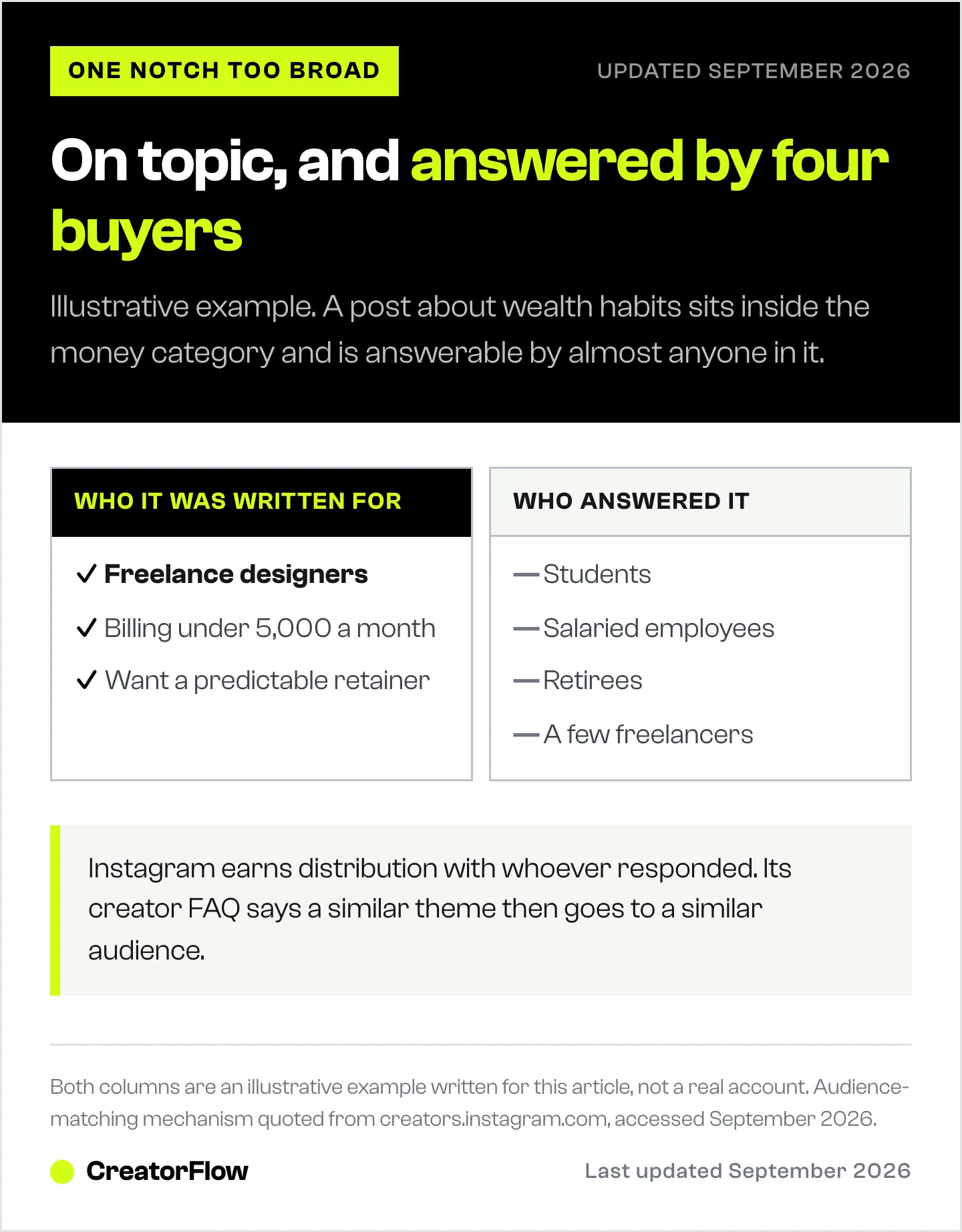
Take a coach whose paying clients are freelance designers billing under 5,000 a month. A post titled “three habits that build wealth” sits inside the money category. It is on topic by any reasonable audit. It is also answerable by a student, a salaried employee, a retiree and a business owner, and those four will out-number the freelancers in the responses by a wide margin. Instagram earns distribution with that mixed group, and the FAQ above says what happens next: the following post goes toward a similar audience.
Nothing looks broken while this is happening. Views hold. Followers climb. The number that moves is the one nobody checks weekly, which is the share of responders who match the buyer. That figure decays quietly for months and only announces itself on a launch day. This is a different failure from account-wide reach dropping, and it needs a different fix, because reach here is fine.
Large accounts post broadly and grow anyway, which looks like a contradiction and is not. An account with years of consistent responder history has a formed position, so a wide post inherits it. A younger account has no such ballast, and a wide post there becomes the positioning rather than sitting on it.
Narrow the Who, Widen the What
Put the two decisions on separate axes and the strategy reads at a glance.
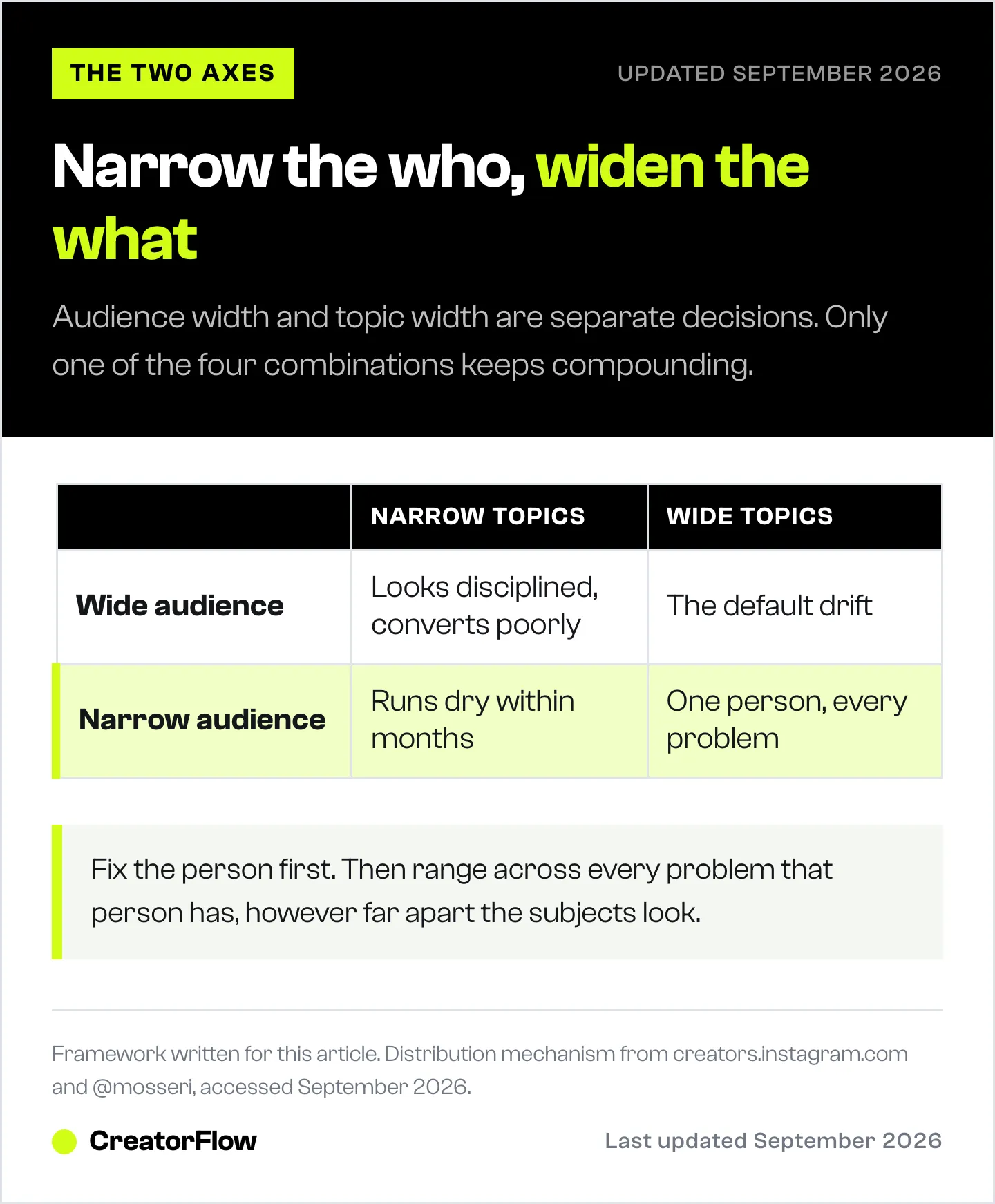
| Narrow topics | Wide topics | |
|---|---|---|
| Wide audience | Feels disciplined, converts poorly. On-topic posts answerable by four different buyers | The default drift. High views, no consistent responder |
| Narrow audience | Sustainable for a few months, then you run dry | The target. One person, every problem they have |
The bottom-right cell is the one to build. Fix the person, then range across everything that person deals with. A coach serving freelance designers can post about pricing a retainer, chasing a late invoice, quarterly tax set-asides, saying no to scope creep, packaging a service, and what to charge a returning client. Six subjects, six searches, one buyer answering all of them.
This is the inversion most accounts run backwards. They go wide on the person and narrow on the subject, which produces the same three posts aimed at everybody.
How to Define the Person Your Content Is For
Write down three problems, not a demographic
Open the list of people who have already paid you, or who have already asked you something specific in DMs. Write the three problems that come up most. Phrase each one the way the person says it, not the way you would title it.
“I have no idea what to charge.” “Some months I make nothing.” “I am scared of what I owe in tax.”
Three is deliberate. One problem starves the calendar. Five stops being a person and becomes a category again. If nobody has paid you yet, write the three you believe are true, publish against them for a month, and correct from the replies.
Run two checks before anything goes out
Check one: which of the three does this hit? If you cannot name it in one sentence, the post is not ready. Not two of the three. One.
Check two: who does this leave out? A post that is equally useful to every person in your category will be answered by every person in your category. If you cannot name a group this post is not for, widen the specificity until you can. Content built for one person should read as mildly irrelevant to everyone outside that description, and that is the mechanism working, not a bug.
The Metric That Tells You Whether Your Audience Is Aligned
Sends per reach is the number to watch, because sends carry the most weight with people who do not follow you, and that group decides who arrives next. Open a post in Insights, take sends and divide by the accounts reached, then compare that ratio across your last twenty posts rather than reading any single one.
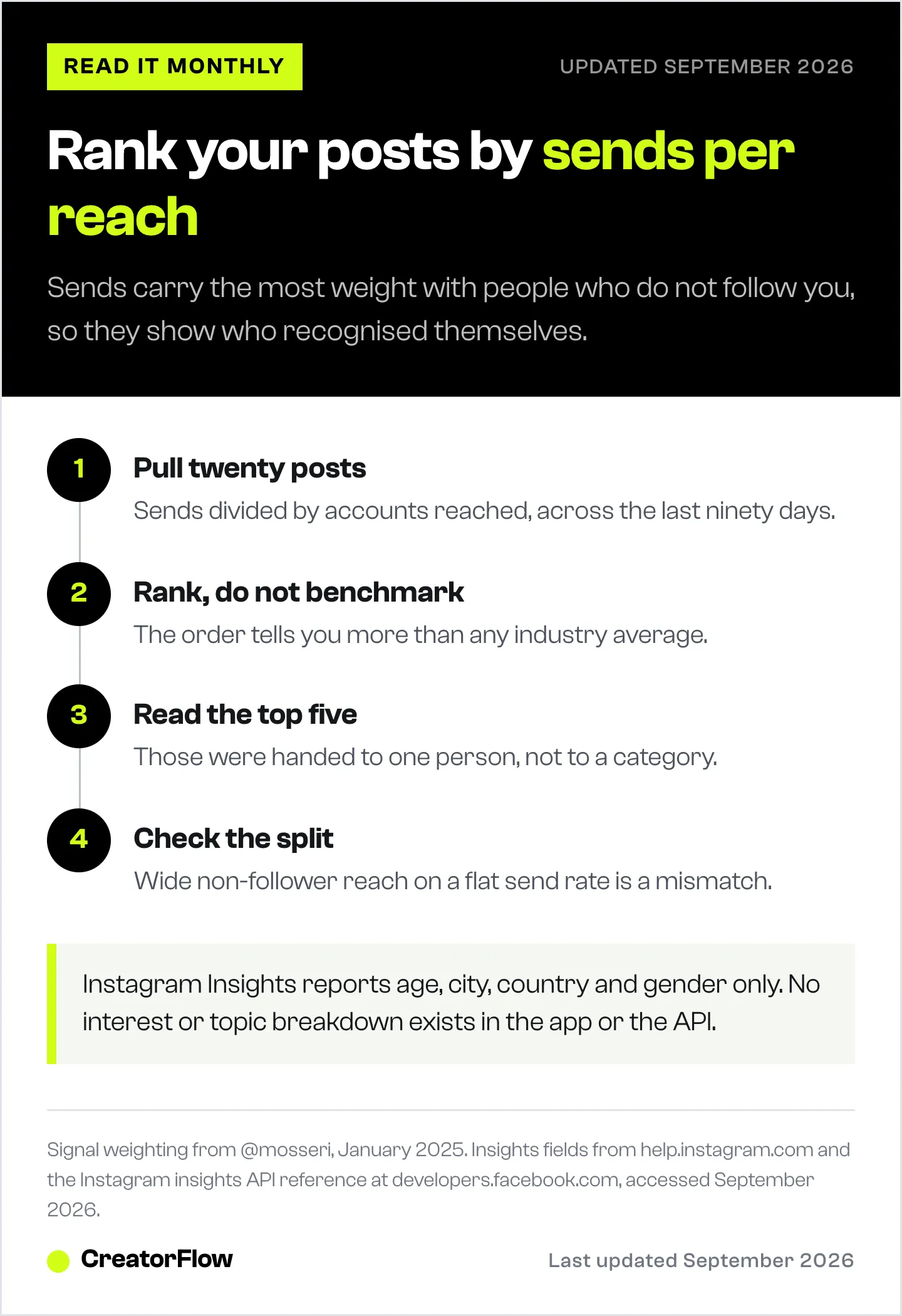
The ranking matters more than any benchmark. Posts at the top of that list were handed by one person to one specific other person, which means they were recognisably addressed to somebody. Posts at the bottom were addressed to a category.
Pair it with the follower and non-follower split on views. A post pulling large unconnected reach on a flat send rate reached a crowd that did not recognise itself in it, and that crowd is now part of what the next post inherits.
Instagram’s originality rules add a second reason to keep the work first-hand. Since April 2026 accounts that mainly re-upload other people’s photos and carousels are not eligible for recommendations, having had the same rule applied to Reels since 2024. Recommendations are the entire non-follower surface, so an account that reposts its way to a content calendar loses access to the group that decides its niche (creators.instagram.com, April 30, 2026).
How to Test Who Is Listening
Insights will not tell you who these people are. A keyword test will.
Pick the sharpest of your three problems. Publish a post that solves a piece of it and offer the rest as something the reader keeps, a template, a calculator, a checklist. Ask for a specific comment word to get it. Then read the handles that claim it.
That claimed list is the closest read of your audience Instagram allows, because claiming costs the reader something and only somebody with the problem pays it. Run it across three or four posts on different problems, and the overlap between the lists is your buyer.
CreatorFlow is the distribution layer for that test. It watches for the keyword, sends the resource by DM through the official Instagram API as a Meta Tech Provider, and tracks who claimed and where they clicked, with a Follow Gate and an Email Gate available on Pro at 15 dollars a month. Exporting the claimers to CSV turns a test into a list you can sell to later. For phrasing that gets claimed, see comment keywords that convert, and for the behavioural read on the people already in your following, the signals that show who really buys.
What to Expect When You Realign
Expect the responses to thin out first. The cohort assembled by your wider posts has no reason to answer content built for somebody more specific, and it takes several weeks for the newer group to make up the difference. Most accounts give up inside that window and go back, which is why the change so rarely gets tested to completion.
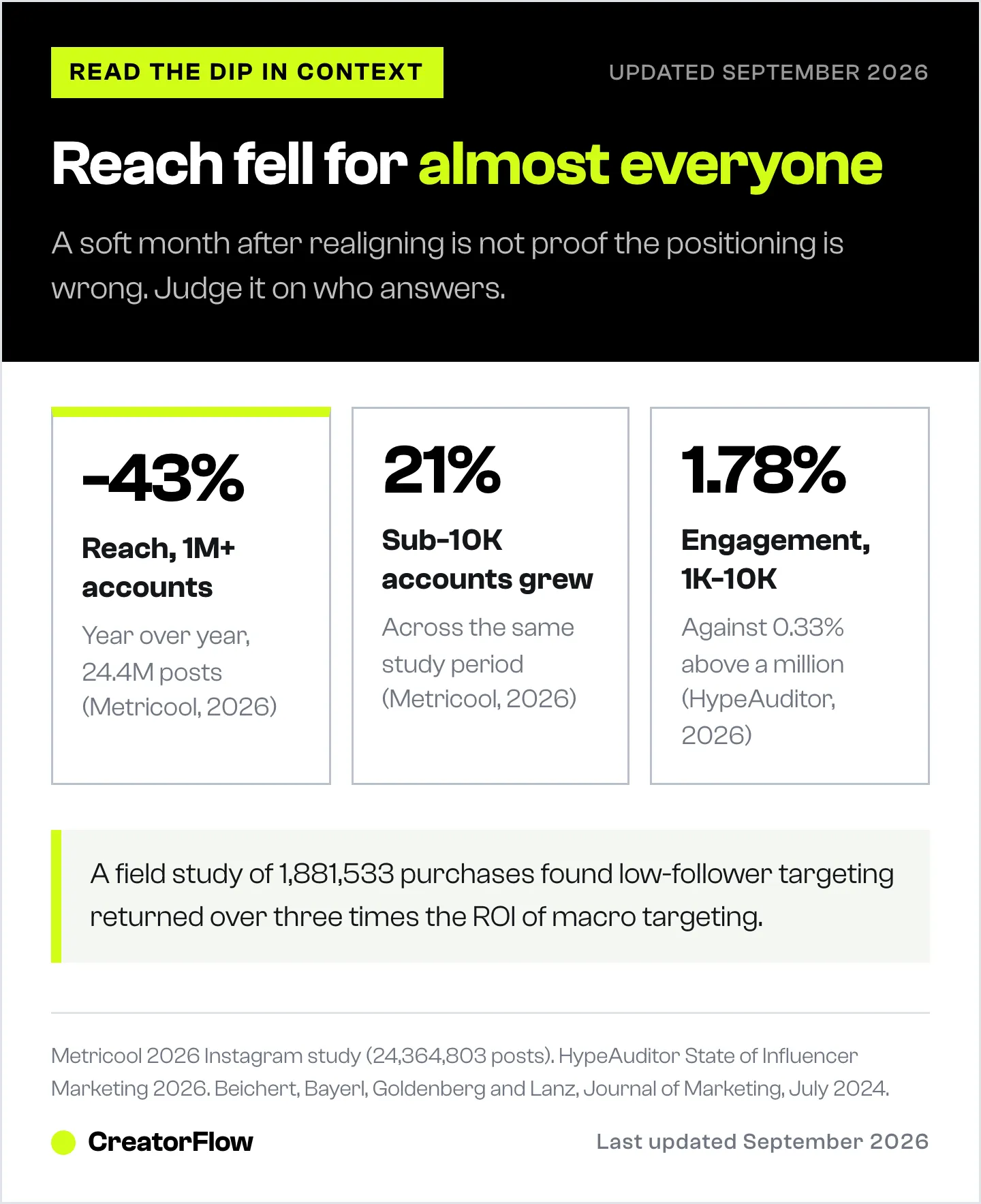
Read the dip against the background rather than in isolation. Instagram reach fell across the board in the last year: a study of 24.4 million posts found accounts over a million followers lost 43 percent of their reach year over year, and only 21 percent of accounts under 10,000 followers grew at all (Metricool, 2026). A soft month is not evidence your positioning is wrong.
Size is a weak predictor of income in any case. Engagement rate runs highest at the smallest tier, 1.78 percent between 1,000 and 10,000 followers against 0.33 percent above a million, across 88.7 million accounts (HypeAuditor, 2026). A field study of 1,881,533 purchases found targeting low-follower creators returned more than three times the ROI of macro targeting (Beichert, Bayerl, Goldenberg and Lanz, Journal of Marketing, July 2024).
Judge the change on the composition of who answers, which you can see inside a month in your claimed-keyword lists, rather than on view counts, which will move for reasons that have nothing to do with you.
FAQ
What does niching down on Instagram mean?
It means restricting who your content is for. Most advice restricts the topic instead. Narrowing the topic limits your calendar while leaving the audience mixed. Narrowing the audience keeps the calendar wide and makes the group that responds consistent, which is the input Instagram uses to decide who sees the next post.
Does the Instagram algorithm know what my content is about?
Instagram ranks by similarity in an embedding space rather than by labels. Adam Mosseri said in February 2026 that a topic which was once an uninterpretable number can now be read as close to a named subject, and that topics can be mapped onto the same space as videos, which is what powers the Your Algorithm topic controls.
Can I post about more than one topic on Instagram?
Yes, provided every topic is addressed to the same person. Six subjects that one buyer cares about will pull one crowd. Two subjects aimed at different buyers will pull two, and the responses will average out into a group that matches neither.
How do I know if my Instagram audience is the wrong one?
Compare who responds against who pays. Rank your last twenty posts by sends divided by accounts reached, then look at who claims a keyword offer. If the people claiming do not resemble your customers, the mismatch is in who your posts are addressed to, not in how often you post.
Can I see my audience’s interests in Instagram Insights?
No. Insights reports top countries, top cities, age ranges and gender. The API confirms it: the audience-demographics metrics accept only age, city, country and gender as breakdowns, with no interest or topic dimension (developers.facebook.com, accessed September 2026).
Why is my reach fine but my sales flat on Instagram?
Reach measures how many people saw the post. It says nothing about whether they were the right people. An account can hold steady views for years on posts that are correct for the category and unowned by any single buyer, and the gap only becomes visible on a launch day.
Should I start a second account instead of niching down?
A second account restarts your unconnected reach from nothing and doubles the posting load. Realigning the account you have keeps the follower base that already matches while the composition of new arrivals changes. Split only when the two audiences genuinely buy different things.
Ranking signals and originality rules verified from @mosseri (January 2025, June 2026), Armchair Expert with Dax Shepard (February 2026), creators.instagram.com, help.instagram.com and developers.facebook.com as of September 2026. Benchmarks from HypeAuditor State of Influencer Marketing 2026, Metricool (2026) and Beichert et al., Journal of Marketing (July 2024). Individual results vary.