
Social media personalization is the practice of tailoring content, offers and messages to one individual based on data you hold about them. On social platforms, most of that data belongs to the platform rather than to you. The portion you own comes from what someone hands over in a comment, a DM or a form: a keyword, an email address, an answer to a question.
Every guide on this topic lists the same tactics. Segment your audience. Use dynamic content. Trigger messages from behaviour. Address people by name. All of it assumes you already know who the individual is. On Instagram, TikTok or Facebook, you usually do not. You get a username and an aggregate demographic chart, and neither of those lets you send one person a different message from the next.
This guide works the other way around. It starts with the data, maps what each kind of data permits, names the four fields a social audience realistically yields, and covers what each one lets you do. Sources are listed at the end.
Key Takeaways
- It is a data problem before it is a messaging problem: personalization tactics all require identity data, and social platforms hold most of it themselves
- Three kinds of data, one that matters: platform signals and aggregate insights shape what you publish; only individual declared records let you address a person
- Declared records are the portable ones: the keyword someone typed and the email they gave survive an algorithm change, a reach drop or a platform ban
- Four fields are realistically collectable from a social audience: declared interest, contact address, click behaviour and rough location
- Declared interest beats inferred interest: someone who types SIZING has told you what they want, which is stronger than any demographic guess
- The market moved on this in 2026: Klaviyo shipped Social Marketing on 30 June 2026 to route Instagram engagement into CRM profiles (klaviyo.com, August 2026)
- You do not need a CRM to start: a keyword, a reply and an exported list cover most of what small accounts need
What Is Social Media Personalization?
Social media personalization means changing what a person sees or receives based on something you know about them specifically. That covers a DM that answers the exact question someone asked, an email sequence that differs by which product a subscriber asked about, and an ad audience built from people who took a particular action.
It is distinct from segmentation, though the two get used interchangeably. Segmentation splits an audience into groups and treats each group the same. Personalization goes down to the individual. Most work sold as personalization is segmentation with a first-name field bolted on.
The distinction matters because the two need different data. Segmentation runs on aggregate attributes you can guess at. Personalization runs on individual records, and individual records only exist if someone created one.
The Data Problem Nobody Mentions
Social platforms are built so that the platform holds the identity graph and you rent access to it. That arrangement is what makes the products work. It also means the personalization you experience as a marketer on those platforms is mostly the platform personalizing on your behalf, inside its own walls, under its own rules.
Ask a practical question about it: if Instagram reduced your reach by half next month, which of your personalization would survive? Feed ranking would not, because you never controlled it. Ad targeting would not, because the audience lives in Meta’s system and the rules change. A list of 4,000 people who each told you which product they were interested in would survive intact, because it sits in your own file.
That test sorts everything into what you rent and what you keep.
What Each Kind of Data Lets You Personalize
Not all data supports the same depth of personalization. Sorting what you hold by what it permits removes most of the confusion in this topic.
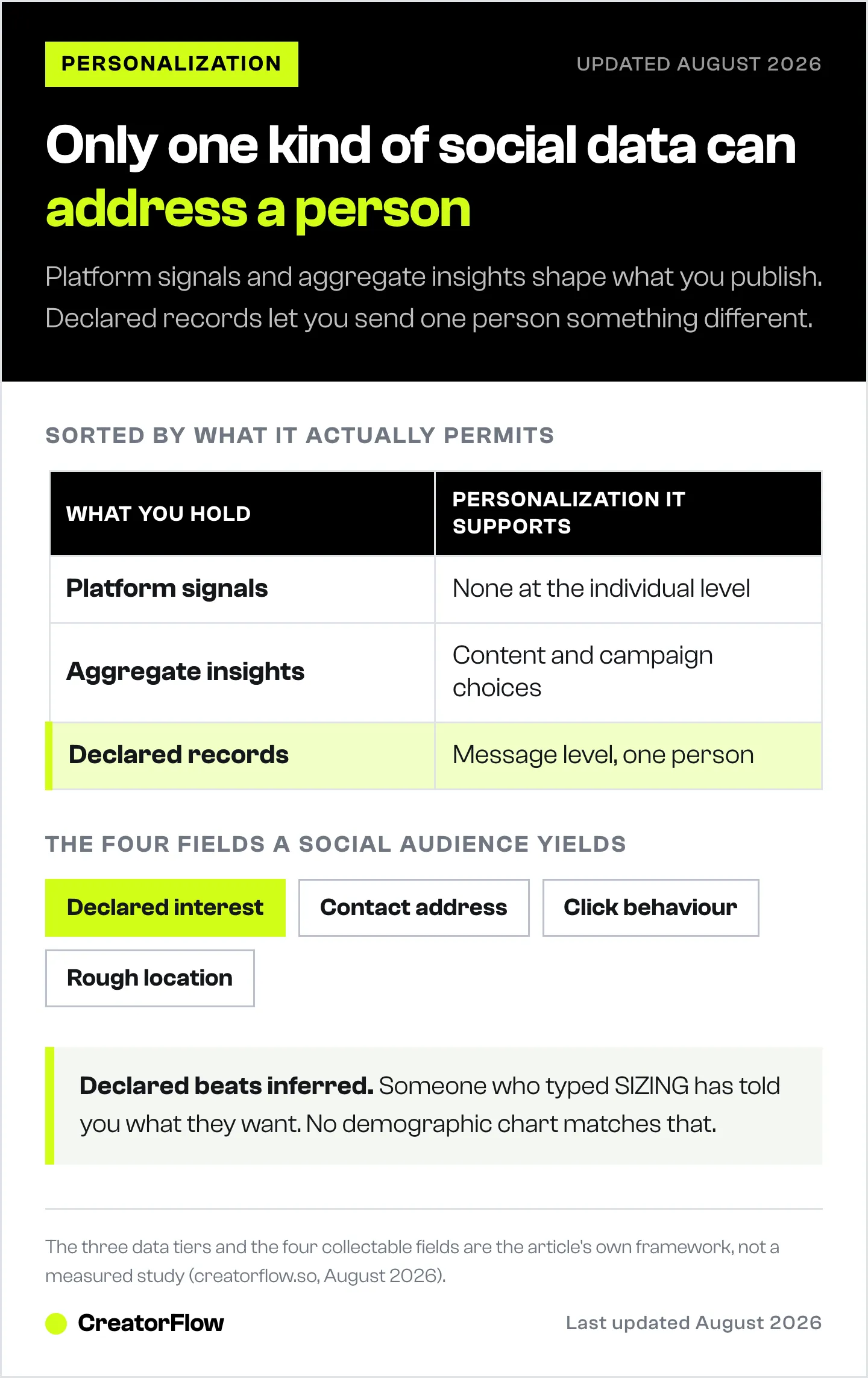
| What you hold | Personalization it supports | Worked example |
|---|---|---|
| Platform signals (reach, impressions, follower demographics) | None at the individual level | You learn a Reel reached 40,000 people, and nothing about any one of them |
| Aggregate insights (audience age, location, active hours) | Content and campaign choices | You publish at 7pm and write for a UK audience |
| Declared individual records (keyword, email, click, answer) | Message-level, per person | The person who typed SIZING gets the fit guide; the one who typed PRICE gets the pricing |
The jump between row two and row three is where personalization begins. Rows one and two shape what you make. Only row three lets you send one person something different from the next.
Those rows also differ in how long they last, because rows one and two live inside the platform’s systems and row three lives in yours. That durability question, and exactly which fields Meta’s API returns, is covered in our breakdown of Instagram first-party data.
The Four Fields and What Each One Unlocks
Row three of that table is short. A social audience realistically yields four fields worth having, and each one enables a different kind of personalization. Most accounts can collect all four without specialist software.
Declared interest. The keyword someone typed. If a person comments SIZING under a product Reel, they have told you what they want in a way no demographic model can match. Declared interest carries the post it came from, so it doubles as attribution: you know which piece of content produced this contact.
Contact address. An email address or phone number, given in exchange for something specific. This is the field that converts a rented follower into a contact you can reach without an algorithm in the way. It is also the field with real consent obligations attached.
Click behaviour. Whether the person opened the link you sent. A click is a stronger buying signal than a like, a follow or a save, because it costs the person more effort and points at one product.
Rough location. Country and city, derived from link clicks rather than from profiles. Enough to time a send, pick a currency, or decide whether a shipping offer applies. Not enough to identify anyone, which is the correct level of precision here.
Four fields sounds thin next to the customer-data-platform pitch. In practice, declared interest plus a contact address covers the majority of what a small brand or creator would do with a fifty-field profile. The wider category these declared fields belong to, and the consent rules attached to it, are covered in this guide to what customers tell you on purpose.
How Brands Wire This Up
The tooling caught up with this idea during 2026. Klaviyo shipped Social Marketing to general availability on 30 June 2026, built on Gatsby, an Instagram DM automation product it acquired in August 2025 (klaviyo.com, August 2026). The mechanic is a keyword auto-reply: someone comments, they get a DM, the DM asks for an email or phone number, and the resulting profile carries the Instagram username, follower count, follow status and the keyword they typed.
Klaviyo publishes a case study on the Australian swimwear brand Kulani Kinis, whose Sun Chasers ambassador programme is credited with $425,000 in revenue over six months across roughly 22,000 ambassadors, alongside a reported $3.39 cost per acquisition (klaviyo.com, August 2026). Those are vendor-published figures from a large brand with an established programme, so read them as a demonstration of what the mechanic supports at scale rather than as a forecast for a new account.
The architecture is the point worth taking. Social engagement creates a profile, the profile carries the context that produced it, and downstream channels read from the same record. That is what makes later personalization possible. A fuller breakdown of the product sits in our guide to Klaviyo Social Marketing.
How to Personalize Without a CRM
Most accounts reading this do not run a customer data platform and do not need one to start. The same architecture works with far less.
Step 1: Pick one keyword per offer. One post, one keyword, one thing the person receives. Resist the urge to run a single generic keyword across everything, because the keyword is the data. A shared keyword collapses five different intents into one undifferentiated list.
Step 2: Reply with the thing, then ask for the address. Deliver value first. The DM that arrives should contain what was promised, and the request for an email should be attached to a second, specific benefit rather than being the toll gate on the first one.
Step 3: Ask one qualifying question. A single question inside the DM turns a flat contact into a segmented one. Which size, which goal, which platform. One question, answered by tapping, is worth more than a five-field form nobody completes.
Step 4: Track the click. Use tracked links so you can tell openers from clickers. That single flag separates people who are curious from people who are shopping.
Step 5: Export on a schedule. Move the collected contacts into whatever sends your email. CreatorFlow supports this through CSV export on the Pro plan at $15 a month, alongside keyword triggers, an email gate, a follow gate, link tracking and clicks by country and city (creatorflow.so, August 2026). The full mechanics of that capture step are covered in our guide to collecting emails through Instagram DMs.
The five steps above produce all four fields. No integration work, no data warehouse, no per-contact pricing tier to grow into.
Where Personalization Crosses the Line
There is a boundary here and it is worth naming, because crossing it costs more than staying safely inside it.
Personalization reads as service when it uses something the person knowingly gave you, and as surveillance when it uses something they did not realise you had. Referencing the keyword someone typed is service. Referencing a post they viewed and never engaged with is surveillance. The test is whether the person would be surprised to learn you knew it.
The compliance layer sits underneath that. Collecting an email address for marketing needs a clear statement of what you will send and a working way to stop it. Under GDPR that consent has to be specific and freely given, which means a checkbox pre-ticked or a consent bundled into an unrelated action does not hold up. Storing a contact you obtained through a DM carries the same obligations as one obtained through a website form. Nothing about the channel makes the rules lighter.
Practical version: collect less, say what it is for, and make leaving easy.
Measuring Whether It Worked
Personalization gets measured badly because the flattering metrics are the easy ones. Open rates and engagement rates go up almost automatically when messages get more relevant, which makes them poor evidence of anything.
Three measurements carry actual information:
- Contacts created per post. Divide contacts collected by reach on the posts that ran a keyword. This tells you which content produces people rather than impressions.
- Rate of qualified contacts. The share of contacts who answered your qualifying question. A low rate usually means the question was too much work or arrived too early in the conversation.
- Revenue per contact by declared interest. Group contacts by the keyword they typed and compare what each group is worth. This is the number that tells you which offer to build more content around.
McKinsey’s Next in Personalization research reported that 71% of consumers expect personalized interactions and 76% become frustrated when they do not get them, and that companies excelling at personalization generate around 40% more revenue from those activities than average performers (McKinsey, Next in Personalization, 2021). Worth citing carefully: that study is from 2021 and is quoted across the industry as though it were current. Use it to justify the direction of travel, not to forecast your own numbers.
For the wider strategic frame these tactics sit inside, see our overview of social media marketing, and for the mechanics of moving contacts between channels, our guide on how to integrate email marketing with social media.
Where to Start This Week
Pick your best-performing post from the last month. Add one keyword to a new post on the same topic. Write a DM reply that delivers the thing, asks one question, and offers an email address exchange for something specific. Run it for two weeks and count contacts created per thousand people reached.
That single test produces a real number for your account, which is worth more than any benchmark in this article. It also gives you the first entries in a file that belongs to you rather than to a platform. If you are weighing which channel should carry the follow-up, our comparison of a DM funnel against an email funnel covers the trade-offs.
FAQ
What is social media personalization?
Social media personalization is tailoring content, offers or messages to an individual based on data you hold about that person. It differs from segmentation, which groups an audience and treats each group identically. True personalization needs individual-level records, which on social platforms come from what someone hands over in a comment, a DM or a form.
What data can you use to personalize social media marketing?
Four fields are realistically collectable from a social audience: declared interest (the keyword someone typed), a contact address (email or phone, given with consent), click behaviour (whether they opened your link), and rough location from those clicks. Platform demographics are aggregate and cannot address an individual.
What is the difference between personalization and segmentation?
Segmentation divides an audience into groups and sends each group the same message. Personalization changes the message for one person based on a record specific to them. Segmentation runs on inferred attributes; personalization needs data an individual actively provided.
Can you personalize social media without a CRM?
Yes. A keyword trigger, a DM reply that asks one qualifying question, tracked links and a regular export cover the four useful fields. A CRM becomes worth its cost when contact volume, channel count or team size makes manual handling impractical, not at the start.
Is social media personalization legal under GDPR?
Collecting contact details through social channels is legal when consent is specific, freely given and informed, and when unsubscribing works. The channel does not change the obligations: a contact collected through a DM carries the same duties as one collected through a website form. Pre-ticked boxes and consent bundled into an unrelated action do not satisfy the standard.
What are examples of social media personalization?
A DM that answers the exact question someone commented, an email sequence that branches by which product a subscriber asked about, an ad audience built from people who clicked a specific link, and a follow-up that references the size or goal someone selected in a DM.
Does personalization work on organic posts or only on ads?
Both, in different ways. On ads the platform performs the personalization for you inside its own system. On organic posts the personalization happens after the interaction, in the DM or email that follows, using data the person handed over. Organic is where you build the record; ads are where you rent access to the platform’s.
Klaviyo product details, launch date and the Kulani Kinis figures verified at klaviyo.com (August 2026); the Kulani Kinis revenue and cost-per-acquisition numbers are vendor-published. Personalization benchmarks from McKinsey’s Next in Personalization research (2021). CreatorFlow pricing and features verified at creatorflow.so (August 2026). Individual results vary.


