
Social media marketing is the practice of using platforms like Instagram, TikTok, YouTube and Facebook to build awareness, talk to customers, and drive sales. It covers four jobs: publishing content, engaging with the people who respond, converting that attention into contacts you own, and measuring what worked. Most teams staff the first, second and fourth. The third is where the revenue is.
That last point is not a stylistic complaint. It is a measured gap. In a VaynerX and Ipsos survey of 100 senior brand marketers, 79% said they had increased investment in organic social over the previous three years. Only 48% agreed organic social contributes to lower-funnel objectives (ipsos.com, January 2025). More money going in, under half convinced it produces anything at the point of sale.
This guide covers what it is, how organic and paid work differently, how to build a strategy without guessing, and how to close the gap between attention and revenue. It is written for creators, small teams, and brands who post consistently and still cannot draw a line from a post to a customer.
Key Takeaways
- The definition: Using social platforms to build awareness, engage an audience, and drive sales, through both unpaid content and paid promotion
- Organic and paid are different tools: Organic builds trust and costs time; paid buys reach and costs money. Most working strategies use both, for different jobs
- The audience is effectively everyone: 5.79 billion social media user identities exist worldwide, more than 2 in 3 people on Earth (datareportal.com, April 2026)
- Reach per post is falling: Instagram’s average engagement rate sits near 0.48%, down about 24% year over year (socialinsider.io, 2026). Getting more attention is harder every year
- The unstaffed job is conversion: Publishing, engaging and reporting all have owners on most teams. Moving a commenter into an email list or a sales conversation usually has nobody
- Owned beats rented: Followers belong to the platform. Email addresses, phone numbers and DM conversations belong to you. Every strategy should include a step that converts one into the other
- Measure outcomes, not applause: Followers and likes describe reach. Subscribers, replies, clicks and revenue describe results
What Is Social Media Marketing?
Social media marketing is using social platforms to reach an audience, build a relationship with it, and turn that relationship into business results. It includes the content you publish for free, the conversations you have in comments and DMs, and the money you spend promoting posts. The goal is not attention on its own. It is attention that leads somewhere.
The work splits into recognisable pieces. You publish content: photos, videos, Reels, Stories, carousels, live streams. You respond to what comes back: comments, replies, mentions, direct messages. You capture the people who show real interest so you can reach them again. You measure which of it worked and do more of that.
The work sits next to, but is not the same as, social media management. Management is the operational side: scheduling, publishing, moderation, community care. Marketing is the strategic side: deciding what you are trying to achieve, on which platform, for which audience, and how you will know it worked. Small teams do both with the same two people. Large teams split them.
Social media marketing vs social media advertising
Marketing is the umbrella. Social media advertising is one tool inside it, the one where you pay a platform to put your content in front of people who do not follow you. Everything else, the posting, the community work, the creator partnerships, the DMs, is unpaid or organic.
The distinction matters because the two behave differently. Ads scale linearly with money and stop the moment you stop paying. Organic compounds slowly, costs labour rather than budget, and keeps producing after publication. Neither replaces the other.
Organic vs Paid Social Media Marketing
Organic social is everything you publish and do without paying for distribution. Paid social is buying placement in feeds, Stories and Reels through the platform’s ad system. Organic builds credibility and costs time. Paid buys predictable reach and costs money. Most brands that grow use both, assigned to different jobs rather than treated as alternatives.
Here is how the two compare on the dimensions that usually decide the choice.
| Dimension | Organic social | Paid social |
|---|---|---|
| Cost | Time and labour | Media budget, ongoing |
| Speed to first result | Weeks to months | Hours |
| Reach control | Algorithm decides | You choose the audience |
| What stops when you stop | Little, posts keep working | Everything, immediately |
| Best at | Trust, community, proof | Volume, testing, retargeting |
| Main risk | Effort with no distribution | Spend with no relationship |
The practical rule most small teams land on: use organic to build the thing worth advertising, then use paid to put budget behind the posts that already earned attention on their own. Advertising a message nobody responded to organically usually buys reach for a message that does not work.
Why Social Media Marketing Still Works in 2026
It works because that is where the audience is and where buying now happens. There are 5.79 billion social media user identities worldwide, more than two thirds of the people on Earth, growing by 294 million in a year (datareportal.com, April 2026). Working-age users spend an average of 18 hours 36 minutes a week on social and video feeds (GWI, via DataReportal, 2026).
Selling has followed the attention. US social commerce sales reached $87.02 billion in 2025, up 21.5% year over year, and are forecast to pass $100 billion in 2026, roughly 6.9% of US retail ecommerce and rising toward 9.3% by 2029 (emarketer.com, 2026 forecast). Buying inside a social app is no longer unusual behaviour.
The pressure sits on the other side of the ledger. Per-post performance keeps falling. Instagram’s average engagement rate is around 0.48%, down roughly 24% year over year (socialinsider.io, 2026). Reaching people costs more effort than it did, which raises the value of every person who does respond. If reach is getting more expensive, wasting the responses you already earn gets more expensive with it.
The Four Jobs of Social Media Marketing
Every social strategy, whatever the industry, does four things. Naming them separately makes it obvious which one your team has quietly left unassigned, and it is the fastest way to work out which layer of automation to buy first.
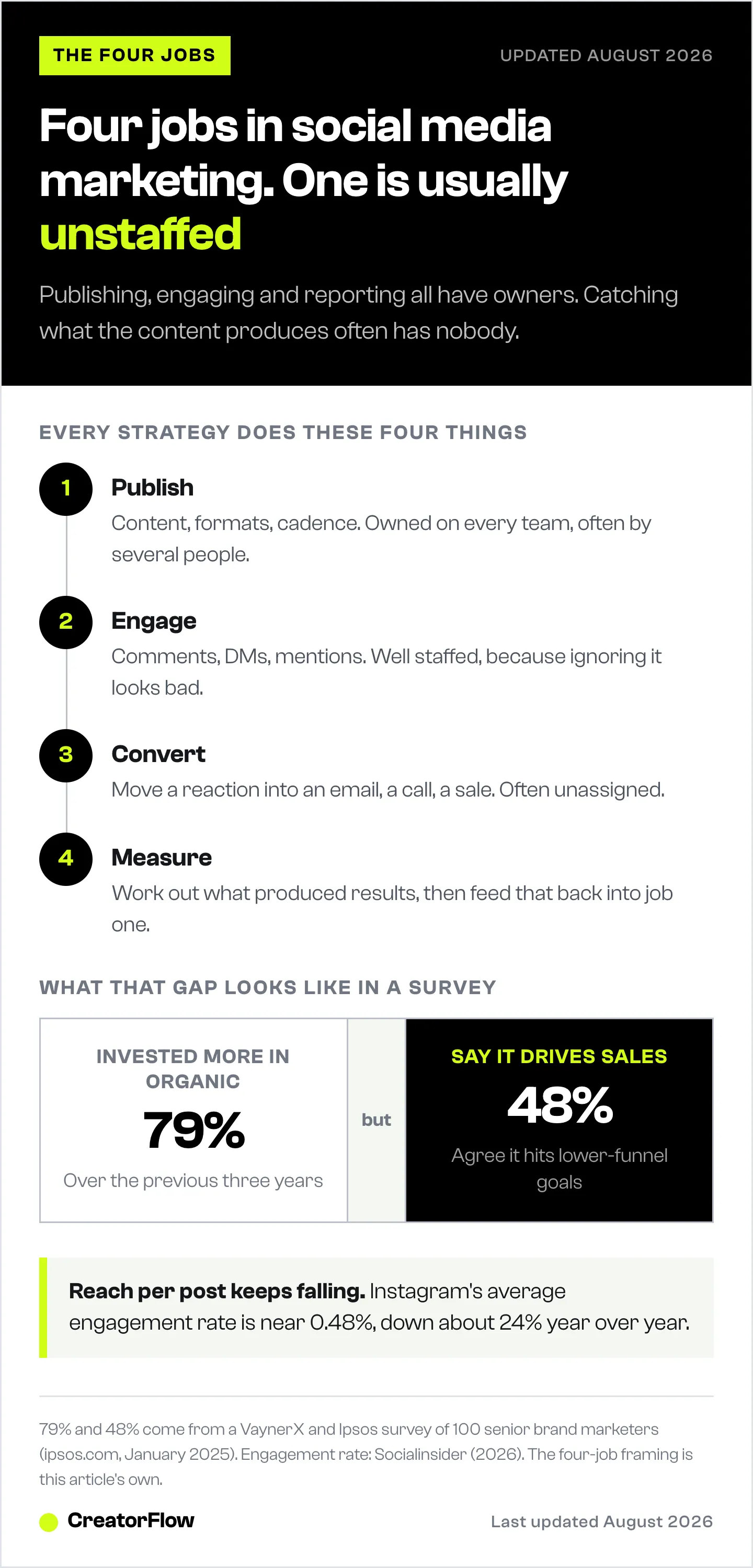
1. Publish. Make things people want to see. Content pillars, formats, posting cadence, editorial calendar. This job has an owner on every team, usually several.
2. Engage. Reply to comments, answer DMs, repost mentions, join conversations. Also well staffed, because it is visible and because ignoring it looks bad.
3. Convert. Take a person who reacted to a post and move them somewhere you can reach them again without the algorithm’s permission. An email address. A phone number. A booked call. A purchase.
4. Measure. Work out what produced results and feed that back into job one. Usually owned by whoever builds the monthly deck.
Jobs one, two and four have job titles attached. Job three often does not. That is the structural reason behind the VaynerX and Ipsos finding above: 79% of marketers put more money into organic social, and only 48% believe it drives lower-funnel outcomes (ipsos.com, January 2025). The funnel does not break because the content is bad. It breaks because nothing is built to catch what the content produces.
The fix is not more content. It is a defined handoff, running automatically, between the moment someone reacts and the moment they become a contact.
How to Build a Social Media Marketing Strategy
A social media marketing strategy is a written answer to five questions: what outcome you want, who you are talking to, where they are, what you will publish, and how you will know it worked. Writing it down takes an afternoon and prevents months of posting without direction. Work through these steps in order, because each one narrows the next.
Step 1: Pick one business outcome. Not “grow the brand.” Something countable: 500 email subscribers this quarter, 40 booked calls a month, $10K in attributed sales. One primary outcome, with a number and a date. Everything downstream gets judged against it.
Step 2: Define who you are talking to. Age and location are the weakest version of this. The useful version is the problem they have, the words they use for it, and what they have already tried. Read your own comments and DMs for the phrasing.
Step 3: Choose one or two platforms, not six. Pick where your audience already is and where the format suits what you can produce. A team that posts well on one platform beats a team that posts thinly on five.
Step 4: Set three or four content pillars. Recurring themes you can produce indefinitely: education, proof, behind the scenes, product. Pillars stop the weekly scramble for ideas. If planning is the bottleneck, an Instagram content calendar turns pillars into a schedule you can actually keep.
Step 5: Build the conversion step before you scale posting. Decide now what happens when someone comments, replies to a Story, or sends a DM asking for the link. If the answer is “someone gets to it eventually,” the strategy has a hole in it.
Step 6: Choose your metrics and your review rhythm. Pick three numbers tied to Step 1, review them monthly, and ignore the rest. A simple social media report template is enough; the discipline matters more than the tooling.
How to Turn Followers Into Contacts You Own
Followers are rented. The platform decides how many of them see you, changes that decision without notice, and can remove the account entirely. Email addresses, phone numbers and open DM threads are owned. They reach the person directly. The single highest-value move you can make is converting the first into the second, systematically, rather than hoping people find the link in your bio.
There are three reliable places where that handoff happens, and all three are conversations rather than clicks.
Comments. Someone comments asking where to buy, how much it costs, or what you used. That is the highest-intent signal a public post produces. Replying with a link, publicly, buries it under fifty other comments within a day. Sending it as a direct message puts it in an inbox they will open. This is what comment-to-DM automation does: someone comments your keyword, a message with the link arrives in seconds, and the exchange continues privately. The keyword they choose is also the first piece of data specific enough to personalize on, which is the starting point for social media personalization.
Story replies. Story replies land in the DM inbox already. A viewer who replies to a poll or a question sticker has raised their hand in a channel where you can respond directly. Most brands read these and reply to none of them.
Direct messages. People ask about price, sizing, availability and booking in DMs constantly. Each of those messages is a sales conversation that already started. Answering fast, with a link or a booking calendar, closes the distance between interest and action.
The mechanic that ties them together is a DM funnel: a defined sequence that starts with a public reaction, moves into a private message, collects an email or phone number in exchange for something worth having, and ends somewhere you control. Done properly, it runs whether or not anyone is at a desk. The full build for the email side is covered in the guide to building an email list from Instagram automatically.
This is not a niche technique. It is the direction the whole category moved in: Klaviyo acquired an Instagram DM automation tool and rebuilt it inside its CRM, shipping Klaviyo Social Marketing in June 2026 (klaviyo.com, August 2026). When a CRM company buys a DM tool, the market is telling you where social attention becomes customer data.
CreatorFlow handles this layer for Instagram: comment-to-DM, Story-reply and keyword triggers, an email gate that collects addresses inside the DM, a follow gate, CSV export into your email platform, and click tracking with country and city breakdowns. It runs on Meta’s official Instagram API, and CreatorFlow has been a Meta Tech Provider since December 2025. Pricing is flat at $15/month on Pro, with a free plan to test it (creatorflow.so, August 2026).
Which Social Media Platforms Should You Use?
Choose platforms by two filters: where your audience already spends time, and which format you can produce consistently at a decent standard. Being good on one platform outperforms being present on five. Audit where your existing customers found you before assuming a platform is required.
A rough guide to what each platform is structurally good at:
| Platform | Strongest for | Format that carries it |
|---|---|---|
| Visual products, creators, local services, DM-led selling | Reels, carousels, Stories | |
| TikTok | Discovery, reaching non-followers, product demand | Short video |
| YouTube | Search intent, high-consideration purchases, depth | Long video, Shorts |
| Communities, local business, older demographics | Groups, events, video | |
| B2B, recruiting, professional services | Text posts, documents | |
| Planning-stage intent, home, fashion, food | Vertical images, idea pins |
If you sell something people need to see, and if buying decisions get made in conversations, Instagram tends to be the strongest starting point, because comments and DMs are native to how people already shop there. Whichever you pick, organic reach on Instagram and everywhere else rewards consistency over bursts.
Running several accounts at once changes the problem from creative to operational. That shift, and the systems that survive it, is covered in the guide to managing multiple social media accounts.
How to Measure Social Media Marketing
Measure social media marketing against the business outcome you set, not against platform applause. Followers and likes describe how many people saw something. Subscribers, replies, clicks and revenue describe whether it changed anything. Track a small number of outcome metrics monthly and let the vanity numbers be context rather than the headline.
| Goal | Metric that answers it | Metric that does not |
|---|---|---|
| Build awareness | Reach, new followers, share of mentions | Total follower count |
| Build community | Comments, saves, DM volume, repeat repliers | Likes |
| Generate leads | New email or SMS subscribers from social | Profile visits |
| Drive sales | Attributed revenue, click-to-purchase rate | Impressions |
| Improve service | First response time in DMs | Sentiment guesswork |
Two practices make the numbers usable. Tag every link you post with UTM parameters so traffic shows up correctly in analytics rather than as direct. And record where new subscribers came from at the point of capture, because attribution reconstructed three months later is a guess wearing a suit.
Reporting itself can eat the week. If it does, AI social media management tools handle the collection and summarising well enough to free the time for judgment, which is the part that actually needs a person.
Mistakes That Waste a Social Media Budget
Most social media efforts that fail are not failing for exotic reasons. It repeats a short list of errors.
- Posting without a defined outcome. Content produced to fill a calendar cannot be judged, so it never improves
- Spreading across every platform at once. Five thin accounts lose to one good one, every time
- Treating followers as the goal. A 50,000-follower account with no list and no sales conversations is a rented asset with no exit
- Letting comments and DMs go unanswered. The highest-intent people you will meet all week are in there
- Buying reach for content that never earned any. Paid amplifies a message; it does not fix one
- Publishing links only in the bio. One clickable link, buried, for every post you have ever made
- Reporting reach to people who asked about revenue. The gap between those two numbers is why social budgets get cut
The through-line is the same in all of them. Attention gets treated as the finish line rather than the raw material.
Getting Started
Pick one platform. Write one countable outcome. Set three content pillars. Then, before you increase how much you post, build the step that catches what your posting produces, so the next post that performs turns into contacts instead of a spike on a chart.
CreatorFlow turns Instagram comments, Story replies and keyword DMs into a distribution channel you own, with the email addresses and click data to prove it worked. Setup takes about five minutes on a free plan.
FAQ
What is social media marketing in simple terms?
Social media marketing is using platforms like Instagram, TikTok and YouTube to get in front of people, build a relationship with them, and turn that into sales. It covers the free content you post, the conversations you have in comments and DMs, and any money you spend promoting posts.
What is the difference between social media marketing and social media management?
Management is the operational work: scheduling posts, publishing, moderating comments, looking after the community. Marketing is the strategic layer above it, deciding what you are trying to achieve, on which platform, for whom, and how success gets measured. In small teams the same person does both.
Is social media marketing free?
Organic social has no media cost, but it costs time, and time is the larger expense for most small teams. Paid social costs money per impression or click. A realistic budget accounts for both: hours to produce and respond, plus any spend behind posts that already performed.
How long does social media marketing take to work?
Paid social produces measurable data within days. Organic social generally takes two to three months of consistent publishing before patterns are reliable enough to act on, and longer to compound. Judge organic on a quarterly cycle rather than weekly, because weekly variance is mostly noise.
Which social media platform is best for marketing?
The one your customers already use and whose format you can produce well. Instagram suits visual products, creators and anything sold through conversation. YouTube suits high-consideration purchases. LinkedIn suits B2B. TikTok suits discovery. Start with one, get results, then add a second.
Do you need paid ads for social media marketing to work?
No, but paid ads shorten the timeline. Organic works without any budget and compounds; it is slower and less predictable. A common approach is to publish organically, identify which posts earned real engagement on their own, and put budget only behind those.
How do you measure social media marketing ROI?
Compare what social produced against what it cost, using outcome metrics rather than reach. Track subscribers gained, leads booked and revenue attributed, tag links with UTM parameters, and record the source at the moment someone becomes a contact. Reconstructing attribution later produces estimates, not measurements.
What is a social media marketing strategy?
A written document answering five questions: the business outcome you want, who you are talking to, which platforms you will use, what content pillars you will publish, and which metrics you will review. It should fit on one page and be specific enough that someone else could execute it.
Statistics verified from DataReportal (April 2026), VaynerX and Ipsos (January 2025), EMARKETER (2026 forecast) and Socialinsider (2026) as of August 2026. CreatorFlow pricing and features verified at creatorflow.so, August 2026. Individual results vary.


