

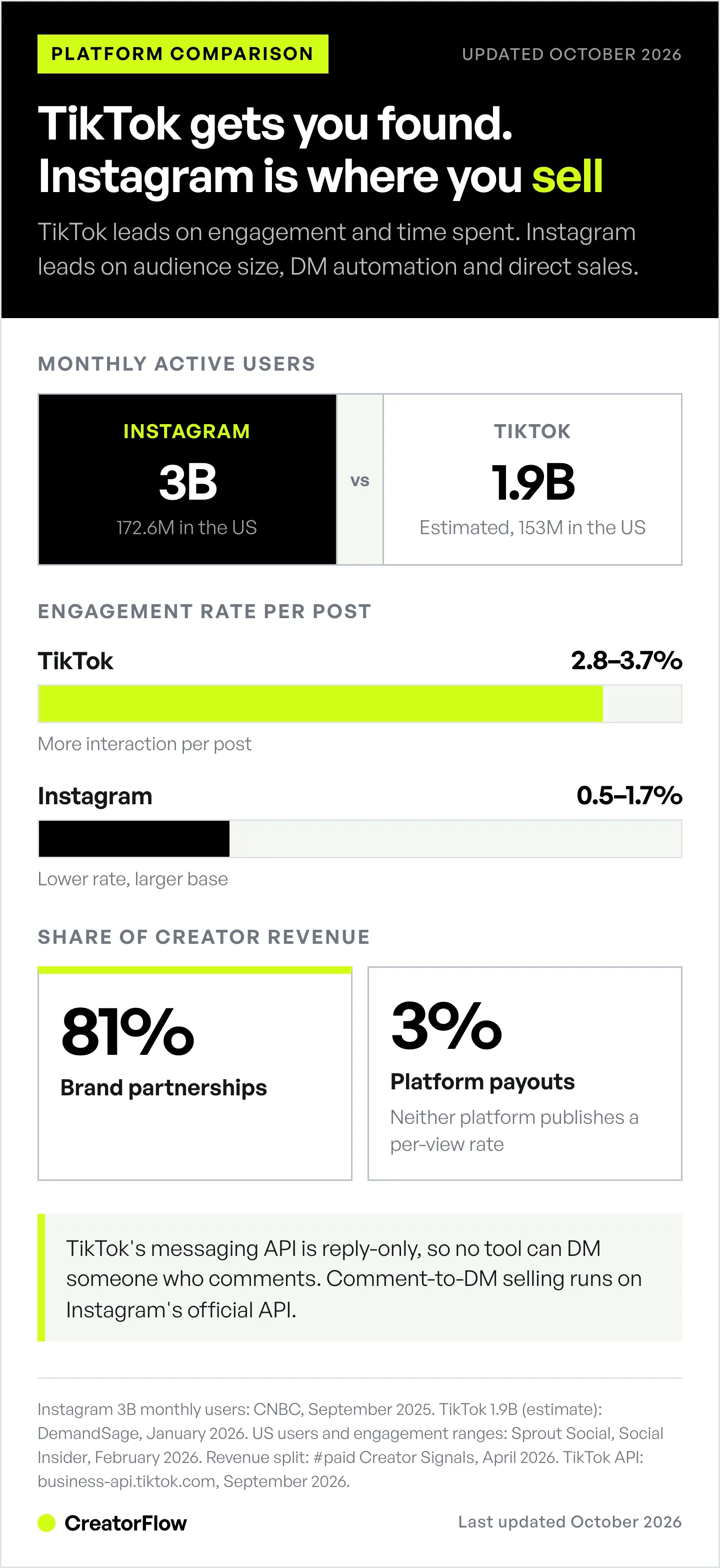
Instagram vs TikTok comes down to what you are building. Instagram has 3 billion monthly users and converts better, with mature DM automation and e-commerce links. TikTok has an estimated 1.9 billion monthly users and higher engagement at 2.8-3.7% against Instagram’s 0.5-1.7%, so it wins on discovery. Most creators use TikTok to get found and Instagram to sell.
Key Takeaways
- Instagram: 3 billion monthly users, better for monetization, DM automation, and e-commerce
- TikTok: an estimated 1.9 billion monthly users, better for organic reach, discovery, and going viral with new audiences
- Engagement: TikTok averages 2.8-3.7% engagement vs. Instagram’s 0.5-1.7% (but Instagram converts better)
- Monetization: Neither platform publishes a per-view rate. Creators report $0.40-$1 per 1,000 views from TikTok’s Creator Rewards. Brand deals make up most creator income
- DM automation: Instagram has an official messaging API, and tools like CreatorFlow use it to send a DM when someone comments a keyword, replies to a Story or messages a keyword. TikTok’s Business Messaging API is reply-only and region-restricted, which is why TikTok comment to DM does not exist
- Best strategy: Use TikTok for discovery, Instagram for conversion
Instagram vs TikTok is the question every creator faces. The answer depends on what you’re building.
TikTok’s algorithm pushes content to non-followers faster than any other platform, making it the top choice for discovery and reach. Instagram’s tools favor relationship-building, DM automation, and direct sales, making it stronger for monetization and conversions.
This comparison breaks down the numbers, features, and strategic tradeoffs so you can make the right call for your specific goals.

Instagram vs TikTok for Creators: Which One Should You Pick?
Pick Instagram if you sell. Pick TikTok if you need to be found. Instagram is the bigger platform at 3 billion monthly users against TikTok’s estimated 1.9 billion, and it offers mature DM automation, product tags, and higher brand deal rates. TikTok pushes content to non-followers by default and averages 2.8-3.7% engagement against Instagram’s 0.5-1.7%. Most creators run both: TikTok for discovery, Instagram for conversion.
Instagram vs TikTok: User Base and Demographics
Both platforms have massive global audiences, but their user compositions differ in ways that matter for targeting.
Monthly active users (MAU):
| Metric | TikTok | |
|---|---|---|
| Global MAU | 3 billion | 1.9 billion |
| US users | 172.6 million | 153 million |
| Daily time spent (US adults) | 33 minutes | 52 minutes |
| Average user age | 30.1 years | 26.5 years |
Instagram hit 3 billion MAU in September 2025, confirmed by Mark Zuckerberg (CNBC, September 2025). TikTok reached an estimated 1.9 billion MAU by early 2026, with projections to pass 2 billion during 2026 (DemandSage, January 2026). TikTok’s last official global figure was 1 billion monthly users, announced in September 2021.
In the US, 50% of all adults use Instagram compared to 37% on TikTok. Among 18-29 year-olds, Instagram reaches 80% (Pew Research Center, November 2025).
Age breakdown:
| Age Group | TikTok | |
|---|---|---|
| 18-24 | 31.7% (largest group) | 31% |
| 25-34 | 30.3% | 35% (largest group) |
| 35-44 | 16.2% | 15.7% |
| 45-54 | 8.4% | 8.3% |
| 55+ | 7.3% | 5.5% |
(Sources: Sprout Social, LitCommerce, MarketingLad, February 2026)
The gap is narrowing. TikTok’s fastest-growing segment is 25-34 year-olds, and users 30+ now make up 38% of TikTok’s user base (up from 22% in 2021). Instagram’s core audience spans 18-34, with stronger representation among users 35+.
What this means for creators: If your audience is 18-24, both platforms work. If you’re targeting 25-44 professionals or buyers with disposable income, Instagram gives you more direct access to that demographic.
Engagement Rates Compared
TikTok wins on raw engagement. Instagram wins on engagement quality.
| Metric | TikTok | |
|---|---|---|
| Average engagement rate | 0.50-1.7% | 2.8-3.7% |
| Nano-influencer engagement (1K-10K) | 3.65% | 7.50% |
| Mega-account engagement (10M+) | 0.35% | 2.88% |
| Average videos watched/day | 177 | 265 |
(Sources: Sprout Social, Social Insider, Phantom Digital, February 2026)
TikTok’s algorithm shows your content to non-followers by default. That means a new creator with 500 followers can get 100,000 views on a single video. Instagram’s Feed still favors accounts you follow, but Reels work more like TikTok: Instagram says most of what people see in Reels comes from accounts they don’t follow (about.instagram.com). In September 2026, Adam Mosseri said Instagram also shows small creators’ public posts to non-followers to test how people respond (Social Media Today, September 2026).
The tradeoff: TikTok engagement is broad but shallow. A viewer might watch your 15-second clip, double-tap, and scroll on.
Instagram engagement tends to be deeper. Comments are longer, DMs are more personal, and followers are more likely to click links and buy.
For a detailed breakdown of what drives Instagram’s algorithm in 2026, see our Instagram algorithm guide.
Content Formats: Reels, Stories, and Short-Form Video
Instagram and TikTok both offer short video, Stories, photo posts and Live.
Instagram content formats:
- Reels (up to 20 minutes; only Reels up to 3 minutes are recommended to non-followers, help.instagram.com, October 2026) - Primary discovery tool
- Stories (24-hour) - Best for follower engagement, polls, Q&A, and link stickers
- Carousels - Highest engagement rate of any format at 0.50% (Socialinsider, Q2 2026), strong for educational content
- Feed posts - Still relevant for portfolio-style content
- Broadcast Channels - One-to-many messaging for announcements
- Lives - Real-time interaction with followers
TikTok content formats:
- Videos (up to 10 minutes recorded in the app; some accounts can upload longer files) - Core format, algorithm-driven discovery
- Photo Mode - Instagram carousel-style static content
- Lives - Real-time with virtual gifting monetization
- Stories - Similar to Instagram Stories, 24-hour content
- Series - Gated premium content behind a paywall
Instagram offers more format variety. TikTok’s strength is that its algorithm treats every video as a potential viral hit regardless of follower count. For creators who repurpose content across platforms, short-form vertical video (under 90 seconds) performs well on both.
If you’re using Instagram Story reply automation, every reply to a Story can get an instant DM, so Stories become a conversion tool.
Monetization: Where Creators Make Money
Instagram pulls ahead of TikTok on monetization for most creators who sell products, services or affiliate links.
| Revenue Stream | TikTok | |
|---|---|---|
| Pay per 1K views | No published rate | $0.40-$1.00 (Creator Rewards, creator-reported) |
| Brand deal avg (100K followers) | $1,000-$5,000/post | $500-$2,500/post |
| Shopping/e-commerce | Instagram Shopping, product tags | TikTok Shop |
| Subscriptions | Instagram Subscriptions ($0.99-$99.99/mo) | TikTok Subscriptions (from $2.99/mo), Super Fan for LIVE ($9.99/mo), Series |
| Live gifting | Badges (limited) | Virtual Gifts (stronger) |
| Affiliate marketing | Link in bio, DM automation, story links | Link in bio, TikTok Shop affiliate |
(Sources: Foursixty, Metricool, RankTracker, February 2026)
Instagram’s monetization advantage comes from three areas:
1. Higher brand deal rates. Brands pay more for Instagram posts because Instagram audiences convert better. A sponsored Reel on Instagram drives more trackable sales than a sponsored TikTok video in most niches (Foursixty, February 2026).
2. Direct sales infrastructure. Product tags in posts, Reels and Stories send shoppers to your product page. The purchase finishes on your own website, because Meta ended in-app checkout for US shops in August 2025. Combined with DM automation for e-commerce, Instagram becomes a complete sales channel.
3. DM-based selling. Instagram’s official API lets you automate DM conversations. When a follower comments “LINK” on your Reel, tools like CreatorFlow send the product link instantly. The link lands in a one-to-one message while the viewer is still on the post, instead of asking them to open your bio and hunt for it. Learn how to set this up in our comment-to-DM automation guide.
TikTok Shop is growing fast, especially in Southeast Asia and the US. But for most Western creators, Instagram remains the stronger monetization platform in 2026. For the TikTok side of the ledger, our guide on how to monetize TikTok content breaks down every program’s requirements and what each one pays.
DM Automation and Sales Funnels
DM automation is Instagram’s biggest advantage over TikTok for creators who sell products, services, or affiliate links.
Instagram DM automation:
- Official Instagram API with Instagram Login, fully documented by Meta
- Mature third-party tools (CreatorFlow, ManyChat, LinkDM)
- Comment-to-DM automation (send links when followers comment keywords)
- Story reply automation (respond to story replies automatically)
- Keyword trigger DMs (detect keywords and send relevant content)
- Email capture within DM conversations
- Tool-side pacing at ~200 DMs/hour (behavioral cap most tools enforce, not a Meta-published hourly figure)
TikTok DM automation:
- TikTok’s Business Messaging API is reply-only. A business can answer inside a 48-hour window that opens when a person sends it a message, and cannot start a conversation (business-api.tiktok.com, September 2026)
- A comment is not a message, so no tool sends a DM when someone comments on a TikTok video. That auto-delivered link is the core DM selling motion on Instagram
- Approved tools can reply to keywords inside DMs that people send to a US business account (manychat.com, July 2026)
- Accounts in the EEA, Switzerland and the UK cannot use the API to send direct messages at all (respond.io TikTok channel documentation, September 2026)
The gap is significant. On Instagram, a fitness coach can post a Reel saying “Comment PLAN for my free workout PDF” and CreatorFlow sends the PDF link via DM within seconds. On TikTok, that same workflow either isn’t possible or requires manual effort.
If DM-based selling is part of your strategy, Instagram is the only reliable choice right now. See our complete DM automation guide for a full walkthrough.
Which Platform Is Better for Business?
Instagram is the better platform for businesses that sell through DMs and links. TikTok is the better platform for businesses that need organic reach first.
Choose Instagram if:
- You sell products or services (e-commerce, coaching, consulting)
- You need DM automation for lead capture or sales
- Your audience is 25-45 with purchasing power
- You run a local business relying on community engagement
- You want to build an email list from Instagram DMs
- You need mature advertising tools (Meta Ads Manager)
Choose TikTok if:
- You need maximum organic reach with minimal ad spend
- Your product appeals to 18-30 demographics
- You’re building brand awareness before monetizing
- You create entertainment-first content
- You want to use TikTok Shop for direct product sales
- You’re in a trending or visually dynamic niche (food, fashion, fitness)
Advertising ROI by the numbers:
| Metric | TikTok | |
|---|---|---|
| 2025 global ad revenue | ~$83.6 billion | ~$33.1 billion |
| Average CPC | ~$2.00 | ~$1.20 |
| E-commerce conversion rate | 2.1% | 4.7% (TikTok Shop) |
| Monthly shoppers tapping products | 130 million | 71.4 million (US) |
(Sources: eMarketer, Enhencer, Capital One Shopping, February 2026)
Instagram’s ad infrastructure is more mature. Over 50% of all Instagram ads ran on Reels in 2025 (CNBC, January 2026). TikTok offers lower CPCs but Instagram delivers 1.3x higher e-commerce conversion rates from Reels ads (Enhencer, 2025).
The two conversion figures in the table measure different journeys. TikTok Shop’s 4.7% is checkout completed inside the app. Instagram’s 2.1% counts purchases that finish on your own site after the click.
For e-commerce: Instagram Shopping integrates with Shopify, WooCommerce, and most major platforms. TikTok Shop hit $10.3 billion in cumulative US GMV by Q3 2025 and is growing fast, but has stricter seller requirements and isn’t available in all markets (eMarketer, Retail Dive, 2025).
TikTok’s US status (resolved): The divest-or-ban saga is over. TikTok’s US divestiture deal closed on January 22, 2026, moving the US business into an American-led joint venture. Oracle, Silver Lake, and MGX hold about 15% each (45% combined), existing US investors hold roughly 30%, and ByteDance is capped at 19.9%, which leaves around 80% in non-ByteDance hands, with Oracle as the security partner overseeing the recommendation algorithm (CNN, CNBC, accessed May 2026). Since the deal closed, TikTok has operated legally in the US without an imminent ban threat, though some lawmakers questioned whether the structure fully satisfies the 2024 law. For US creators, two years of uncertainty have given way to stability.
The Best Strategy: Use Both Platforms Together
You don’t have to choose one platform. Many creators use each for what it does best.
The discovery-to-conversion funnel:
- Create on TikTok for reach. Post short, engaging content optimized for TikTok’s recommendation algorithm. Focus on watch time and shares
- Funnel to Instagram for conversion. Add “Follow me on Instagram for [specific value]” CTAs. Offer something exclusive on Instagram (free PDF, discount code, DM-only content)
- Automate on Instagram for revenue. Use keyword trigger automation to capture leads, send affiliate links, and book calls without manual DM work
- Build your email list. Capture emails through Instagram DM automation, then own that audience independent of any algorithm
This approach uses TikTok’s strength (algorithm-driven discovery) and Instagram’s strength (relationship-driven conversion). You’re not dependent on one platform, and you’re building assets (email list, customer relationships) that survive algorithm changes.
For creators who want to turn Instagram followers into customers, this dual-platform approach maximizes both reach and revenue.
FAQ
Is Instagram or TikTok better for small businesses?
Instagram is better for most small businesses in 2026. Instagram’s DM automation, Shopping integration, and mature ad platform make it easier to generate leads and sales directly. TikTok works well for brand awareness and TikTok Shop sales. Capturing leads by DM takes more steps on TikTok, because its messaging API only lets a business reply to people who message first.
Can you automate DMs on TikTok like Instagram?
Only partly. TikTok’s Business Messaging API lets approved tools reply to people who message a business account first, inside a 48-hour window, and it does not work for accounts in the EEA, Switzerland or the UK. No tool can send a DM when someone comments on a TikTok video (business-api.tiktok.com, September 2026). Instagram’s official API supports comment-to-DM, keyword and story-reply automation through tools like CreatorFlow, which is why DM-based selling remains an Instagram play.
Which platform has better engagement rates in 2026?
TikTok has higher raw engagement rates (2.8-3.7% average) compared to Instagram (0.5-1.7% average). Nano-influencers on TikTok see up to 7.5% engagement. Instagram engagement tends to convert better into sales and leads because the audience relationship is deeper (Social Insider, Influencer Marketing Factory, February 2026).
Should I post the same content on Instagram and TikTok?
You can repurpose short-form vertical video across both platforms, but optimize for each. Remove TikTok watermarks before posting to Instagram (Instagram’s algorithm deprioritizes watermarked content). Adjust captions for each platform’s style. TikTok favors trending sounds and fast hooks. Instagram Reels perform better with text overlays and clear CTAs.
Is TikTok or Instagram better for affiliate marketing?
Instagram is stronger for affiliate marketing because of DM automation. When a follower comments a keyword on your post, tools like CreatorFlow send the affiliate link via DM instantly (see how CreatorFlow, ManyChat, and LinkDM stack up if you are still picking one). The link arrives in the conversation instead of behind a bio tap. TikTok affiliates rely on link-in-bio or TikTok Shop, which adds steps to the purchase path. Whichever platform you post from, the FTC requires a clear disclosure such as #ad on every affiliate post, with penalties up to $53,088 per violation in 2026 (ftc.gov; Federal Register, October 2026).
Which pays creators more per view, Instagram or TikTok?
Neither platform publishes a pay rate per view. TikTok’s Creator Rewards pays about $0.40-$1 per 1,000 qualified views by creator reports, and it requires 10,000 followers, 100,000 views in 30 days and videos over 1 minute (support.tiktok.com, September 2026). Instagram gives no per-view figure to compare. Views are a small part of creator income: in #paid’s April 2026 Creator Signals report, brand partnerships made up 81% of creator revenue and platform payouts 3%.
Sources: CNBC, “Instagram now has 3 billion monthly active users” (September 2025). Pew Research Center, “Americans’ Social Media Use 2025” (November 2025). DemandSage, TikTok User Statistics (January 2026). Sprout Social, Social Media Statistics (2026). Social Insider, Social Media Benchmarks (2026). Phantom Digital, TikTok vs Reels Statistics (November 2025). Foursixty, Instagram vs TikTok Monetization (2026). eMarketer, Instagram Ad Revenue and TikTok Shop Social Commerce (2025). Enhencer, Instagram Reels vs TikTok Ads ROI (2025). NPR, “TikTok finalizes deal to form new American entity” (January 2026). developers.facebook.com, Instagram API documentation (February 2026). business-api.tiktok.com and respond.io TikTok documentation (September 2026). manychat.com (July 2026). TikTok Creator Academy and support.tiktok.com (September 2026). #paid Creator Signals (April 2026). Rechecked October 2026: Reels and carousel limits (help.instagram.com) and the FTC penalty (Federal Register). LitCommerce, TikTok vs Instagram Comparison (2026). Capital One Shopping, Instagram Shopping Statistics (2025). CNBC, “Most of Instagram’s ads ran on Reels in 2025” (January 2026).


