
Integrating email marketing with social media means running two connected moves, not two parallel calendars. Social media supplies reach you rent. Email supplies an audience you own. The reason the handoff has to happen inside a conversation is that Instagram publishes no email field at all, covered in the breakdown of Instagram first-party data. The loop runs in both directions: capture email addresses inside the social platform where the attention already sits, then upload that list back to the ad platform as a Custom Audience to buy cheaper reach against people who already know you.
Most guides on this topic give you the same four tactics. Add social icons to your emails. Put a signup link in your bio. Cross-post your content. Build a community. Those are decorations on a funnel that is already leaking, because none of them fix the one step where the two channels meet: the moment a follower turns into a subscriber.
This guide covers the handoff. You will get the two-directional loop, the capture mechanics that survive contact with a real audience, the tagging you need to prove the channel works, and the consent rules that apply the second an email address lands in your database. Written for creators, coaches, and small teams who own both channels and have nobody to delegate the plumbing to.
Key Takeaways
- Integration is a loop, not a calendar: social converts strangers into subscribers, email converts subscribers into customers, and the email list then buys cheaper social reach as a Custom Audience.
- The handoff is where it breaks: sending an engaged follower to an off-platform signup form adds four steps between intent and action, and each step sheds people.
- Capture where the attention already is: an email collected inside a DM conversation keeps the person in the app they were already using.
- Email ownership is the real asset: Instagram Reels reached an average 30.81% of followers in 2026, carousels 14.45%, and static photos 13.14% (socialinsider.io, 2026). Your email list has no such gate.
- Push the list back into social: Meta hashes customer contact data before upload so you can build a Custom Audience from your subscribers and advertise to them directly (facebook.com/business/help, July 2026).
- Tag at the moment of capture: without a source tag written at capture time, you cannot tell which posts produce subscribers, and the channel becomes impossible to defend.
- Consent is not optional: GDPR requires a clear affirmative act plus a record of who consented, when, and how (gdpr-info.eu, July 2026). CAN-SPAM carries penalties up to $53,088 per offending email (ftc.gov, July 2026).

What Does It Mean to Integrate Email Marketing With Social Media?
Integration means each channel does the job it is structurally good at, and hands off to the other at a defined point. Social media finds people who have never heard of you. Email reaches people who already raised their hand, without an algorithm deciding whether the message gets delivered. Integration is the mechanism that moves a person from the first group to the second, and the mechanism that spends your owned list to make the rented channel cheaper.
Run separately, the two channels compete for the same hours. Run as a loop, each one lowers the cost of the other.
| Job to be done | Social media | |
|---|---|---|
| Reach people who do not know you | Strong | No mechanism |
| Reach people who already opted in | Algorithmically gated | Direct |
| Who owns the audience | The platform | You |
| Cost of one more message | Free, capped by reach | Near-zero, uncapped |
| Typical response speed | Minutes | Hours to days |
| Consent record required | No | Yes, by law |
| Works when the account is locked | No | Yes |
That last row is the one people learn the expensive way. A suspended account takes the audience with it. An exported list does not.
The Two-Way Loop Between Social and Email
The loop has two directions and a measurement layer holding them together, which maps onto the same split between publishing, responding, and measuring that structures social tooling generally.
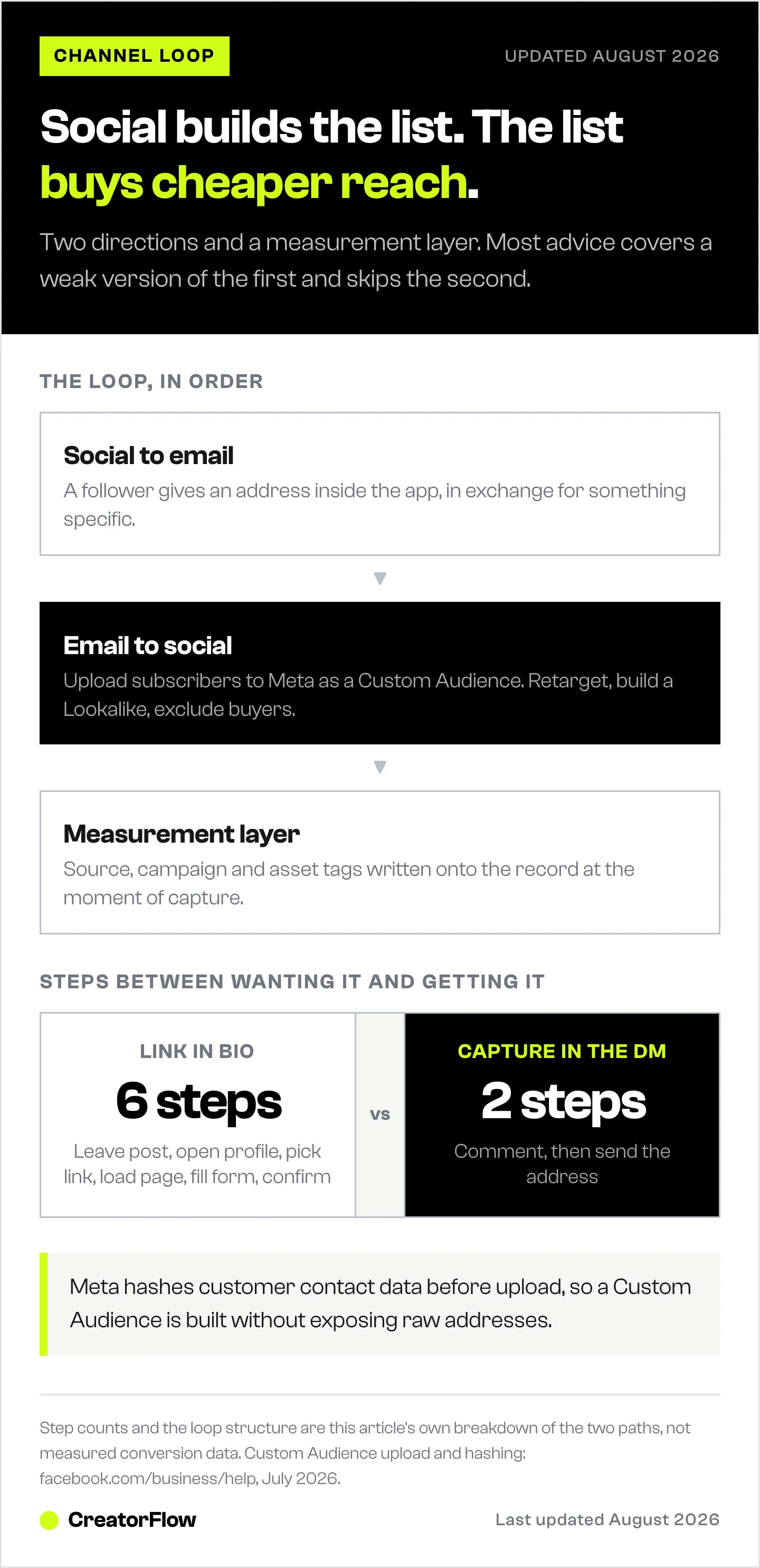
Direction one, social to email. A follower engages with a post. Instead of being sent somewhere else, they are asked for an email address inside the platform, in exchange for something specific. The address lands in your email platform carrying a tag that says where it came from.
Direction two, email to social. You export your subscriber list and upload it to Meta Ads Manager as a Custom Audience. Now you can run ads to people who already opted in, or build a Lookalike from them to find similar strangers. The owned asset buys better rented reach.
The measurement layer. Every address carries a source tag and a campaign tag from the moment it is captured. Without this, paid and organic credit collide and you cannot answer the only question that matters, which is whether the channel earns its cost.
Most published advice covers a weak version of direction one and skips direction two entirely. Direction two is where the compounding happens, because it turns a cost centre into an audience-targeting asset.
Why Integration Fails at the Handoff
The standard advice is to put a signup link in your bio and drive people to it. That path asks a person who is already engaged to leave the post, tap into your profile, find the right link among several, wait for an external page to load, fill a form, and often confirm a second email. Six actions, each one a place to quit, all of them happening after the moment of peak intent has passed.
The failure is structural rather than a copywriting problem. Every step between wanting the thing and getting the thing costs you people. If you compare link-in-bio pages against in-DM capture, the difference is almost entirely accounted for by step count.
The fix is to move the capture point to where the attention already is. Someone comments on your post asking for the guide. They get a message in their inbox seconds later, in the app they are already holding, that asks for an email and delivers the guide. Two actions instead of six.
This is also why the “add social icons to your emails” advice sits so low on the value list. It moves people from a channel you own to a channel you rent, in the direction that loses you control. Worth doing, worth ranking last.
Direction One: Turn Social Engagement Into Email Subscribers
Capture works when three things are true: the trigger is specific, the offer is worth an email address, and the delivery is immediate.
Pick a trigger tied to intent. A keyword in a comment, a reply to a Story, or a direct message containing a phrase. Each of these signals someone who wants something right now. Automation tools respond through Meta’s official Instagram API and are paced by the tool at roughly 200 messages per hour as a safety convention rather than a Meta-published hourly cap. Meta’s own published constraint is a 24-hour window to respond to a user’s message, extendable to seven days with the human agent tag (developers.facebook.com, July 2026).
Make the offer specific. “Join my newsletter” asks for something and offers nothing. “Comment GUIDE and I will send you the 12-page pricing template” names the asset, so the trade is legible. Specificity is the single biggest lever on capture rate, and a distinct keyword per offer is what makes later social media personalization possible at all.
Deliver in the same conversation. The email request and the asset delivery belong in one exchange. Ask, receive, deliver. A full walkthrough of the trigger and gate setup lives in the guide on how to collect emails inside Instagram DMs, and the broader funnel view is in the Instagram to email funnel build.
Then get the address into your email platform. CreatorFlow’s Email Gate collects the address before releasing the link and stores it in Contacts, with CSV export available on Pro at $15 per month or $12 per month billed annually (creatorflow.so, July 2026). ManyChat runs a per-contact ladder starting at $17 per month for 250 contacts, rising to $199 per month for 25,000, or $14 to $139 per month billed annually, and publishes integrations across Instagram, Facebook, WhatsApp, SMS, TikTok, and email (manychat.com/pricing, July 2026). The route into Klaviyo, Kit, Mailchimp, or Flodesk differs by tool, which the guide on moving captured contacts into Klaviyo, Kit, or Mailchimp covers platform by platform.
Direction Two: Push Your Email List Back Into Social Ads
Here is the half of the loop that almost nobody writes about, and the reason integrated programs get cheaper over time instead of more expensive.
Your subscriber list is a targeting asset. Meta lets you upload customer contact information to build a Custom Audience, and hashes the contact data before it is passed to Meta so raw addresses are not exposed (facebook.com/business/help, July 2026). Lists upload as a CSV or TXT file. Once the audience exists, three plays open up.
Retarget subscribers who did not convert. Someone joined the list, opened three emails, bought nothing. They are a warm audience with proven interest. Reaching them through an ad costs less to convert than a cold impression because the education has already happened.
Build a Lookalike from your best segment. Do not build it from the whole list. Build it from buyers, or from the top engagement decile. The source audience quality determines the output quality, and a Lookalike built from everyone is a Lookalike built from your average.
Suppress the people who already bought. Upload customers as an exclusion so acquisition spend stops chasing people who converted last month. This one usually pays for the whole exercise within a cycle.
Note the direction of value. The email list, built free from organic social engagement, now makes paid social measurably more efficient. That is the compounding loop, and it only exists if direction one was built properly.
How to Measure an Integrated Email and Social Strategy
Attribution has to be written at capture time. Reconstructing it later does not work, because by the time the address is sitting in your email platform, every signal about where it came from is gone.
Write three tags on every captured address:
- Source tag. Where the address came from as a channel, for example “instagram-dm” or “linkedin-post”.
- Campaign tag. The specific post, Reel, or trigger keyword that produced it. This is what tells you which content converts rather than which content gets liked.
- Asset tag. Which lead magnet they took. Segment your welcome sequence on this and open rates rise, because the first email references the thing they asked for.
Then track four numbers, monthly:
| Metric | What it tells you | Where it goes wrong |
|---|---|---|
| Capture rate | Emails collected per 100 people who engaged the trigger | Low means the offer is vague, not that the tool is broken |
| Cost per subscriber by source | Which channel is cheapest to grow from | Ignoring tool cost and staff time flatters the number |
| Welcome sequence open rate by asset tag | Whether the promise matched the delivery | A generic welcome email undoes a specific offer |
| Revenue per subscriber by source | Whether social-sourced subscribers convert like the rest | Social-sourced lists often skew warmer, sometimes colder, and you cannot guess which |
The last one settles arguments. If subscribers sourced from social convert at a materially different rate from your other sources, that changes how much the channel is worth and how hard you should push it. The comparison of which channel closes better goes deeper on the conversion economics of each side.
Consent Rules for Collecting Emails on Social Platforms
An email address collected in a DM is regulated exactly like an email address collected on a web form. The informal setting changes nothing.
Under GDPR, consent must be freely given, specific, informed, and unambiguous, given by a statement or clear affirmative action (Article 4(11), gdpr-info.eu, July 2026). Article 7(1) requires you to be able to demonstrate that the person consented. The UK regulator adds that valid consent names your organisation, covers the specific type of marketing you intend to send, and is recorded so you can show who consented, when, and how (ico.org.uk, July 2026). In practice this means your DM has to say what they are signing up for, in the message, before they hand over the address. “Send me your email” is not consent to a weekly newsletter unless the message says the newsletter is what they are getting.
Under CAN-SPAM in the US, every commercial email needs a valid physical postal address, accurate header information, a non-deceptive subject line, and a working opt-out that you honour within 10 business days and keep live for at least 30 days after sending. Penalties run up to $53,088 per offending email (ftc.gov, July 2026).
Two practical habits cover most of it. State the subscription plainly in the message that asks for the address, and store a timestamp against every record. The detailed treatment of GDPR rules that apply to DM-collected emails covers lawful basis, retention, and deletion requests.
Your First 30 Days
| Week | Action | Output |
|---|---|---|
| 1 | Pick one lead magnet and one trigger keyword. Write the DM copy including the consent line. | One live capture flow |
| 2 | Publish three posts that end with the trigger CTA. Tag every captured address with source, campaign, and asset. | First cohort of tagged subscribers |
| 3 | Build the welcome sequence, segmented on the asset tag. Import the first export into your email platform. | Working handoff, measurable capture rate |
| 4 | Export subscribers, upload as a Custom Audience, build a Lookalike from your best segment, add buyers as an exclusion. | Loop closed in both directions |
Thirty days gets you a measured loop rather than a finished program. The number to watch at the end is capture rate by campaign tag, because it tells you which content to make more of.
FAQ
Should I build my email list or my social following first?
Build both, with social feeding email from day one. Social media is the only one of the two with a discovery mechanism, so it has to come first chronologically. Waiting to add email capture until the following is “big enough” means every engaged follower before that point was reach you paid attention for and never converted into an asset you keep.
How do I get social media followers to join my email list?
Trade something specific for the address, and ask for it inside the platform rather than on an external page. A named asset such as a template, checklist, or pricing guide converts better than an invitation to a newsletter, because the person can evaluate the trade. Deliver in the same conversation where they asked.
Can I upload my email list to Facebook and Instagram ads?
Yes. Meta supports building a Custom Audience from a customer list uploaded as a CSV or TXT file, and hashes the contact information before it is passed to Meta (facebook.com/business/help, July 2026). From that audience you can retarget subscribers, build Lookalikes, or exclude existing customers from acquisition campaigns.
Is it legal to collect email addresses through Instagram DMs?
Yes, with the same consent obligations as any other collection method. GDPR requires a clear affirmative act and a record of consent (gdpr-info.eu, July 2026), which means the DM must state what the person is subscribing to before they send the address. US senders must also meet CAN-SPAM requirements on every message they subsequently send (ftc.gov, July 2026).
How often should I promote my email list on social media?
Attach the capture trigger to content people already want, rather than running dedicated “subscribe to my newsletter” posts on a schedule. A post that offers a specific asset carries its own reason to exist, so the promotion costs you no separate slot in the calendar.
How do I track which social posts produce email subscribers?
Write a campaign tag at the moment of capture identifying the specific post or trigger keyword, and store it on the subscriber record in your email platform. Reporting on capture rate by campaign tag tells you which content converts, which is a different list from the content that gets the most engagement.
Is it worth adding social icons to my emails?
It helps marginally and belongs last in priority order. Moving a subscriber from email to social moves them from a channel you own to one you rent, in the direction that loses you control of the relationship. Worth including in the footer, not worth building a strategy around.
Platform limits and consent requirements verified from developers.facebook.com, facebook.com/business/help, gdpr-info.eu, ico.org.uk, and ftc.gov as of July 2026. Reach benchmarks from Socialinsider’s 2026 Instagram dataset. Pricing verified from creatorflow.so and manychat.com/pricing, July 2026. The widely quoted $36-to-$1 email ROI figure originates in Litmus State of Email survey research and is self-reported by marketers rather than independently audited; treat it as directional. Individual results vary by audience, offer, and list quality.


