Food creators make money on Instagram by stacking income streams instead of chasing one. The core six: affiliate links for kitchen tools and groceries, display-ad revenue on a recipe blog, digital products like ebooks and meal plans, brand sponsorships, paid communities, and email-driven sales. Instagram is the top of the funnel. The money happens when a comment turns into a click, a click into a recipe, and a recipe into a subscriber.
You post a 25-second sheet-pan dinner Reel on a Tuesday night. By the time you finish dishes, 140 people have commented “recipe?” You reply to the first dozen, then your kid needs a bath, and the rest sit there cold. Those are not idle comments. Each one was a person ready to click your blog, buy your meal-plan ebook, or join your newsletter. They wanted to give you a path to money. You were busy living your life, which is exactly the problem.
The fix is treating your content like a system, not a hobby that occasionally pays. This guide maps the six ways food creators earn, who each stream fits, the effort it takes, and how Instagram feeds every one of them. If your blog traffic is already thin, start with the mechanics in our guide to growing recipe blog traffic from Instagram, then come back here to build the full money map.
Key Takeaways
- Stack streams, don’t chase one: Most food creators who earn well run three or more income streams at once, so a slow month in one is covered by another.
- Instagram is the funnel, not the cash register: Almost no money is made inside the app. The earning happens on your blog, in your email list, and on your product pages, after a click.
- The click is the bottleneck: A comment that never reaches your link is wasted intent. Comment-to-DM automation is the layer that turns “recipe?” into a delivered link while the intent is still hot.
- One Reel can feed every stream: The same dinner video can send a blog link (ad revenue), a kitchen affiliate, a meal-plan upsell, and a newsletter opt-in, all from one automated DM.
- Email is the stream you own: Followers belong to Instagram. Email subscribers belong to you, and they buy at a higher rate, which is why every stream should route through an opt-in.
- Start by follower count: Under 10K, build affiliate and email habits. From 10K to 100K, add a blog and a first digital product. Past 100K, add sponsorships and a paid community.
- Disclosure is not optional: Affiliate links and paid posts need clear disclosure. Skipping it risks your account and your trust with followers.

See how the comment-to-DM flow looks inside the product in the short video above, and follow CreatorFlow on Instagram for more examples.
What are the main ways food creators make money on Instagram?
Food creators earn through six income streams: affiliate commissions on kitchen tools and groceries, display-ad revenue from a recipe blog, digital products such as ebooks and meal plans, brand sponsorships, paid communities or memberships, and direct sales driven by email. Instagram drives attention to each one. The actual transaction almost always happens off the app, on a blog, a store, or an email.
The mistake most creators make is picking one stream and treating it as the whole business. A creator who only takes brand deals has no income in a slow sponsorship quarter. A creator who only runs affiliate links is exposed the day Amazon changes its commission rates. Stacking is what makes food creator income stable.
Here is the full picture before we go stream by stream.
| Income stream | What it is | Who it fits | Effort to start | How Instagram feeds it |
|---|---|---|---|---|
| Affiliate (kitchen + grocery) | Commission on tools, pantry items, gadgets you already use | Anyone, any size | Low | Comment asks “what pan?” — DM sends the link |
| Display-ad revenue | Ad income from pageviews on your recipe blog | Creators who write full recipes | High | DM sends the blog link, the pageview pays |
| Digital products | Ebooks, meal plans, recipe packs, cookbooks | Creators with a clear niche | Medium | DM delivers the sales page or a free sample |
| Sponsorships | Paid posts and Reels for food and kitchen brands | 10K+ with engaged audience | Medium | The post itself is the deliverable |
| Paid community | Membership, recipe club, cooking group | Loyal, repeat audience | High | DM routes warm fans to the join page |
| Email-driven sales | Selling anything to a list you own | Everyone, eventually | Medium | DM captures the email, the list does the selling |
Notice the last column. Every stream is fed by a moment where a follower acts, and you respond with a link. Multiply that moment across hundreds of comments a week and you see why the response layer matters as much as the content.
How does affiliate marketing work for food and recipe creators?
Affiliate marketing pays you a commission when a follower buys something through your link. For food creators, two flavors dominate: kitchen affiliate (the Dutch oven, the knife, the stand mixer, the sheet pan everyone asks about) and grocery or pantry affiliate (the specific gochujang, the olive oil, the protein powder in your smoothie).
It fits everyone, at every size, which is why it is the right first stream. You do not need a blog or a product. You need an account that lets you generate links, like Amazon Associates or a grocery affiliate program, and a way to deliver those links fast.
Effort is low to start, higher to do well. Anyone can drop a link. The creators who earn real affiliate income do two things: they only recommend gear they cook with daily, and they answer the “what is that?” question in seconds, not hours. Food shopping intent is short. Someone who wants your pan at 7pm has bought a pan by 9pm, from you or from a search result.
This is where Instagram does the heavy lifting. Your “what knife is that?” comments are pre-qualified buyers raising their hands. The job is to get them the link before the intent fades. A simple comment-to-DM setup sends your affiliate link the moment they comment a keyword like “knife,” with a short, on-brand message instead of a cold paste of a URL.
One honest note on tooling: some affiliate-focused tools build Amazon-specific deep links. CreatorFlow focuses on the Instagram side of the funnel. It delivers any link you give it, including your affiliate link or a clean redirect, instantly and reliably through the DM. For deeper affiliate mechanics built around recipe creators, see our walkthrough on comment-for-recipe Instagram flows.
How do food bloggers make money from blog ad revenue?
Display-ad revenue pays you based on pageviews. You join an ad network suited to food sites, place ads around your recipes, and earn from impressions and clicks. Food and recipe content is one of the strongest niches for this because readers stay on the page, scroll the whole recipe, and often come back.
It fits creators willing to write full, genuinely useful recipe posts. This is the highest-effort stream on the list. A recipe blog means recurring writing, photography, and basic SEO so search traffic compounds over time. The payoff is that a single popular recipe can earn ad revenue for years with no extra work, which is rare among these streams.
The math is simple and brutal: no traffic, no ad revenue. That is exactly where Instagram fits. Every “recipe?” comment is a pageview you have not collected yet. If you reply manually, most of that traffic evaporates before you get to it. If you automate the response, the blog link goes out in seconds and the pageview lands while the reader is still hungry.
Here is the connective tissue made concrete. One dinner Reel can send the blog link to everyone who comments “recipe,” which feeds ad revenue, while the same DM also offers your newsletter, which feeds email. The Reel does double duty without you typing a single reply. For the full traffic playbook, including how to phrase the DM so it reads like you, our guide on Instagram automation for food bloggers goes step by step.
What digital products can recipe creators sell?
Digital products are things you make once and sell many times: recipe ebooks, weekly or monthly meal plans, themed recipe packs (30-minute dinners, high-protein breakfasts, holiday baking), and self-published cookbooks. There is no inventory, no shipping, and the margin is almost all profit after the first sale.
This stream fits creators with a clear, repeatable niche. “Quick weeknight dinners for busy parents” sells a meal plan far better than “general food content.” The tighter your niche, the easier the product writes itself, because your audience already told you what they struggle with in your comments and DMs.
Effort is medium. Building the product takes a focused week or two. Selling it is ongoing, but the selling is mostly distribution, which Instagram handles. A Reel that solves part of the problem (a single weeknight recipe) naturally leads to the product that solves the whole problem (a month of weeknight recipes). The comment “do you have more like this?” is a buying signal.
The automation pattern here is a soft one. When someone comments a keyword like “mealplan,” the DM does not hard-sell. It sends a free sample (one week of the plan) plus the link to buy the full version, and asks for an email along the way. That gives you a sale today or a subscriber to sell to later. Both are wins.
How do food creators land brand sponsorships and deals?
Sponsorships are paid collaborations where a food or kitchen brand pays you to feature their product in a post, Reel, or Story. This is the stream most creators imagine when they picture “making money on Instagram,” and it is real money, but it sits later in the priority order for a reason.
It fits creators past roughly 10K followers with genuine engagement, because brands care more about whether your audience trusts you than about a raw follower count. A 25K account with active, replying followers in a defined niche often out-earns a larger, quieter one. Effort is medium: you pitch brands or get pitched, negotiate, produce the content, and handle the admin.
Instagram feeds this stream differently than the others. Here the post itself is the paid deliverable, so the platform is the product, not only the funnel. But your other streams strengthen your pitch. A creator who can tell a brand “I will post the Reel and route every interested commenter into a DM with your link, then capture their email” is offering more than a view count. You are offering a measurable path from post to action.
Disclosure matters most here. Paid partnerships need clear labeling, both in the caption and using Instagram’s paid-partnership tools. Skipping disclosure risks penalties from the platform and erodes the audience trust that made you worth sponsoring in the first place.
Can food creators make money from paid communities or memberships?
Paid communities are recurring-revenue products: a monthly recipe club, a cooking group with live sessions, a members-only feed of exclusive recipes and meal plans. Members pay a subscription, and you get predictable income instead of one-off sales.
This fits creators with a loyal, repeat audience rather than a large casual one. You need people who do not only watch your Reels but cook your food, share results, and want more access to you. That kind of bond usually forms after you have been consistent for a while, which is why this stream sits near the end of the priority list.
Effort is high and ongoing. A community is a commitment to show up every week, answer questions, and keep the content flowing. The upside is recurring revenue, which is the most stable money on this entire list. A few hundred members paying monthly can outperform sporadic brand deals.
A clear scope note on tooling: CreatorFlow is an Instagram DM tool, and where it helps here is routing. When a follower comments “join” or “club,” the DM sends them straight to your membership page on whatever platform hosts it, so warm fans reach the join button while they are motivated. Your membership platform handles payment and hosting; CreatorFlow handles the doorway.
Why is email the most important income stream for food creators?
Email is the stream you own. Your Instagram followers belong to Instagram. If the algorithm shifts or your account has a bad week, that reach can vanish. An email list is yours, and food audiences open recipe emails at high rates because the content is genuinely useful to them.
It fits everyone, eventually, and the smart move is to start capturing emails on day one even if you have nothing to sell yet. Effort is medium. You need an email tool and an opt-in offer, usually a free recipe pack or a sample meal plan that solves one specific problem.
Here is why email sits at the center of the whole map: it makes every other stream more durable. Affiliate links sent to an email list convert better than cold social traffic. A digital product launched to subscribers sells from day one. A blog post emailed to your list gets pageviews on demand instead of waiting on the algorithm. Email is the multiplier.
Instagram feeds your list through the DM. When someone comments for a recipe, the automated reply can ask for their email before sending the blog link or the freebie. Done well, it feels like a fair trade, not a gate. We break down the exact opt-in flow in our guide to collecting emails from Instagram DMs, including how to keep it light enough that people willingly opt in.
How does comment-to-DM automation tie all these streams together?
Comment-to-DM automation is the distribution layer that connects your content to your money. A follower comments a keyword on your post. The tool detects it and sends them a direct message with the link, the freebie, or the opt-in, automatically, in seconds, while the intent is still hot. You are asleep or filming. The system is working.
This is the piece most “how to make money” advice skips. You can have a blog, a product, an affiliate account, and a newsletter, and still earn little if the moment of intent dies in an unanswered comment thread. The streams are the destinations. Automation is the road.
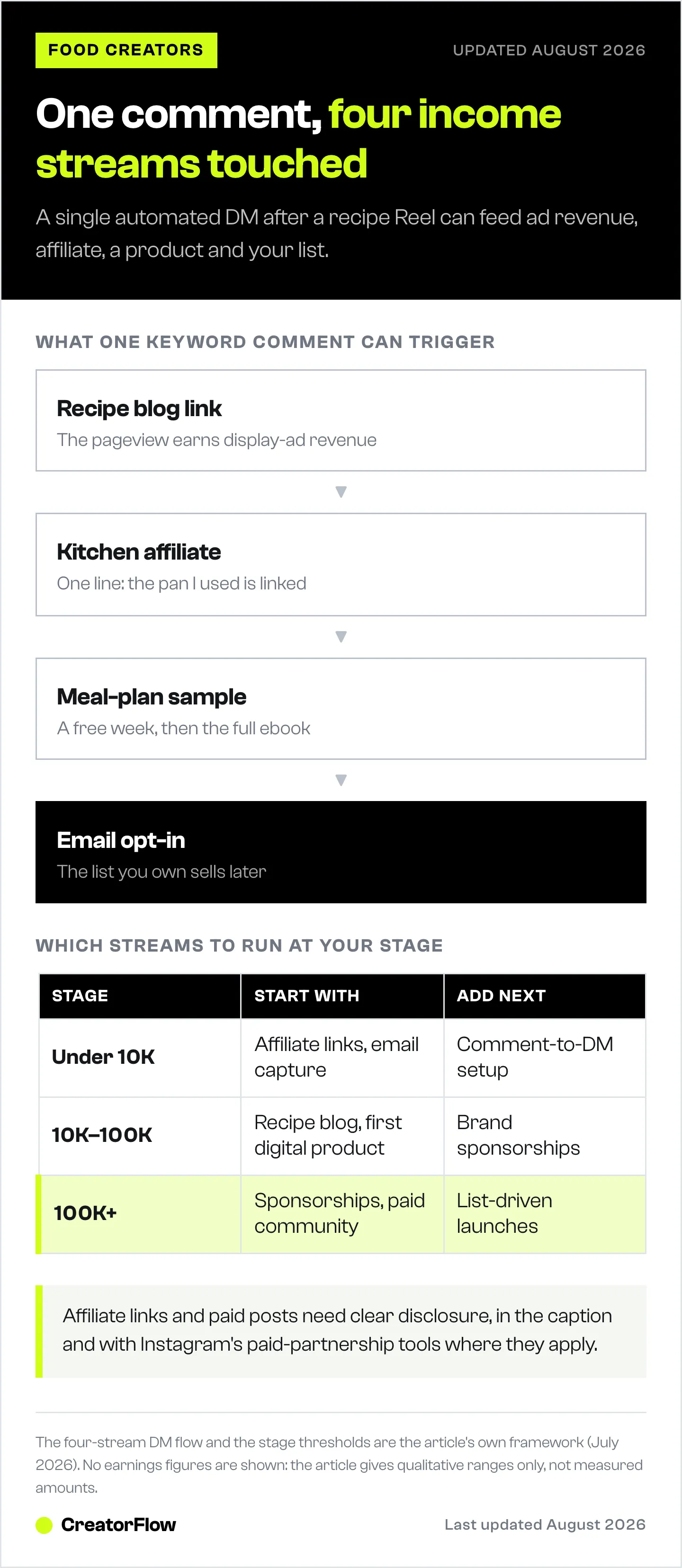
The power move is that one Reel can feed several streams from a single setup. Picture a high-protein breakfast Reel with the caption “comment BREAKFAST for the recipe.” Here is what one automation can do with that comment:
- Send the recipe blog link — the reader clicks, the pageview earns ad revenue.
- Include the kitchen affiliate — “the blender I used is linked here,” capturing affiliate intent.
- Offer the meal plan — “want a full week of these? here is a free sample,” seeding a digital-product sale.
- Ask for the email — “want my Sunday recipe email? drop your address,” growing the list you own.
One comment. Four income streams touched. No manual reply. That is the connective tissue working.
The reason this matters for food creators specifically is volume and timing. Food posts generate floods of short-window intent. Manual replies cannot keep up, and the intent expires fast. Automation is the only way to catch most of it. For a side-by-side of the tools built for this, see our roundup of the best Instagram DM tools for food bloggers.
A note on doing this without sounding like a robot. The DMs only work if they feel like you. CreatorFlow is template-first, so you write the message once in your own voice, with your phrasing and your emoji, and it sends that. Setup runs about five minutes per automation, with no complex flow-builder to learn, which matters when you would rather be cooking than configuring software.
How should I prioritize income streams by follower count?
Do not start all six at once. That is the fastest way to do all of them badly. Match the stream to your stage, build the habit, then layer the next one on. Here is the framework.
| Stage | Start with | Add next | Skip for now |
|---|---|---|---|
| Under 10K | Affiliate links + email capture | A simple comment-to-DM setup | Sponsorships, paid community |
| 10K to 100K | Recipe blog (ad revenue) + first digital product | Brand sponsorships | Large paid community |
| 100K+ | Sponsorships at scale + paid community | Multiple digital products, list-driven launches | Nothing — run the full stack |
Under 10K followers. Your goal is habits and an asset you own. Set up affiliate links for the gear you genuinely use, and start capturing emails immediately, even with a tiny list. Add a basic comment-to-DM automation so you are not losing the limited intent you do get. Do not chase sponsorships yet; brands rarely pay at this size, and the time is better spent building your list.
10K to 100K followers. Now you have enough traffic to justify a blog. Start writing full recipes for ad revenue, because your Instagram comments will feed those pageviews. Build your first digital product from the problem your audience asks about most. This is also where sponsorships become realistic, especially with an engaged niche audience.
100K and above. You have the audience to support recurring revenue. Take sponsorships selectively, and launch a paid community for your most loyal fans. Run list-driven product launches, because by now your email list is large enough to move real numbers on launch day. At this stage you run the full stack, and automation is what keeps it from eating your entire week.
What does a real income stack look like for a food creator?
A stack is two or three streams working together so the whole earns more than the sum. Here is a clean example for a mid-sized creator, around 40K followers, in the weeknight-dinner niche, running three streams.
Stream one: the recipe blog (ad revenue). Every dinner Reel ends with “comment DINNER for the recipe.” The automation sends the blog link, the reader cooks from the post, and the pageviews earn ad income. This is the workhorse, paying steadily on old content.
Stream two: kitchen affiliate. The same DM that sends the recipe also includes one line: “the pan I used is linked in the post.” No hard sell, only the answer to the question people always ask. A slice of readers buy, and the commissions add up across hundreds of comments a week.
Stream three: the meal-plan ebook (digital product + email). Once a week, a “want a full week of dinners?” Reel routes commenters into a DM that sends a free three-recipe sample, asks for their email, and links the full ebook. Some buy now. The rest join the list and buy later when the next launch lands in their inbox.
Three streams, one content engine, one automation layer. The creator does not reply to comments by hand. They post, the system distributes, and the money comes from the blog, the affiliate, and the ebook. A slow ad month is cushioned by ebook sales. A slow ebook month is cushioned by affiliate. That is the point of stacking.
There is a page built specifically for food creators that walks through the setup end to end: CreatorFlow for food creators.
Curious what your account is worth today? The Instagram money calculator works it out from your followers and engagement rate.
What mistakes do food creators make when monetizing Instagram?
The patterns below show up again and again, and each one quietly caps how much a talented creator earns.
Chasing every stream at once. Trying to run a blog, a product, sponsorships, a community, and affiliate all in month one means none of them get the attention to work. Pick the stream that fits your stage, get it running, then add the next.
No email capture. This is the most expensive mistake. Creators pour energy into reach, then send all of it to platforms they do not own. Without an opt-in in the flow, every follower is a renter, not a resident. Start capturing emails before you think you are ready.
Letting intent die in the comments. A flood of “recipe?” comments you never answer is money walking out the door. Manual replies cannot match the volume or the speed food content generates. If you are not automating the response, you are losing most of the traffic your content earns.
Ignoring disclosure. Affiliate links and paid posts require clear disclosure, in the caption and with Instagram’s partnership tools where they apply. Skipping it puts your account at risk and breaks the trust that makes monetization possible. Treat disclosure as part of the deliverable, not an afterthought.
Selling before serving. Audiences forgive a lot if the free content is genuinely good. The creators who monetize well give away real value first, then sell. The recipe is free; the month of recipes is paid. The answer to “what pan?” is free; the commission is a quiet byproduct of being helpful.

FAQ
How much money can food creators make on Instagram?
It varies enormously by niche, audience size, and how many streams you run. Rather than a single number, think in ranges and stability. A creator running three stacked streams, affiliate, ad revenue, and a digital product, tends to earn more predictably than one chasing only brand deals. The honest answer is that consistent income comes from the system, not the follower count alone.
Do I need a blog to make money as a food creator?
No, but it helps a lot. You can earn through affiliate links, digital products, sponsorships, and email without ever writing a blog post. A blog adds display-ad revenue, which is one of the strongest streams for food content because recipes hold readers on the page. If you are under 10K followers, skip the blog and build affiliate plus email first, then add a blog as you grow.
How do I get my Instagram followers to reliably click my links?
Speed and relevance. Food intent is short, so a link delivered in seconds converts far better than one sent hours later. Use comment-to-DM automation so a follower who comments a keyword gets the exact link they asked for, immediately, in a message that sounds like you. Generic bio links underperform because they make people hunt for the recipe they already wanted.
What is the easiest income stream to start with?
Affiliate links combined with email capture. Both work at any size, need no product, and build habits you will use forever. Recommend gear you genuinely cook with, deliver the link fast when someone asks, and ask for an email along the way. This gives you commission income now and a list you own for selling anything later.
How does CreatorFlow help food creators make money?
CreatorFlow is an Instagram DM tool that delivers your links, freebies, and email opt-ins automatically when followers comment a keyword. It is template-first, so you write the message in your own voice once, and setup takes about five minutes per automation with no complex flow-builder. The Free plan includes 500 DMs a month; Pro is $15/month and adds a follow gate, email gate, and CSV export (creatorflow.so, June 2026).
Do I have to disclose affiliate links and sponsorships?
Yes. Affiliate relationships and paid partnerships require clear disclosure, both in your captions and using Instagram’s paid-partnership tools where they apply. Beyond the rules, disclosure protects the trust that makes your audience worth monetizing. Treat it as a standard part of every paid or commissioned post, not an optional extra you add when you remember.
Can I run all six income streams at the same time?
Eventually, but not at the start. Running every stream from day one usually means doing all of them poorly. Match the stream to your stage: affiliate and email under 10K, blog and a digital product from 10K to 100K, sponsorships and a community past 100K. Add one stream at a time once the previous one is running on its own.
How does one Reel make money from multiple streams?
Through a single automated DM. When a follower comments a keyword, the message can send your blog link (ad revenue), include a kitchen affiliate, offer a meal-plan sample (digital product), and ask for their email, all at once. One piece of content touches four income streams without a manual reply. That layering is why automation matters as much as the content itself.
Sources: CreatorFlow product and pricing (creatorflow.so, June 2026). All income figures are described as qualitative ranges, not guarantees; actual earnings vary by niche, audience, and effort. Affiliate and sponsorship disclosure requirements reflect standard platform and advertising guidance as of June 2026.