Amazon affiliate income for food creators on Instagram comes from recommending the kitchen tools and ingredients you already cook with, then getting your tracked Amazon link into a follower’s hands the second they ask. You join Amazon Associates or the Amazon Influencer Program, build a storefront, disclose every link, and deliver the right product link by DM instead of pointing to a buried bio. Speed and a clean link are what turn a “where’s that pan?” comment into a commission.
You film a 40-second skillet pasta. The sear is loud, the cheese pull is perfect, the post takes off overnight. By morning the comments are all the same: “what pan is that?” “where do you get that knife?” “link to the olive oil?” Those are buying questions. Every one of them is a follower with a credit card already half out, asking you to sell them something. And most food creators answer them six hours late, with a Linktree that has 80 links and none of them the right one.
That gap between the question and the link is where Amazon affiliate money leaks out of food accounts every day. This guide fixes it. We cover how Amazon Associates and the Amazon Influencer Program work for recipe creators, how to pick products that convert, how to disclose the right way so you stay trusted and compliant, and the delivery problem that quietly kills conversions. For the deeper mechanics of how Amazon links behave inside Instagram, the companion piece on how Amazon deep links work for Instagram affiliates goes one level down. This article keeps it practical for the kitchen.
Key Takeaways
- Two Amazon programs, one goal: Amazon Associates pays commission on links you place anywhere; the Amazon Influencer Program adds a storefront and on-platform earnings. Food creators often use both.
- Commission varies by category: Amazon’s published associate rates differ by product type, with grocery and kitchen sitting in low single-digit percentages and some categories higher. Always check current rates rather than assume a flat number (affiliate-program.amazon.com, June 2026).
- Pick gear you cook with: Cookware, knives, gadgets, and pantry staples you show on camera convert far better than random affiliate dumps, because the recommendation is already proven on screen.
- Disclosure is required, not optional: The FTC requires a clear “I earn from qualifying purchases” style disclosure, and Amazon requires it too. Done right, it builds trust instead of hurting it.
- The link delivery problem is real: A standard Amazon link tapped inside Instagram opens an in-app browser that is often logged out, adding friction at the worst moment. Amazon deep links open the Amazon app directly, and that is a feature of some tools.
- DM delivery beats the bio: Tools like GRO build the full website-plus-Amazon stack for recipe bloggers (gro.co, June 2026), while CreatorFlow keeps it simple and sends your link by DM the instant someone comments a keyword (creatorflow.so, June 2026).
See how the comment-to-DM flow looks inside the product in the short video above, and follow CreatorFlow on Instagram for more examples.
How Amazon Affiliate Programs Work for Food Creators
Amazon runs two related programs that food creators use, and they are easy to mix up. Understanding the split decides how you set up tracking and where your commissions come from. For the full comparison of eligibility and commission rates, see Amazon Associates vs the Influencer Program.
Amazon Associates
Amazon Associates is the core affiliate program. You sign up for free, get a unique tracking ID, and generate a link for any product on Amazon. When a follower taps that link and buys, you earn a percentage of the sale, because the link carries your tag.
The window matters. Amazon typically attributes purchases made during the session and within a short cookie window after the click. So if a follower clicks your Dutch oven link, then buys a sheet pan and a spice rack in the same trip, you can earn on all of it, not only the item you linked. Getting the click is the whole game, because everything bought after walking through the door can count.
Amazon Influencer Program
The Amazon Influencer Program sits on top of Associates and is built for creators with an active social following. It gives you a storefront, a dedicated page on Amazon where you curate products into shoppable lists, like “My Kitchen Essentials,” “Holiday Baking,” or “Gifts for Home Cooks,” all in one Amazon-hosted page you can point followers to.
The storefront has two advantages. The first is trust: the page lives on Amazon, so followers feel safe buying there. The second is on-platform earning, since the Influencer Program lets you earn on certain shoppable content and curated lists in ways a plain associate link does not. Many food creators run both, Associates for one-off product links in DMs, and the storefront for browse-and-shop moments.
How tracking and storefronts fit together
Your tracking ID ties it all together. Whether a follower buys from a single DM link or from your storefront, the commission routes back through your tag. The move for a food creator: set up Associates first so you can link any product, apply for the Influencer Program once you have a steady following, build a storefront you can reference in DMs and your bio, then make sure the right link reaches the right follower fast, which is where most of the lost money hides.
Commission Categories at a High Level
Amazon does not pay one flat rate across the catalog. Commission is set by product category, and the categories most relevant to food creators tend to land in the low single digits. Grocery, kitchen, and home products generally sit lower than categories like luxury beauty, while some niches pay more. Rates change, so the only safe move is to check the current Amazon Associates rate card before you build a content plan around any number (affiliate-program.amazon.com, June 2026).
What this means for a recipe creator is simple. You earn a small percentage on each kitchen item, so volume and basket size carry the model. Two things move the needle. First, recommending products people buy in clusters, like a knife plus a cutting board plus a honing rod. Second, getting the click during a short cookie window, because once they are shopping on Amazon, the rest of the cart can count. You are chasing many small commissions that add up across a hungry, engaged audience.
One honesty note: do not invent specific commission percentages in your captions or DMs. If a follower asks “how much do you make,” tell them you earn a small commission at no extra cost to them. That is true, compliant, and enough.
Picking Products That Convert
The fastest way to waste an Amazon affiliate setup is to link products you have never touched. Food creators have a built-in advantage: the camera proves the recommendation. If viewers watched you sear a steak in a specific pan, the pan sells itself. Your job is to link what is on screen. Here is how the product types stack up for a food account.
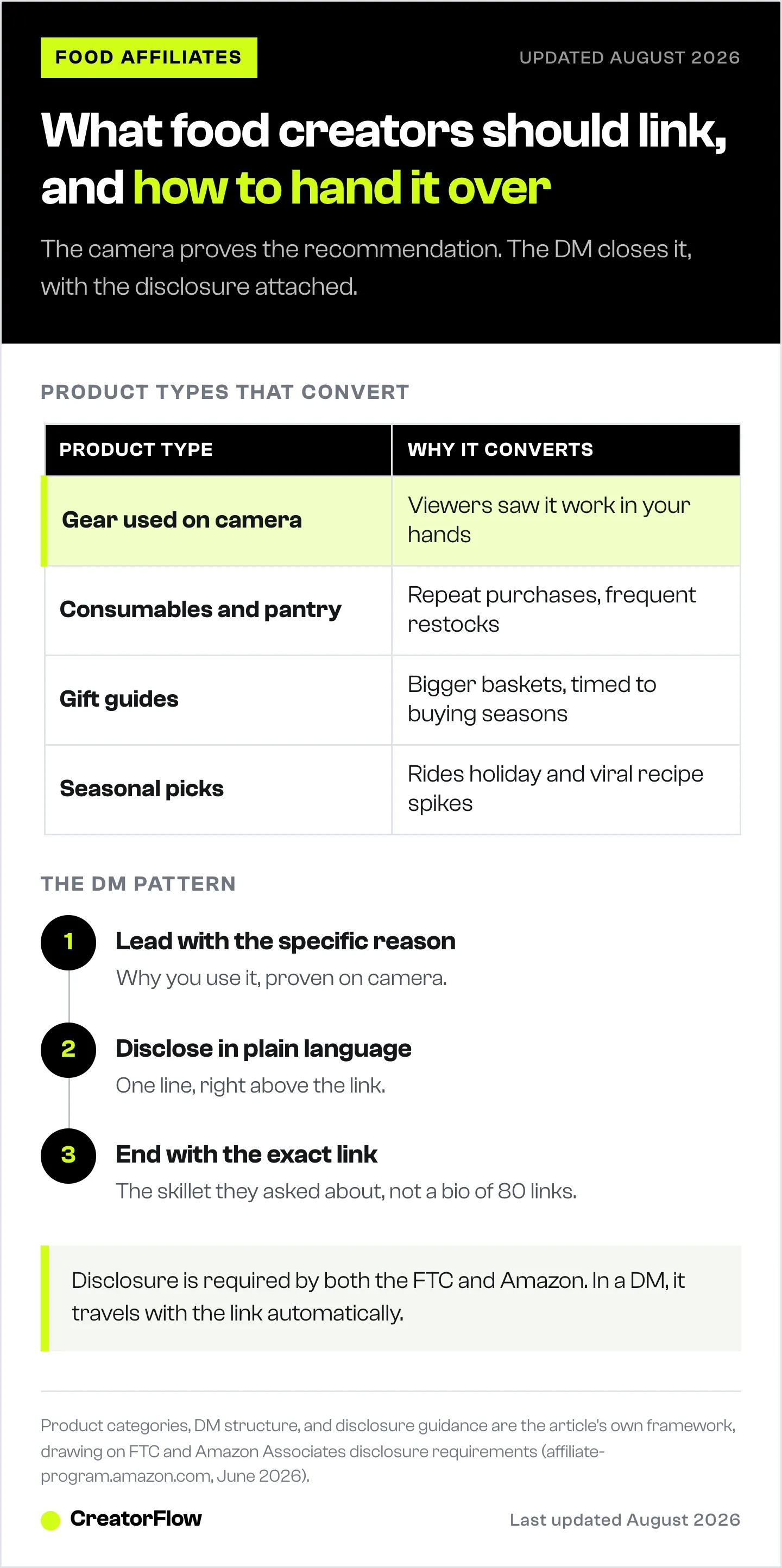
| Product type | Why it converts for food creators | Example |
|---|---|---|
| Gear you use on camera | Viewers already saw it work in your hands | Cast-iron skillet, chef’s knife, stand mixer |
| Consumables and pantry | Repeat purchases, low hesitation, frequent restocks | Olive oil, specialty flour, spice blends, parchment |
| Gift guides | Bundles raise basket size and time it to buying seasons | ”Gifts for the home cook” curated list |
| Seasonal and trend-driven | Rides demand spikes around holidays and viral recipes | Pie dishes in November, ice cream maker in summer |
The gear you cook with on camera
This is the strongest category because trust is already built. When someone comments “what pan is that?” they have decided they want it. They need the link, nothing more. Cookware, knives, small appliances, and gadgets you genuinely cook with convert because the demonstration came first and the ask came second.
Consumables and pantry staples
Consumables are the best long-term play. A skillet is a one-time purchase. Specialty flour, good olive oil, a spice blend, and parchment paper get bought again and again. Link the ingredient you reach for in a recipe, and you tap into restock behavior a one-time cookware sale never gives you.
Gift guides and curated lists
Gift guides do two jobs at once. They raise basket size, because people buying gifts add multiple items, and they ride seasonal intent. A “gifts for the home cook” storefront list, surfaced in your bio and dropped into DMs through the holidays, can carry a meaningful share of a food creator’s affiliate income for the quarter.
Seasonal and trend-driven products
Food is seasonal in a way few niches are. Pie dishes spike before the holidays. Grilling tools spike in summer. An ice cream maker spikes during a heatwave. Line your product picks up with when people are cooking that thing, and you meet demand instead of manufacturing it.
For a wider playbook on turning recipe content into a steady link-delivery machine, the guide on Instagram automation for food bloggers covers the content side in depth.
FTC Disclosure Done Right
Disclosure is a requirement, not a nice-to-have. The FTC requires creators to clearly disclose a material connection when they earn from a recommendation, and Amazon’s own operating agreement requires affiliates to identify themselves as Amazon Associates. Skipping it risks your Amazon account and your credibility. Doing it well builds trust, because honesty reads as confidence.
The standard Amazon-approved language is a version of: “As an Amazon Associate I earn from qualifying purchases.” That line, or a clear equivalent, needs to be present where followers can see it before or as they engage with your link.
Here is how to place it across Instagram surfaces.
- In captions: Add a short disclosure line near the top of captions that include affiliate links or that drive to affiliate links. Do not bury it under a wall of hashtags.
- In Stories and Reels: Say it or show it. A spoken “these are affiliate links, I earn a small commission” or an on-screen text overlay works. Do not rely on a tiny sticker no one reads.
- In your bio: Keep a standing disclosure in your bio or storefront so the relationship is always visible.
- In your DMs: When an automated DM delivers an Amazon link, include the disclosure in the message itself. This is the cleanest place to put it, because the disclosure and the link arrive together.
The DM is the disclosure win most creators miss. When your link reaches a follower through a direct message, you control the full text around it. You can put “heads up, this is my Amazon affiliate link, I earn a small commission at no extra cost to you” one line above the product link, every time, automatically. The disclosure travels with the link instead of getting lost three scrolls up in a caption.
The Link Delivery Problem Nobody Talks About
You can pick the perfect product and disclose flawlessly, and still lose the sale on the tap. This is the part of Amazon affiliate work on Instagram that gets ignored, and it costs food creators real money.
Here is the friction. A standard Amazon web link tapped inside Instagram does not open the Amazon app. It opens Instagram’s in-app browser, a stripped-down mini-browser inside the Instagram app. That browser is often logged out, or at least not carrying the follower’s saved payment and shipping details. So the follower who was one tap from buying now faces a sign-in screen, a fresh cart, and a checkout that feels like starting over. A meaningful share of them bail right there. The intent was there. The friction killed it.
This matters more for food than for most niches, because food intent is perishable. Someone wants the pan now, while the recipe is fresh and they are excited to cook. Add three steps and a login wall, and “now” becomes “later,” and later becomes never.
Where Amazon deep links come in
Amazon deep links solve the in-app browser problem. Instead of a web URL that opens Instagram’s mini-browser, a deep link is built to open the native Amazon app directly, where the follower is already signed in with payment and address saved. One tap, the app opens to the product, and checkout is the frictionless one they already trust. Generating those deep links is a feature of some tools, and being honest about the tooling matters here.
GRO is purpose-built for exactly this audience: food and recipe bloggers who run a WordPress site and monetize through pageviews plus Amazon affiliate. GRO’s Pro plan includes Amazon deep links that open the Amazon app, plus a WordPress plugin that converts the existing Amazon links on your recipe site into those app-opening links (gro.co, June 2026). If your business runs on a website and Amazon, that stack is built for you. GRO prices by follower count: free under 15,000 followers, then Plus at $30/month and Pro at $80/month, scaling higher as your audience grows (gro.co, June 2026).
CreatorFlow takes a different scope. It focuses on the Instagram side of the funnel, delivering your link by DM the instant a follower comments your keyword, through Meta’s official Instagram API. So if you already have a deep link, an Amazon storefront, or a recipe blog URL, CreatorFlow gets that exact link into the DM in seconds, with your disclosure attached. Different scope, same goal: get the right link in front of the buyer while they still want it. The two are not mutually exclusive, since a creator can generate deep links one way and deliver them with a comment-to-DM tool the moment the buying question lands.
The Comment-to-DM Workflow for Recipe and Kitchen Reels
This is the engine that closes the gap between the question and the link. The setup is short and it runs on autopilot once it is live. For a deeper walkthrough of the recipe-specific version, the guide on running a comment-for-recipe flow for food creators breaks it down step by step.
Here is the workflow.
- Post the Reel or photo. Show the dish and the gear. Make sure the product is clearly on screen, because that visual is the sales pitch.
- Add a keyword call-to-action in the caption. Tell viewers exactly what to do: “Comment SKILLET and I’ll DM you the pan.” A one-word keyword is the lowest-effort ask there is.
- Set the trigger. In your DM automation tool, attach the keyword to that specific post and write the DM that goes out when someone uses it.
- The instant DM fires. A follower comments the keyword, the tool sends them a direct message in seconds with the product link and your disclosure. No manual reply, no waiting six hours.
- Capture the email (optional). With an email gate, the automation asks for an email before it hands over the link. That turns one affiliate click into a subscriber you can email future recipes and product picks to.
This works for Amazon affiliate income because it removes every step between intent and action. The follower asked. They got the exact link, not a bio with 80 other links. The disclosure was right there. And if you captured the email, you can sell to them again next week without paying for reach.
On CreatorFlow, the comment-to-DM trigger and email gate are part of how the product is built. The free plan sends up to 500 DMs per month on one account, which is enough to test the workflow on a few posts. The Pro plan at $15/month, or $12/month billed annually, covers 5,000 DMs per workspace and adds the follow gate, email gate, CSV export, and geographic analytics. The Growth plan at $30/month raises volume and accounts for creators running multiple kitchens or brands (creatorflow.so, June 2026). For a side-by-side on which delivery tool fits a food account, see the best Instagram DM tools for food bloggers.
DM Templates That Sell Without Being Pushy
The DM is where the sale closes, so the copy matters. Plain text, warm, with the disclosure built in. Here are three you can adapt. The bold labels show the structure; the quoted lines are the message a follower receives.
Kitchen tool DM
Hey! Here’s that skillet from the pasta video. It’s the one I use for almost everything, holds heat like nothing else.
Heads up, this is my Amazon affiliate link, so I earn a small commission at no extra cost to you. Thanks for the support.
Link: [your Amazon product or deep link]
Ingredient DM
Thanks for asking! The olive oil I poured in the reel is right here. I go through a bottle a week, it’s that good on everything.
Quick note: that’s my Amazon affiliate link, I get a small commission if you grab it, costs you nothing extra.
Link: [your Amazon product or deep link]
Gift guide DM
Here you go! This is my full kitchen gift list, everything I’d want a home cook to own, all in one place.
These are Amazon affiliate links, so I earn a small commission on anything you pick up, at no extra cost to you. Happy shopping.
Link: [your Amazon storefront list]
Notice the pattern. Lead with the helpful, specific reason you recommend it. Put the disclosure in plain language right above the link. End with the link itself. No hype, no pressure, no urgency tricks. The follower already wants it. Your job is to hand it over cleanly and honestly.
Common Mistakes That Cost Food Creators Commissions
These are the recurring leaks. Fix them and the same content earns more.
- No disclosure. Skipping the affiliate disclosure risks your Amazon account and your trust with followers. It is required by both the FTC and Amazon, and it is one line. There is no upside to leaving it off.
- Generic links instead of the specific product. Sending someone to your homepage, your full storefront, or a category page when they asked about one pan adds friction. They asked about the skillet. Send the skillet.
- Pasting links manually. Manual replies are slow and inconsistent. You miss comments, you answer hours late, and food intent has already cooled. The follower who would have bought has moved on. Automating the delivery is the single biggest fix here.
- No tracking. If you are not using your Amazon Associates tag on every link, you earn nothing on the click. Double-check that every link you put in a DM carries your tracking ID. A link without your tag is a free referral to Amazon.
- Ignoring the in-app browser problem. Linking a plain Amazon web URL and accepting the logged-out in-app browser friction leaves money on the table. Either use deep links that open the Amazon app, or at minimum make the path as short as possible.
- One link for every product. A single bio link cannot answer “what knife” and “what oil” and “what pan” at once. Different questions need different links, delivered per comment. That is the whole point of keyword-triggered DMs.
If you are weighing the website-plus-Amazon stack against simple flat-rate DM delivery, the full breakdown lives in the CreatorFlow vs GRO comparison.
There is a page built specifically for Amazon affiliates that walks through the setup end to end: CreatorFlow for Amazon affiliates.

FAQ
Do food creators need a website to earn Amazon affiliate income on Instagram?
No. A website helps if you monetize pageviews and want the full GRO-style stack of deep links and a WordPress plugin (gro.co, June 2026). But you can earn through Amazon Associates with only an Instagram account, a tracking ID, and a way to deliver links. Many food creators run entirely off DMs and a storefront, no blog required.
What’s the difference between Amazon Associates and the Amazon Influencer Program?
Amazon Associates is the core affiliate program: free to join, gives you tracked links for any product. The Amazon Influencer Program sits on top and adds a curated storefront page on Amazon plus on-platform earning options for creators with an active following. Food creators often use both, Associates for DM links and the storefront for browse-and-shop.
Why does my Amazon link open a logged-out browser inside Instagram?
Because a standard web link tapped inside Instagram opens Instagram’s in-app browser, not the Amazon app. That mini-browser often is not signed in, so the follower hits a login wall and a fresh cart. Amazon deep links solve this by opening the native Amazon app directly, where the follower is already logged in. Generating deep links is a feature of some tools, including GRO Pro (gro.co, June 2026).
Where does CreatorFlow fit alongside an Amazon deep link?
CreatorFlow focuses on the Instagram side of the funnel. It delivers whatever link you give it by DM the instant a follower comments your keyword, through Meta’s official Instagram API. If you already have a deep link, an Amazon storefront URL, or a recipe blog link, CreatorFlow gets it into the DM in seconds with your disclosure attached, and tracks the clicks it earns (creatorflow.so, June 2026).
How do I disclose affiliate links the right way?
Use clear language like “As an Amazon Associate I earn from qualifying purchases,” and place it where followers see it before they engage: near the top of captions, spoken or on-screen in Reels and Stories, in your bio, and inside the DM that carries the link. The DM is the cleanest spot, because the disclosure and the link arrive together.
What kitchen products convert best for food creators?
The gear you genuinely use on camera converts best, because viewers already saw it work. Cookware, knives, and small appliances lead. Consumables like specialty oils, flours, and spice blends are the strong long-term play because they get repurchased. Gift guides raise basket size, and seasonal items ride demand spikes around holidays and viral recipes.
How fast does the comment-to-DM workflow deliver a link?
In seconds. A follower comments your keyword, and the automation sends the direct message with the product link almost instantly. That speed is the point, because food intent is perishable. A link delivered in seconds while the follower is still excited converts far better than a manual reply six hours later. On CreatorFlow the free plan covers up to 500 DMs a month to test it (creatorflow.so, June 2026).
Can I collect emails while sending Amazon affiliate links?
Yes. With an email gate, the automation asks for an email before it hands over the link, so a single affiliate request grows your subscriber list. On CreatorFlow the email gate is part of the Pro plan, which also includes CSV export to move those contacts into your email platform and send future recipes and product picks directly (creatorflow.so, June 2026).
CreatorFlow details from creatorflow.so as of June 2026. GRO details from gro.co as of June 2026. Amazon program details from affiliate-program.amazon.com as of June 2026. Commission rates and program terms change; verify current rates before building a content plan. Individual results vary.