

An Instagram DM setter is a salesperson who works a coach’s Instagram inbox, qualifies leads, and books discovery calls. A human setter costs roughly $2,000 to $4,000 a month, or $20 to $50 per booked call. Software that does the same first half of the job costs $15 to $149 a month. Most coaches under 30 calls a month save money with software.
Every guide to Instagram DM setting explains the workflow and then stops before the only question that decides anything: what does each option cost, and which bottleneck does it actually remove? A human setter and an AI setter solve two different problems. The human buys back your call hours by filtering who reaches your calendar. The software buys back your typing hours by answering everyone in seconds. Coaches who choose on price alone usually fix the wrong bottleneck and stay stuck.
This guide puts sourced numbers on both. Payroll data for human setters, real per-call math, the Meta policy rule that limits what an AI setter can legally send, and a volume threshold that tells you which one you need right now.
Key Takeaways
- A DM setter is an SDR for social: the role qualifies leads and books calls through Instagram DMs instead of cold calls and email, and it is standard in online coaching, consulting, and agency businesses
- Human setter cost: US appointment setters average $16.08 per hour with commission of $9,000 to $15,000 a year, putting total annual pay at $28,000 to $47,000 (payscale.com, May 2026). Part-time coaching setters commonly land at $2,000 to $4,000 a month or $20 to $50 per booked call
- Software cost: rule-based DM automation runs $0 to $30 a month and AI setters that generate replies run $50 to $149. CreatorFlow Pro is $15 flat (creatorflow.so, May 2026); ManyChat runs $17 to $199 a month depending on active contacts and channel count (manychat.com, August 2026)
- The threshold: below about 30 booked calls a month, software costs less per call by two orders of magnitude. Above that, a human setter starts paying for itself in close rate rather than volume
- Meta’s rule most guides skip: the tag that extends messaging past 24 hours is reserved for human agents. An AI setter cannot use it to chase a cold lead on day five
- The honest trade: software books more calls, a human books better ones. Pick based on whether your calendar or your inbox is the thing overflowing
What is an Instagram DM setter?
An Instagram DM setter is a sales development rep who works inside a coach’s Instagram inbox. They open conversations with people who commented, replied to a Story, or sent a message, ask two or three qualifying questions, and book the fit ones onto the coach’s calendar. The unfit ones get pointed at a free resource.
The role exists because high-ticket coaching sells on a call, and the coach cannot both fill the calendar and run it. In traditional B2B this split is called the setter-closer model. On Instagram the setter works in text at high volume, and the closer works on the phone at high value.
An AI setter does the same first half of that job with software. It watches for a trigger, sends the first reply, asks the qualifying questions, and drops the booking link when the answers clear your bar. What it does not do is read a hesitant reply and decide to slow down.
AI setter vs DM automation vs human setter
These three terms get used interchangeably in the coaching space, and they are not the same thing.
| What it is | What it costs | What it is good at | |
|---|---|---|---|
| Human DM setter | A contractor or employee working your inbox | $2,000-$4,000/mo or $20-$50 per booked call | Judgment, objection handling, protecting your calendar |
| AI setter | Software with a language model writing replies | $50-$149/mo typical | Handling volume with varied phrasing, 24/7 coverage |
| DM automation | Rule-based triggers and templates | $0-$30/mo | Instant, predictable, identical delivery of a known answer |
Rule-based DM automation is the mature end of this market and the one Meta’s API was built for. A follower comments a keyword, a template goes out in about eight seconds, a link lands. There is no interpretation step, so there is nothing to go off-script.
An AI setter adds a generation step. That buys you replies that read differently each time and can handle a question you did not anticipate. It also means you are approving a category of message rather than a message, which matters more the higher your ticket goes.
Most coaching stacks end up using both: automation for the first reply and the link delivery, a human for anything that turns into a real conversation.
What a human DM setter costs
Public payroll data covers the appointment setter role broadly rather than the Instagram-specific version, and it is the most reliable number available.
US appointment setters average $16.08 an hour, with a 10th-to-90th percentile band of $12.74 to $20.85 (payscale.com, updated May 12, 2026, n=76). Commission adds $9,000 to $15,000 a year on top, putting total annual pay between $28,000 and $47,000.
Coaching businesses rarely hire that full-time. The common shapes are:
- Part-time retainer: $2,000 to $4,000 a month for someone working your inbox daily
- Per-appointment: $20 to $50 per booked call for a setter working several coaches at once (setsmart.io, 2026)
- Commission-only: 3% to 5% of closed deal value, so roughly $150 to $375 on a $7,500 program
- Outsourced agency: $50 to $350+ per booked meeting in the B2B market, where the lead is colder and the qualification work is heavier
Add the parts nobody quotes. Recruiting and replacing a setter takes real hours. Training on your offer, your objections, and your voice takes two to four weeks before they are net positive. Turnover in commission-heavy setter roles is high. Budget the loaded cost, not the invoice.
What an AI setter costs
Software pricing splits on whether you pay per month or per contact.
CreatorFlow is flat-rate: Free covers 500 DMs a month, Pro is $15 a month or $12 billed annually, and Growth is $30 a month for higher volume and up to five workspaces (creatorflow.so, May 2026). The number does not move when a Reel takes off.
ManyChat prices on active contacts across a five-plan ladder introduced March 2, 2026: Free covers 25 contacts, Essential is $17 a month for 250, Pro is $39 for 2,500, Business is $99 for 7,500, and Advanced is $199 for 25,000. Billed annually those become $14, $29, $69, and $139 a month. Contacts beyond the plan bill at $0.004 to $0.10 each depending on tier (manychat.com, August 2026). It covers Instagram, Facebook, WhatsApp, SMS, TikTok, Telegram, and email, so the ladder is buying channel breadth as well as volume.
Dedicated AI setter products that write replies with a language model sit higher, commonly $50 to $149 a month, because inference costs money.
Budget for the booking tool too. Calendly is free for one event type and $12 a month for paid features. A solo coach running comment-to-DM plus a calendar realistically spends under $30 a month total.
Cost per booked call, and why it is the wrong number alone
Run the math and the gap looks absurd.
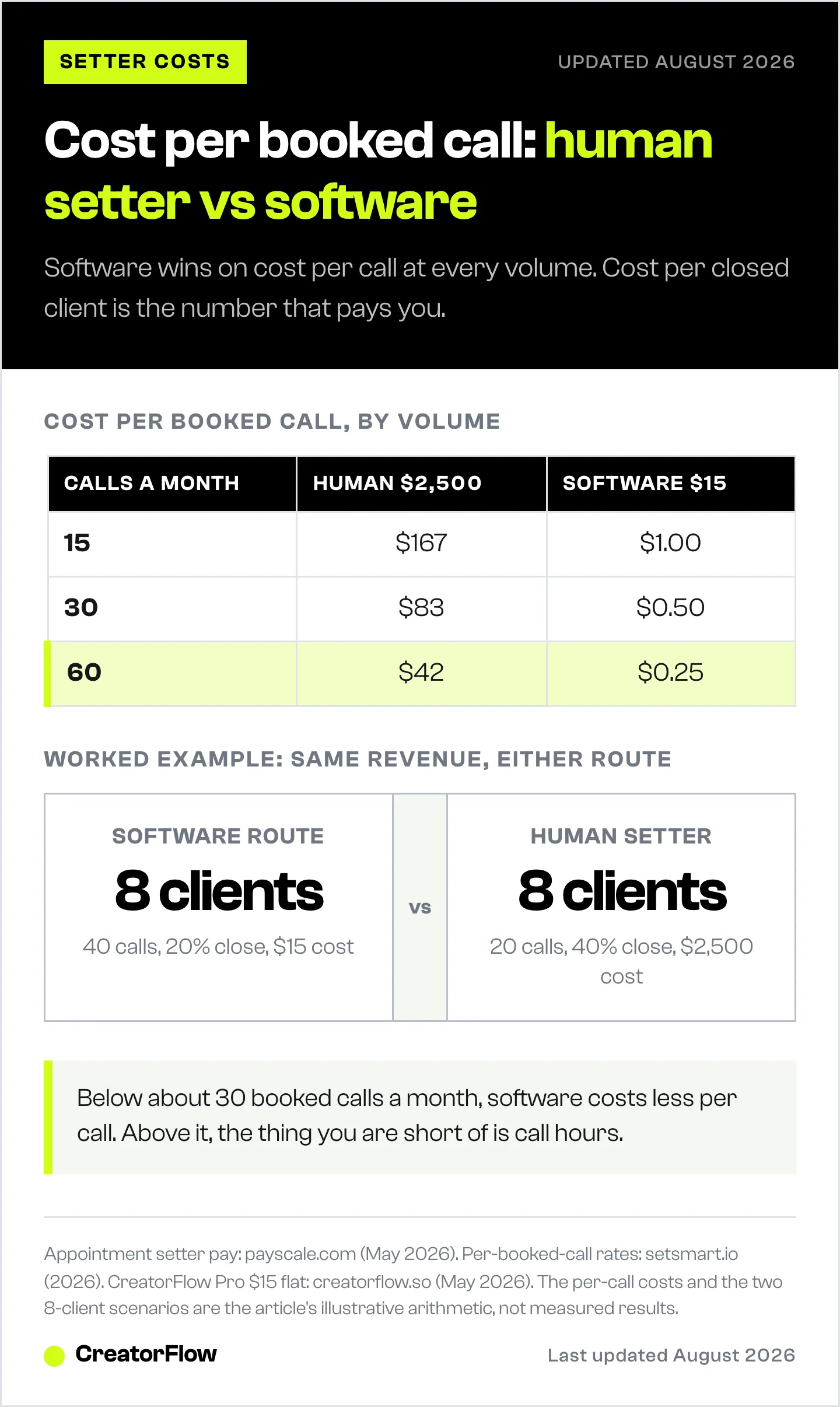
| Volume | Human setter at $2,500/mo | CreatorFlow Pro at $15/mo |
|---|---|---|
| 15 calls/month | $167 per call | $1.00 per call |
| 30 calls/month | $83 per call | $0.50 per call |
| 60 calls/month | $42 per call | $0.25 per call |
On this table software wins at every volume, which is exactly why the table is misleading on its own.
Cost per booked call is not the metric that pays you. Cost per closed client is, and the two options move different variables. Software books more calls because it answers everyone in seconds instead of some people in hours. A trained human books fewer calls at a higher close rate because they screen out the people who were never going to buy.
Two coaches, same $5,000 program, same month:
- Software: 40 booked calls, 20% close, 8 clients, $40,000. Cost of sale, $15. The coach sits through 40 calls.
- Human setter: 20 booked calls, 40% close, 8 clients, $40,000. Cost of sale, $2,500. The coach sits through 20 calls.
Identical revenue. The software route costs $2,485 less and 20 extra hours of the coach’s time. If your calendar has room, take the software. If your calendar is the constraint and your hourly value is above $125, the human is cheaper in the currency you are actually short of.
That is the whole decision. The five-stage appointment-setting system works the same either way; only the cost of running it changes.
What Meta’s rules let an AI setter do
This is the constraint most DM setting guides leave out, and it decides what you can promise a lead.
Meta runs a 24-hour standard messaging window. Once someone messages your business, you have 24 hours to reply, and messages inside that window may contain promotional content. After 24 hours the window closes.
There is a tag that extends it to seven days. Meta reserves it for a human support agent handling an issue that could not be resolved inside the standard window, and it explicitly prohibits using it for automated or bot messages or for promotional content (developers.facebook.com, August 2026). Meta detects misuse.
So an AI setter that promises to nurture a cold lead on day five is describing something the tag rules do not permit for automated sends. Automated follow-up lives inside the 24-hour window. Day five belongs to a human typing, or to email.
Two more platform facts worth building around. Private replies to comments on posts and Reels run on their own 7-day window and a 750-per-hour rate limit on the Instagram Login path. Separately, tools pace sends at roughly 200 DMs an hour as a conservative safety cap; that figure is a tool-side convention, not a Meta-published limit. The full picture is in our breakdown of Meta’s rules for DM automation.
Design your sequence to fit those windows and neither option gets you flagged. Design it around a vendor’s marketing copy and you will find the gap the hard way.
The DM setting workflow, whoever runs it
The steps are identical for a human, an AI setter, or plain automation. Only the handoff point moves.
1. Trigger. A comment keyword, a Story reply, or a keyword DM. Keep it to one word people can spell. Post the instruction in the caption and say it on camera.
2. First reply, under 10 seconds. Acknowledge what they responded to and ask one question. One. The single most common failure is stacking three questions into the opening message and getting silence back.
3. Qualification, two or three questions maximum. Situation, timeline, budget awareness. These are the qualifying questions that filter tire-kickers before they reach your calendar, and they are the part worth spending real time writing.
4. Route. Qualified leads get the booking link. Everyone else gets a genuinely useful free resource and stays on the list. Nobody gets told they do not qualify.
5. Handoff. Automation stops here and a human picks up. For programs above $5,000, the handoff should happen earlier, usually right after the first answer. Coaches selling at that level should read how to qualify $10K+ coaching leads before they hit the calendar.
6. Review weekly. Pull the numbers: replies per trigger, qualified per reply, booked per qualified, showed per booked. The stage with the worst drop is the only thing worth editing this week.
Speed at step two is where the gains are, and the evidence behind it is older than most people citing it realize. The 5-minute rule traces to a study by Dr. James Oldroyd at MIT Sloan with InsideSales.com, presented in October 2007, covering six companies, more than 15,000 leads, and over 100,000 call attempts. It found that moving first response from 5 minutes to 30 minutes cut the odds of contacting a lead by 100x and the odds of qualifying one by 21x. The finding has held up in later work, but treat it as a two-decade-old B2B phone benchmark rather than a 2026 Instagram statistic, whatever the vendor blogs imply.
How to choose, by volume
| Your situation | Buy this |
|---|---|
| Under 10 booked calls/month, ticket under $2K | Rule-based automation, $0-$15/mo. A setter has nothing to do yet |
| 10-30 calls/month, ticket $2K-$5K | Automation plus you handling the conversation after question two |
| 30+ calls/month, calendar full, ticket $5K+ | Add a human setter. You are short on call hours, not replies |
| High volume, low ticket, no call needed | Automation only. Send the checkout link and skip the call |
| Multiple offers, several accounts | Automation across workspaces first, then one setter across all of them |
Two rules that survive every version of this table. Do not hire a setter to fix a messy offer, because a human repeating an unclear promise faster only produces confused leads faster. And do not automate a conversation you have never had manually, because you will not know which two questions matter until you have asked ten.
Start with automation, run it yourself for 30 days, read the drop-off, and only then decide whether the thing you are short of is replies or hours. The DM funnel built for coaches covers the templates for that first month.
FAQ
What is an Instagram DM setter?
An Instagram DM setter is a salesperson who works a coach’s Instagram inbox, qualifies incoming leads with two or three questions, and books the qualified ones onto a discovery call calendar. It is the social-media version of a sales development rep, and it is a standard role in online coaching, consulting, and agency businesses.
How much does an Instagram DM setter cost?
US appointment setters average $16.08 an hour with $9,000 to $15,000 in annual commission, for total pay of $28,000 to $47,000 a year (payscale.com, May 2026). Coaching businesses more often pay a part-time retainer of $2,000 to $4,000 a month, $20 to $50 per booked call, or 3% to 5% of closed deal value.
Can an AI setter replace a human DM setter?
For the first half of the job, usually yes. Triggering, first reply, qualifying questions, and link delivery are all mechanical and software does them faster and around the clock. Objection handling, reading hesitation, and anything above a $5,000 ticket still belong to a person. Most coaches run software up to the handoff and a human after it.
What does an AI setter cost per month?
Rule-based DM automation runs $0 to $30 a month. CreatorFlow Pro is $15 flat, or $12 billed annually (creatorflow.so, May 2026). ManyChat ranges from $17 to $199 a month depending on active contacts (manychat.com, August 2026). Dedicated AI setter products that generate replies with a language model typically sit between $50 and $149 a month.
Can an AI setter follow up after 24 hours?
Not with an automated message. Meta’s standard messaging window is 24 hours, and the tag that extends it to seven days is reserved for human agents handling unresolved issues, with automated and promotional messages explicitly excluded (developers.facebook.com, August 2026). Automated follow-up belongs inside the 24-hour window. Later touches need a human or an email list.
How many booked calls justify hiring a human setter?
Around 30 a month is where the argument changes. Below that, software costs a fraction per call and your calendar can absorb the extra volume. Above it, the constraint stops being reply speed and becomes your call hours, and a setter who screens harder is buying back time worth more than the retainer.
Do I need both DM automation and an AI setter?
Most coaches do not need two paid tools. One platform handling the trigger, the first reply, the qualifying questions, and the booking link covers the whole automated half of the job. Add a second product only when you have a specific gap the first one does not cover, and check the total contact cost before you do.
Appointment setter pay verified from payscale.com (May 2026). Software pricing verified from creatorflow.so (May 2026) and manychat.com (August 2026). Messaging window and human agent tag rules verified from developers.facebook.com (August 2026). Lead response findings from the Oldroyd/MIT Sloan and InsideSales.com Lead Response Management study, 2007. Individual results vary.


