
Instagram social proof is the evidence other people leave that your product is worth buying: customer photos, tagged posts, comments, story mentions, reviews and creator posts. It works when a viewer can check who made it. Survey data puts real customer reviews as the single biggest factor in the final purchase decision for 52% of shoppers, while 44% say they are wary of reviews that read as uniformly positive.
Both numbers come from the same study. That is the part most advice about social proof misses. The audience that trusts customer content is the same audience running a fraud check on it, and the checks are specific enough to name.
This guide covers what buyers say they trust, which types of Instagram social proof survive their scrutiny, the platform windows that decide whether you can reach the person behind a comment at all, and where each piece of proof belongs once you have it.
Key Takeaways
- Proof works on attribution, not volume: a viewer needs to see whose face and whose account is behind the claim, and every step that hides it costs you credibility
- Buyers audit proof actively: 44% are wary of overly positive generic reviews and 39% distrust a spike in review volume over a short period (Bazaarvoice Shopper Preference Report, surveyed by Savanta among 8,000+ consumers in six countries, January 2025)
- A comment gives you one message and seven days: Meta allows a single private reply to a comment on a post, ads post or reel, within 7 days, and the thread continues only if the person replies (developers.facebook.com, August 2026)
- Story mentions cannot be kept: Meta’s Story mention documentation states you must not store or cache the media, so a customer’s story is proof you can see and not proof you can own (developers.facebook.com, June 2026)
- Hashtag search finds the post but never the poster: Meta’s hashtag edges state you cannot request the username field, so hashtag discovery can never start a DM (developers.facebook.com, August 2026)
- Incentives are legal, sentiment conditions are not: the FTC’s Consumer Reviews Rule bars paying for positive reviews even when the payment is disclosed (16 CFR 465.4, effective October 21, 2024)
- Best first move: pick the last five customer posts that tagged you, reply to each in a DM within the window, and ask one question you can quote
What Is Instagram Social Proof?
Instagram social proof is any signal from someone other than your brand that supports a purchase decision. On Instagram it arrives in six forms: feed posts and reels that tag your account, story mentions, comments on your own posts, replies in your DMs, creator partnership posts, and reviews that started with an Instagram customer.
The unifying property is third-party authorship. A caption you wrote about how good your product is carries no proof value. The same sentence from a named account that bought the product carries a great deal, because the viewer can tap the handle and check whether the person exists.
That tappability is the asset. Proof degrades in direct proportion to how far you move it from its author.
What Buyers Say They Trust
Bazaarvoice commissioned Savanta to survey more than 8,000 consumers across the United States, United Kingdom, Germany, France, Australia and Canada in January 2025. The results split cleanly into what raises trust and what destroys it.
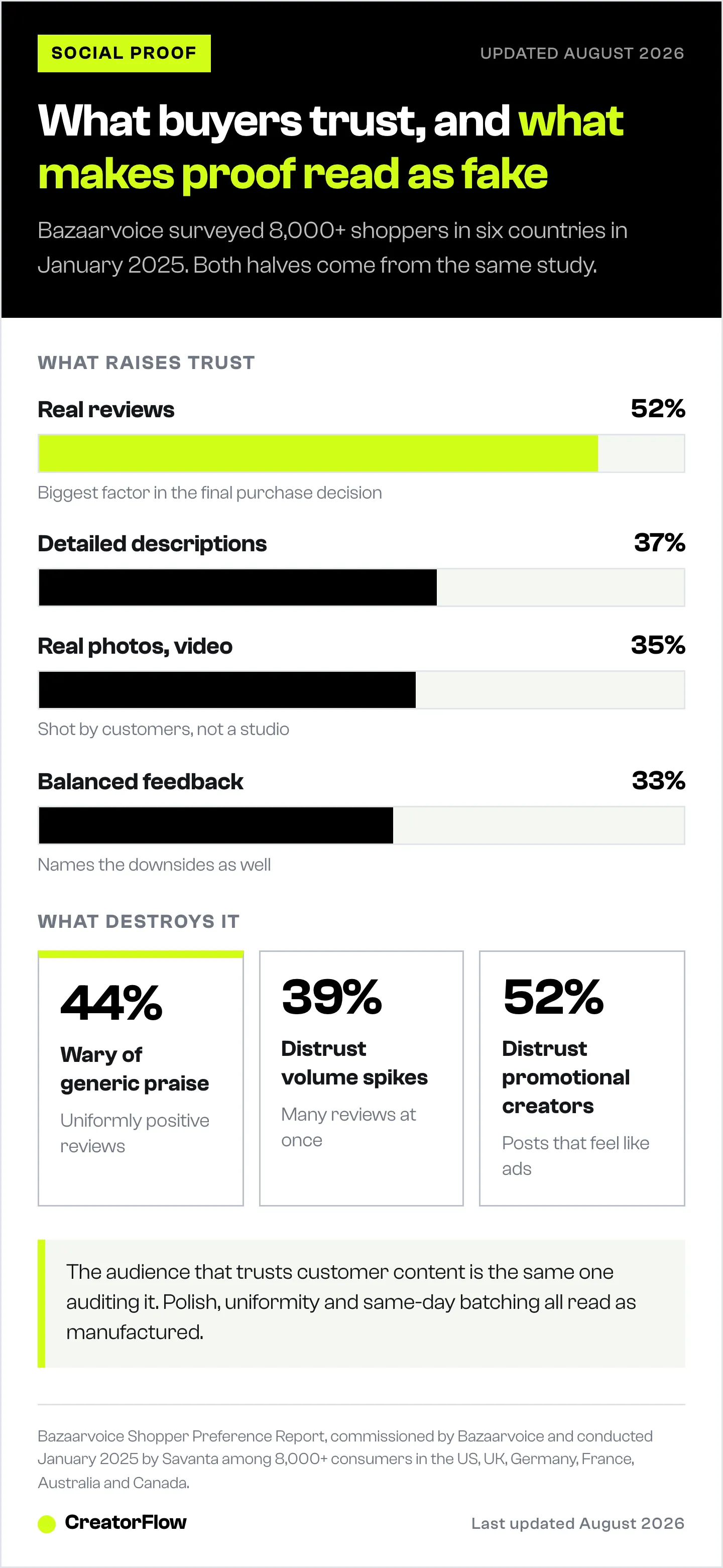
What raises trust:
- Real customer reviews, named as the biggest factor in the final purchase decision by 52% of shoppers
- Detailed product descriptions (37%)
- Real-life photos and videos (35%)
- Balanced feedback that covers the downsides (33%)
What destroys it:
- Overly positive, generic reviews (44% are wary)
- A suspiciously high volume of reviews in a short period (39%)
- Creator content that feels overly promotional (52% distrust it)
An earlier volume of the same research programme, the Shopper Experience Index published in November 2024 from a survey of more than 8,000 global shoppers, found 65% of shoppers rely on customer content in buying decisions and 86% engage with creator content before buying (bazaarvoice.com, November 2024).
Put the two halves together and the instruction is uncomfortable for most brand accounts. Shoppers want more customer content and less produced customer content. Specificity, real photos and admitted flaws raise trust. Polish, uniformity and batching lower it.
Social Proof Has a Credibility Budget
Every piece of customer content starts with a full credibility balance: a named author, a timestamp, an unedited sentence, a face. Each production decision you make spends some of it.
Crop the username out of a comment screenshot and the viewer cannot verify the person. Set a testimonial in your brand template and it now looks exactly like the copy your marketing team writes. Publish twenty testimonials on the same day and you have created the volume spike that 39% of shoppers read as manufactured. Select only the five-star quotes and you produce the uniform positivity that 44% distrust.
None of those steps is dishonest. Each one is a normal design instinct, and each one trades a point of believability for a point of polish. The trade is worth making sometimes. It is worth making deliberately.
The practical version of the rule: publish the proof in the form closest to how it arrived. A screenshot with the handle visible beats a designed quote card. A customer’s own reel beats your edit of their footage. A three-sentence DM reply with a spelling mistake in it beats a cleaned-up testimonial.
The Six Types, Ranked by What Survives Scrutiny
| Proof type | Can a viewer verify the author | Credibility cost | Best placement |
|---|---|---|---|
| Customer feed post or reel that tags you | Yes, the handle is tappable | Lowest | Repost, story, product page |
| Story mention from a customer | Yes, while it is live | Low, but it expires | Reshare same day |
| Comment or DM screenshot with the handle visible | Partly, the handle is readable but not tappable | Medium | Story, carousel slide |
| Photo or video review from a verified buyer | Yes, if the platform issues a purchase badge | Low | Product page, email, ads |
| Creator partnership post | Yes, and disclosure is required | Medium, the audience discounts paid posts | Feed, paid amplification |
| Written testimonial in your brand template | No | Highest | Use when nothing better exists |
Two rows deserve a note. Follower counts and like counts get called social proof often, and they are the weakest form, because they say a lot about your reach and nothing about the product. Treat them as bio decoration rather than evidence.
Creator posts sit mid-table for a reason that is a feature rather than a defect. The audience knows a partnership is paid, and 52% report distrusting creator content that feels overly promotional. The creators who convert are the ones who name a drawback, which is the same balanced-feedback signal that 33% of shoppers say they trust.
The Three Clocks That Decide What You Can Capture
Proof is only half the job. The person who made it is the durable asset, because they can be reached again. Meta’s platform sets three separate timers on that, and each one closes a different door.
| Clock | Duration | What it governs |
|---|---|---|
| Story clock | 24 hours | A customer’s story mention disappears from feed, profile and Direct unless they save it as a highlight |
| Comment clock | 7 days | A private reply to a comment on a post, ads post or reel must be sent within 7 days of the comment |
| Conversation clock | 24 hours | Once someone messages you, standard messaging runs for 24 hours from their last message |
The details underneath those numbers matter more than the numbers.
A comment buys you exactly one message. Meta’s private replies documentation states that only one message can be sent to the Instagram user who commented, and that the conversation continues only when that user responds, at which point the 24-hour messaging window opens (developers.facebook.com, July 2026). One shot, then their move. A private reply that asks nothing gets no reply and the thread ends there.
Live comments are stricter. Private replies to comments on an Instagram Live can be sent only during the broadcast. Once it ends, they cannot be sent at all (developers.facebook.com, July 2026).
A story mention is proof you can see and not proof you can own. Meta’s story mention documentation states you must not store or cache the media content on your server, and that once the user deletes the story or it expires the URL stops rendering (developers.facebook.com, June 2026). Instagram’s own help pages confirm the 24-hour expiry and note that the archive belongs to the person who posted it (help.instagram.com, August 2026). Reshare it on the day, ask the customer for the original file if you want to keep it, and treat the mention itself as a prompt rather than an asset.
Hashtag discovery is a dead end for outreach. Meta’s hashtag recent media and top media references both state that you cannot request the username field on returned media objects (developers.facebook.com, August 2026). The endpoint shows you the post and withholds the poster. A branded hashtag is a way to see what people are making. It is not a way to reach them. Our breakdown of what UGC tracking can and cannot measure covers the reporting consequences of that split.
Tagged media is the exception that works. GET /{ig-user-id}/tags returns the media objects your professional account was tagged in, with the posting account attached (developers.facebook.com, July 2026). Tags are the queryable library. Comments and story replies are the real-time triggers.
How to Capture Proof Before the Window Closes
The workflow that fits those constraints is short.
-
Reply inside the window, automatically. A comment carrying a keyword triggers a DM in seconds rather than whenever someone checks notifications. This is the mechanic behind every tool in the category, including Klaviyo Social Marketing, and CreatorFlow runs it on comment triggers, story reply triggers and keyword triggers. Choosing the trigger word well matters more than people expect, which is covered in our guide to Instagram comment keywords that convert.
-
Spend the one message on a question. The reply has to earn a response, because the thread dies without one. “Thanks for the tag” earns nothing. “Which colour did you get, and would you mind if we reshared this?” earns a reply, a detail you can quote, and a permission record in the same breath.
-
Ask for the email while the conversation is open. Once they reply, the 24-hour window is live. That is the moment to offer something worth an address. CreatorFlow’s Email Gate collects the address inside the DM before the link goes out, and Pro exports the contacts to CSV for your email platform. The full mechanics are in our guide to collecting emails inside Instagram DMs, and the routing options for each major platform are in the walkthrough of Instagram DMs to Klaviyo, Kit and Mailchimp.
-
Get the rights in writing, in that thread. A tag is not a licence. Name the post, the channels, the time period and whether paid ads are included, because a bare yes covers none of that. The full request template is in our guide on how to request usage rights in a DM.
The whole sequence lives inside one conversation, which is why the DM is the right room for it rather than an email sent three days later.
What You Can and Cannot Offer for Proof
Incentives are where good social proof programmes get into legal trouble, and the line is sharper than most brands assume.
The FTC’s Consumer Reviews and Testimonials Rule took effect on October 21, 2024. The agency’s own guidance states that the rule does not prohibit giving incentives for reviews, so long as there is no express or implied requirement that the review express a particular sentiment. Asked directly whether a brand may pay for five-star reviews if reviewers disclose the incentive, the FTC answers no, and cites section 465.4 (ftc.gov, August 2026).
Disclosure does not cure a sentiment condition. It is a separate obligation on top of it.
The second obligation catches a practice almost every brand runs without thinking about it. The FTC’s Endorsement Guides name “the possibility of being paid, of winning a prize, or of appearing on television or in other media promotions” as a material connection requiring clear and conspicuous disclosure (16 CFR 255.5, effective July 26, 2023). A giveaway entry sits inside that list by name. Offering to feature someone on your account is not called out in those words, but it falls squarely under appearing “in other media promotions”, and the Guides work through the logic in an example about a restaurant that posts a sign telling patrons they may appear in a television ad.
That example draws the line worth copying. When people know in advance they might be featured, the expectation is itself the connection and needs disclosing, because a patron who reads the sign “might be more inclined to give a positive review of that item in order to appear on television”. When someone posts spontaneously and you ask permission afterwards, the featuring triggers nothing. Announcing “post with our hashtag and we might reshare you” is the first case. Replying to a tag you did not solicit is the second.
The FTC’s plain-English guidance also suggests putting the word contest or sweepstakes into the hashtag, and notes that an abbreviation like #sweeps probably is not enough because many people would not understand it.
Three rules cover most cases:
- Ask for a review or a post, never for a positive one
- Disclose the incentive, including a prize draw or an announced chance to be featured
- Keep the negative reviews visible, since suppressing them is separately covered by the rule
Running this as a standing programme rather than a one-off ask changes the disclosure obligations, because a recurring reward creates an ongoing relationship. The structure for that sits in our guide to building a social media ambassador program.
The balanced-feedback data argues the same way the rule does. The 33% who trust reviews that cover downsides are not reachable with a wall of five stars.
Where the Proof Belongs
Instagram is where proof is created and a poor place to store it. Organic engagement on Instagram averaged 0.48% of followers across 35 million posts from 447,613 pages during 2025 (Socialinsider, February 2026). Your best customer photo reaches a small slice of the people you already have, once, and then the feed moves on.
Placement by job:
- Product page: photo and video reviews from verified buyers, where a deciding shopper is one click from paying
- Welcome email and abandoned-browse flows: the specific quote that answers the objection that stage raises
- Instagram highlights: reshared customer stories, grouped by product, so the proof outlives the 24 hours
- Paid ads: customer footage you hold written rights to, which converts better than studio work and is also the place a missing permission costs the most
- Your own feed: the reshare, credited, which costs nothing and makes the next customer more likely to post
The reason to move proof off the platform is the same reason to capture the person: the algorithm decides who sees an Instagram post, and you decide who sees an email. That trade is the subject of our comparison of the DM funnel and the email funnel.
How to Tell If It Is Working
Three measurements, in order of how much they tell you.
Reply rate on rights requests. The percentage of DM requests that get a yes. Below 40% usually means the ask arrived late or asked for too much at once.
Proof-attached conversion. Run the product page with customer photos against the version without. This is the only number that isolates the effect of the proof itself rather than the traffic that saw it.
Contacts captured per campaign. How many email addresses came out of the customer conversations you started. This is the compounding one, because a contact stays reachable after the post stops performing.
Vanity counts on the proof posts themselves belong nowhere near this list. A customer photo with 4,000 likes and no captured contact produced a good afternoon and no asset.
FAQ
What is social proof on Instagram?
Social proof on Instagram is evidence from people other than your brand that supports a purchase: customer photos and reels that tag you, story mentions, comments, DM replies, creator posts and reviews from Instagram customers. It works when the viewer can verify who created it, which is why a tappable handle carries more weight than a designed quote card.
What kind of social proof do buyers trust most?
Real customer reviews, named the biggest factor in the final purchase decision by 52% of shoppers, followed by detailed product descriptions (37%), real-life photos and videos (35%), and balanced feedback covering downsides (33%). The same survey found 44% are wary of overly positive generic reviews (Bazaarvoice Shopper Preference Report, Savanta, January 2025).
Can I repost a customer’s photo if they tagged me?
Reposting inside Instagram with credit is a platform norm, and Instagram’s native repost feature credits the original poster. Using the photo in an ad, an email or on a product page is a different act that needs written permission, because the person who took the photo owns the copyright. Ask in the DM and keep the reply.
How long do I have to reply to an Instagram comment?
Seven days. Meta allows a private reply to a comment on a post, ads post or reel within 7 days of the comment, and only one message per commenter. The conversation continues only if that person replies, which then opens a 24-hour messaging window (developers.facebook.com, August 2026). Comments on an Instagram Live are stricter and can only receive a private reply during the broadcast.
Can I save a customer’s story mention?
Not the media file. Meta’s documentation states you must not store or cache story mention media on your server, and the URL stops rendering once the story expires or is deleted (developers.facebook.com, June 2026). Reshare it the same day, and ask the customer to send you the original file if you want a copy you can keep and use.
Can I offer a discount in exchange for a review?
Yes, provided you do not require the review to be positive. The FTC’s Consumer Reviews and Testimonials Rule permits incentives but bars conditioning them on sentiment, and the agency states that paying for five-star reviews violates section 465.4 even when the incentive is disclosed (ftc.gov, August 2026). The incentive itself, including the chance to be featured, still has to be disclosed.
Does a branded hashtag help me find customers to contact?
It helps you find the content, not the person. Meta’s hashtag search endpoints do not return the username field on media objects, so a hashtag hit gives you a post you cannot attribute or reply to (developers.facebook.com, August 2026). Tagged media and mentions carry the account, which is why they are the surfaces worth building a workflow on.
Where to Start
Open your tagged tab and look at the five most recent posts. Reply to each one in a DM, ask which product they bought and whether you can reshare, and save every yes with the date and the channels it covers. That takes an afternoon and produces five pieces of attributable proof plus five open conversations.
Then automate the part that keeps missing the window. CreatorFlow replies to comments, story replies and keywords in seconds, collects emails inside the DM with the Email Gate, and tracks clicks and location on every link you send. Flat $15 a month on Pro, free plan available.
Shopper survey figures from the Bazaarvoice Shopper Preference Report, commissioned by Bazaarvoice and conducted in January 2025 by Savanta among 8,000+ consumers in the US, UK, Germany, France, Australia and Canada, and the Bazaarvoice Shopper Experience Index Vol 18, November 2024. Instagram platform behaviour verified against Meta’s Instagram Platform reference for private replies, story mentions, hashtag search and tagged media as of August 2026. Story expiry verified at help.instagram.com, August 2026. FTC positions verified against 16 CFR 255.5, 16 CFR Part 465 and the FTC’s published questions and answers, August 2026. Engagement benchmark from Socialinsider’s Instagram study of 35 million posts across 447,613 pages, published February 2026 covering calendar 2025. Individual results vary.


