
Real estate agents get leads on social media by turning public engagement into a private conversation, then moving that conversation off the platform before it expires. NAR’s 2025 Technology Survey ranks social media the top lead-generating technology at 39%, ahead of CRM at 23% and the local MLS at 17%. The constraint is timing: Instagram’s messaging window closes 24 hours after a lead’s last reply.
You post a listing Reel. Thirty people comment “price?” You are mid-showing. You reply that evening, and Instagram has already shut the door on eleven of them because more than 24 hours passed since their last message. Those eleven were never bad leads. They were leads with an expiry date nobody told you about.
This guide covers what NAR’s own data says about where real estate leads come from, why the platform-picking advice you have read misses the binding constraint, the capture flow that converts a comment into a contact record inside one exchange, what to post so the flow has something to catch, and the fair housing rules that apply the moment automation answers first.
Key Takeaways
- Social is already the top lead source, and almost nobody automates it. 39% of REALTORS name social media their best lead-generating technology, 15% now say no technology produces quality leads at all, and 7% use chatbots for lead capture or client communication (National Association of REALTORS, 2025 REALTORS Technology Survey, September 2025)
- The 24-hour window is the real constraint. Meta’s Instagram messaging API lets you reply within 24 hours of a user’s last message. Miss it and the automated reply is blocked, not delayed
- The transaction is 10 weeks out, minimum. Buyers searched a median of 10 weeks in NAR’s 2025 Profile of Home Buyers and Sellers. A platform thread that expires in 24 hours cannot hold a 10-week relationship
- Capture beats posting. The job of a listing post is to produce an email address or a phone number in the first exchange, not a comment count
- Qualify with three questions, not seven. Timeline, financing status, and area. Anything more reads as an interrogation and drops people mid-flow
- Fair housing follows the automation. HUD guidance is explicit that the Fair Housing Act applies to housing advertising delivered through digital platforms and automated systems. The bot answers as you, and the liability stays with you
- Bottom line: pick one post, one keyword, and one capture step that ends in an email address, and run it before you build anything larger
How Do Real Estate Agents Get Leads on Social Media?
Real estate agents generate social media leads through a three-step chain: a post that invites a specific public action, an automated private reply that fires within seconds of that action, and a capture step that collects an email address or phone number before the platform’s messaging window closes. Comment-triggered DMs are the most common entry point because commenting costs a buyer nothing and signals intent publicly.
Everything else on social media is upstream of that chain. Follower count, posting frequency, hashtag strategy, and video quality all affect how many people reach step one. None of them affect whether step three happens, and step three is where a stranger becomes a lead you own.
Is Social Media Still the Top Source of Real Estate Leads?
Yes. Social media ranked first among lead-generating technologies in NAR’s 2025 survey at 39%, below the 52% it scored in 2024. That drop is a measurement artifact rather than a decline. The 2025 questionnaire added two answer options that did not exist the year before, and between them they absorbed a quarter of all responses. Every technology on the list fell. Social media fell the least.
Here is the full comparison, both years taken from NAR’s own reports.
| Technology | 2024 | 2025 | Share retained |
|---|---|---|---|
| Social media | 52% | 39% | 75% |
| CRM | 32% | 23% | 72% |
| Business website | 18% | 12% | 67% |
| Local MLS | 26% | 17% | 65% |
| Brokerage website | 20% | 13% | 65% |
| Listing syndication portal | 14% | 9% | 64% |
| Digital ad campaign | 19% | 12% | 63% |
| Email marketing tool | 19% | 11% | 58% |
| Blog | 2% | 1% | 50% |
| Other | not offered | 10% | new option |
| None of these | not offered | 15% | new option |
Sources: National Association of REALTORS 2024 Technology Survey (published August 2024) and 2025 REALTORS Technology Survey (published September 2025). NAR’s 2025 report describes the 39% as consistent with the prior year’s reporting, meaning social media held its rank at the top of the list.
Two things fall out of that table. Social media kept more of its score than anything else on the list, so its lead over CRM widened rather than narrowed. And 15% of REALTORS, asked which technology produces their highest number of quality leads, now answer that none of them do.
That 15% is the number worth sitting with. It was not offered as an option in earlier years, so there is no trend line yet. What it says is that roughly one agent in seven is running the same tools as everyone else and getting nothing countable out of any of them.
Both blocs are posting. What separates them is what happens after someone engages, and NAR measured that too.
The 39/7 Gap Hiding in NAR’s Data
That 2025 survey drew 1,241 usable responses at a 2.5% response rate, with a margin of error of plus or minus 2.78%. Two of its numbers sit next to each other and do not agree.
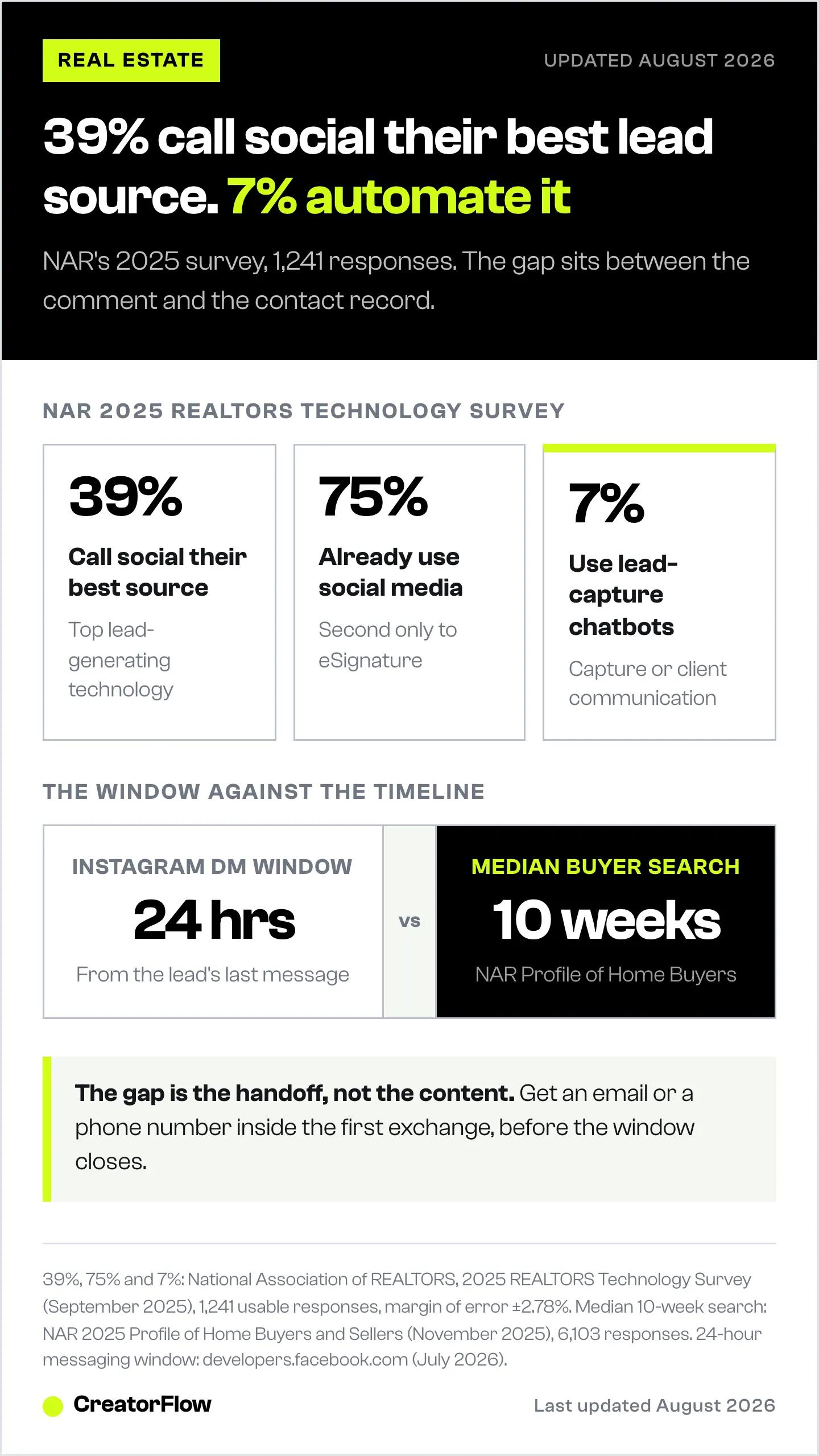
Social media is the top quality-lead source at 39%. Asked separately which technologies they currently use in their business, 75% of REALTORS said social media, second only to eSignature at 79%.
Then, in the same list of current technologies, chatbots for lead capture or client communication came in at 7%.
So three quarters of agents are on social media, two fifths call it their single best lead source, and fewer than one in fourteen has automated the step where a social lead becomes a contact record. That is the gap. It is not a content gap or a platform gap. It is a handoff gap, and it sits between the comment and the CRM.
The reason it persists is that the handoff feels like it should be free. Someone commented. You will reply. The problem is that you will reply in four hours, and by then the platform has changed the rules on you.
Why Social Media Real Estate Leads Expire in 24 Hours
Meta’s Instagram messaging API allows your tool to respond within 24 hours of a user’s last message. After that, the standard window is closed. The HUMAN_AGENT tag extends the reply period to 7 days, but Meta restricts it to genuine human agent support, requires a separate app permission, and prohibits using it for automated or bot messages (developers.facebook.com, July 2026).
Read that against how home buyers behave. In NAR’s 2025 Profile of Home Buyers and Sellers, published November 2025 from 6,103 responses, the median buyer searched for 10 weeks, 88% bought through an agent or broker, and 91% of sellers listed with one.
Ten weeks of searching against a 24-hour messaging window. No amount of posting closes that gap.
This is what most social media advice for agents gets wrong. It treats the platform as the place where the relationship lives. The platform is a lobby with a door that locks behind people. The relationship has to live somewhere you control, which makes the only job inside those 24 hours getting an email address or a phone number out of the conversation.
Which Platform Should a Real Estate Agent Post On?
Pick the platform by whether it lets you capture and export a lead automatically, not by its audience demographics. A platform where you can trigger a private message from a public comment and collect contact details inside that thread is a lead channel. A platform without that path is a discovery channel, and discovery channels have to hand off to somewhere else before they are worth your posting time.
| Platform | Automated DM capture available? | What it realistically does for an agent |
|---|---|---|
| Yes, through Meta’s official Instagram API: comment triggers, keyword DMs, Story replies | Converts engagement into contact records | |
| Yes, through the Messenger platform, plus the strongest geographic ad targeting | Paid reach into a defined farm area | |
| No. The Messages API is restricted to approved partners under the Compliance Partner Program, and LinkedIn’s terms require messages be tied to a member action rather than an automated event | Referral and commercial relationships, worked by hand | |
| TikTok, YouTube | No broadly available automated DM path for most accounts | Discovery that must route people to a capture channel |
For where agents actually are, NAR’s 2024 survey put Facebook at 87% of REALTORS, Instagram at 62%, LinkedIn at 48%, YouTube at 25%, TikTok at 15%, and X at 10% (National Association of REALTORS, 2024 Technology Survey, August 2024). The 2025 edition dropped the platform breakdown, so 2024 remains the most recent published split. The two platforms with working capture mechanics are also the two with the widest adoption, which settles the tooling question for most agents before they ask it.
That table is the whole platform decision for lead generation. LinkedIn still earns your time for referral and commercial work, but treat it as manual relationship work and staff it accordingly. For listing inquiries that turn into booked showings without you touching your phone, Instagram and Facebook are where the mechanics exist.
The Capture Flow: From Comment to Contact Record in One Exchange
The flow that works has four beats and fits inside a single 24-hour window. Each beat has one job, and none of them ask for more than the lead has already offered.
Beat 1: the trigger. Your caption names one keyword. “Comment TOUR and I’ll send the full listing plus my calendar.” One keyword per post. Multiple keywords on one post split your data and confuse the automation.
Beat 2: the instant reply. The DM lands in seconds and delivers something before asking for anything. Full specs, the price, three more photos, the neighborhood breakdown. Value first is not a courtesy here, it is a conversion mechanic: a lead who received nothing has no reason to answer your next message.
Beat 3: the capture. One question, framed as a service rather than a form. “Want the full PDF with floor plans and the HOA breakdown? Drop your email and it’s on the way.” This is the beat almost every agent skips, and the only one that survives past the 24-hour window. Our guide on collecting email addresses inside the DM thread covers the wording that gets the highest reply rate.
Beat 4: the qualification, then the calendar. Three questions, not seven:
- Are you looking to buy in the next 30 days, 3 months, or exploring?
- Have you spoken with a lender yet?
- Which areas are you looking at?
Timeline, financing, geography. Those three sort a serious buyer from a browser well enough to decide whether the call goes on your calendar this week. A lead who answers “30 days, pre-approved, and I know exactly which neighborhood” gets your booking link immediately. Everyone else gets added to a nurture list you email, which is the only channel that still works in week six. For the deeper version of this framework, see how to qualify Instagram leads before a discovery call, and for the booking handoff, auto-booking calls through Calendly.
The full mechanical walkthrough of triggers, keywords, and message blocks lives in our comment-to-DM setup guide. If you want the real-estate-specific templates for open house RSVPs, seller valuations, and no-show follow-ups, those are in our guide to Instagram DM automation built for real estate agents.
What to Post So the Capture Flow Has Something to Catch
The flow above is inert without posts that give people a reason to comment. Five post types carry most of the load for agents, and each one maps to a different keyword and a different capture asset.
| Post type | Keyword | What the DM delivers | Captures |
|---|---|---|---|
| New listing walkthrough | TOUR | Specs, price, showing link | Email + timeline |
| Open house announcement | RSVP | Address, directions, calendar file | |
| Neighborhood or market update | REPORT | Local market PDF | |
| First-time buyer education | CHECKLIST | Pre-approval checklist | Email + lender status |
| Just sold | READY | Consultation booking link | Phone |
Two of those five are seller-facing or seller-adjacent, which matters because seller leads are worth more and get chased less on social. The market update post is the one most agents underuse: it produces the fewest comments and the most valuable contact records, because a homeowner who wants a neighborhood report is thinking about their own equity.
The constraint on running all five is production. Two to four listings a week, a monthly market card, and a just-sold post after every closing adds up to roughly fifteen branded graphics a month, and the moment they stop looking like they came from the same agent, the credibility that makes someone hand over an email address goes with it.
That is a design problem rather than a marketing one. DesignerBox, an AI creative studio built around a brand kit, handles it by loading your brokerage colors, logo, fonts, and headshot once, then generating listing graphics, market cards, and open-house announcements against that kit so a month of posts stays visually consistent. Campaigns save as reusable workflows, which matches how listing content works: same template, new address, every week. The free tier is 112 credits a month, every plan includes the full set of image, video, and avatar models, commercial-use licensing starts on the Pro tier, and paid plans carry a 7-day trial with roughly 40% off on annual billing (designerbox.ai/pricing, July 2026). Disclosure: DesignerBox is built by the same team as CreatorFlow.
For post ideas beyond the five above, our list of Instagram content ideas that generate leads covers formats by niche.
Fair Housing Rules When Automation Answers First
Automated messaging does not create a separate compliance category. The Fair Housing Act applies to housing advertising and communication regardless of whether a person or a system sends it, and HUD’s Office of Fair Housing and Equal Opportunity issued guidance in 2024 on how the Act applies to housing advertising delivered through digital platforms that use algorithms and automated systems for targeting and delivery (hud.gov, HUD No. 24-098, May 2024). The tool is your agent. What it sends, you sent.
Practical consequences for an agent running DM automation:
- Do not use protected characteristics in ad targeting or automation branching. Targeting or excluding audiences by characteristics protected under the Act, or steering people toward particular neighborhoods, is the exact conduct HUD’s guidance addresses
- Do not write neighborhood descriptions into templates that describe people rather than property. “Great for families” is a phrase about occupants. “Three bedrooms, fenced yard, walkable to the elementary school” is a phrase about a house
- Send every lead the same qualifying questions. A branching flow that asks different people different things based on how they answered an early question is where disparate treatment becomes provable, because every DM is a written record
- Identify yourself in the template. Name, brokerage, and license number where your state requires it, plus the standard information-deemed-reliable line
- Test the flow yourself. Run your own automation from a second account and read what it says back. Most compliance problems in automated messaging are template problems, and templates are easy to fix before they scale
On the platform side, Meta’s own rules on what automated DMs may and may not do are covered in our breakdown of what Meta allows and bans in automated DMs.
What Social Media Lead Capture Costs
Comment-to-DM tooling is priced in two shapes, flat rate by message volume or metered by active contact, and the shape matters more than the headline number for an agent whose audience grows over a couple of years.
| Tool | Entry price | Pricing model | Fit |
|---|---|---|---|
| CreatorFlow | Free plan at $0 (500 DMs/month, 1 workspace), Pro $15/month (5,000 DMs, 2 workspaces), Growth $30/month (10,000 DMs, 5 workspaces) | Flat rate by DM volume | Solo agents and small teams; Instagram only |
| ManyChat | Free plan (25 active contacts), Essential $17/month (250 contacts), Pro $39/month (2,500), Business $99/month (7,500), Advanced $199/month (25,000); annual billing runs $14/$29/$69/$139 per month | Per active contact | Teams needing Facebook, WhatsApp, SMS, and TikTok alongside Instagram |
| LinkDM | Free plan (1,000 DMs/month), Pro $19/month (up to 3 Instagram accounts) | Flat rate by DM volume | Agents wanting a large existing user base; reports 50,000+ creators, brands, and agencies |
Pricing verified from manychat.com/pricing and help.manychat.com, linkdm.com, and creatorflow.so, July 2026. ManyChat’s current plan structure applies to accounts created on or after March 2, 2026.
The choice comes down to one question: do you need channels beyond Instagram? If your leads arrive through Facebook groups and WhatsApp as well, ManyChat covers all of them in one place and the per-contact model is the price of that coverage. If Instagram is where your listings live and you want the cost fixed as your following grows, a flat-rate tool does the same capture job for a number that does not move. CreatorFlow adds a follow gate, an email gate, and click analytics by country and city on the $15 tier, which is where most solo agents land. A fuller side-by-side is in our comparison of Instagram DM automation tools.
Against one lost showing, all three are rounding errors. The expensive line item is the eleven expired conversations from that listing Reel.
FAQ
What is the best social media platform for real estate leads?
Instagram and Facebook, because both support automated comment-to-DM capture through Meta’s official APIs. LinkedIn generates strong referral and commercial relationships but has no generally available messaging API, so leads there are worked manually. TikTok and YouTube function as discovery channels that need to route people somewhere capture is possible.
How many followers does a real estate agent need to get leads on social media?
Follower count is close to irrelevant for lead capture. A local listing post seen by 800 people in your farm area produces more qualified conversations than a viral Reel seen by 80,000 people scattered across the country. What matters is whether the post has one clear keyword and whether the reply captures contact details before the messaging window closes.
Do social media leads convert as well as referrals?
Referrals convert faster because trust already exists. Social media leads arrive earlier in the buying cycle, which is why the median buyer’s 10-week search matters: a social lead you captured in week one is a referral-grade relationship by week eight if you nurtured it off-platform. Captured leads convert. Uncaptured ones expire.
Is automated DM messaging allowed on Instagram for real estate agents?
Yes, through Meta’s official Instagram API. Tools connect by OAuth without password sharing, respect the 24-hour messaging window, and pace sends to stay clear of spam thresholds. Ban risk stays low when you use an approved tool and follow the platform’s rules, though no API guarantees absolute account safety.
How do I qualify a real estate lead in a DM without being pushy?
Deliver value first, then ask three questions: timeline, lender status, and target area. Frame each as something that helps you send better information rather than something that screens them. Stop at three. Qualification flows that run past four questions read as interrogation and lose people before the calendar link.
Can automated messaging violate Fair Housing rules?
Yes. HUD’s 2024 guidance confirms the Fair Housing Act applies to housing advertising delivered through digital platforms and automated systems. Discriminatory ad targeting, steering language in templates, or branching logic that treats groups differently all create exposure, and every automated message is a written record. Using a vendor does not transfer the liability.
Is social media still the top lead source for real estate agents?
Yes. It ranked first in NAR’s 2025 Technology Survey at 39%, ahead of CRM at 23% and the local MLS at 17%. The figure sits below 2024’s 52% because the 2025 questionnaire added “Other” and “None of these” options that together took a quarter of responses. Every listed technology’s score fell, and social media’s fell the least.
What share of real estate agents say no technology generates quality leads?
15%, in NAR’s 2025 Technology Survey. The option was not offered in earlier years, so there is no trend to compare it against. It sits alongside the 7% who use chatbots for lead capture, which points at the handoff after the engagement rather than at the posting itself.
How much does social media lead capture cost a real estate agent?
Between $0 and $30 a month for most solo agents. CreatorFlow’s free plan covers 500 DMs a month and Pro runs $15; LinkDM’s free plan covers 1,000 DMs and Pro runs $19; ManyChat starts free at 25 active contacts with paid plans from $17 a month, priced by contact count rather than message volume (July 2026).
The Bottom Line
Social media is already the top lead-generating technology for REALTORS at 39%, it held that rank better than any other tool on NAR’s list, and only 7% have automated the step where a comment becomes a contact record. Meanwhile 15% of agents say nothing they use produces quality leads. That is not a content problem waiting on better Reels. It is a 24-hour window closing on leads who are 10 weeks from a transaction.
Fix the handoff before you touch the content calendar. One post, one keyword, one automated reply that ends with an email address in your list.
Related Articles
- Instagram DM Automation for Real Estate Agents
- How to Qualify Instagram Leads Before Discovery Calls
- How to Collect Emails via Instagram DMs Automatically
- Comment-to-DM Automation: Step-by-Step Setup Guide
- Instagram DM Compliance: Meta’s Allowed vs Banned
Survey data verified from the National Association of REALTORS 2025 REALTORS Technology Survey (September 2025, n=1,241, response rate 2.5%, margin of error plus or minus 2.78%), the 2024 Technology Survey (August 2024), and the 2025 Profile of Home Buyers and Sellers (November 2025, n=6,103). Messaging window behaviour verified from Meta’s Instagram Platform documentation, fair housing guidance from HUD No. 24-098, and tool pricing from creatorflow.so, manychat.com, linkdm.com, and designerbox.ai, all as of July 2026. Individual results vary.
Disclaimer: This article is general information, not legal advice. Real estate professionals are responsible for their own compliance with the Fair Housing Act, state licensing and advertising rules, their local MLS rules, and the terms of service of any platform they use. Consult your broker or counsel before deploying automated messaging. Instagram and Facebook are trademarks of Meta Platforms, Inc. CreatorFlow is not affiliated with, endorsed by, or sponsored by Meta Platforms, Inc. ManyChat and LinkDM are trademarks of their respective owners. DesignerBox is built by the same team as CreatorFlow. Platform features, rate limits, and pricing change; verify before relying on any figure here.