

Find brands to work with by checking which ones already pay creators, not by guessing. Meta’s Ad Library publishes every active ad running on Facebook and Instagram, and its Branded Content search lists public paid-partnership posts along with the creator, the brand partner and the post type. Both are free to search. Qualify a brand on that evidence first, then pitch the short list.
You built a list of 60 brands you love. You wrote 60 versions of the same message. Two replied. One said the budget was already committed, the other never followed up. Most creators read that as a pitch problem and go rewrite the pitch.
The pitch was fine. The list was full of companies that have never paid a creator and had no plan to start. This guide covers how to build a list where every name on it has published evidence of a creator budget, using two free Meta tools plus three signals you already have access to. It is written for creators pitching brands directly, not for brands shopping for creators.
Key Takeaways
- The list decides your reply rate, not the wording. A short list of brands with proven creator spend outperforms a long list of brands you happen to like.
- Meta publishes who each brand already pays. The Branded Content search in the Ad Library returns the creator, the brand partner, the post type and a link to the post, for public paid-partnership content created on or after August 17, 2023 (facebook.com/business/help, August 2026).
- The Ad Library shows whether a brand spends at all. It contains all active ads across Meta technologies and anyone can search it by name, Page or keyword (facebook.com/business/help, August 2026).
- UK and EU delivery adds targeting data. Ads that reach the UK, EU and associated territories are archived for a year and show total reach plus the advertiser’s age, gender and location choices (facebook.com/business/help, August 2026).
- Most deals are small, so volume of the right names matters. Collabstr’s 2026 report puts the average paid Instagram collaboration at $193 against a $214 listed price, with roughly 80% of collaborations closing under $300 (collabstr.com, 2026).
- Timing is a signal you can watch for free. Launches, rebrands and new market entries release budget, and they are announced publicly before the campaign briefs go out.
- Proof wins the renewal. The creator who reports clicks, geography and captured intent from the first post is a different vendor from the one who sends a screenshot.
How to Find Brands to Work With
Find brands to work with in two free searches. Meta’s Branded Content database returns public paid-partnership posts with the creator, the brand partner, the post type and a link to the post, so you can see who a brand already pays and at what follower size. The main Ad Library shows whether a brand runs ads at all, which proves a media budget exists. Qualify on that evidence, then pitch the 10 to 15 names that clear it.
Why Most Brand Lists Go Nowhere
The standard advice is to list 20 brands you already use. It produces a list built entirely from your bathroom shelf and your kitchen cupboard, which tells you nothing about whether those companies have a marketing team, a creator line item, or a person whose job is to answer you.
Three types of dead names end up on that list. Companies that market through retail and paid search only. Companies that ran a creator program two years ago, got a bad result, and quietly stopped. And companies large enough to have a budget but locked to an agency roster you cannot reach from a DM.
None of those are visible from the product packaging. All three are visible in public data before you write anything.
What Proves a Brand Has a Creator Budget
A brand qualifies when it has published evidence of paying for distribution in the last 90 days. The strongest evidence is a paid-partnership post with a creator. The next strongest is an active ad campaign, which proves a media budget exists even if creators are not in it yet. Everything else, including follower count, aesthetic fit and how much you personally like the product, is a tiebreaker between qualified names.
That definition is deliberately narrow. It cuts a 60-name wish list down to somewhere between 8 and 15 real prospects, and those are the ones worth a personalised message.
How to See Which Creators a Brand Already Pays
Meta runs a public search of branded content at facebook.com/ads/library/branded_content. It covers public and active branded content on Facebook and Instagram carrying a paid partnership label, globally, for content created on or after August 17, 2023 (facebook.com/business/help/2405092116183307, August 2026).
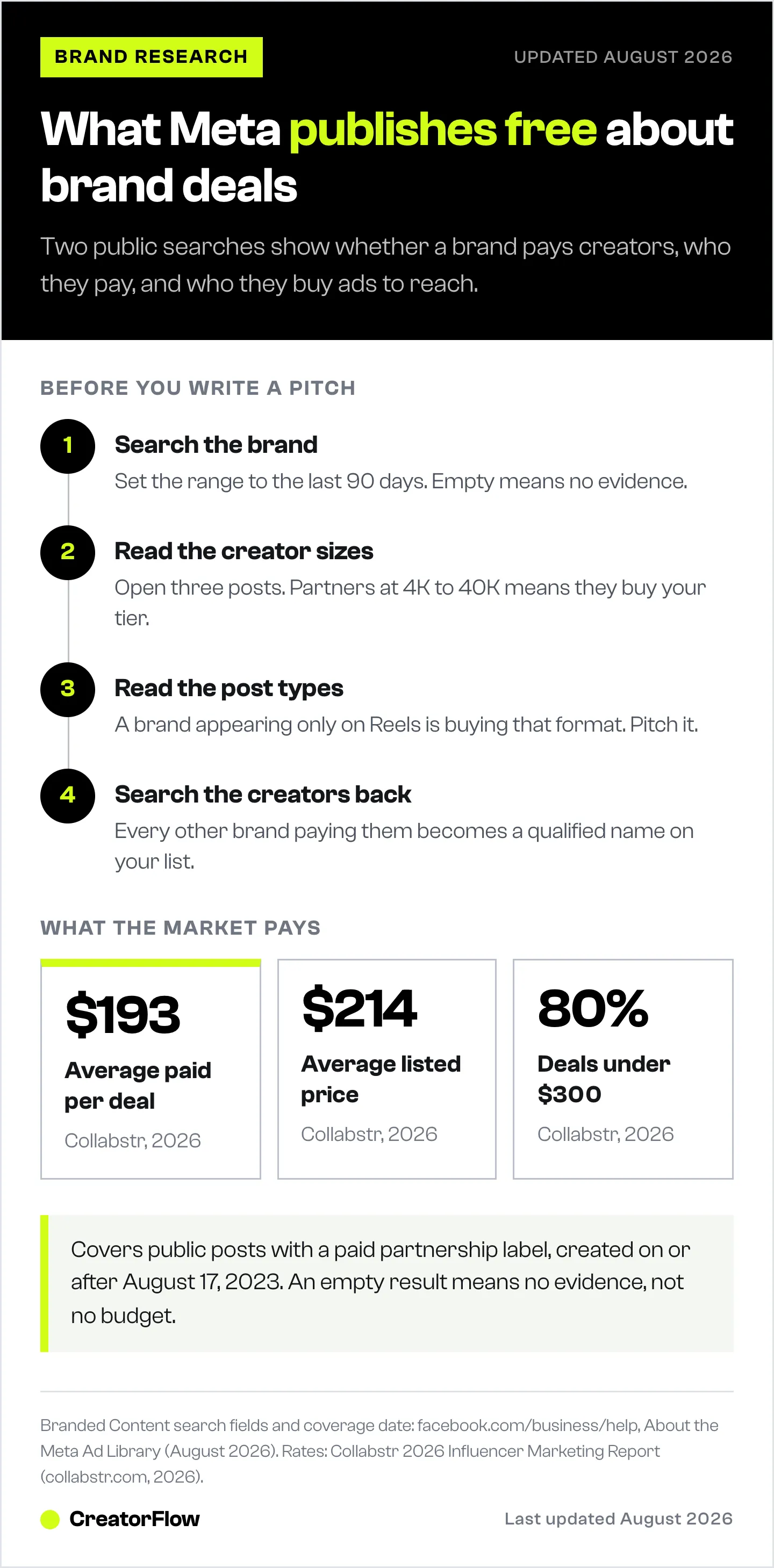
Here is what a search returns for each post: the date the branded content was created, the creator of the content, the brand partner, the type of post such as a video or a Reel, and a link to the content itself (facebook.com/business/help/2405092116183307, August 2026). You search by Page or by Instagram account, and you have to select either Facebook or Instagram plus a date range before it will run.
Run it four ways on every brand you are considering:
- Search the brand. Set the date range to the last 90 days. Empty result means no active labelled partnerships right now.
- Read the creator sizes. Open three or four of the linked posts. If every partner sits above 200,000 followers, you are looking at an agency roster. If the partners are in the 4,000 to 40,000 range, they buy at your tier.
- Read the post types. A brand that only appears on Reels is buying a format. Pitch that format.
- Search the creators back. Take a creator who partnered with your target brand and search their account instead. Every other brand paying them becomes a qualified name on your list, for free.
That fourth step is where the list gets built. One qualified brand leads to a creator, and that creator leads to five more qualified brands in the same category.
Two honest limits. The database only catches posts where the label was applied, so a brand paying creators who skip the label will look inactive. And it shows active public content in the window you select, not a lifetime history. Treat an empty result as “no evidence”, not as proof of nothing.
How to Check Whether a Brand Spends on Ads
The main Ad Library at facebook.com/ads/library contains all active ads shown across Meta technologies, and anyone can view and search it by term, name or Page (facebook.com/business/help/2405092116183307, August 2026). If a company is running ads, it has a media budget, a person managing it, and a reason to care about cheaper distribution.
What you see depends on where the ad runs. For an ordinary commercial ad that is not political and does not deliver to the EU, you get the ad creative, the Page it ran from and the date it started. No spend figure, no impressions, and no archive once it stops (facebook.com/business/help/2405092116183307, August 2026).
Ads delivered to the UK, EU and associated territories carry more. Those are archived for one year after the last impression and display total reach plus the targeting the advertiser chose at ad level, including age, gender and location, and whether each was included or excluded (facebook.com/business/help/2405092116183307, August 2026).
For a UK or EU creator that last part is the most useful data in this whole article. You can read the exact age band, gender split and country list a brand is paying to reach, then say in your first message whether your audience sits inside it. That is a specific, checkable claim, and almost nobody sends one.
Read the creative too. If a brand’s ads are all talking-head video, propose talking-head video. You are not guessing at their content preference, you are reading what they already put money behind.
Two Signals You Already Have
The ads you get served. Every ad in your own feed is a brand paying a platform to reach someone with your profile. If your audience resembles you, the targeting overlap is already proven, and you can say so plainly. Screenshot the ones in your category for a week and you have a shortlist assembled from your own scrolling.
Announcements that release budget. A product launch, a rebrand, a new market, a new retail listing or a certification change all come with money attached and a deadline. Press release wires publish these for free and let you browse by industry, including consumer products and retail (prnewswire.com, August 2026). Most brands also run a press or newsroom page. Checking your category once a week gives you a reason to reach out that is about them, dated, and true.
The value here is timing. A brand three weeks into a launch has budget and a gap. The same brand five months later has neither.
Score the List Before You Write a Word
Run each name through this before it earns a message.
| Signal | Where to check | What it tells you |
|---|---|---|
| Paid partnership posts, last 90 days | Meta Branded Content search | They pay creators now, and at what size |
| Active ads on Facebook or Instagram | Meta Ad Library | A media budget exists |
| Ad targeting on UK or EU delivery | Ad Library ad detail | Exactly who they pay to reach |
| Launch, rebrand or new market | Press wires, brand newsroom | Budget is being released now |
| They served you an ad | Your own feed | Their targeting already matches you |
| Creator or ambassador page | Brand website footer | An intake route exists |
Three or more signals means pitch this week. One or two means park the name and re-check in a month, because brands move in and out of active campaigns constantly. Zero signals means the brand is not in the market, and no amount of rewriting fixes that.
A qualified list of 12 beats an unqualified list of 60 on reply rate and on close rate, and it takes less time to write because each message has something real in it.
What to Send a Brand That Qualifies
Lead with the evidence you gathered, not with your follower count. Two sentences of specific observation, one sentence of relevance, one clear ask. Something in this shape:
Saw the three Reels you ran with creators in the last month, all around 20K followers. My account sits at 18K in the same category, and 62% of my audience is in the UK, which matches the targeting on your current ads. Happy to send a short idea for a Reel in that format if you are booking for autumn.
That message is short, it names checkable facts, and it proposes the format the brand already buys. It also skips the part that gets pitches deleted, which is a paragraph about how much you personally love the product.
Send one ask. Not rates, a media kit, a contest idea and a discount code in the same message. Ask if they are booking, then let the reply decide what comes next. For what happens after they say yes, our guide to the full brand deal process from media kit to contract covers rates, negotiation and terms, and there is a version written for brand deals with under 10,000 followers.
Direct outreach is not the only route. Brand deal platforms put open campaigns in front of you and handle contracts and payment, which suits creators who would rather apply than research. The two work well together: qualify names yourself, apply on platforms in parallel.
Price the Deal Against What the Market Pays
Knowing what these partnerships are worth stops you from pricing off a follower-count calculator. Collabstr’s 2026 report puts the average listed Instagram price at $214 and the average price a brand pays at $193, with about 80% of collaborations closing under $300 (collabstr.com, 2026). Aspire’s 2026 survey of roughly 1,200 creators puts the median Instagram Reel at $250 for nano creators and $4,000 for macro creators (learn.aspireiq.com, July 2026).
Budgets are moving toward smaller accounts. Brands put an average of 23% of marketing budgets into creator partnerships in 2025 and 74% planned to increase that in 2026 (Aspire, State of Influencer Marketing 2026, February 2026). In Influencer Marketing Hub’s May 2026 survey of 600+ marketing professionals, 51% planned to expand nano partnerships and 53% micro partnerships (influencermarketinghub.com, May 2026).
The full tier-by-tier picture, including how the engagement benchmarks are calculated, is in our breakdown of what brands pay per creator tier.
Turn the First Deal Into the Second
Research gets you the first deal. Evidence gets you the fourth. Brands renew with whoever can answer the question their finance team asks, which is what the money bought.
Instagram Insights gives you reach, impressions and engagement. It cannot tell a brand how many people asked for the link, how many clicked it, or where in the world they were sitting. A comment-to-DM automation can, because every request and every click passes through it.
CreatorFlow runs that layer through Meta’s official Instagram API. Someone comments your keyword under the sponsored Reel and the link goes out in seconds, tagged and counted. Pro shows click-through rate per automation and clicks by country and city, and the email gate collects addresses inside the DM so the audience the campaign built stays yours after the contract ends. It starts at $15 per month, with a free plan for testing the flow first.
That last part changes what you can put in a wrap report: not only how many people saw the post, but how many asked, how many clicked, and where they were. Geography alone has won renewals, because a brand shipping only to the UK wants to know what share of the demand was addressable. The technical detail on running a brand’s own tracking link through an automation without breaking their attribution is in our guide to tracking a sponsored post without breaking the brand’s link.
Two more things worth having ready before the first call: a current engagement number you calculated yourself, using the method described in our guide to Instagram engagement rate by follower count, and a one-page audience summary with age, gender and top countries.
FAQ
How do I know if a brand works with influencers?
Search the brand in Meta’s Branded Content database at facebook.com/ads/library/branded_content, select Instagram, and set the date range to the last 90 days. It returns public paid-partnership posts with the creator, the brand partner, the post type and a link to the post (facebook.com/business/help, August 2026). Results mean an active creator programme. An empty result means no published evidence in that window.
Where can I see which influencers a brand has paid?
The same Branded Content search lists them by name for public labelled content created on or after August 17, 2023. Open a few posts to see the follower sizes the brand buys at. Then search those creators individually to find every other brand paying them, which is the fastest way to build a category list.
How many brands should I pitch at once?
Fewer than most advice suggests. A qualified list of 10 to 15 names, each with a specific observation in the message, produces more replies than 100 identical messages. Personalisation only works when there is something real to personalise with, which is what the qualification step produces.
Do I need a certain follower count for brands to consider me?
No fixed threshold applies across the market. Budgets are moving down: 51% of marketers planned to expand nano-influencer partnerships and 53% micro partnerships in Influencer Marketing Hub’s May 2026 survey. What matters more is whether a brand already books creators at your size, which the Branded Content search shows you directly.
Should I pitch brands I do not already use?
Yes, if they qualify and the fit is explainable in one sentence. Category adjacency works: a brand does not need to be in your niche, it needs to reach the same person. A creator posting about home cooking has a real case to make to a kitchenware brand, a grocery delivery service and a cookware retailer.
Is it better to use a platform or reach out directly?
Both, for different reasons. Platforms surface open campaigns and handle contracts and payment, which removes admin. Direct outreach reaches brands that never post a public campaign, and it lets you arrive with evidence at the moment budget is released. Run them in parallel rather than choosing.
How long should I wait before following up?
Give it 7 to 10 working days, then send one follow-up that adds something new, such as a fresh idea or a recent result. If a second message goes unanswered, move the name back to the watch list and re-check when the next launch or campaign appears in the Ad Library.
Ad Library and Branded Content search behaviour, fields and coverage dates verified from Meta’s Business Help Center (About the Meta Ad Library) and the Branded Content search page as of August 2026. Rate benchmarks from Collabstr (2026 Influencer Marketing Report), Aspire (How Much to Pay Influencers 2026; State of Influencer Marketing 2026) and Influencer Marketing Hub (Benchmark Report, May 2026). Press release browsing verified at prnewswire.com, August 2026. CreatorFlow pricing and features from creatorflow.so, August 2026. The example outreach message is illustrative. Individual results vary.


