
Instagram Trial Reels publish to non-followers only, which is the same cold audience a Meta ad buys. That makes them a free pre-flight test for ad creative. Instagram returns views, likes, comments and shares within 24 hours. Share the winner to everyone first, then promote it in Ads Manager. Judge it on shares per view, not on the view count.
Most creators run this loop backwards. They post a Reel, watch the view counter, pick whichever one got the biggest number, and put money behind it. Then the ad flops and they blame the targeting. The view count was never the signal. It is the metric Instagram shows you most prominently and the one that tells you least about whether strangers will sit through your first three seconds.
This guide covers what a Trial Reel actually measures, the one number that decides whether a Reel has earned ad spend, how to promote a winner without losing its engagement, and what Meta genuinely publishes about creative testing versus what the internet has invented. If you need the feature basics first, start with how Instagram Trial Reels work.
Key Takeaways
- Trial Reels are a cold-audience test. They go to non-followers only, so the audience composition matches what a Meta ad buys. No other free Instagram feature does that.
- The threshold dropped to 200 followers. Professional accounts need 200 followers, not 1,000. Personal accounts still need 1,000 (help.instagram.com, August 2026).
- Judge on shares, not views. Adam Mosseri named watch time, likes and sends as the top three ranking signals, and said sends matter more for unconnected reach (Instagram, January 2025). A trial gives you shares. It does not give you average watch time.
- Graduate before you promote. A trial does not appear on your profile until you share it to everyone. Share it first, then select it in Ads Manager as an existing post.
- Reposting an old Reel as a trial is now penalized. Meta’s help centre warns that reach is limited if it detects the content was shared before (help.instagram.com, August 2026).
- Meta publishes no number for how many creatives to test. Every “test 5 variants” or “you need 20 creatives a week” figure circulating online traces to agency blogs, not to Meta.
What Is the Trial Reel to Meta Ads Loop?
The loop has three stages. You publish several cuts of one idea as Trial Reels, which reach only people who do not follow you. After roughly 24 hours you compare their engagement and identify which cut held strangers. You then share that cut to everyone and put budget behind it in Ads Manager.
Organic picks the winner. Paid buys more of it. The value is that stage one costs nothing and carries no risk to your feed, because your followers never see the losers.
Meta launched Trial Reels in December 2024, describing them as “a new way to try out content and see what performs best by sharing reels with people who don’t follow you” (about.fb.com, December 2024). The feature was built for testing. Using it as a free creative lab before paid spend is the intended use, not a workaround.
Who Can Post Trial Reels Now
The requirement most articles still quote is out of date. Instagram’s help centre currently states that a professional (business or creator) account needs at least 200 followers, while a personal account needs at least 1,000. The account must be public (help.instagram.com, accessed August 2026).
That matters because the 1,000-follower figure was correct in July 2025 and has been repeated ever since. If you switched to a creator account and assumed you were locked out at 400 followers, check again.
Trial Reels can also be scheduled now. Adam Mosseri announced the change in April 2026, saying the team built it in response to a creator request (Instagram, April 2026). Scheduling matters for this loop because a clean test needs its variants posted at a consistent time.
Why a Trial Reel Predicts Ad Performance
This is the part worth understanding before you spend anything.
Instagram ranks two kinds of reach. Connected reach means accounts that already follow you. Unconnected reach means accounts that do not. A Trial Reel is 100% unconnected reach by design, because Meta’s documentation confirms followers will not see it in Feed or Reels (help.instagram.com, August 2026).
A Meta ad is also unconnected reach. You are paying to put a video in front of people with no prior relationship to you, no context for your face, and no reason to be generous with their attention. Those two audiences behave the same way. A regular Reel does not give you that read, because a chunk of its performance comes from followers who already like you.
So a trial is not a rough proxy. It is a structural match for the audience your ad budget will buy.
Meta also confirms trials are scored separately: “Trial reels are evaluated independently in Instagram’s ranking and don’t impact the performance or ranking of your standard reels content” (help.instagram.com, August 2026). A failed test costs you nothing in feed distribution.
The Metric That Decides If a Reel Deserves Ad Spend
In January 2025 Adam Mosseri posted what the algorithm weighs. His words: “the top three signals that matter most for ranking are watch time, likes and sends. So when looking at your insights, pay close attention to average watch time, likes per reach, and sends per reach.” He added a nuance that decides this whole question: “likes are slightly more important for connected content, and sends are slightly more important for unconnected content” (Instagram, January 2025).
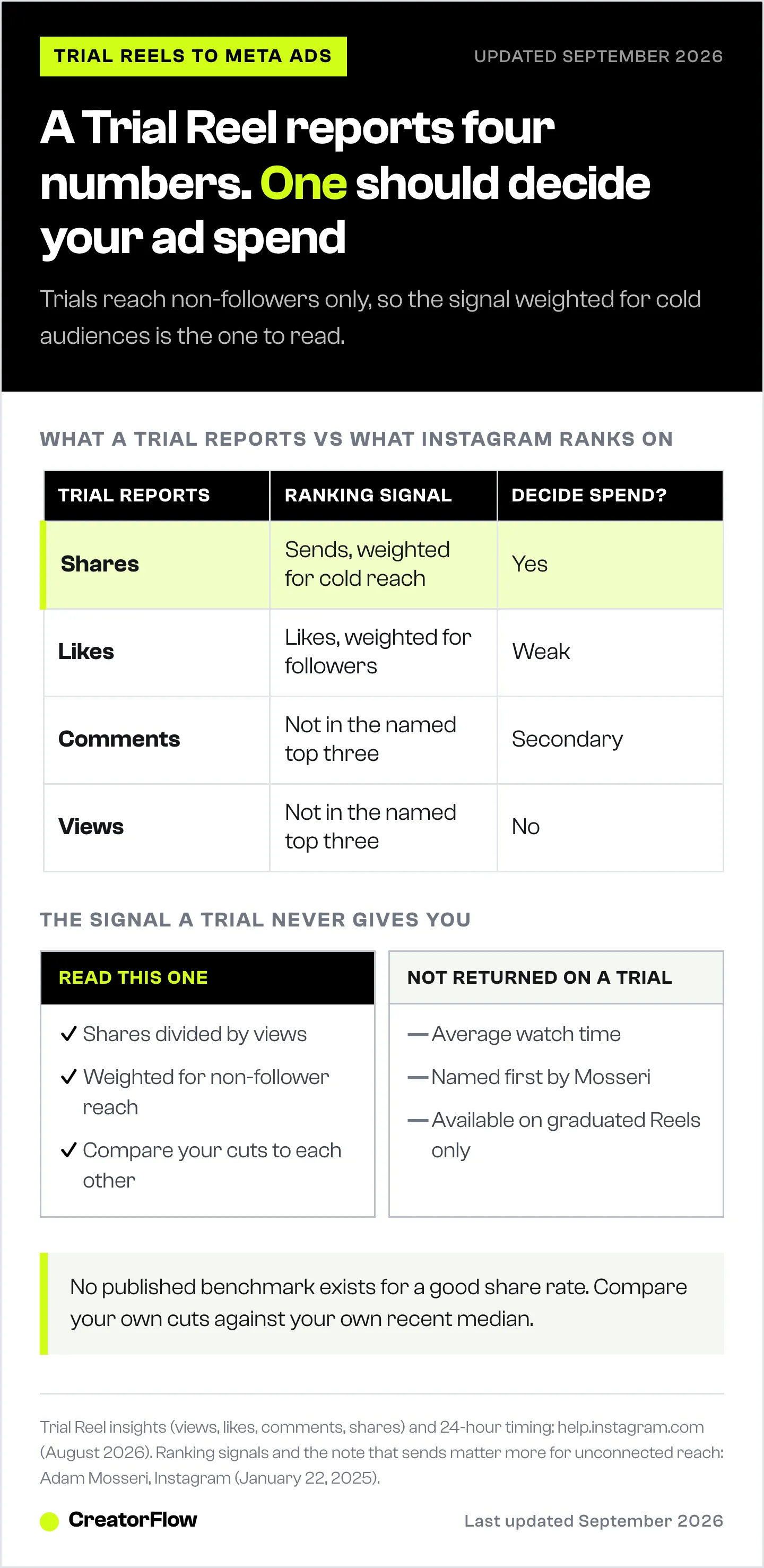
Trial Reels are entirely unconnected content. By Instagram’s own account, sends are the signal that governs them.
Now compare that against what a trial actually reports. Instagram returns views, likes, comments and shares on a Trial Reel within 24 hours (help.instagram.com, August 2026). Average watch time, which Mosseri listed first, is not in that set.
That leaves one usable signal. Of the three things Instagram says matter, a trial hands you exactly one, and it happens to be the one weighted highest for cold audiences.
| Trial Reel returns | Mosseri ranking signal | Use it to decide ad spend? |
|---|---|---|
| Shares | Sends, weighted higher for unconnected reach | Yes. This is the primary signal |
| Likes | Likes, weighted higher for connected reach | Weak. Wrong audience type for this test |
| Comments | Not in the named top three | Secondary. Useful for DM capture, not ranking |
| Views | Not in the named top three | No. Reports delivery, not response |
How to compute it. Divide shares by views for each cut, then compare the cuts against each other and against your own recent median. There is no published industry threshold for a good share rate, and any article quoting one has invented it. The comparison that matters is relative: which of your four cuts pulled the most shares per view, and does it beat what your account normally does.
Views tell you how far Instagram pushed the video. Shares tell you whether a stranger thought it was worth sending to someone. Only the second one predicts whether a paid impression will do anything.
How to Run the Test
Four steps. The discipline is in changing one variable at a time.
- Record one idea, cut four openings. Same body, same offer, same length. Vary only the first two seconds: the visual, the spoken line, or the on-screen text. Meta’s own A/B testing guidance warns that “when you’re testing more than one variable, you won’t know exactly which variable led to the winning ad set” (facebook.com, August 2026). The same logic applies here.
- Publish all four as Trial Reels on the same schedule. Same time of day, same days apart. Turn off “Share to everyone automatically” while testing, or Instagram will graduate a cut mid-test and contaminate the comparison. That setting applies to every future trial until you change it (help.instagram.com, August 2026).
- Wait the full 24 hours, then compute shares per view. Not sooner. Instagram states insights arrive within 24 hours, and reading at hour four ranks delivery speed rather than response.
- Kill three, rebuild one. Take the winning opening and cut three new variations of the body against it. You are now testing the second variable with the first one locked.
Two or three rounds of this and you have a creative you can defend spending on, plus a record of which hook shape works on strangers in your niche.
How to Promote a Winning Trial Reel
Here is where the sequence matters, because a Trial Reel is not a normal post yet.
Meta’s documentation says a trial “won’t appear in your profile unless you decide to share them to everyone” (help.instagram.com, August 2026). Ads Manager builds an ad from an existing post by letting you “turn an existing Instagram Feed, Reels or Stories post into an ad” (facebook.com, August 2026). So the order is: share to everyone first, then promote.
To do it:
- Open the Trial Reel and choose the option to share it to everyone. It now behaves as a normal Reel and appears on your profile.
- In Ads Manager, at the ad level, set Ad setup to Use existing post, then Select post, and pick the graduated Reel.
- Check the format rules first. Meta requires boosted Reels to be 90 seconds or under and vertical 9:16, and excludes Reels using licensed music, third-party camera filters or effects, product tags, interactive stickers, and any Reel already shared to Facebook (help.instagram.com, August 2026). Licensed audio is the one that catches most creators.
Two things to know before you click. Meta documents that editing the ad writes back to your organic post: “Modifying details on the ad, such as adding a phone number, will also change the information on the existing post you selected.” And some posts will be rejected outright, because “if the post has an existing call to action with a different goal, you can’t use it to create an ad” (facebook.com, August 2026).
Promote the same cut, do not recut it for the ad. The whole point of the test was to identify a specific opening that held cold viewers. Recutting it for the ad discards the result you paid four posts to learn. Recut later, as your next test.
What Meta Actually Publishes About Creative Testing
Search this topic and you will find confident numbers: test five variants, refresh twenty creatives a week, run every test for seven days minimum, Advantage+ lifts return by 22%.
None of those come from Meta.
Meta publishes what A/B testing is and how to run one cleanly. It states that “A/B testing lets you compare two versions of an ad strategy by changing variables such as ad images, ad text, audience or placement,” and it warns against informal testing: “We do not recommend testing informally, such as by turning ad sets or campaigns on and off manually. This can lead to inefficient ad delivery and unreliable test results” (facebook.com, August 2026).
What Meta does not publish is a recommended creative count, a recommended test duration, or a refresh cadence. Those figures circulate through agency blogs quoting each other. One of those blogs concedes the point directly, noting that Meta does not publish a rule about how many fresh creatives an account needs per week.
The practical version: the number of variants you test is set by how much creative you can produce without the quality dropping, and the test runs until the difference between cuts is obvious rather than for a fixed number of days. Trial Reels make that cheap, which is the actual argument for using them.
For the organic half of this system, the Instagram Reels testing system covers batch production and how to read results across a week rather than a single post.
Capture the Comments Before You Spend
A trial reaches strangers who will scroll past and never see you again. The comments are the only thing you keep from the test, and they arrive while the test is still free.
Comment-to-DM automation sends an instant reply when someone comments your trigger word, which turns a one-time impression into a conversation you own. Someone comments “guide” under the trial, and the DM with your link or lead magnet lands in seconds rather than whenever you next open the app.
Building that trigger into the Reel itself is covered in the Reels to DM strategy guide. That does three things for this loop specifically:
- It funds the test. Leads collected during the free stage offset the ad spend that follows.
- It grades the creative on intent, not just reach. A cut that produces 40 keyword comments from strangers is telling you something the share count alone will not.
- It builds a list before the ad runs. A follow gate converts trial viewers into followers, and an email gate captures addresses inside the DM, so the audience exists before you buy more of it.
CreatorFlow runs this on flat-rate pricing at $15 a month, connects through Meta’s official Instagram API, and includes the follow gate, email gate, CSV export and click analytics by country. ManyChat covers the same job across Instagram, Facebook, WhatsApp, SMS, TikTok and email, priced per active contact from $17 a month monthly or $14 billed annually (manychat.com, July 2026). InstantDM is Instagram-first at $12 a month, or $9.99 billed annually (instantdm.com, August 2026). Which fits depends on how many channels you run. The full breakdown is in the CreatorFlow vs ManyChat vs LinkDM comparison.
Once the ad is live, the same automation catches comments on the paid placement. Routing paid clicks into a DM thread rather than a landing page is covered in the Instagram click-to-DM ads playbook.
Mistakes That Waste the Test
Reposting an old Reel as a trial. This was a popular tactic through 2025 and it no longer works. Meta’s help centre now instructs: “Make sure to create a new reel. Your trial reel may get limited reach if Instagram detects that you’ve previously shared the same content” (help.instagram.com, August 2026). A suppressed trial reads as a failed hook when the hook was never tested.
Reading the view count. Covered above, and it is the single most common error. Delivery volume is not audience response.
Leaving auto-share on during a test. Instagram will graduate a strong cut on its own, at which point followers enter the audience and the cold-audience read is gone.
Changing everything between cuts. Different hook, different length, different music, different caption. The winner tells you nothing you can reuse.
Promoting before graduating. The trial is not selectable as an existing post while it sits outside your profile.
Expecting trial reach to match feed reach. Trials are scored independently against a cold audience with no follower boost. Lower numbers are the format working as designed, not a penalty. What you are reading is the ratio between cuts.
FAQ
Can you turn an Instagram Trial Reel into a Meta ad?
Yes, once you share it to everyone first. Meta’s documentation states a trial does not appear on your profile until you graduate it, and Ads Manager builds ads from existing Feed, Reels or Stories posts. Share the winning trial to everyone, then select it in Ads Manager under Use existing post. Meta’s help centre does not document promoting a trial that is still in testing.
How many followers do you need for Trial Reels?
A professional (business or creator) account needs at least 200 followers. A personal account needs at least 1,000. The account must be public (help.instagram.com, accessed August 2026). The widely quoted 1,000-follower requirement was accurate in July 2025 and is now out of date for professional accounts.
Do Trial Reels get fewer views than regular Reels?
Often, yes, and that is expected. A trial is shown only to non-followers, so it has no follower base giving it early engagement. Compare trials against other trials rather than against your feed Reels. The useful number is the ratio of shares to views across your test cuts, not the raw total.
Should you reuse the winning trial or recut it for the ad?
Promote the same cut. The test identified a specific opening that held a cold audience, and recutting discards that result. If the creative needs a different call to action for the ad objective, change the caption or the CTA rather than the first three seconds.
Can you repost an old Reel as a Trial Reel?
Meta advises against it. The help centre states that a trial may get limited reach if Instagram detects the content was previously shared. Build a new Reel for each test. Rebuilding an old idea with a fresh recording and a new hook is fine; re-uploading the same file is not.
Do Trial Reels replace Meta ads?
No. They do different jobs. A trial tests whether a hook holds strangers, for free, with no targeting control. An ad buys a specific geography, age range and campaign objective at a chosen volume. Trials decide what to promote. Ads decide who sees it and how many.
How do you collect leads from a Trial Reel before you spend on ads?
Put a keyword call to action in the Reel and run comment-to-DM automation on it. Viewers comment the keyword, an automated DM delivers the link or lead magnet, and an email gate collects the address inside the conversation. The leads arrive during the free testing stage, before any budget is committed.
Sources verified August 31, 2026. Trial Reels launch and description: about.fb.com (December 10, 2024). Eligibility, non-follower distribution, 24-hour insights, auto-share behaviour, independent ranking, duplicate-content warning and Reels boost format rules: help.instagram.com. Reels ranking signals and the connected/unconnected nuance: Adam Mosseri, Instagram (January 22, 2025). Trial Reel scheduling: Adam Mosseri, Instagram (April 2026). Existing-post ad setup, edit write-back and objective compatibility, plus A/B testing guidance: Meta Business Help Centre (August 2026). Competitor pricing: manychat.com (July 2026) and instantdm.com (August 2026). Instagram features and ad rules change by account and region, and individual results vary.