

Use Claude Sonnet for most content work. It is Anthropic’s stated default for writing, analysis, and multi-step tasks. Drop to Haiku for fast, high-volume jobs like batch captions and alt text. Move up to Opus for research and strategy that needs sustained reasoning, and to Fable for long projects you want finished with fewer check-ins, as Anthropic’s model guide describes them (checked October 2026).
Most creators pick a Claude model once, on the day they sign up, and never touch the picker again. That default costs you twice. Running a 30-caption batch through the heaviest model burns your weekly usage limit by Wednesday. Running a quarterly content audit through the lightest one gives you a summary of what you already knew.
This guide maps the four Claude models to the jobs a creator does every week: hooks, captions, Reels scripts, carousel copy, repurposing, and performance audits. It covers what each model costs, which plans give you access to which, and when moving up a tier changes the output enough to be worth it.
Key Takeaways
- Four models, one default: Anthropic ships Haiku, Sonnet, Opus, and Fable. Sonnet is the stated starting point, described as “your versatile default” for writing and multi-step workflows (Anthropic model guide, checked October 2026)
- Match the model to the job, not to your budget: Haiku handles “quick answers, summaries, and simple extraction,” Opus handles “deep research and complex reasoning that genuinely needs sustained thinking,” and Fable handles “your largest, most critical projects” (Anthropic model guide, checked October 2026)
- The free plan covers two models: Claude’s free tier includes Sonnet and Haiku. Opus starts on Pro, and Fable runs on Pro through usage credits or on Max at 50% of the weekly limits (claude.com/pricing, checked October 2026)
- Cost scales sharply: API rates run $0.10 per million input tokens for Haiku 5.5, $2 for Sonnet 5.5, $4 for Opus 5.5, and $10 for Fable 5.1. Output tokens run five times the input rate on every model (claude.com/pricing, checked October 2026)
- Claude Opus 5.5 is the current Opus, with an effort setting that lets you dial reasoning depth from low up to max, so one model covers a wide range of jobs (Anthropic API documentation, checked October 2026)
- The model is one step in the chain: writing the caption is a different job from getting the link into the hands of everyone who comments on the post
The Four Claude Models and What Each One Is For
Anthropic publishes a plain-language description of what each model is meant to handle. Those definitions are the most reliable routing guide available, because they come from the company that trained the models.
| Model | Anthropic’s stated use | Usage weight |
|---|---|---|
| Haiku | ”Quick answers, summaries, and simple extraction, anything you want done instantly” | Lightest |
| Sonnet | ”Coding, writing, analysis, and multi-step workflows, your versatile default” | Moderate |
| Opus | ”Deep research and complex reasoning that genuinely needs sustained thinking” | Heavy |
| Fable | ”Your largest, most critical projects: long, complex tasks Claude works through with fewer check-ins” | Heaviest |
Source: Anthropic’s model selection guide, checked October 2026.
Two things stand out for creator work. Sonnet is the only tier where Anthropic names writing directly. And the split between Opus and Fable is about task length and check-in frequency rather than raw quality, which matters if you batch work in long sessions.
The current generation as of October 2026 is Claude Haiku 5.5, Claude Sonnet 5.5, Claude Opus 5.5, and Claude Fable 5.1. Model names carry version numbers that move independently, so a guide naming Opus 5 or Sonnet 5 as the current tier is describing a lineup that has since been replaced.
Which Claude Model Is Best for Captions and Hooks?
Sonnet for hooks, Haiku for batch captions. Hook writing rewards judgment about what makes someone stop scrolling, which is a reasoning task. Caption writing from a brief you already wrote is a formatting task, and Haiku does it at a fraction of the usage cost.
The practical test is whether you are asking Claude to decide something or to execute something you already decided. “Give me 15 hook variations for a Reel about meal prep and rank them” is a decision. “Write the caption for each of these 12 posts using this template and this brand voice” is execution.
Creators who batch content in one sitting feel this most. If you are producing a month of posts in a day, the caption pass is the highest-volume step and the lowest-judgment one. Routing it to Haiku leaves your heavier usage available for the parts that need it. Our team documented how we make a month of Instagram content in one day, and the model split maps almost exactly onto that workflow.
For prompts to run at either tier, 21 copy-paste AI prompts for Instagram covers captions, Reels, and analytics.
Which Claude Model Is Best for Reels Scripts and Carousels?
Sonnet, in both cases. A Reels script and a carousel are structured multi-part outputs, which is the exact shape Anthropic names for Sonnet: “coding, writing, analysis, and multi-step workflows.”
A carousel needs a hook slide, a body sequence that builds, and a closing slide that earns the save. Getting that right means holding the whole arc in mind while writing each slide. Haiku will produce ten slides. Sonnet will produce ten slides that follow one argument. The gap shows up in the middle slides, where a lighter model tends to restate the hook instead of advancing it.
Moving up to Opus for a single carousel rarely changes the output enough to notice. Where Opus earns its cost is a carousel built from source material you have not read yet: a research report, a transcript, a competitor’s back catalogue. The reading and synthesis are the hard part, not the slide copy.
The full slide-by-slide workflow, including the specs Claude should follow, is in our guide on how to build Instagram carousels with Claude.
Which Claude Model Should You Use for Content Strategy and Audits?
Opus. Strategy work has the two properties Anthropic names for that tier: it needs sustained reasoning, and it benefits from depth over speed.
Concretely, that means the jobs where you hand Claude a pile of inputs and ask for a judgment:
- Reading three months of post performance and telling you which format to stop making
- Auditing your account against four competitors and finding the positioning gap
- Turning a quarter of comment data into a content plan
- Diagnosing why a series that worked in March stopped working in July
Claude Opus 5.5, the current Opus, has an effort setting that lets you dial reasoning depth from low up to max (Anthropic API documentation, checked October 2026). That makes the model less of a fixed commitment. A quick performance read can run at low effort. A quarterly strategy rebuild can run at high.
Fable is the tier above, meant for “your largest, most critical projects: long, complex tasks Claude works through with fewer check-ins” (Anthropic model guide, checked October 2026). For most solo creators that threshold is rarely crossed. It fits the once-a-year rebuild: redesigning your entire content system, migrating a back catalogue, or building a repurposing pipeline from scratch.
What Each Claude Model Costs
Two pricing systems run in parallel. If you use Claude through the app, you pay a flat monthly subscription and models draw against usage limits at different rates. If you build with the API, you pay per token.
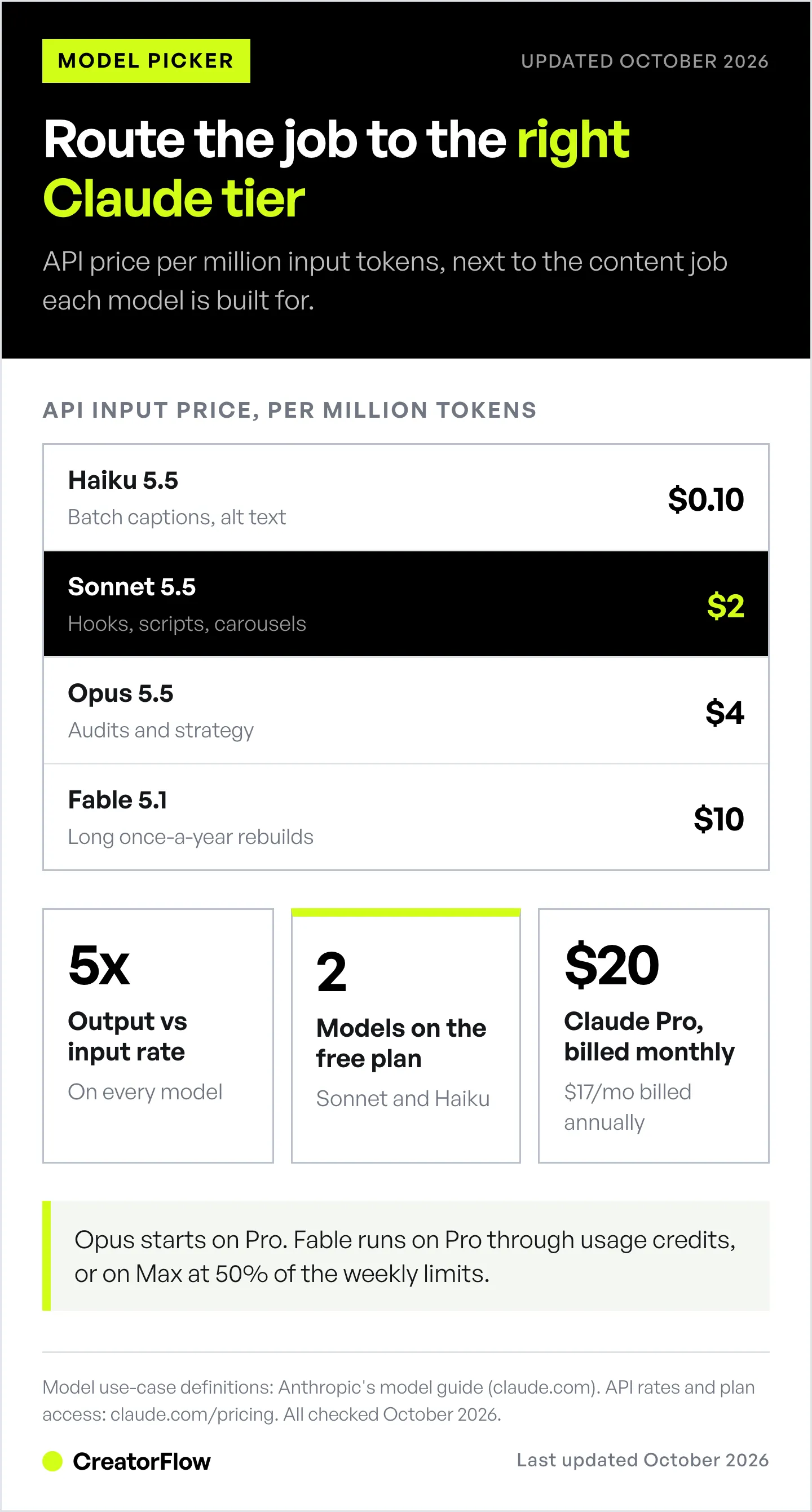
The per-token rates are the clearest signal of how the tiers relate to each other:
| Model | Input per 1M tokens | Output per 1M tokens |
|---|---|---|
| Claude Haiku 5.5 | $0.10 | $0.50 |
| Claude Sonnet 5.5 | $2 | $10 |
| Claude Opus 5.5 | $4 | $20 |
| Claude Fable 5.1 | $10 | $50 |
Source: Anthropic’s pricing page, checked October 2026. Haiku 5.5’s rates apply to prompts up to 100,000 tokens; longer prompts cost $0.50 input and $2.50 output per million tokens.
Output costs five times input on every tier, which has a direct consequence for content work: the length of what Claude writes drives cost far more than the length of what you paste in. Feeding a model a long transcript is cheap. Asking it to write ten long captions is not.
The spread from Haiku to Fable is a hundredfold. Sending every caption through the top tier is the single most expensive habit in an AI content workflow, and the one with the least to show for it.
Do You Need Claude Pro, or Is the Free Plan Enough?
The free plan includes Sonnet and Haiku. Opus starts on Pro, and Fable runs on Pro through usage credits or on Max at 50% of the weekly limits, according to Claude’s pricing page (checked October 2026). The free plan still covers most creator work, because Sonnet and Haiku handle hooks, captions, scripts, and carousels. Test those two on your own content before paying for Opus.
| Plan | Price | What you get |
|---|---|---|
| Free | $0 | Sonnet and Haiku |
| Pro | $20/month, or $17/month billed annually | More usage, adds Opus, Fable through usage credits |
| Max | From $100/month | 5x or 20x Pro’s usage, Fable at 50% of weekly limits |
Source: claude.com/pricing, checked October 2026.
The upgrade trigger is usage, plus Opus. If you are hitting weekly limits mid-week on the free plan, or you want Opus for strategy work, Pro solves it. If you are hitting Pro limits, the question worth asking first is whether heavy work is being routed to a heavier model than it needs. Moving your caption batches down to Haiku often buys back more headroom than moving up a plan.
For a broader view of running an account with Claude, including Claude Code and the task hand-off features formerly called Claude Cowork, see Claude AI for Instagram creators, brands, and agencies. If you want Claude to hold your brand voice and format rules across every session, Claude Skills for content creation covers building reusable instruction files instead of re-pasting the same brief.
How to Switch Models in Claude
The model picker sits at the top of the conversation in the Claude app. Switching applies to the next message, so a conversation can start on Sonnet and move to Opus when the work gets heavier.
A workflow that fits how creators batch:
- Start on Sonnet. Give Claude your brief, your brand voice, and the month’s content pillars.
- Stay on Sonnet for the structured pieces. Reels scripts, carousel copy, and repurposing passes.
- Drop to Haiku for the volume pass. Captions from finished briefs, alt text, and hashtag sets.
- Switch to Opus at the end of the month (Pro and above). Feed it the performance data and ask what to change.
Keeping one conversation per project matters more than which model you start in. Claude carries the context forward when you switch, so the brand voice you established on Sonnet still applies after you move to Opus.
Creators comparing assistants rather than tiers may also want how ChatGPT handles Instagram content work, and AI marketing tools sorted by the job they do for the wider stack.
What Happens After Claude Writes the Post
Picking the right model gets you a caption, a script, and a set of slides. The post still has to earn something once it is live.
For most creators that means a link: a product page, an affiliate link, a booking calendar, a lead magnet. The comments fill up with people asking for it, and the window where those people are still paying attention is short.
CreatorFlow is the distribution layer that closes that gap. When someone comments your trigger word on a post, they get your link in a DM automatically. Set the trigger once, and every post you write with Claude becomes a way to move people from a comment to your link without you sitting in the inbox.
That pairing is the point of getting model choice right. The faster and cheaper your writing pass gets, the more posts you ship, and each one runs the same delivery step on its own.
FAQ
Which Claude model is best for writing?
Sonnet. It is the only tier where Anthropic names writing directly, describing it as the right fit for “coding, writing, analysis, and multi-step workflows” and calling it “your versatile default” (Anthropic model guide, checked October 2026). Opus and Fable are positioned around research depth and project length rather than writing quality.
Is Claude Opus worth it over Sonnet for content?
For writing a post, rarely. For deciding what to post, often. Opus is built for “deep research and complex reasoning that genuinely needs sustained thinking” (Anthropic model guide, checked October 2026), which describes a content audit or a quarterly plan more than it describes a caption. A useful test: if you could brief a competent freelancer to do the task from your notes, Sonnet handles it.
Can you use Claude Fable on the free plan?
No. Claude’s free plan covers Sonnet and Haiku. Fable needs Pro, where it runs on usage credits, or Max, where it gets 50% of the weekly limits (claude.com/pricing, checked October 2026). Because Fable draws against limits fastest, even paid users get fewer Fable messages than Sonnet messages.
What is the difference between Claude Haiku and Sonnet?
Speed and depth. Haiku is built for “quick answers, summaries, and simple extraction, anything you want done instantly” and uses the lightest share of your usage limit. Sonnet handles multi-step work and holds a longer thread of reasoning (Anthropic model guide, checked October 2026). On the API, Haiku 5.5 runs $0.10 per million input tokens against Sonnet 5.5’s $2.
Does switching Claude models mid-conversation work?
Yes. The picker at the top of the conversation applies to your next message, and the conversation history carries forward. That makes it practical to draft on Sonnet and switch to Opus for a final strategy pass without restarting or re-pasting your brand voice.
How much does Claude cost per month for a creator?
Free covers Sonnet and Haiku. Pro is $20 per month, or $17 per month billed annually, and adds Opus. Max starts at $100 per month for 5x Pro’s usage, with a 20x tier above it (claude.com/pricing, checked October 2026). Most solo creators sit on Pro, and hit the limits less often once high-volume work is routed to Haiku.
Is a bigger Claude model always better for captions?
No. Caption writing from a finished brief is execution rather than judgment, and the heavier tiers are built for judgment. Running captions through Opus or Fable spends your weekly limit faster without changing the output much. The gain from a heavier model shows up on tasks with more to reason about, like ranking hooks or reading performance data.
Model lineup, use-case definitions, plan access, and API pricing checked against Anthropic’s model guide, pricing page and API documentation in October 2026. Model lineups and prices change; check current rates before budgeting. Individual results vary.


