

Instagram DM automation for home, candle, and food brands answers the two questions these categories get most: what does it smell or taste like, and where can I buy it. Both are hard to answer at scale because the first cannot be shown in a photograph and the second has a different answer for every shopper depending on where they live. A keyword-triggered DM handles both in seconds.
Your candle Reel does 90,000 views. The comments are split between “what does this smell like?” and “do you sell in Manchester?” You answer the first fifteen. The rest scroll on. The Manchester question was the expensive one, because that shopper had a stockist eleven minutes away and never found out.
This guide covers the sensory gap, the stockist gap, and the wholesale enquiries hiding in your comment section. It applies to candles and home fragrance, homeware and decor, and food and drink brands selling direct, through retail, or both.
Key Takeaways
- Two questions dominate these categories: what it smells or tastes like, and where to buy it locally. Most brands answer neither at scale.
- The category is growing and moving online. Mordor Intelligence’s home fragrances market report values the market at $15.02 billion in 2026 and forecasts $20.88 billion by 2031, with online retail the fastest-growing channel at an 8.16% CAGR (checked October 2026).
- A stockist keyword is the highest-value automation here. It converts a comment into a store visit, and it works for brands with no ecommerce at all.
- Sensory questions need a sampling route, not a better adjective. Discovery sets and sample credits convert where descriptions do not.
- Shipping rules are a real objection. Candles carry transport restrictions and food carries cold-chain limits. Publishing the answer removes an abandoned cart.
- Retail buyers hide in your DMs. A wholesale keyword separates a stockist enquiry from a consumer one before it gets lost.
How Candle Brands Use Instagram DM Automation
A handful of keywords carry most of the load. SCENT sends the fragrance family, top and base notes, burn time, throw and room-size guidance, plus a discovery-set link, because a photograph cannot carry a smell. WHERE asks for the shopper’s region and returns three to five nearest stockists, with your shop link as the fallback. SHIP covers transport restrictions and warm-weather handling. WHOLESALE separates retail buyers from consumer DMs.
The Two Questions These Categories Cannot Answer at Scale
Every product category has a gap between what the photo shows and what the buyer needs to know. In apparel it is fit. In beauty it is shade. In home fragrance and food, the gap is the entire product.
A candle photograph shows a vessel. The thing being bought is a smell. A jar of chilli oil photographs as a jar. The thing being bought is heat and salt and how it behaves on a fried egg. No amount of art direction closes that gap, which is why these categories over-index on sampling, gifting, and repeat purchase from people who have already tried the product.
The second gap is distribution. A large share of home and specialty food brands sell through stockists as well as direct, and often through more stockists than they can list legibly on a website. The shopper asking “where can I buy this?” is at the bottom of the funnel, ready to buy today, and the honest answer depends entirely on where she is standing.
Both gaps live in your comment section. Both are answerable in one message.
The Five Automations Worth Building
| Comment pattern | Trigger keyword | What the DM sends | What it unblocks |
|---|---|---|---|
| ”What does it smell like?” / “Is it spicy?” | SCENT or TASTE | Notes or flavour profile, intensity, plus a discovery-set link | The sensory gap a photo cannot cross |
| ”Where can I buy this?” | WHERE | Stockist list by region plus the direct shop link | A ready buyer with no route to the product |
| ”Do you ship to Ireland?” | SHIP | Zones, costs, restrictions, and delivery windows | Category-specific shipping doubt |
| ”Do you do wholesale?” | WHOLESALE | Line sheet, minimums, and a buyer contact form | A retail account lost in consumer DMs |
| ”Is this nut-free?” / “Is the wax soy?” | INGREDIENTS | Full ingredient and material disclosure | Allergen and materials safety |
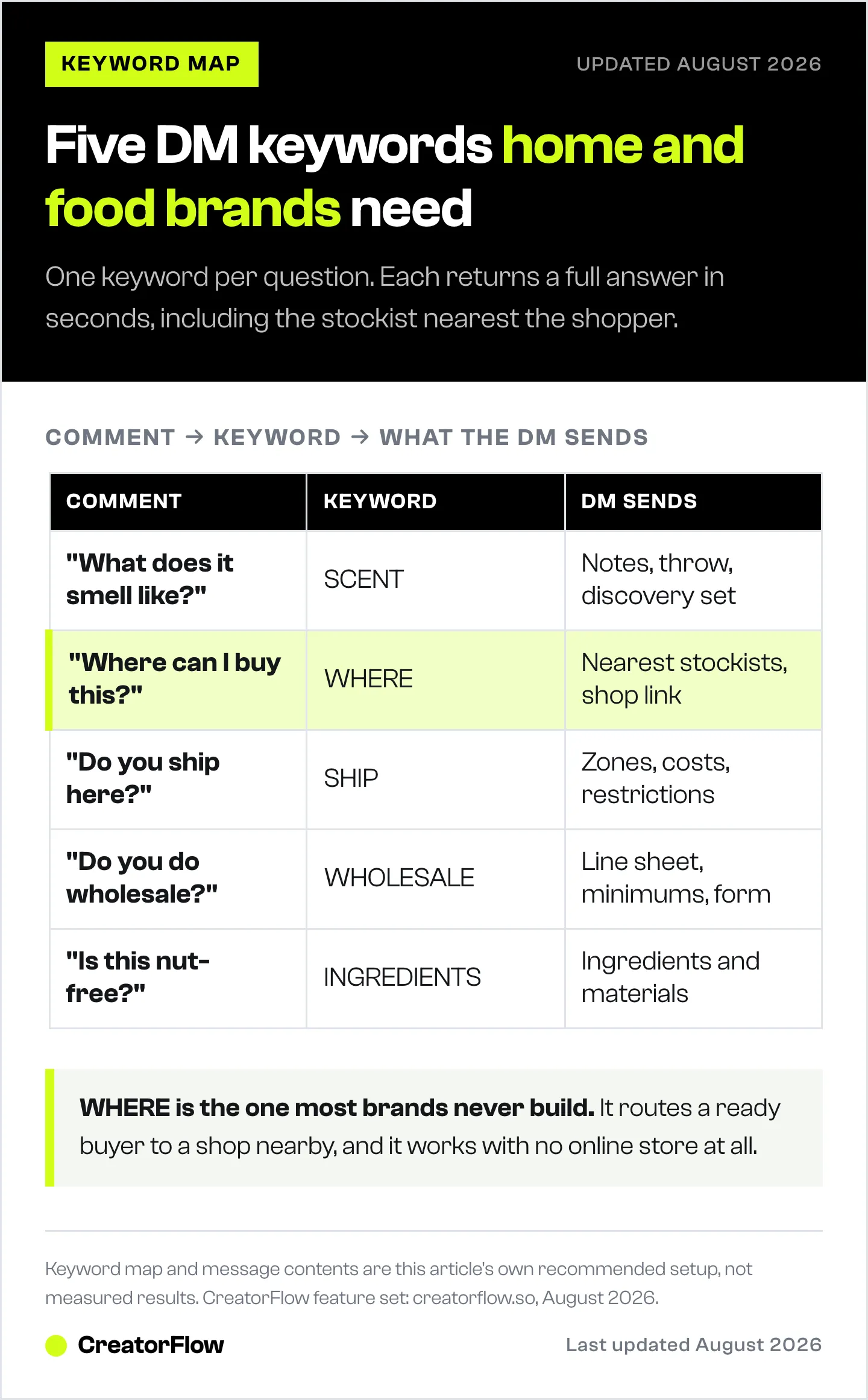
The WHERE row is the one most brands have never built, and it is usually the most valuable.
Building a Stockist Locator Into a DM
Most brands answer “where can I buy this?” with a link to a stockist page that lists 60 shops in alphabetical order across four countries. The shopper scans it, fails to find her city, and leaves.
A WHERE keyword does better, because a DM can be structured around the shopper rather than around your account list.
Build it in this shape:
- Ask one question first: country or region, offered as a short list rather than an open field.
- Return three to five stockists maximum, nearest first, with the neighbourhood named.
- Include the direct shop link as the fallback, phrased as an option rather than an apology. “Not near any of these? We ship nationwide here.”
- Add stock reality where you know it. “Call ahead for the winter scents” is more useful than a pin on a map.
Two things make this worth the setup effort. It converts shoppers who would never have bought online, and it gives your retail partners measurable traffic, which is the argument you make at the next buying meeting.
Geographic click data closes the loop. When you can see that a third of your link taps come from a city with no stockist, you have both a wholesale target list and the evidence to open the conversation. CreatorFlow’s Pro plan includes clicks by country and city on tracked links, which is the reporting layer this automation runs on.
The trigger setup itself is covered in our comment-to-DM automation setup guide.
Answering Sensory Questions Without Overselling
The instinct is to write a better description. The better move is to give the shopper a cheap way to find out.
For candles and home fragrance, the SCENT message should carry the fragrance family, the top and base notes, burn time, throw (how far the scent carries), and room-size guidance. Then a discovery set or sample link, with the sample cost credited against a full purchase.
For food and drink, the TASTE message should carry the flavour profile in plain terms, heat level on a scale the buyer can calibrate against something common, texture, and serving suggestions. Then a tasting bundle or small-format link.
Both messages benefit from an honest comparison anchor. “Closer to woodsmoke than vanilla” tells a shopper more than three sentences of atmosphere. The same is true of “hotter than sriracha, milder than a habanero sauce.”
Market growth supports the sampling approach. Mordor Intelligence’s scented candles market report forecasts growth from $3.71 billion in 2026 to $5.25 billion by 2031, and online retail is the fastest-growing channel across home fragrance (checked October 2026). More of that growth is happening with buyers who have never smelled the product before they order, which makes the sample the acquisition tool.
Shipping Restrictions Are a Conversion Problem
These two categories carry shipping constraints that most brands treat as fine print and shoppers treat as a reason to abandon.
Candles and home fragrance face transport restrictions on certain formats and destinations, and wax behaves badly in summer heat. Food and drink face cold-chain limits, shelf-life windows, and customs rules on anything containing dairy, meat, or alcohol.
Publish the answers in a SHIP message rather than at checkout:
- Which countries or regions you ship to, listed plainly
- Any format that cannot travel, and what the alternative is
- Warm-weather handling, if you pause or insulate shipments in summer
- Delivery windows for perishables, stated as a range
- Duties and customs responsibility for international orders
An objection answered before checkout costs you a message. The same objection discovered at checkout costs you the order and the shipping label you already paid to print.
Wholesale Enquiries Are Hiding in Your Consumer DMs
For home and specialty food brands, a retail buyer enquiry is worth many multiples of a consumer order, and it arrives in exactly the same inbox as “what does it smell like.”
A WHOLESALE keyword separates them at the door. The message should send:
- A line sheet or a link to one
- Minimum order quantity and case sizes
- Lead times
- Territory or exclusivity policy, if you have one
- A short intake form: shop name, location, and buyer contact
Then route it to a person. The automation captures the enquiry at 9pm on a Sunday and puts it in front of you Monday with the basics already collected. The four-stage approach in our Instagram DM sales playbook covers running the human half of a buyer conversation.
Ingredients, Materials, and Allergens
The INGREDIENTS message is short, factual, and non-negotiable in these categories.
For candles: wax type, wick material, fragrance load, whether the fragrance is phthalate-free, and vessel material.
For food and drink: the full ingredient list, the fourteen major allergens where you sell into the UK or EU, cross-contamination status of the facility, and storage instructions.
State facts and route judgment. A pre-written message can list what is in a product. It should never tell someone whether their allergy makes it safe for them. Add a plain instruction to check the label and contact you directly for anything specific, and keep that route open to a person.
Gifting and Reorders
Home fragrance and specialty food are gift categories, and gift buyers are deadline buyers. From October onward, run a GIFT keyword that sends bundle options, the last order dates by region, whether a gift note is included, and a digital gift card fallback for anyone who misses the cutoff.
Both categories are also consumables. A candle burns out. A jar empties. The reorder is the profitable order, and it runs on your email list rather than on Instagram, since Meta’s 24-hour messaging window closes long before the product does.
Capture the address inside the DM that answered the question, while intent is high. Our guide to collecting emails in Instagram DMs covers the email gate setup and the export into your marketing platform. For the broader handoff from Instagram to your own checkout, see our DTC Instagram strategy guide.
Tools and Pricing
CreatorFlow runs $15/month on Pro, flat, with unlimited automations, two workspaces, comment-to-DM, Story reply automation, keyword triggers, link tracking, a follow gate, an email gate, and clicks by country and city. The Free plan covers 500 DMs a month on one workspace. The geographic click data is the piece that makes a stockist automation measurable, and the flat rate holds through a seasonal spike.
ManyChat covers Instagram, Facebook, WhatsApp, SMS, TikTok, Telegram, and email with a multi-channel flow builder. Pricing is per active contact. ManyChat’s pricing page lists Free at 25 contacts, then Essential $17/month for 250, Pro $39/month for 2,500, Business $99/month for 7,500, and Advanced $199/month for 25,000, billed monthly (checked October 2026). Billed annually, those tiers work out to $14, $29, $69, and $139 per month. Plans apply to accounts created on or after March 2, 2026. Best for brands running gifting campaigns across email and SMS at the same time.
LinkDM reports over 60,000 creators, brands, and agencies. Its pricing page lists Free at 1,000 DMs a month, Pro at $19/month for 25,000 DMs, and Platinum+ at $99/month for 300,000 DMs (checked October 2026). Best when message volume is the main cost variable.
Seasonal brands should price the peak, not the average. A December that adds several thousand new contacts prices differently on per-contact plans than on flat ones.
Platform Rules
Meta’s rate-limiting documentation lists these limits for the Instagram API with Instagram Login: 100 calls per second for text and links, 10 per second for audio and video, and 750 per hour for private replies to comments on posts and Reels (checked October 2026). Tools including CreatorFlow pace sends at roughly 200 DMs an hour as a conservative behavioural cap, which is a tool-side convention rather than a Meta-published hourly figure.
Meta’s 24-hour messaging window governs organic DMs, comment replies, and Story replies (a chat started from a Click-to-Direct ad gets up to 7 days since 28 September 2026), and Meta finished removing in-app checkout from Instagram Shops in August 2025, so every purchase completes on your own site or in a stockist’s shop (ppc.land, August 2026). For brands selling mostly through retail, that second fact is less of a constraint than it looks. Your DM was always sending people somewhere else.
FAQ
How do I set up a stockist locator on Instagram?
Use a WHERE keyword that first asks for country or region as a short list of options, then returns three to five nearest stockists with neighbourhoods named, and offers your direct shop link as a fallback. Keep the list short. A DM listing sixty shops performs the same as the stockist page that already failed.
Does Instagram DM automation work for brands with no online store?
Yes, and it is arguably more useful. A brand selling only through retail can use DM automation to route shoppers to the nearest stockist, answer product questions, and capture wholesale enquiries. The link in the message can point to a store locator, a stockist’s site, or a booking page rather than a checkout.
What should a candle brand put in an automated DM?
Fragrance family, top and base notes, burn time, scent throw, recommended room size, wax and wick materials, and a discovery-set link with the sample cost credited toward a full purchase. Add shipping restrictions, since candles carry format and destination limits that surprise buyers at checkout.
Can food brands automate allergen questions?
They can automate disclosure: the full ingredient list, allergen declarations, and facility cross-contamination status. They should not automate any assessment of whether a product is safe for a specific person. Include a clear line directing anyone with an allergy to check the label and reply for a human answer.
How do I separate wholesale enquiries from customer DMs?
Run a dedicated WHOLESALE keyword and promote it in your bio and on trade-relevant posts. The automated message sends the line sheet, minimums, and lead times, then collects shop name, location, and buyer contact before handing the conversation to a person.
Is the home fragrance market still growing?
Yes. Mordor Intelligence values the home fragrances market at $15.02 billion in 2026 with a forecast of $20.88 billion by 2031, and scented candles specifically are forecast to grow from $3.71 billion to $5.25 billion over the same period (checked October 2026). Online retail is the fastest-growing channel in the category.
Will automated DMs make a small artisan brand feel corporate?
Only if the copy does. Write the automated message in the same voice as your captions, keep it to one screen, and end every flow with a visible route to a person. Shoppers respond to a fast, specific, plainly written answer regardless of whether a system sent it.
In October 2026 we checked the home fragrance and scented candle market figures on Mordor Intelligence’s home fragrances and scented candles reports, competitor pricing on ManyChat’s pricing page and LinkDM’s pricing page, and Meta’s limits in its rate-limiting documentation. This article is not food-safety or regulatory advice. Individual results vary.


