

Instagram SEO means choosing the words people type into Instagram search and putting them where Instagram reads text: your username, your profile name, your bio, your captions, your hashtags and your location tags. Instagram says the text someone types is the most important signal for search. So the word you pick decides which audience can find you.
Most creators treat that word as an afterthought. They write the Reel first, then add a caption at the end. The topic word they choose is often one their followers know but strangers never search, or one that a completely different audience already uses. The post reaches the people who follow them and stops there.
This guide explains how Instagram search ranks results, a two-minute test that shows whether a keyword belongs to your audience, how to pick between a narrow word and a broad one, and where each keyword should go. It is written for creators, coaches and small businesses who want new people to find them on Instagram, not only the people who already follow.
Key Takeaways
- Your search text is the top signal: Instagram says the words a person types matter most, then that person’s activity, then how popular each result is.
- Search reads text in five places: usernames, bios, captions, hashtags and places, according to Instagram’s own search explainer. Your profile name counts too.
- Run the search test before you post: type your topic word into Instagram search. If the results serve several unrelated audiences, the word cannot target yours.
- Name the result, not the method: people search for what they want, not the technique that gets it. Put the result in your hook and caption, and teach the method inside the post.
- Hashtags label, they do not lift: Instagram allows 5 hashtags per post and Reel since December 2025, and Adam Mosseri has said hashtags do not improve visibility.
- Search brings strangers to your posts: a keyword comment trigger turns those visits into DM conversations you can follow up.
What Is Instagram SEO?
Instagram SEO is the work of making your account and posts appear when people search inside Instagram. Instagram search matches the words someone types against usernames, profile names, bios, captions, hashtags and places. You do Instagram SEO by choosing words your audience types, checking that no other audience owns them, and placing them in those fields.
It is a smaller job than Google SEO. There are no backlinks to build and no page speed to fix. You control almost every input yourself: your profile and what you write under each post.
It also overlaps with Google now. Since July 10, 2025, public posts from professional accounts can appear in Google results, so the same words can bring visitors from both places. More on that further down.
How Does Instagram Search Decide What to Show?
Instagram explained its search ranking in an official post on how Instagram Search works. It names three groups of signals, in order of importance:
- Your search text. Instagram calls the text you type “the most important signal” and matches it against usernames, bios, captions, hashtags and places.
- Your activity. Accounts you follow, posts you viewed and how you interacted with accounts in the past.
- Popularity. How many clicks, likes, shares and follows an account, hashtag or place gets.
Two things follow from this. The first signal is the only one you control before you post, so the words matter most. And popularity sits third, so a small account with the exact words a person types can still appear above a bigger account with vague ones.
Instagram’s 2023 ranking explainer adds that each part of the app, Search included, “uses its own algorithm”. Search is separate from Reels and Explore ranking. A post can do well in search and still get few Reels-tab views, and the reverse.
In August 2026, Instagram’s creator account repeated the point for captions. As reported by Social Media Today, Instagram search uses captions as reference data for discovery. A caption is not decoration. It is the text search reads.
The Search Test: Check Who Owns a Word Before You Use It
A keyword only works if the people searching it are your audience. Many words are shared by groups who have nothing in common. “Cutting” means a diet phase to a gym crowd, a haircut to a barber’s followers and an editing step to a video editor. If you post a fitness Reel built around “cutting”, Instagram has three audiences to choose from and no clear way to know which one you meant.
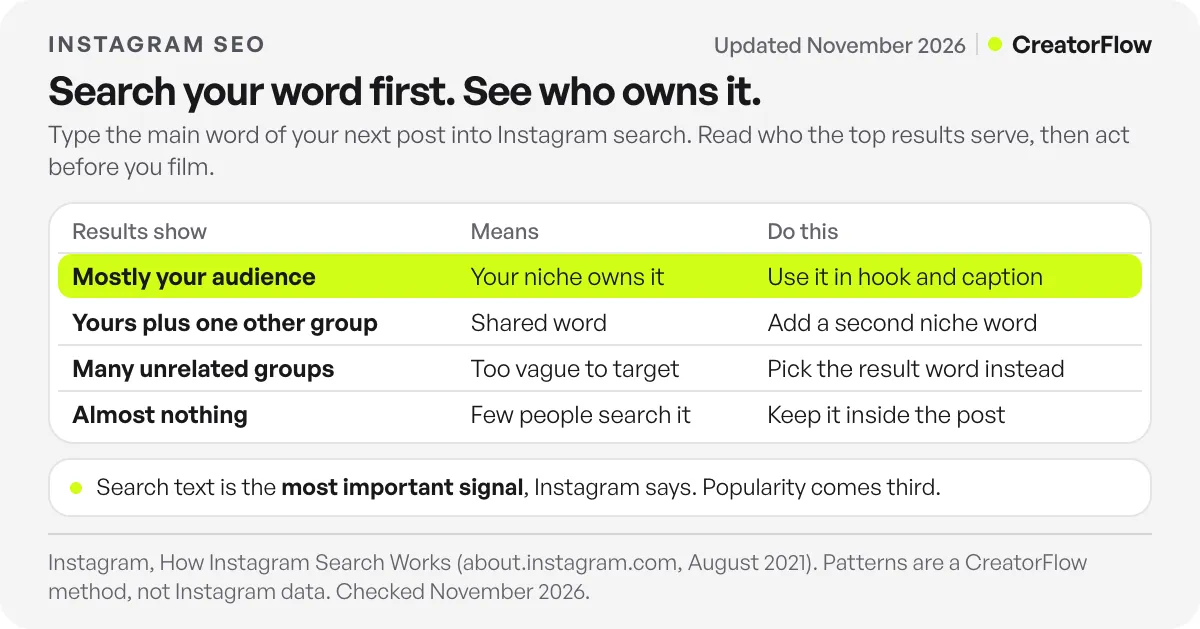
The test takes two minutes and costs nothing:
- Open Instagram search and type the main word of your next post. Use the word you would put in the hook or the first line of the caption.
- Read the top 12 results in the grid and the suggested searches. Note who each one is for. Do not judge quality. Judge audience.
- Sort what you see into one of the four patterns below, then act on it before you film or write.
| What the results show | What it means | What to do |
|---|---|---|
| Mostly your audience, posts like yours | The word belongs to your niche | Use it in the hook, caption and one hashtag |
| Your audience plus one unrelated group | The word is shared | Add a second word that only your audience uses, such as “cutting diet” or “cutting meal plan” |
| Several unrelated groups, none dominant | The word is too vague to target anyone | Pick a different word, usually the result your viewer wants |
| Almost nothing | Few people search it | Keep it in the body of the post, but lead with a word people do type |
The suggested searches under the search bar are the most useful part. They are phrased the way people type, and they show which pairings already exist. If “proofing” suggests “proofing bread”, “proofing dough temperature” and “proofreading jobs”, you know a baker should write “proofing dough”, not “proofing”.
Run the test on your own phone and on a second account if you have one. Your results lean on your own activity, which is the second signal, so a clean second account gives a more neutral view.
Method Words vs Result Words: Pick the Right Size of Audience
The second mistake is choosing a word that is accurate but too small. Experts name things by method: “levain”, “retinoid buffering”, “zone 2 training”, “batch cooking”. Their audience thinks in results: bread that rises, retinol without peeling, more stamina, dinner ready on a weeknight.
A method word reaches only people who already know the method. A result word reaches everyone who wants the result, including the people who would benefit from the method but have never heard of it. A word that is too broad, such as “baking” or “skincare”, fails the other way: millions of posts compete for it, and most of the people searching want something else.
| Niche | Method word (small audience) | Result phrase (right size) | Too broad |
|---|---|---|---|
| Home baking | Levain build | Sourdough that rises every time | Baking |
| Skincare | Retinoid buffering | Retinol without peeling | Skincare |
| Running | Zone 2 training | Run longer without getting tired | Fitness |
| Meal prep | Batch cooking ratios | Weeknight dinners in 20 minutes | Food |
The rule: put the result phrase in the hook and the first line of the caption, because that is what a new viewer recognises. Keep the method word in the post itself, where it proves you know what you are talking about. Your existing followers still get the depth they came for.
Run the search test on the result phrase too. If it passes, you have a word that is big enough to bring new people and specific enough to bring the right ones. If you are still deciding what your account is about, our guide to choosing a creator niche on Instagram covers that step first.
Where to Put Your Keywords on Instagram
Instagram’s search post names usernames, bios, captions, hashtags and places as the text it matches, and says a profile name related to your content helps too. Each field does a different job.
| Field | What it does for search | How to use it |
|---|---|---|
| Username | Matched when people search for accounts | Keep your name or brand. Add a niche word only if it still reads as a name |
| Profile name | Matched when people search for accounts | Add your main niche keyword after your name, such as “Ana, sourdough baking” |
| Bio | Read by search, and tells visitors what you do | One plain sentence with your main keyword and who you help |
| Captions | Read by search for every post and Reel | Main keyword in the first line, one or two related words in the body |
| Hashtags | Matched by search, and label the topic | 3 to 5 specific tags, never more than 5 |
| Location tag | Matched by search for places | Tag a real place on posts where location matters, such as a studio, shop or city |
Instagram’s search post says a handle or profile name related to your content is your best bet for showing up in relevant searches. For the full profile setup, see how to write a bio for Instagram.
Instagram has not said that it reads the words spoken in a Reel or the text on screen for search. Write the important words into the caption so they are read for certain, and keep the on-screen text for the viewer.
Instagram SEO for Reels: The First Line Does Most of the Work
For a Reel, the caption’s first line has two jobs. It is the line people read under the video, and it is the text search reads first. Write it as a plain statement of the result, using the word that passed your search test:
- Weak: “You won’t believe this trick 😳”
- Strong: “Retinol without peeling: the order I apply it in”
The second version tells search what the Reel is about and tells a stranger why to keep watching. The emoji version tells neither.
Hashtags come after. Instagram started rolling out a limit of five hashtags per post and Reel on December 18, 2025, as reported by Social Media Today. The same report quotes Adam Mosseri saying hashtags do not improve visibility but help people understand what a post is about. Treat them as labels. Our guide on how many hashtags to use on Instagram covers which five to pick.
Search also works best with the rest of the ranking system. Mosseri said in January 2025 that watch time, likes and sends are the top three ranking signals. Search can bring a viewer to the Reel. Whether Instagram shows it to more people afterwards depends on what that viewer does next. The Instagram algorithm guide explains each ranking system in detail.
Instagram SEO on Google
Since July 10, 2025, public posts from professional accounts can appear in Google and other search engines, as PPC Land reported at the time. Instagram’s help center sets three conditions: the account holder is over 18, the account is public, and it is a professional account. You can turn it off in your privacy settings.
The same caption that works in Instagram search does most of the work on Google, because Google reads the caption text too. A caption that answers one question in plain words gives both search engines a clear match. Our guide to getting Instagram Reels into Google search results covers the Google side step by step.
Turn Search Visits Into Conversations
Search brings you people who do not follow you yet, often at the exact moment they want the result you post about. A follow is the usual next step, but a follow is easy to forget.
A comment keyword gives them a faster next step. End the caption with one ask, such as “Comment PROOF and I’ll send you my dough schedule”. CreatorFlow sends the private reply in a DM as soon as someone comments your keyword on a post or Reel, so the visitor from search gets the resource while they are still looking at your post. On Pro and Growth, Email Gate asks for an email address before sending it, so you can reach that person again later.
FAQ
What is Instagram SEO?
Instagram SEO is the practice of making your account and posts appear in Instagram search. It means choosing words your audience types and placing them in the fields search reads: username, profile name, bio, captions, hashtags and location tags.
Does Instagram SEO still work in 2026?
Yes. Instagram still says the text a person types is the most important search signal, and in August 2026 it told creators that search uses captions for discovery. The fields you write are still what search reads.
How do I find keywords for Instagram?
Type your topic into Instagram search and read the suggested searches and the top results. Suggestions show how people phrase the topic. The results show whether the word belongs to your audience or to several unrelated groups.
Do hashtags help Instagram SEO?
A little. Hashtags are one of the fields search matches, and they label your topic. Adam Mosseri has said they do not improve visibility, and Instagram allows a maximum of 5 per post and Reel since December 2025.
Does Instagram read the text on my Reel for search?
Instagram has not said so. Put the important words in the caption, which Instagram confirms search uses, and keep on-screen text for the viewers watching the video.
Should I put keywords in my username?
Only if the result still reads as a name. Your profile name is the easier place: add your niche keyword after your name, and keep your username short and recognisable.
Why do my posts not show up in Instagram search?
The most common causes are a vague topic word that other audiences already use, a caption that never states the topic in plain words, or a private account. Run the search test on your main word and rewrite the first line of the caption.
Instagram search is the one part of reach where the words you write before posting decide most of the result. Two minutes in the search bar before you film is cheaper than a week of Reels that only your followers see.
Sources and checks
Search signals from Instagram’s How Instagram Search Works post and its 2023 ranking explainer. Caption guidance and the 5-hashtag limit as reported by Social Media Today in August 2026 and December 2025. Ranking signals from Adam Mosseri, January 2025, via Social Media Today. Google indexing rules from Instagram’s help center. All checked November 2026. The keyword examples are illustrations, not search-volume data.